


September 15, 2026
|
5 min de lecture


Accédez instantanément à un environnement TrueFoundry en direct. Déployez des modèles, acheminez le trafic LLM et explorez la plateforme complète : votre sandbox est prête en quelques secondes, aucune carte de crédit n'est requise.



Published: September 15, 2026
Une méthode incroyablement rapide pour créer, suivre et déployer vos modèles !
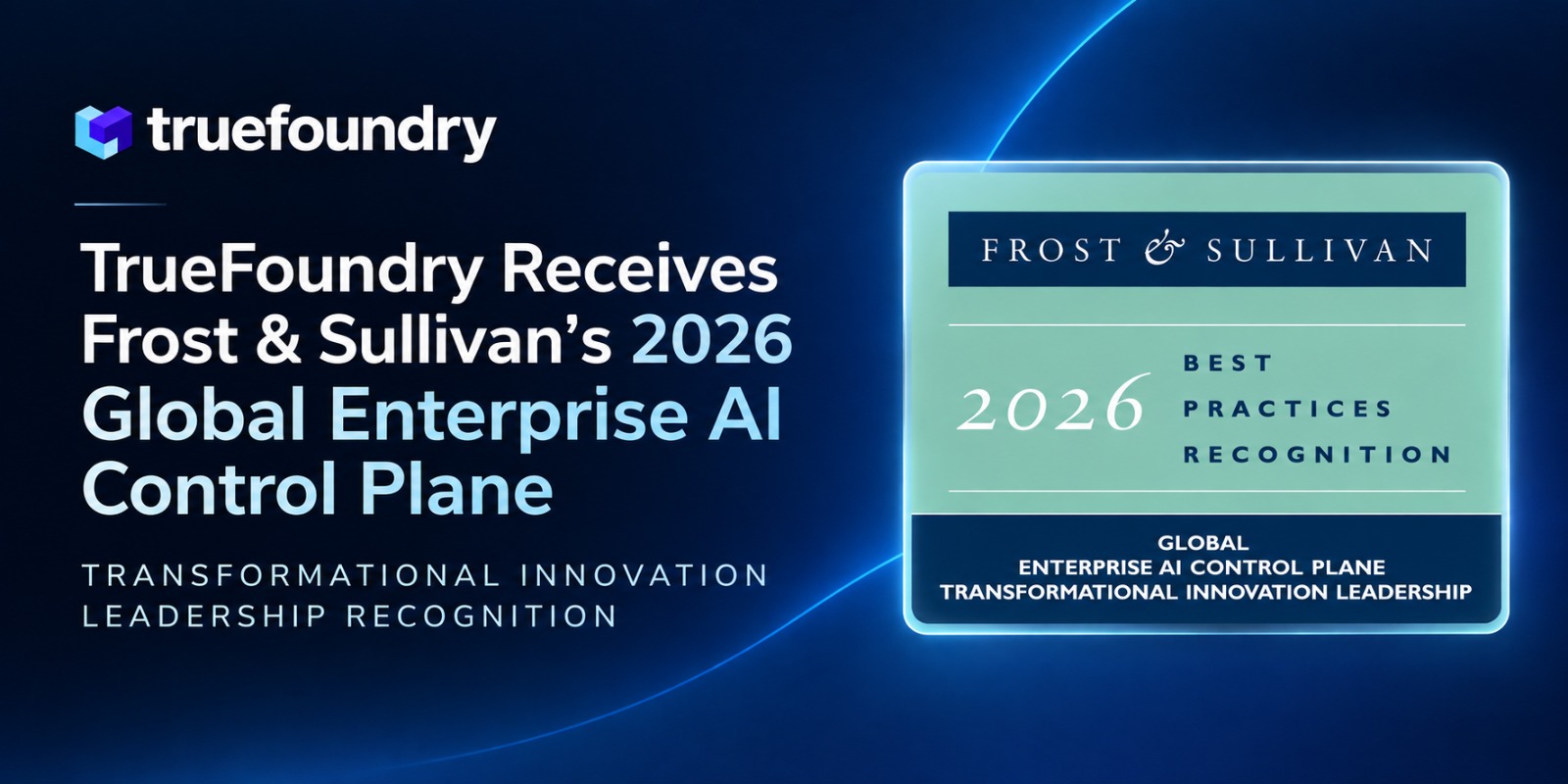
We're proud to share that TrueFoundry has received Frost & Sullivan's 2026 Global Transformational Innovation Leadership Recognition in the enterprise AI control plane industry.
This matters to us for two reasons. First, it is Frost & Sullivan's top honor, awarded after a 12-month independent evaluation across two dimensions, transformational innovation and customer impact, benchmarked against every other nominee in the category.
Second, and more importantly, the recognition validates an entire category. When we started building in 2021, "enterprise AI control plane" wasn't a market anyone was buying. Today Frost & Sullivan describes it as a distinct layer of enterprise technology, and names TrueFoundry a "category-defining leader" within it. That shift, from a thesis we were arguing for to a category enterprises now budget for, is crucial.
Download the full report by Frost & Sullivan here.
Here are the five important themes from the report.
Frost & Sullivan is direct about why this category exists: enterprises "grapple with fragmented AI ecosystems, where models, deployment frameworks, governance solutions, observability platforms, and agent orchestration systems often operate in silos."
The analysts draw the historical parallel explicitly. Just as cloud management platforms unified infrastructure operations and observability platforms centralized monitoring, AI control planes provide "a centralized operational layer through which organizations can govern, secure, observe, optimize, and scale AI across models, agents, applications, and infrastructure environments."
The report credits TrueFoundry's core differentiator as "its ability to unify the fragmented layers of enterprise AI into a single non-opinionated operational platform." This is important because consolidation only works if it lets teams keep what they've already built.
The report puts it plainly: "A general-purpose API gateway retrofitted with AI plugins has no native concept of token economics, prompt-level tracing, or the identity of an agent invoking a tool on a user's behalf."
This is a distinction we often make, as well. An API Gateway, by definition, is stateless. It can pass on requests, but it can’t budget for expensive chained requests, pause them for human approval, or govern identity centrally. This is unlike TrueFoundry’s AI-native gateway built on stateful architecture where cost and governance are treated as first-class concepts.
The report's treatment of AI sovereignty is the sharpest sectio. Data residency "depends not only on where data is stored, but also on how it moves at runtime." Model routing, retries, failover, agent workflows, MCP tool invocations, and observability pipelines can each create unintended cross-region data movement.
Frost & Sullivan credits our split-plane architecture here: the control plane manages configuration and policy, while the gateway plane, where models run and requests are proxied, operates on the customer's own infrastructure. The consequence is that residency becomes "a hard constraint, failing a request closed if no compliant path exists rather than routing around it."
Frost & Sullivan believes TrueFoundry "has established an early architectural advantage by investing ahead of the market in governed agent infrastructure, including MCP Gateways, Agent Gateways, Model gateway, Skills Registries,
The report also highlights TrueForge, our open-source, vendor-neutral agent harness, and predicts agent harnesses will become a foundational layer as enterprises move from individual agents to fleets. The report quotes our customer Rob Rubin, Senior Director of Developer Platform Engineering at NetApp: "A lot of these agent platforms have their own kind of proprietary connectors and then you're vendor locked in. TrueForge is a better way to be a little bit vendor agnostic and be able to be portable." Read the full NetApp success story.
The report's diagnosis of AI spend states that, "without centralized governance, costs get fragmented across model providers, applications, and business units, and no one has a clear view of where the money is going."
The 30% to 60% infrastructure savings customers report aren't the product of a cost tool bolted on beside the platform. They fall out of the same choke point that enforces policy, because a layer that already sees every call is the only place that can route to a cheaper capable model, serve a near-duplicate from cache, or attribute spend to a team.
Read together, the five findings describe one shift. Enterprises spent the last few years buying AI capability and are now buying the ability to operate it. Frost & Sullivan's assessment reflects this in that it chose to evaluate not model quality or benchmark scores, but governance, sovereignty, observability, and cost control. The report's conclusion is that a control plane is what makes AI "a strategic business capability rather than a collection of disconnected tools," and that the gateway is where the promise gets tested.
Our conviction is that this becomes the default architecture within the next few years, for three reasons.
That is the market we have built for since 2021, and this recognition suggests the category is arriving on schedule. Our thanks to Frost & Sullivan for the assessment, and to the enterprises who committed to this architecture while it was still an argument.
Book a demo to see the AI Control Plane and AI Gateway running in your own environment.
TrueFoundry AI Gateway offre une latence d'environ 3 à 4 ms, gère plus de 350 RPS sur 1 processeur virtuel, évolue horizontalement facilement et est prête pour la production, tandis que LiteLM souffre d'une latence élevée, peine à dépasser un RPS modéré, ne dispose pas d'une mise à l'échelle intégrée et convient parfaitement aux charges de travail légères ou aux prototypes.





Les dernières nouvelles, articles et ressources envoyés dans votre boîte de réception
.webp)
.webp)

.webp)
.webp)


