


Obtenga acceso instantáneo a un entorno TrueFoundry en vivo. Implemente modelos, dirija el tráfico de LLM y explore la plataforma completa: su sandbox estará listo en segundos, sin necesidad de tarjeta de crédito.


What is a multi-agent system and how does it work?

Some AI workflows are difficult to handle effectively with a single agent. A task may require different tools, permissions, areas of expertise, or independent subtasks that can run in parallel.
Multi-agent systems address this problem by distributing work across multiple interacting agents. This approach can make complex workflows more modular, but it also introduces new requirements around communication, orchestration, reliability, and governance.
This article explains how multi-agent systems work, their common architectures and organizational structures, when to use them, and the benefits and challenges involved in running them.
What is a multi-agent system?
A multi-agent system (MAS) is a system in which multiple autonomous or semi-autonomous agents interact within a shared environment to perform tasks, solve problems, or pursue shared or related goals.
In AI applications, each agent can have its own role, instructions, context, tools, permissions, or responsibilities. For example, a research agent might gather information, an analysis agent could interpret the findings, and a review agent could evaluate the resulting output.
Agents may work sequentially or in parallel and can exchange information, delegate tasks, or hand work to other agents. Depending on the architecture, coordination may be controlled centrally or emerge through direct interactions among agents.
A system does not become multi-agent simply because one AI agent uses several tools. The defining characteristic is the presence of multiple agents that interact as part of the broader system.
How do multi-agent systems work?
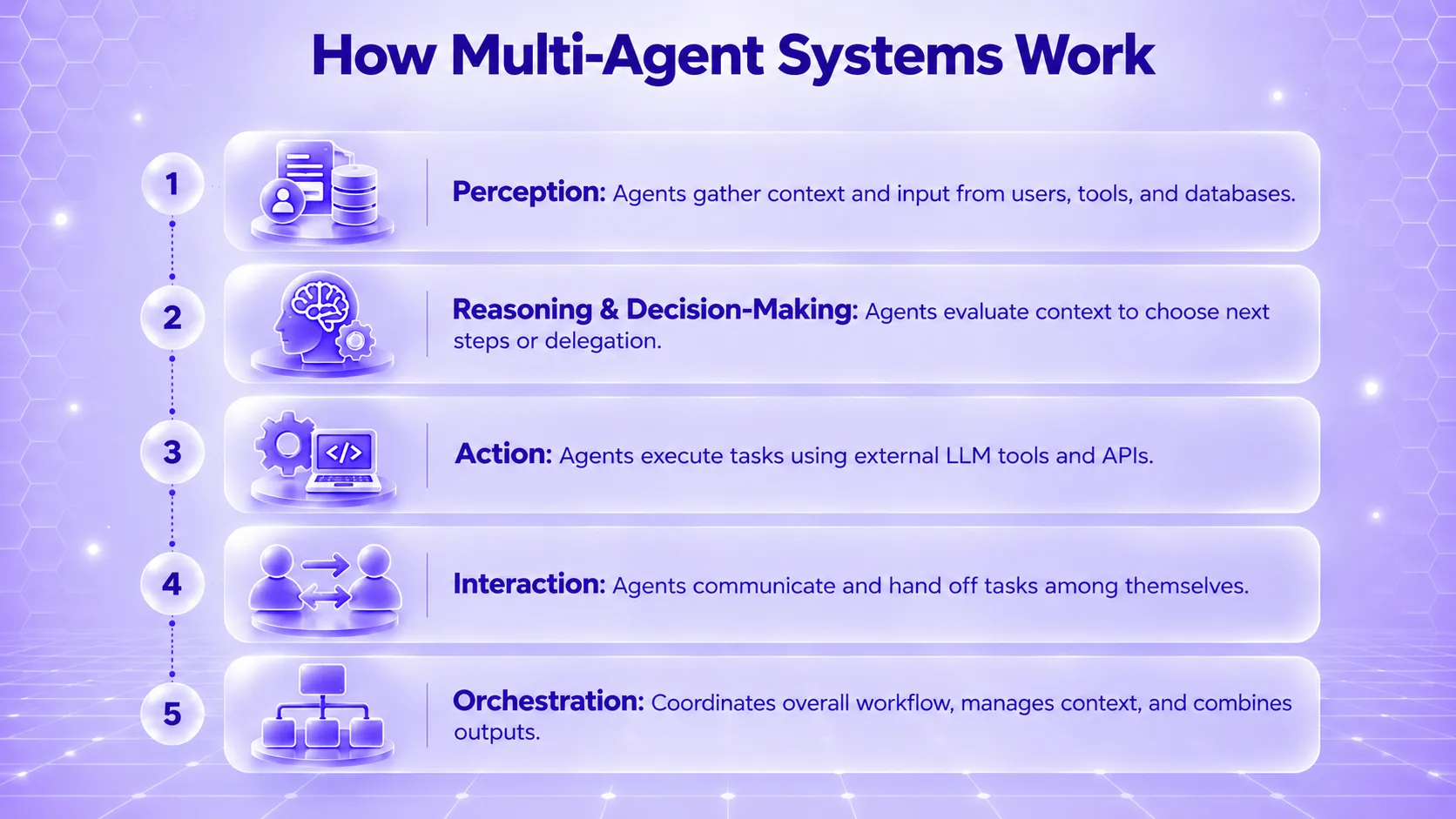
Multi-agent systems do not follow one universal five-step lifecycle. Instead, their operation typically involves several recurring capabilities: agents receive information, reason about their responsibilities, take actions, communicate with other agents, and coordinate how work moves through the system.
These activities can repeat throughout a workflow rather than occurring only once in a fixed sequence.
1. Perception
Agents receive information needed to perform their responsibilities. Inputs can come from user requests, documents, databases, APIs, sensors, tools, or messages from other agents.
The available information becomes part of the context the agent uses to determine what should happen next.
2. Reasoning and decision-making
Using the available context, an agent determines its next step. Depending on its role and the system design, it may decide to perform the task itself, call a tool, request additional information, or delegate work to another agent.
This decision then determines what action or interaction occurs next.
3. Action
An agent acts on its decision by generating an output or interacting with an external system. This can involve querying a database, calling an API, retrieving information, executing code, or using another connected tool.
LLM tool calling enables language-model-based agents to invoke external tools through structured requests, allowing the agent to perform operations beyond generating text.
4. Interaction
Agents communicate by exchanging information, requesting tasks, or passing results to one another.
For example, a planning agent can send different research tasks to specialist agents and then pass their findings to an analysis agent. Protocols such as Agent2Agent (A2A) can support communication between independent AI agents.
5. Orchestration
Orchestration coordinates the overall workflow. It can assign tasks, manage hand-offs, maintain context, and combine outputs from different agents.
Interaction describes how agents exchange information. Orchestration describes how those interactions fit into the overall workflow. Some systems rely on a central orchestrator, while others distribute coordination across agents.
LLM orchestration becomes increasingly important as workflows involve more agents, tools, and steps.
What is an example of a multi-agent system?
Consider an AI research workflow. A planner agent can divide a request into smaller tasks; several research agents can investigate different topics in parallel; an analysis agent can compare their findings; and a review agent can evaluate the final result.
An orchestration layer can coordinate the workflow by assigning tasks, tracking their status, handling dependencies, and determining when each agent should act.
This qualifies as a multi-agent system because multiple agents have distinct responsibilities and interact to complete the broader workflow.
What are the architectures of multi-agent systems?
Multi-agent architectures can be described by how agents communicate, where coordination occurs, and how decisions are distributed. Two useful high-level patterns are centralized and decentralized coordination, although real systems can combine elements of both.
Centralized networks
In a centralized architecture, a central agent or orchestration layer manages the workflow. It can assign tasks, collect outputs, maintain context, and decide what happens next.
This provides a clear coordination point and can simplify monitoring, but the central component can become a bottleneck or failure point. Redundant orchestration services, persistent state, retries, and failover mechanisms can reduce this risk.
Decentralized networks
In a decentralized architecture, agents communicate and make decisions more independently instead of relying entirely on one central controller.
This can improve flexibility and resilience, but coordination becomes more difficult. Agents need clear communication rules and ways to handle conflicting decisions.
Some systems combine both approaches by using centralized governance while allowing agents to execute tasks independently.
This can reduce dependence on a single coordinator, but distributed decision-making makes consistency and debugging more difficult. Clear communication protocols, shared state conventions, conflict-resolution rules, and distributed tracing can help manage this complexity.
What are the structures of multi-agent systems?
Architecture describes how coordination and communication are organized across the system. Structure describes how agents themselves are grouped and how responsibilities or authority are arranged.
Common organizational patterns include hierarchical structures, holonic arrangements, temporary coalitions, and teams. These categories are not mutually exclusive, and implementations may combine several patterns.
Hierarchical structure
Agents operate at different levels. A higher-level agent can assign tasks to specialized agents and combine their results.
Holonic structure
Agents form groups that can operate as a larger unit while retaining their individual responsibilities. A group can therefore act as one unit within another part of the system.
Coalition structure
Agents temporarily form a group to solve a specific problem. Once the task is complete, the coalition can change or dissolve.
Teams
Agents work together toward a shared objective while maintaining defined roles. For example, a software development workflow could use separate coding, testing, documentation, and review agents.
What is the difference between a multi-agent system and a single agent?
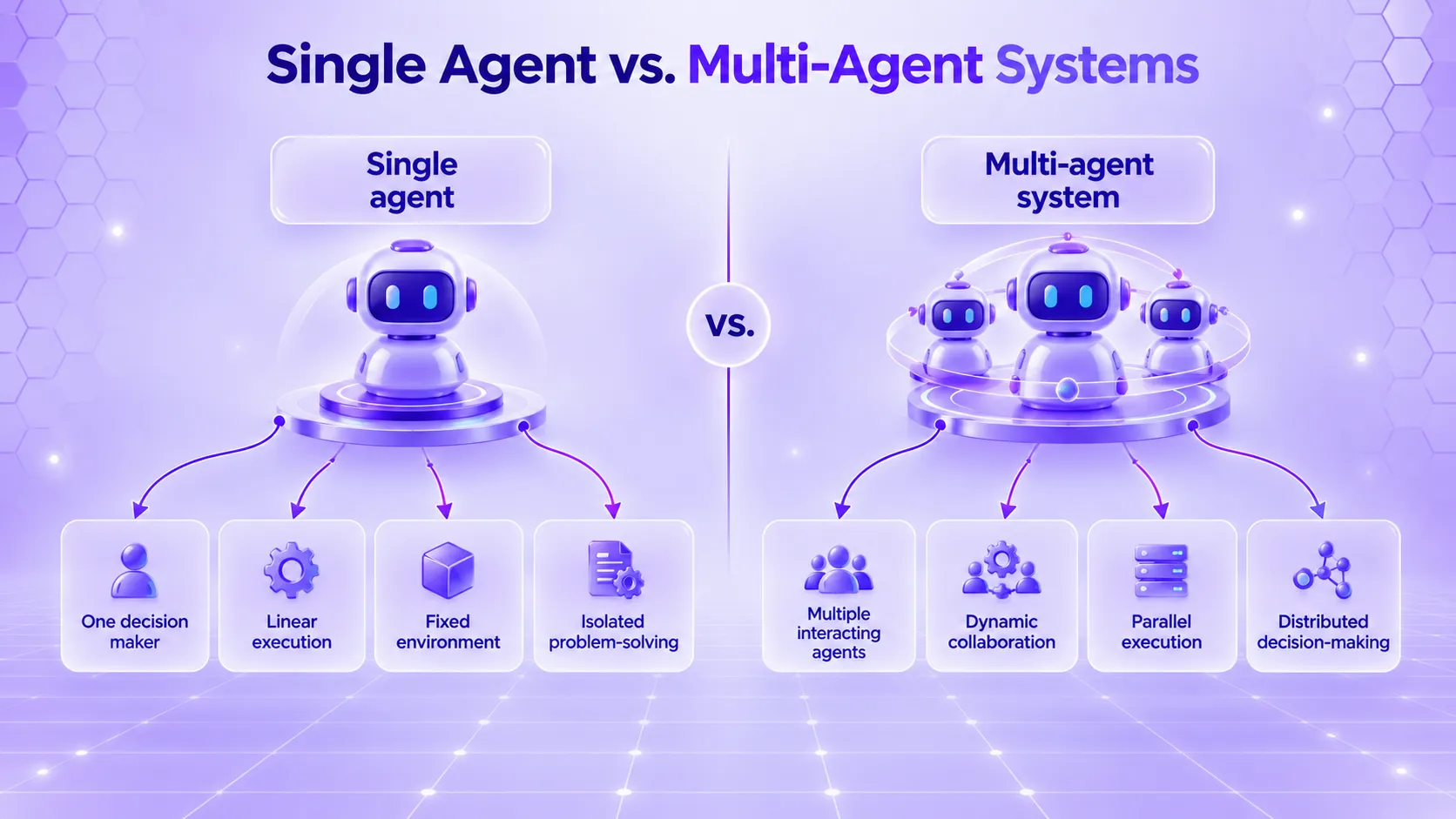
A single-agent system relies on one primary agent to reason about and perform its assigned responsibilities. That agent may use multiple tools, retrieve information, call models, or interact with external systems without becoming a multi-agent system.
A multi-agent system instead includes multiple agents that interact and divide responsibilities between them. Individual agents may specialize in planning, research, execution, verification, or other roles.
The main trade-off is complexity. A single-agent design is often easier to build, evaluate, and observe, while a multi-agent design can support greater specialization and parallel execution when the workflow genuinely benefits from them.
The main difference is how responsibilities are distributed. A single-agent system keeps reasoning and execution within one primary agent, while a multi-agent system divides responsibilities across interacting agents. This introduces additional communication and coordination requirements.
Moving your multi-agent system into production?

When should you use a multi-agent system?
A multi-agent system is most useful when a workflow naturally benefits from separating responsibilities rather than simply because the task is complex.
Consider a multi-agent design when:
- Different subtasks require distinct expertise, tools, models, or context.
- Independent tasks can run in parallel.
- Different responsibilities require separate permissions or access boundaries.
- Planning, execution, and verification benefit from being separated.
- Agents need to collaborate or negotiate across independently owned tasks.
- A single agent has accumulated too many unrelated responsibilities to evaluate or maintain reliably.
More agents do not automatically make a system better. If one agent can complete a task reliably, adding additional agents can increase latency, token usage, cost, failure modes, and coordination complexity without improving the result.
What are the common use cases for multi-agent systems?
Enterprise AI and automation
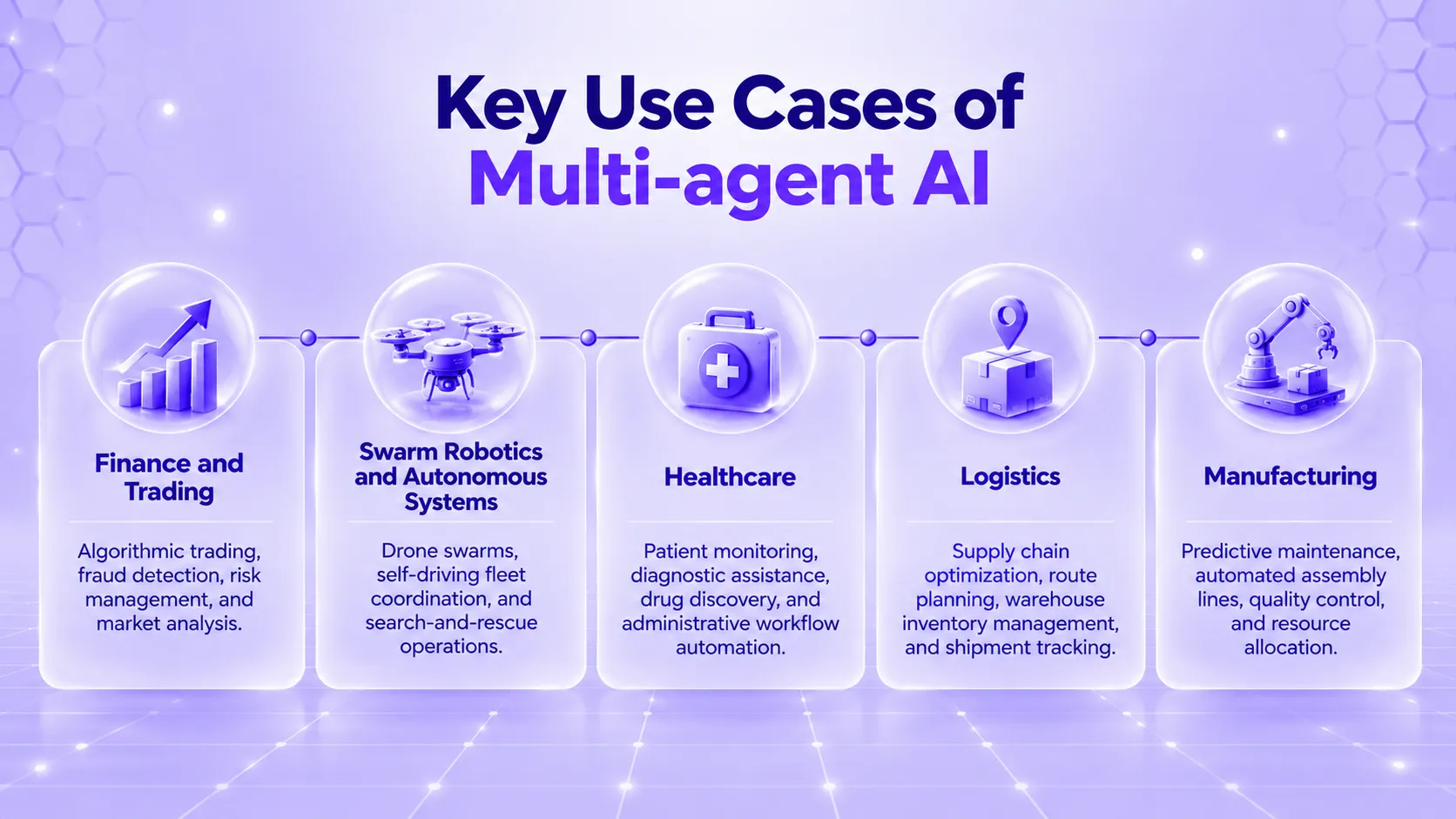
Businesses can use specialized agents for customer support, research, software development, IT operations, document processing, and business process automation.
For example, a customer-support workflow could use separate agents for ticket classification, knowledge retrieval, account verification, and response generation.
This connects closely with Agentic AI, where AI systems can reason, plan, use tools, and take actions toward a goal.
Robotics and autonomous vehicles
Multi-agent systems can coordinate robots, autonomous vehicles, and other machines. Different agents can handle perception, navigation, planning, communication, and control.
Supply chain and logistics
A logistics workflow can use separate agents for demand forecasting, inventory monitoring, route planning, supplier communication, and shipment tracking.
If a shipment is delayed, one agent can identify the problem while another evaluates alternative routes and a third checks the potential impact.
Healthcare, finance, and other industries
Healthcare applications can use agents for scheduling, documentation, information retrieval, and administrative tasks. Financial applications can use them for fraud analysis, compliance checks, transaction monitoring, and customer support.
When agents work with sensitive information or make high-impact decisions, appropriate permissions, monitoring, and human oversight become important.
What are the benefits of multi-agent systems?
Multi-agent systems can make complex AI workflows easier to divide into specialized responsibilities while allowing agents to collaborate and work in parallel.
Modularity
Each agent can focus on a defined responsibility. This makes it easier to modify an individual capability or add new agents as the workflow grows.
Specialization and handoffs
Agents can pass work between one another. A research agent can send its findings to an analysis agent, which can then pass the result to a verification agent.
Adaptability
A well-designed system can redirect work when an agent fails or when another capability is needed. This can make complex workflows more adaptable.
These benefits are workload-dependent. Additional agents also increase communication, compute, and operational overhead, so the architecture should remain as simple as the task allows.
Parallel execution
Independent agents can work on different subtasks simultaneously. This can improve efficiency when several parts of a workflow do not depend on one another.
However, adding more agents also introduces communication and compute costs, so the architecture should be designed around the actual workflow.
What are the challenges of multi-agent systems?
Multi-agent systems introduce additional operational complexity because failures can occur not only within individual agents but also in the interactions between them.
Here are some of the key challenges associated with multi-agent systems:
- Coordination complexity and communication overhead: More agents create additional messages, dependencies, handoffs, and opportunities for conflicting decisions. Teams can reduce this complexity by defining clear agent responsibilities, structured communication patterns, handoff rules, and limits on unnecessary delegation.
- Debugging and observability: Identifying the source of an incorrect result can be difficult when several agents and tools contribute to the final output. End-to-end tracing, structured logs, agent-level monitoring, and consistent correlation IDs can help teams follow a task across agents and identify where failures occur.
- Production reliability and engineering challenges: Teams need to manage failures, retries, latency, state, authentication, resource usage, and changing agent behavior. Teams can improve reliability by defining retry and timeout policies, maintaining state consistently, testing failure scenarios, and providing fallback or human-review paths for critical workflows.
- Ethical and trust considerations: Agents may access sensitive information or take actions on behalf of users, making permissions, monitoring, and human oversight important.
- Evaluation: An individual agent may perform well while the complete workflow still fails because of poor handoffs or coordination. Teams should evaluate both individual agents and end-to-end workflows using task-specific success criteria.
As multi-agent systems move into production, teams also need visibility and control across agent-to-agent communication, tool calls, permissions, failures, and resource usage. An agent gateway can provide a shared control layer for enforcing policies, tracing execution, managing access, and applying runtime limits across agent workflows. Agent evaluation can help teams assess the reliability and performance of individual agents and complete workflows.
Final verdict
Multi-agent systems are most useful when a workflow genuinely benefits from separating responsibilities, running independent work in parallel, or allowing specialized agents to collaborate.
The design should remain as simple as the task allows. Every additional agent introduces another component to coordinate, evaluate, secure, observe, and operate, so teams should use multiple agents when the added specialization or collaboration provides a clear advantage over a simpler single-agent design.
Controle, implemente y rastree la IA en su propia infraestructura

GenAI infra: simple, más rápido y más barato
Los mejores equipos confían en nosotros para escalar GenAI

- © 2022 ENSEMBLE Technologies



Suscríbase a nuestro boletín
Las últimas noticias, artículos y recursos enviados a tu bandeja de entrada


