


.webp)
October 21, 2026
|
5 minutos de lectura


Obtenga acceso instantáneo a un entorno TrueFoundry en vivo. Implemente modelos, dirija el tráfico de LLM y explore la plataforma completa: su sandbox estará listo en segundos, sin necesidad de tarjeta de crédito.



¡Una forma increíblemente rápida de crear, rastrear e implementar sus modelos!
La comparación entre LangChain, LangGraph y LangSmith no es realmente una competencia. Los tres provienen de la misma empresa y la mayoría de los equipos que desarrollan agentes con esta tecnología terminan utilizando varios de ellos simultáneamente. Sin embargo, la confusión es comprensible: los nombres son similares, la documentación se referencia constantemente entre sí y, desde fuera, no siempre es evidente cuál necesitas realmente.
En lugar de elegir uno sobre otro, muchas organizaciones los utilizan de forma conjunta a medida que sus aplicaciones de IA maduran: desde la creación de prototipos con LangChain, pasando por la orquestación de flujos de trabajo complejos con LangGraph, hasta garantizar la fiabilidad con LangSmith.
En esta guía, compararemos LangChain vs LangGraph vs LangSmith, explicaremos qué hace cada herramienta, destacaremos sus puntos fuertes y limitaciones, y te ayudaremos a decidir cuál se adapta mejor a tu flujo de trabajo de desarrollo de IA.
LangChain es la capa de framework: LCEL (LangChain Expression Language), el protocolo Runnable, plantillas de prompts e integraciones con cientos de herramientas y fuentes de datos. A partir de LangChain 1.0, LCEL es la forma canónica de componer pasos: cada prompt, modelo, retriever y analizador implementa la misma interfaz Runnable, por lo que puedes encadenarlos con prompt | model | parser y obtener un único objeto invocable con .invoke(), .stream() y .batch() de forma nativa. LangChain también ofrece una API de alto nivel, create_agent, para equipos que desean un comportamiento de agente sin tener que construir un grafo manualmente.

LangGraph es la capa de orquestación para agentes que necesitan realizar bucles, ramificaciones y mantener el estado a través de múltiples pasos en lugar de ejecutarse de forma lineal. Modela el agente como un StateGraph: los nodos son funciones, las aristas (incluidas las condicionales) deciden qué se ejecuta a continuación y un objeto de estado compartido fluye a través de todo el proceso.

LangSmith es la plataforma que se sitúa sobre ambos. Al decorar una función con @traceable, captura entradas, salidas y cada llamada anidada como una ejecución dentro de un árbol de procesos. También es el lugar donde residen los conjuntos de datos de evaluación, los evaluadores personalizados y LLM-as-judge, así como el despliegue alojado (a través de LangGraph Platform).
La recomendación del equipo de LangChain para 2026 es precisamente esta división de tareas: LangChain para los bloques de construcción, LangGraph para cualquier proceso agente o de múltiples pasos, y LangSmith para la observabilidad.

La diferencia práctica entre LangChain y LangGraph radica en el nivel de control que necesitas sobre la ruta de ejecución. Una cadena de LangChain ejecuta el paso uno, luego el dos y después el tres. Esto es suficiente para muchos casos de uso: generación aumentada por recuperación (RAG), llamadas a herramientas sencillas y pipelines directos.
Los agentes que necesitan decidir qué hacer a continuación basándose en lo que acaba de ocurrir, llamar a una herramienta, analizar el resultado y volver a decidir, plantean un problema distinto. Para eso se creó LangGraph. Representa al agente mediante nodos y aristas, lo que permite expresar bucles, ramas condicionales y puntos de control de forma explícita, en lugar de forzarlos dentro de una cadena lineal. La mayoría de los frameworks de agentes en producción, incluido LangGraph, convergen en este modelo basado en grafos precisamente por esta razón.
En la práctica, no tienes que elegir uno sobre otro. Los agentes de LangGraph suelen utilizar las integraciones y utilidades de prompts de LangChain en su base; LangGraph es más una evolución en la forma de estructurar el bucle del agente que un reemplazo total de LangChain.
Una cadena LCEL de LangChain es una canalización (pipeline) ejecutable. Cada componente integra un ejecutable en el siguiente, y la cadena completa se comporta como un único ejecutable, lo que permite que el streaming y el procesamiento por lotes funcionen de manera consistente en cada paso.
Ese modelo abarca mucho terreno: canalizaciones RAG, extracción estructurada y llamadas a herramientas sencillas. Sin embargo, empieza a fallar cuando el agente necesita decidir qué hacer a continuación basándose en lo que acaba de ocurrir, llamar a una herramienta, observar el resultado y volver a decidir, posiblemente repitiendo el proceso varias veces antes de terminar.
LangGraph modela esto como un grafo en lugar de una tubería. El estado se define explícitamente (mediante un TypedDict o un modelo Pydantic), los nodos lo leen y actualizan, y los bordes condicionales dirigen la ejecución según el estado actual en lugar de seguir una secuencia fija.
En la práctica, no tienes que elegir uno sobre el otro. Los nodos de LangGraph suelen invocar internamente cadenas LCEL; LangGraph se parece más a una capa de ejecución adicional sobre las primitivas de LangChain que a un reemplazo completo de las mismas.
Esta comparación es la que más confunde a la gente, porque LangGraph y LangSmith resuelven problemas realmente distintos que, por casualidad, aparecen juntos en la misma frase con frecuencia.
LangGraph es el entorno donde se ejecuta tu agente: la definición del grafo, el estado y la lógica de ejecución. LangSmith es la herramienta que te permite ver qué ocurrió después de la ejecución. Cada llamada a un LLM, llamada a una herramienta y transición de estado dentro de un agente de LangGraph puede rastrearse en LangSmith; además, LangSmith es donde reside LangGraph Platform si prefieres un despliegue alojado en lugar de ejecutar el grafo en tu propia infraestructura.
En pocas palabras: LangGraph funciona sin LangSmith, pero pierdes la visibilidad de lo que hace tu agente y cualquier opción de alojamiento integrada. LangSmith no tiene mucho sentido sin LangGraph, ya que necesita algo que rastrear.
LangGraph es el entorno donde se ejecuta tu agente: la definición del grafo, el estado y la ejecución con puntos de control. LangSmith es la herramienta que te permite ver qué ocurrió después de la ejecución y, en muchas configuraciones, es donde se aloja.
Envuelve una función en @traceable (o instrúyela mediante la integración nativa de LangSmith en LangGraph) y cada llamada a un LLM, llamada a una herramienta o llamada a un subgrafo anidado se convertirá en un segmento en un árbol de ejecución, donde la ejecución principal muestra la latencia total y cada ejecución secundaria muestra la suya propia.
Más allá del rastreo, el flujo de trabajo de evaluación de LangSmith se ejecuta sobre conjuntos de datos, colecciones de ejemplos de entrada/salida creados a través del SDK y puntuados por evaluadores que tú defines como LLM-as-judge, código personalizado o retroalimentación humana. Los evaluadores en línea pueden puntuar los rastreos de producción de forma continua en lugar de solo durante una prueba previa al lanzamiento, lo que se asemeja más a un panel de control de calidad en tiempo real que a un conjunto de pruebas único.
En pocas palabras: LangGraph sigue funcionando sin LangSmith, pero pierdes el árbol de ejecución, los conjuntos de datos de evaluación y la opción de alojamiento de LangGraph Platform. LangSmith no hace mucho por sí solo, ya que necesita una aplicación rastreada para poder observarla.
La mayoría de los proyectos de agentes reales no eligen solo uno de estos tres, sino que utilizan un subconjunto de ellos. Una pila típica consiste en construir la lógica del agente en LangGraph (usando las integraciones de LangChain cuando sea útil) y luego ejecutarlo con el rastreo de LangSmith activado para poder ver qué está haciendo una vez que esté en producción. Omitir LangSmith es común en prototipos pequeños; omitir LangGraph es común si tu caso de uso es lo suficientemente sencillo como para que una canalización lineal de LangChain sea suficiente.
Donde esto se complica es a escala de producción. El rastreo de LangSmith es realmente útil, pero no gestiona las credenciales de las herramientas que llama tu agente, ni te proporciona una gobernanza a nivel de modelo para todo un equipo. Esos se convierten en problemas independientes que debes resolver una vez que ejecutas más de un puñado de agentes.
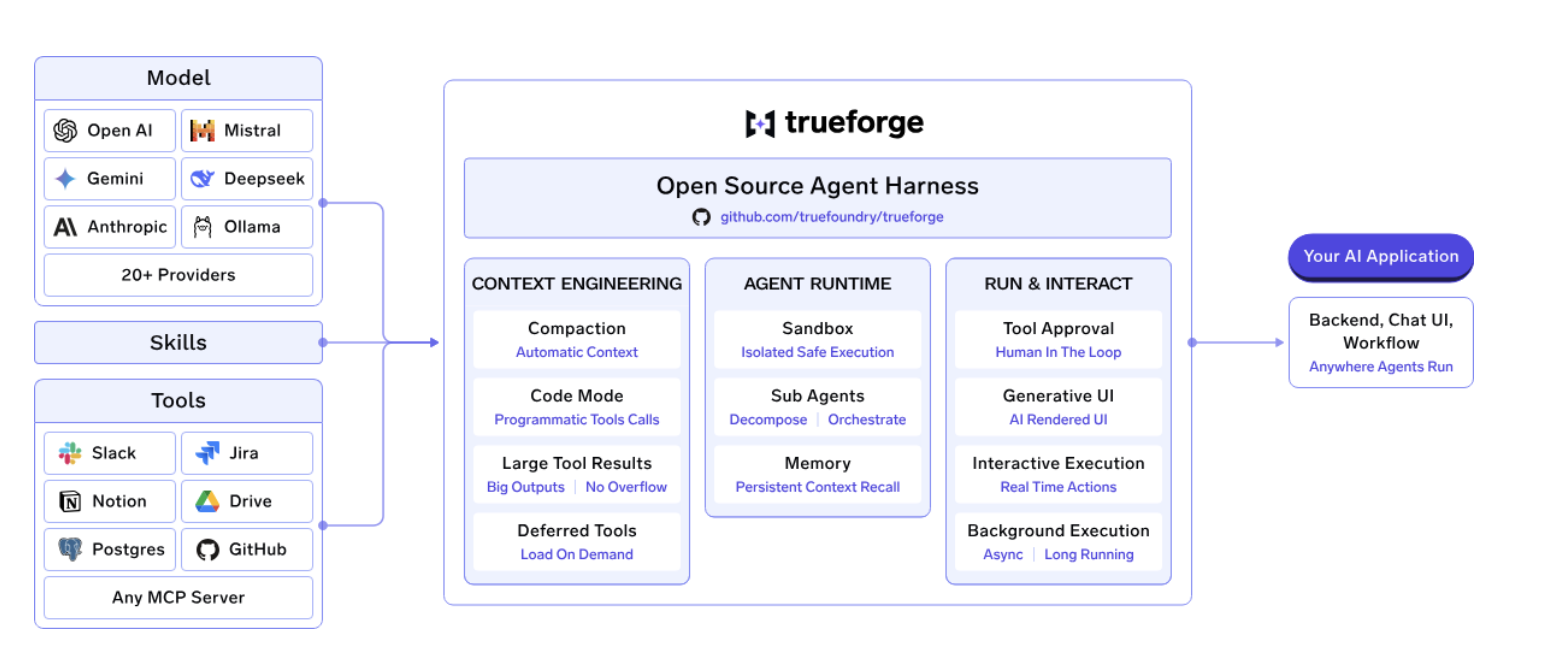
LangChain, LangGraph y LangSmith cubren diferentes partes de la pila de aplicaciones de IA: LangChain proporciona los bloques de construcción, LangGraph gestiona la orquestación de agentes con estado y LangSmith proporciona la observabilidad. TrueForge se sitúa en una capa diferente: es el entorno de ejecución que realmente pone en marcha al agente. Gestiona el bucle en torno al modelo, incluyendo la planificación, las llamadas a herramientas, la gestión del contexto, el sandboxing, las aprobaciones y el estado de la sesión.
TrueForge es un entorno de ejecución de agentes de código abierto y neutral respecto a proveedores. Se divide en un servidor central que ejecuta el bucle del agente, una API HTTP con un SDK de TypeScript para acceso programático, y una interfaz de chat con un SDK de interfaz de usuario que puede utilizarse tal cual o integrarse en su propia aplicación. Puede ejecutarlo localmente con npx @truefoundry/trueforge, o desplegarlo para un equipo mediante Docker Compose o Helm.
La diferencia clave es que TrueForge mantiene el tiempo de ejecución separado del modelo y las herramientas. Los proveedores de modelos, los servidores MCP y los proveedores de sandbox son de libre elección, por lo que cambiar de modelo no requiere reconstruir el agente. TrueForge también trata el sandbox como una herramienta en lugar de ejecutar cada agente dentro de uno de forma continua. El sandbox solo se aprovisiona cuando el agente necesita ejecutar código, lo que permite que un servidor ejecute múltiples agentes manteniendo los turnos que no requieren código más ligeros.
Para los equipos que van más allá de los agentes individuales, TrueForge también puede proporcionar la capa operativa en torno al tiempo de ejecución. Al combinarlo con AI Gateway de TrueFoundry, los equipos pueden añadir control de acceso basado en roles (RBAC), presupuestos, barreras de seguridad, rotación de credenciales y trazabilidad unificada a sus agentes y al uso de modelos.
Así que la distinción es sencilla: LangChain le ofrece componentes con los que construir, LangGraph le proporciona primitivas para orquestar flujos de trabajo de agentes, LangSmith le ayuda a ver qué están haciendo esos flujos de trabajo y TrueForge le ofrece un tiempo de ejecución de código abierto para ejecutar el agente en sí. Si está creando agentes que necesitan pasar de un prototipo local a producción, vale la pena considerar TrueForge como la capa de tiempo de ejecución subyacente a su pila de agentes.
LangChain, LangGraph y LangSmith resuelven cada uno una parte diferente del ciclo de vida de desarrollo de IA. LangChain le ayuda a crear aplicaciones impulsadas por LLM, LangGraph permite crear agentes de IA con estado y de varios pasos, y LangSmith proporciona la observabilidad necesaria para depurarlos y supervisarlos en producción.
En lugar de reemplazarse entre sí, están diseñados para trabajar juntos. Al comprender el papel de cada herramienta, puedes elegir la combinación adecuada para tu caso de uso y crear aplicaciones de IA que sean escalables y estén listas para producción.
¿Cuál es la diferencia entre LangChain, LangGraph y LangSmith?
LangChain es un marco de trabajo para encadenar llamadas a LLM y conectarse a herramientas y fuentes de datos. LangGraph es la capa de orquestación para agentes que necesitan realizar bucles, ramificaciones y mantener un estado. LangSmith es la plataforma para realizar el seguimiento, la evaluación y, opcionalmente, el alojamiento de agentes creados con cualquiera de los otros dos.
¿Necesito los tres para crear un agente?
No. Una canalización sencilla podría requerir solo LangChain. Un agente con estado suele utilizar LangGraph, a menudo junto con las integraciones de LangChain. LangSmith es opcional, pero muy recomendable una vez que el agente hace algo más que un prototipo rápido, ya que es la forma principal de ver lo que el agente hizo realmente.
¿LangGraph reemplaza a LangChain?
No exactamente. LangGraph cambia la forma en que se estructura el bucle de ejecución del agente, pero los agentes de LangGraph siguen utilizando habitualmente las utilidades de integración y prompts de LangChain. Piénsalo como una capa adicional en lugar de un reemplazo.
¿TrueFoundry es compatible con MCP y agentes de IA?
Sí. TrueFoundry incluye una puerta de enlace MCP, una puerta de enlace para agentes y un registro de MCP y agentes con control de acceso a nivel de herramienta, por lo que los agentes creados en LangGraph, CrewAI, AutoGen o marcos personalizados pueden implementarse y gestionarse a través de un único plano de control.
¿TrueFoundry se integra con mi pila de observabilidad actual?
Sí. La plataforma es compatible con OpenTelemetry y se conecta a Grafana, Datadog, Prometheus o a tu pila actual, rastreando cada solicitud desde el prompt hasta la ejecución de la herramienta y el modelo.
TrueFoundry AI Gateway ofrece una latencia de entre 3 y 4 ms, gestiona más de 350 RPS en una vCPU, se escala horizontalmente con facilidad y está listo para la producción, mientras que LitellM presenta una latencia alta, tiene dificultades para superar un RPS moderado, carece de escalado integrado y es ideal para cargas de trabajo ligeras o de prototipos.





Las últimas noticias, artículos y recursos enviados a tu bandeja de entrada


.png)
.png)
.png)
.png)
.png)
.png)
.png)
.png)
.png)
.png)
.png)


