


Erhalten Sie sofortigen Zugriff auf eine TrueFoundry-Live-Umgebung. Stellen Sie Modelle bereit, leiten Sie den LLM-Verkehr weiter und erkunden Sie die gesamte Plattform — Ihre Sandbox ist in Sekundenschnelle einsatzbereit, ohne dass eine Kreditkarte erforderlich ist.


What Is vLLM and How Does It Work?

.png)
Serving a large language model is not the same as calling model.generate() in a notebook. In production you have many requests arriving at once, each generating tokens one at a time, and each holding a growing block of GPU memory called the KV cache. Done naively, most of that memory sits reserved but unused, the GPU is underfed, and throughput collapses.
vLLM is an open-source inference engine built to fix exactly that. It reorganizes how the KV cache is stored and how requests are batched, so the same GPU serves many more tokens per second. It has become one of the most widely used ways to self-host open models.
This guide explains what vLLM is, how it works, how PagedAttention and continuous batching make it fast, and when to reach for it.
What is vLLM?
vLLM is an open-source library and inference server for running large language models efficiently. It loads a model onto one or more GPUs and serves text-generation requests through a Python API or an OpenAI-compatible HTTP endpoint, applying memory and batching optimizations that a plain generation loop does not.
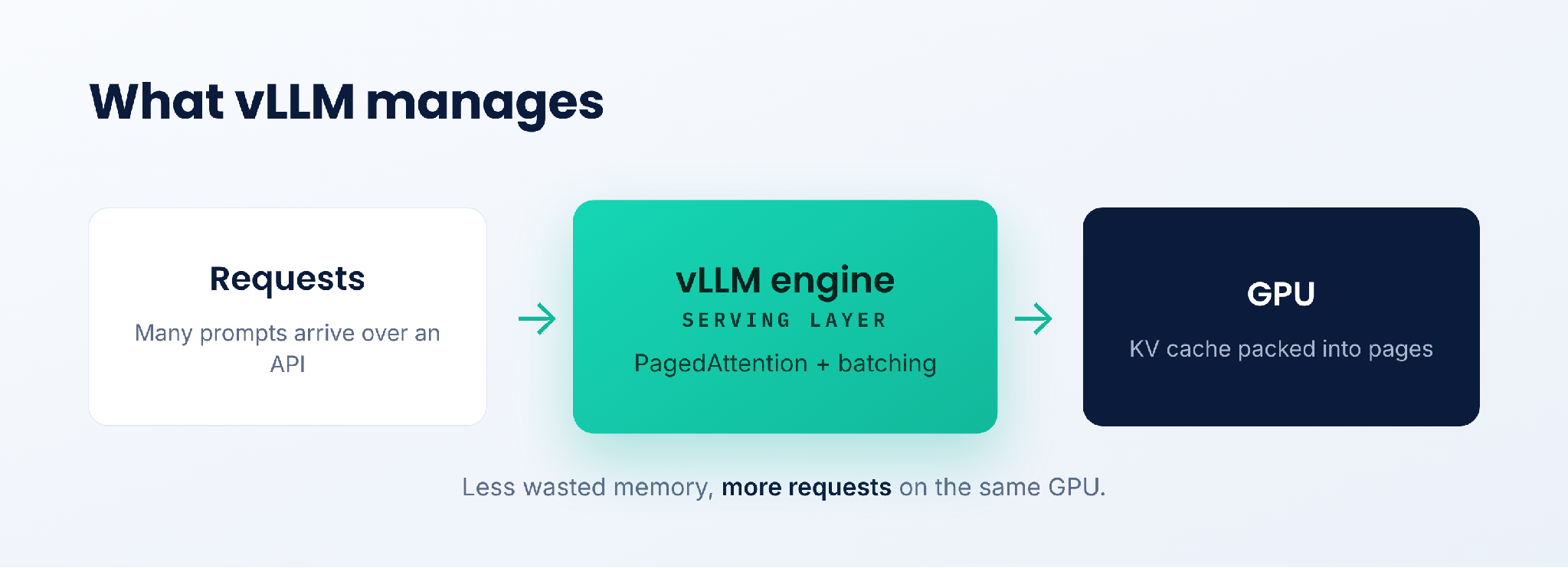
Think of GPU memory as a parking lot. A naive server reserves a long contiguous row of spaces for every car in case it grows, so the lot fills up even when most spaces are empty. vLLM parks cars in small numbered bays and keeps a map of where each one is, so it fits far more cars in the same lot. The bays are memory pages, and the map is PagedAttention.
The practical point is that vLLM is not a model; it is the engine that runs one. You bring a model like Llama, Mistral, or Qwen, and vLLM makes serving it fast and memory-efficient.
How does vLLM work?
A request flows through vLLM's scheduler and memory manager rather than straight into a single generate call.
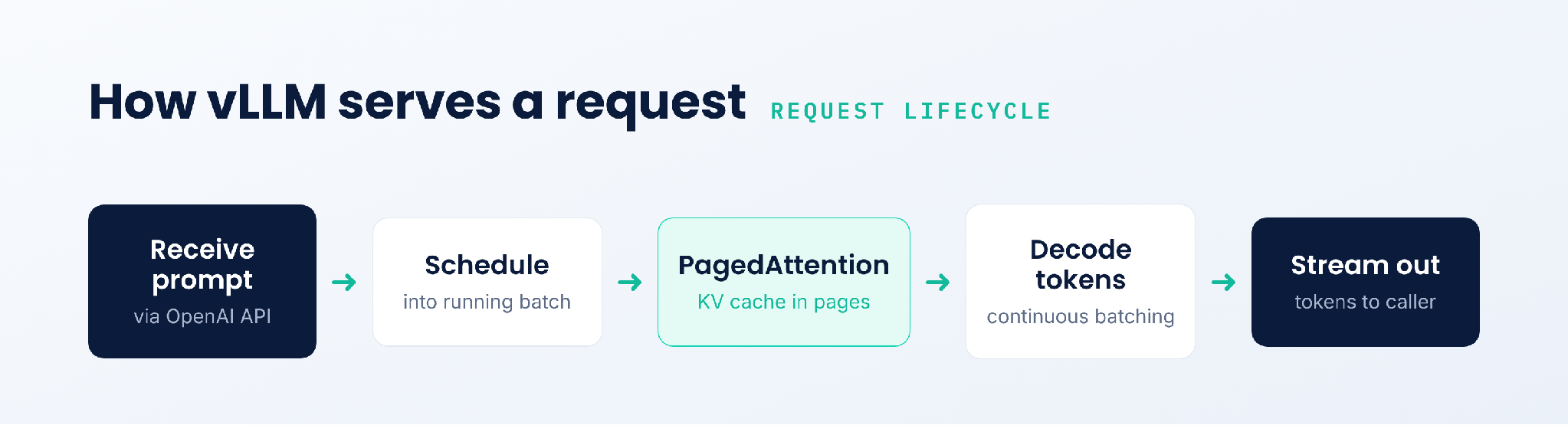
- Receive the prompt. The request arrives over the OpenAI-compatible API, and vLLM tokenizes it and queues it.
- Schedule into a batch. The scheduler adds the request to a continuously running batch alongside other in-flight requests.
- Allocate KV cache in pages. PagedAttention stores each sequence's KV cache in small fixed-size blocks instead of one contiguous chunk, so memory is packed tightly.
- Decode tokens. The model generates one token per step for every sequence in the batch, and finished sequences leave while new ones join.
- Stream the output. Tokens are streamed back to each caller as they are produced, and their pages are freed when the sequence ends.
Because requests join and leave the batch continuously and memory is reclaimed page by page, the GPU stays busy and little memory is wasted. That is where vLLM's throughput advantage comes from.
vLLM vs. vanilla serving and other engines
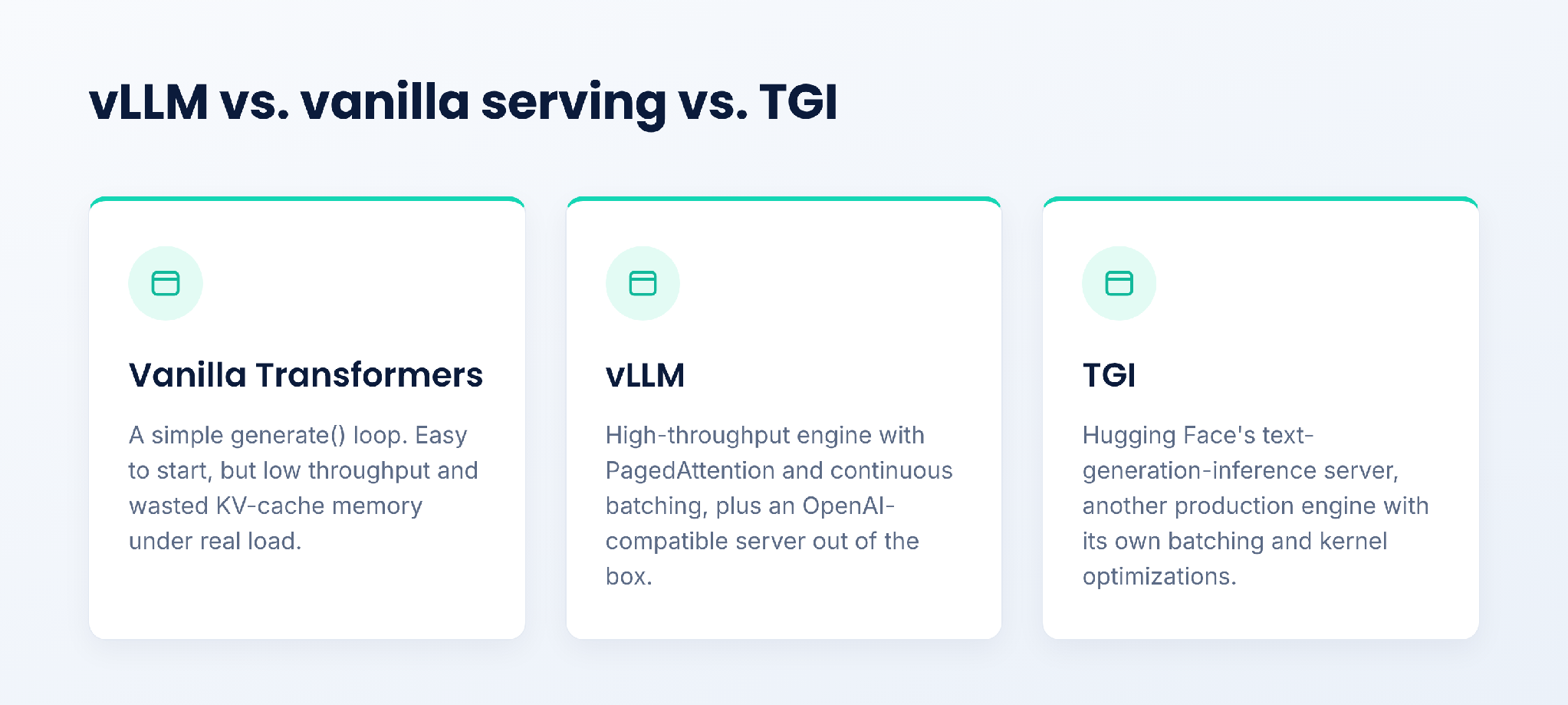
A plain Hugging Face generation loop is the simplest way to run a model, but it batches poorly and wastes KV-cache memory, so throughput is low under real load. vLLM is a purpose-built engine: PagedAttention plus continuous batching give it high throughput and an OpenAI-compatible server out of the box. Other production engines, such as Hugging Face's TGI or NVIDIA's TensorRT-LLM, solve the same problem with their own batching and kernel optimizations.
In short, vanilla Transformers is for experimentation, while vLLM and its peers are for serving at scale. Many teams pick vLLM because it is open, fast, and easy to point existing OpenAI-style code at.
What are the core features of vLLM?
- PagedAttention. It manages the KV cache in small pages, cutting memory waste and letting more requests share a GPU.
- Continuous batching. It adds and removes requests from the running batch on the fly, keeping GPU utilization high.
- OpenAI-compatible server. It exposes the same chat and completions API shape, so clients switch with a URL change.
- Broad model support. It runs most popular open architectures, from Llama and Mistral to Qwen and Mixtral.
- Quantization and parallelism. It supports quantized weights and tensor parallelism to fit larger models across GPUs.
- Streaming and prefix caching. It streams tokens and can reuse shared prompt prefixes to save compute.
What are the limits?
- GPU-focused. vLLM is built for GPU serving; CPU-only use is limited and slow.
- Operational work. Running it in production still means managing GPUs, scaling, and monitoring yourself.
- Feature pace. It moves fast, so new model architectures and features can lag the latest research briefly.
- Not a full platform. It serves models well but does not handle routing, auth, budgets, or multi-model governance on its own.
When should you use vLLM?
vLLM is the default choice when you want to self-host an open-source model and serve it with good throughput and cost. If you are running Llama, Mistral, Qwen, or similar on your own GPUs and need to handle real concurrent traffic, vLLM will usually beat a hand-rolled loop by a wide margin.
It is less relevant if you only call hosted APIs, or if your traffic is so low that a simple loop is enough. The moment you care about tokens per second per dollar on your own hardware, vLLM earns its place.
Best practices for running vLLM
- Right-size GPU memory and set the KV-cache fraction so you maximize batch size without running out of memory.
- Use quantization where accuracy allows to fit larger models or longer contexts on the same GPU.
- Enable prefix caching for workloads with a shared system prompt to avoid recomputing it every call.
- Use tensor parallelism to spread very large models across multiple GPUs rather than forcing them onto one.
- Stream tokens to users so responses feel fast even when total generation takes longer.
- Put vLLM behind a gateway so routing, rate limits, and observability live in one layer across models.
Conclusion
vLLM turns a set of model weights into a fast, memory-efficient endpoint. PagedAttention packs the KV cache into pages so little memory is wasted, and continuous batching keeps the GPU full, which together give it throughput that a naive loop cannot match. Add an OpenAI-compatible API and broad model support, and it is easy to see why it is a default for self-hosting open models.
TrueFoundry serves open-source and custom models through engines like vLLM on your own infrastructure, with autoscaling, observability, and GPU-efficient batching, all behind one gateway with routing, rate limits, and budgets. If you are self-hosting LLMs, vLLM is often the engine doing the heavy lifting underneath.
Steuern, implementieren und verfolgen Sie KI in Ihrer eigenen Infrastruktur
Frequently Asked Questions
What is vLLM in simple terms?
vLLM is an open-source library for running large language models efficiently on GPUs. It optimizes memory and batching in such a way that the same GPU can process many more requests than a simple generation loop would.
What is PagedAttention?
PagedAttention refers to vLLM's approach of allocating the KV cache in smaller page-sized blocks rather than a single large continuous chunk. It is similar to virtual memory, which reduces unused GPU memory while allowing more concurrent requests.
Is vLLM a model?
vLLM is the serving framework, not the model itself. You provide your own model like Llama or Mistral, and vLLM will serve that model for you via an API.
What is continuous batching?
Continuous batching makes it possible for vLLM to dynamically add and remove requests during the execution of a batch. This maximizes the use of GPU resources and significantly increases throughput.
Does vLLM work with OpenAI client code?
Indeed. vLLM offers an OpenAI-compatible API, and therefore existing applications using the OpenAI API can connect to a vLLM server simply by changing the URL.

GenAI infra- einfach, schneller, günstiger
Top-Teams vertrauen uns bei der Skalierung von GenAI

- © 2022 ENSEMBLE Technologies



Abonnieren Sie unseren Newsletter
Die neuesten Nachrichten, Artikel und Ressourcen werden in Ihren Posteingang gesendet


