


Erhalten Sie sofortigen Zugriff auf eine TrueFoundry-Live-Umgebung. Stellen Sie Modelle bereit, leiten Sie den LLM-Verkehr weiter und erkunden Sie die gesamte Plattform — Ihre Sandbox ist in Sekundenschnelle einsatzbereit, ohne dass eine Kreditkarte erforderlich ist.


What Is Shadow AI and How Do You Manage It?

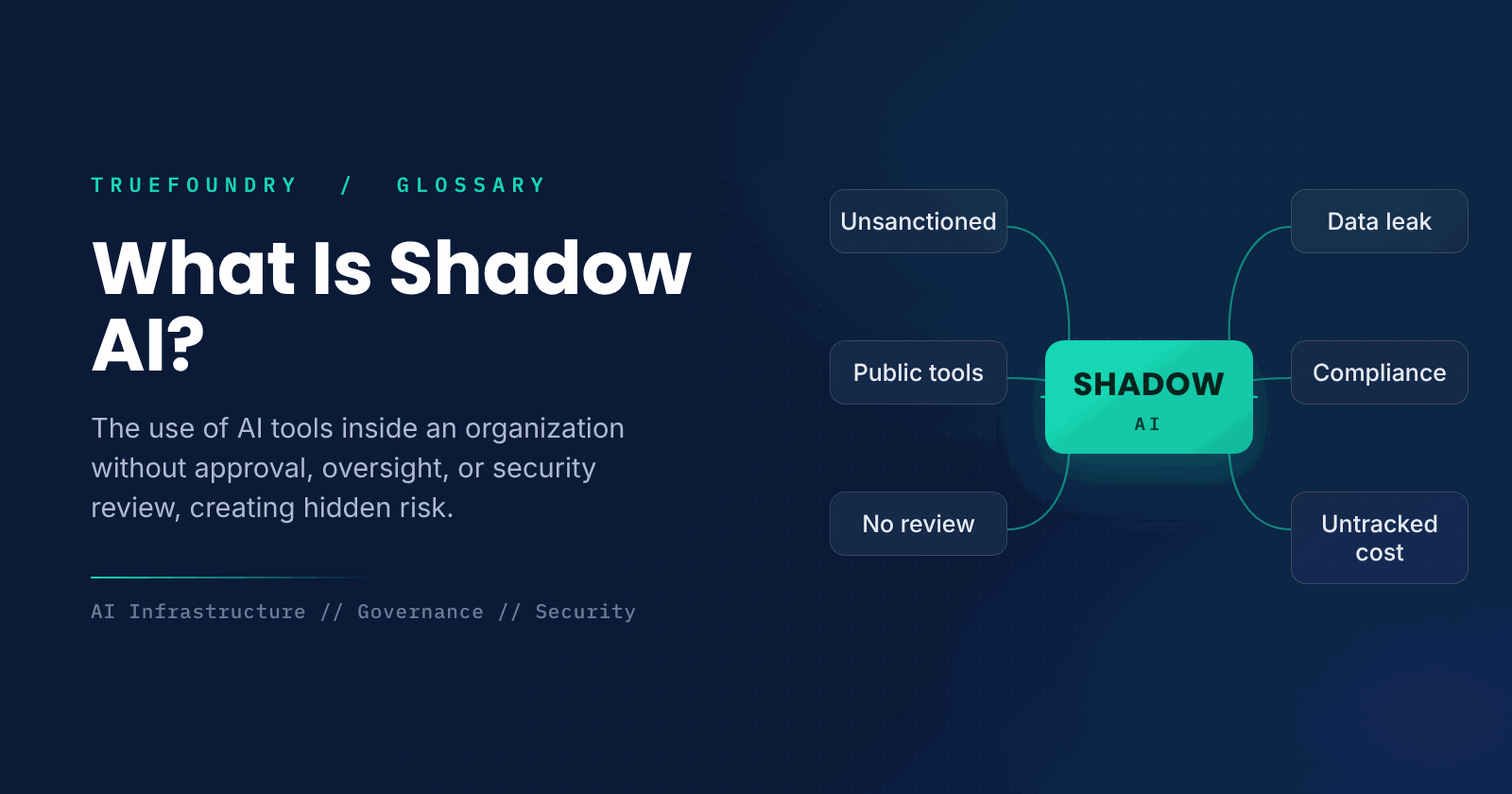
AI tools are easy to reach and genuinely useful, so employees adopt them to write, code, and analyze, often without asking first. When that happens outside any approval or oversight, it is called shadow AI. The work gets done, but the organization loses sight of what data is being shared, which tools are in use, and what risks are building up.
Shadow AI is not a sign of bad intent; it is usually people trying to be productive. The problem is the lack of visibility and control. Sensitive data can flow to third-party models, compliance rules can be broken unknowingly, and costs can accumulate with no one tracking them.
This guide explains what shadow AI is, why it happens, the risks it creates, and how to manage it without killing productivity.
What is shadow AI?
Shadow AI is the use of AI applications, models, or services within an organization without the knowledge, approval, or oversight of IT, security, or governance. It is the AI equivalent of shadow IT: tools adopted directly by employees, outside official channels, to get work done faster.
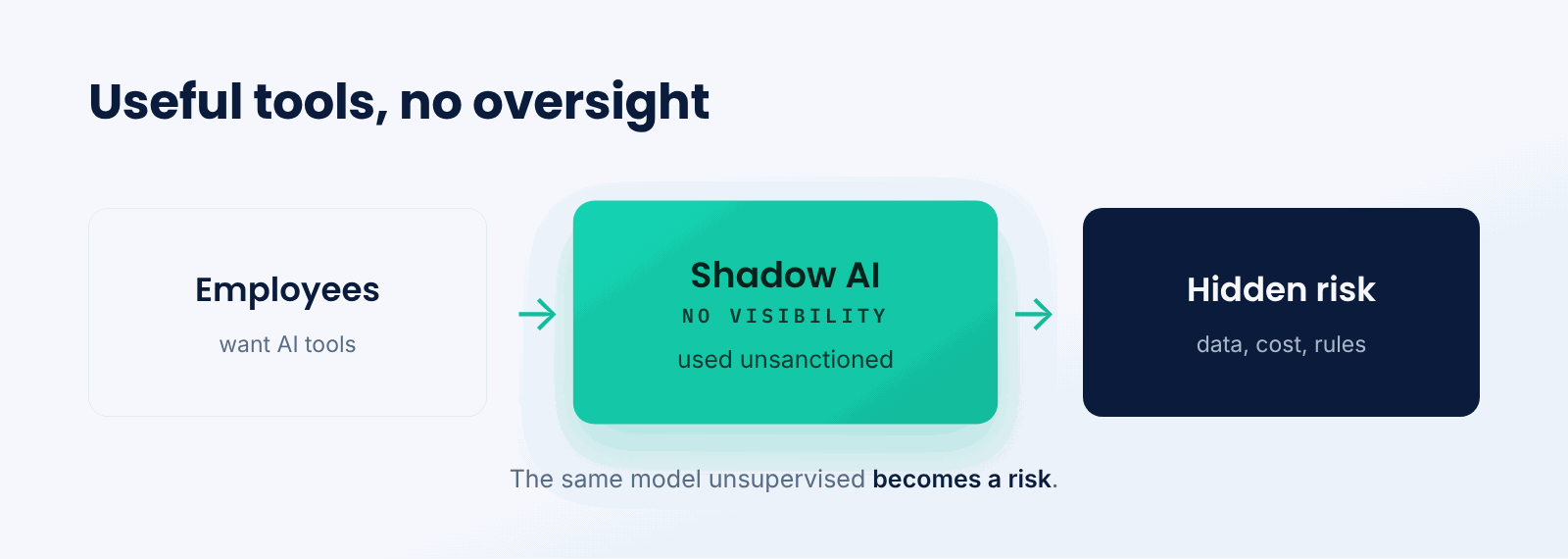
Think of it like employees using their own personal apps for company work. The apps may be effective, but the organization has no visibility into what data goes into them or how they are used. Shadow AI is the same dynamic applied to AI tools, with the same loss of oversight.
The key issue is not the tools themselves but the absence of governance around them. The same model used through an approved, monitored channel is fine; used in the shadows, it is a risk.
Why does shadow AI happen?
Shadow AI emerges when the demand for AI outpaces the organization's official provision of it.
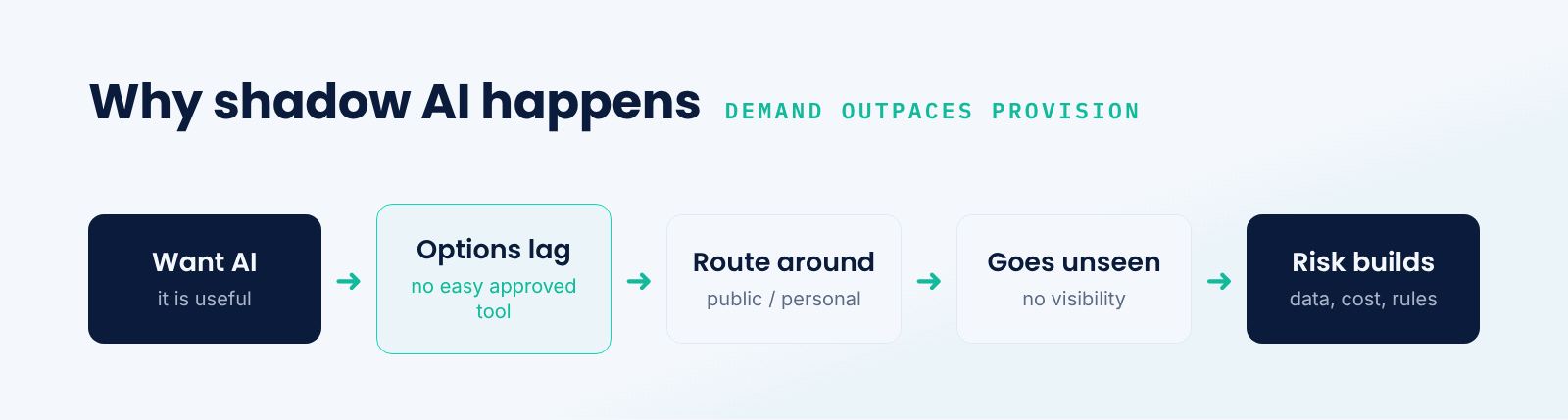
- Employees want AI. The tools are useful, so people want to use them for their work.
- Approved options lag. Official, sanctioned AI access is missing, slow, or hard to use.
- People route around it. They turn to public tools or personal accounts instead.
- Usage goes unseen. The organization has no visibility into what is being used or shared.
- Risk accumulates. Data, compliance, and cost exposure build up unnoticed.
The pattern shows why banning AI rarely works. If approved options are not easy and capable, demand simply pushes usage into the shadows, where it is harder to see and control.
What are the risks of shadow AI?
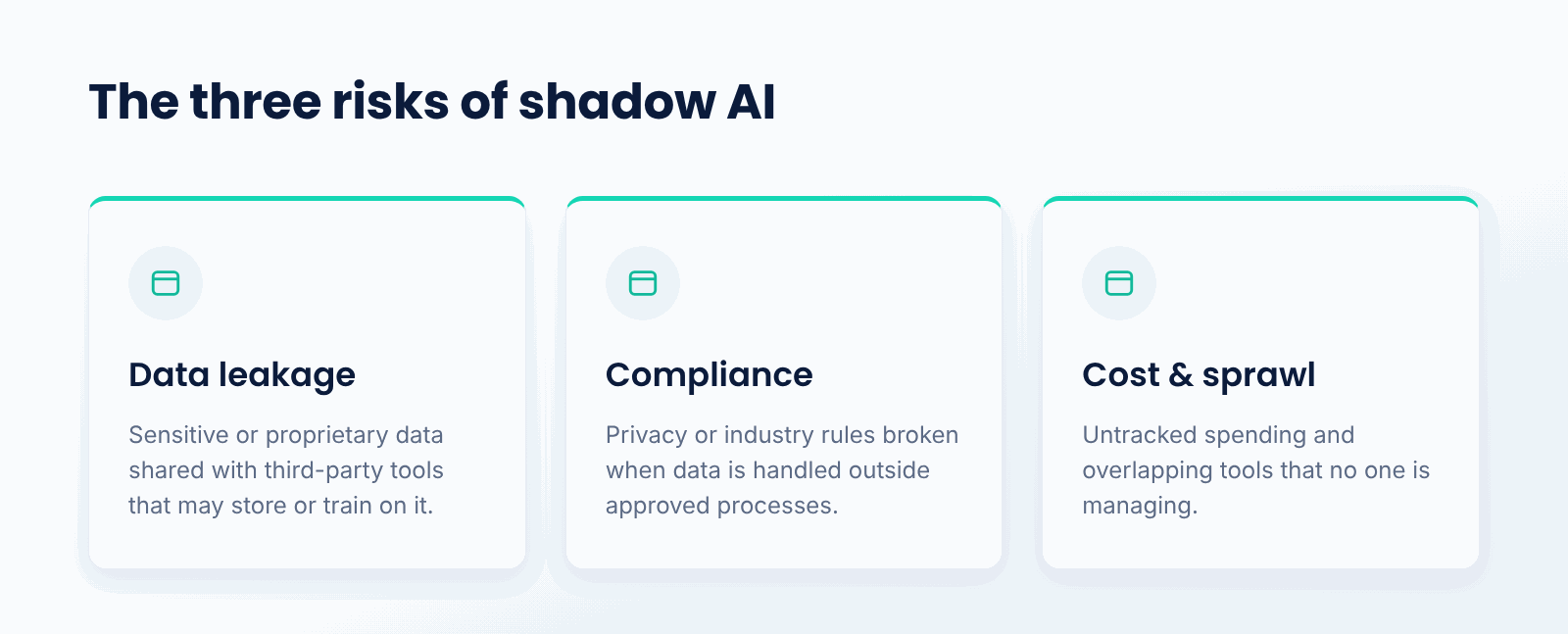
Shadow AI concentrates risk in three areas. Data leakage is the sharing of sensitive or proprietary information with third-party tools that may store or train on it. Compliance exposure is the breaking of privacy or industry rules when data is handled outside approved processes. Cost and sprawl is the untracked spending and tangle of overlapping tools that no one is managing.
These risks are worse because they are invisible. A problem you can see can be managed; shadow AI, by definition, is the usage you do not know about, so the exposure grows until something forces it into the open.
How do you manage shadow AI?
- Provide approved AI. Offer sanctioned, capable tools so people do not need to look elsewhere.
- Make access easy. Low-friction approved options reduce the pull toward unsanctioned ones.
- Set clear policy. Define what AI use is acceptable and what data can be shared.
- Gain visibility. Route AI use through channels you can monitor and log.
- Apply guardrails. Enforce data and safety controls on sanctioned usage.
When should you worry about shadow AI?
You should pay attention to it in any organization where employees have access to AI tools and handle sensitive or regulated data, which is most organizations today. The larger the workforce and the more sensitive the data, the greater the shadow AI exposure.
A small team with no sensitive data faces limited risk. But as an organization grows and its data becomes more valuable or regulated, bringing AI use into governed channels becomes increasingly important.
Best practices for managing shadow AI
- Offer approved, capable AI tools that meet employees' real needs.
- Keep approved access low-friction so the sanctioned path is the easy path.
- Publish clear, practical policies on acceptable AI use and data sharing.
- Route AI traffic through a monitored channel for visibility.
- Enforce data, privacy, and safety guardrails on all sanctioned use.
- Use a gateway to consolidate access, oversight, and cost tracking in one place.
Conclusion
Shadow AI is the unsanctioned use of AI tools inside an organization, outside its oversight and control. It happens when demand for AI outpaces official provision, and it concentrates risk in data leakage, compliance exposure, and untracked cost, all made worse by being invisible. The answer is not to ban AI but to make governed, approved access so easy that no one needs the shadows.
TrueFoundry's AI Gateway gives teams a single governed channel for AI access, with guardrails, monitoring, and cost tracking built in, so sanctioned use is the easy use. By making approved AI the path of least resistance, teams can bring shadow AI into the light.
Steuern, implementieren und verfolgen Sie KI in Ihrer eigenen Infrastruktur
Frequently Asked Questions
What is shadow AI in simple terms?
It is employees working with AI tools in their day-to-day work without authorization or supervision from IT, security, or governance teams. The work gets done, but the organization does not know which data is being shared or what risk is developing.
Why is shadow AI a problem?
Because of its invisibility. Sensitive data can leak into third-party tools, compliance can be inadvertently violated, and expenses can go unnoticed. Invisible risk cannot be managed, and that is exactly what makes shadow AI so dangerous.
Why does shadow AI happen?
Because employees want helpful AI tools and sanctioned choices are often unavailable, inefficient, or complicated to access. When the approved options are hard to reach, people find ways to bypass them in favor of public tools or personal accounts.
How do you manage shadow AI?
Not by outlawing AI, which drives it even deeper underground, but by giving people access to sanctioned, capable tools, setting clear policy, and routing usage through a monitored channel with guardrails.
What is the difference between shadow AI and shadow IT?
Shadow IT refers to unauthorized software and services generally; shadow AI is the same idea applied specifically to AI tools and models. Shadow AI adds extra risk because prompts often carry sensitive data to third-party models.

GenAI infra- einfach, schneller, günstiger
Top-Teams vertrauen uns bei der Skalierung von GenAI

- © 2022 ENSEMBLE Technologies



Abonnieren Sie unseren Newsletter
Die neuesten Nachrichten, Artikel und Ressourcen werden in Ihren Posteingang gesendet


