


Erhalten Sie sofortigen Zugriff auf eine TrueFoundry-Live-Umgebung. Stellen Sie Modelle bereit, leiten Sie den LLM-Verkehr weiter und erkunden Sie die gesamte Plattform — Ihre Sandbox ist in Sekundenschnelle einsatzbereit, ohne dass eine Kreditkarte erforderlich ist.


What Is PII Redaction and How Does It Work?

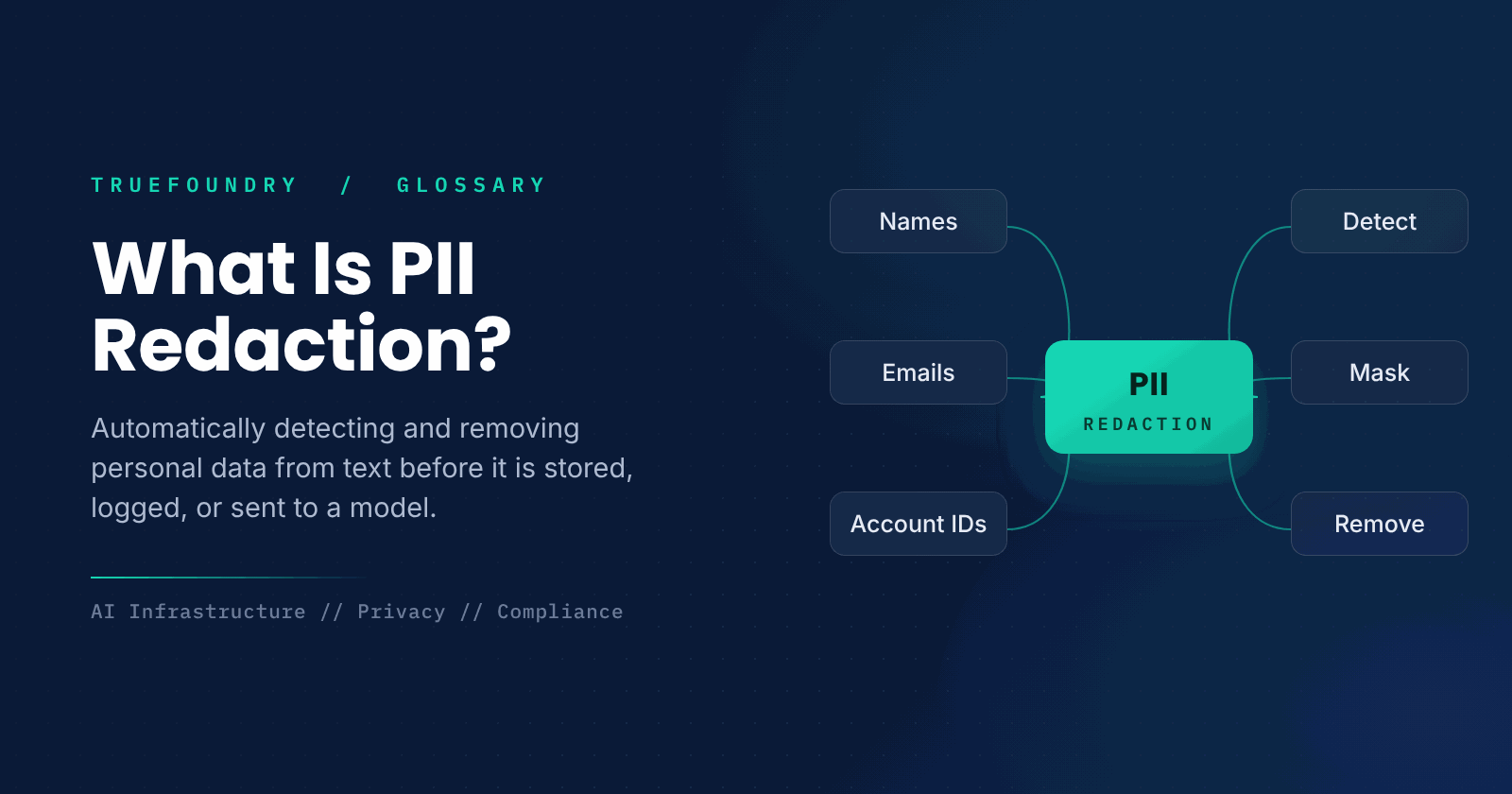
Every time text flows through a system, a prompt to a model, a log line, a stored record, it may contain personal information: a name, an email, a credit card number. PII redaction is the practice of automatically finding that information and removing or masking it, so sensitive data does not end up somewhere it should not.
For LLM applications this matters especially, because prompts often carry user data and responses can echo it back. Redaction lets you use the data you need while keeping personal details out of logs, out of third-party models, and out of reach of anyone who should not see them.
This guide explains what PII redaction is, how it works, where it is used, and why it matters for privacy and compliance.
What is PII redaction?
PII redaction is the automated process of detecting personally identifiable information in text and removing, masking, or replacing it before the text is used further. PII is any data that can identify a person, names, emails, phone numbers, addresses, government IDs, account numbers, and redaction ensures it is stripped out or obscured where it is not needed.
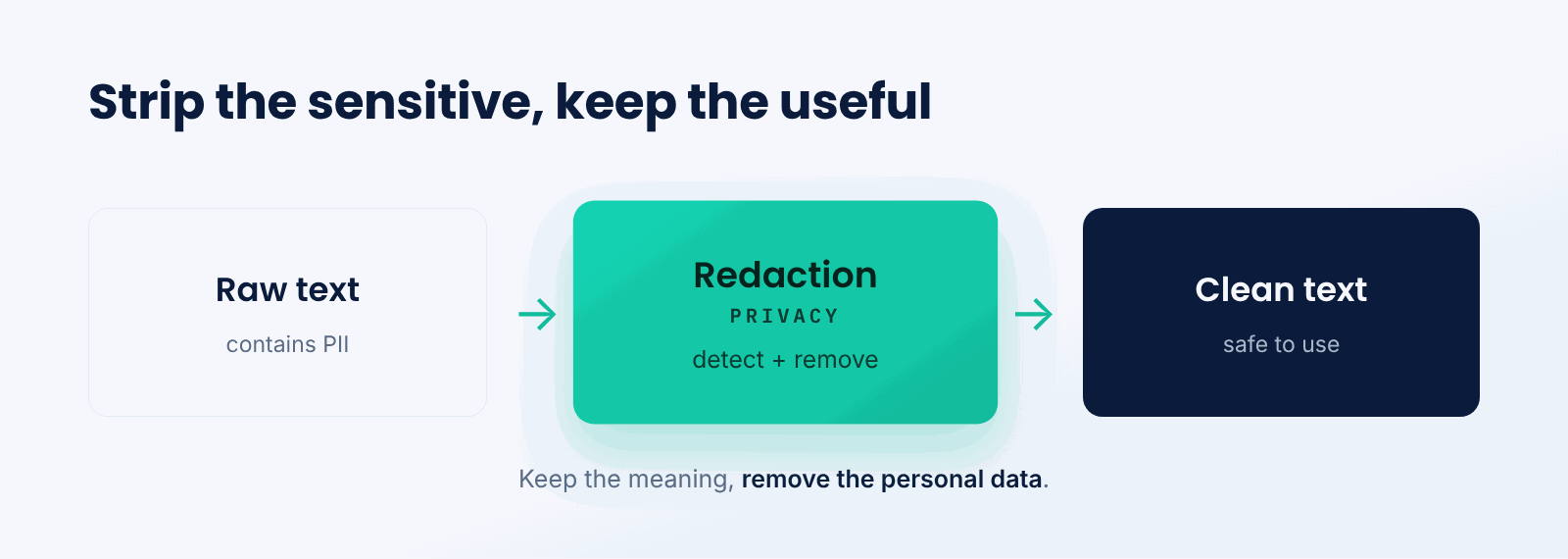
Think of it like a clerk who blacks out sensitive lines in a document before filing it. The document is still useful, the meaning is intact, but the personal details are no longer exposed. Redaction does this automatically, at scale, as data moves through a system.
The key idea is selective removal. Redaction keeps the text usable while taking out just the sensitive parts, so you lose privacy risk without losing the information you actually need.
How does PII redaction work?
Redaction detects sensitive spans in text and replaces them before the text continues downstream.
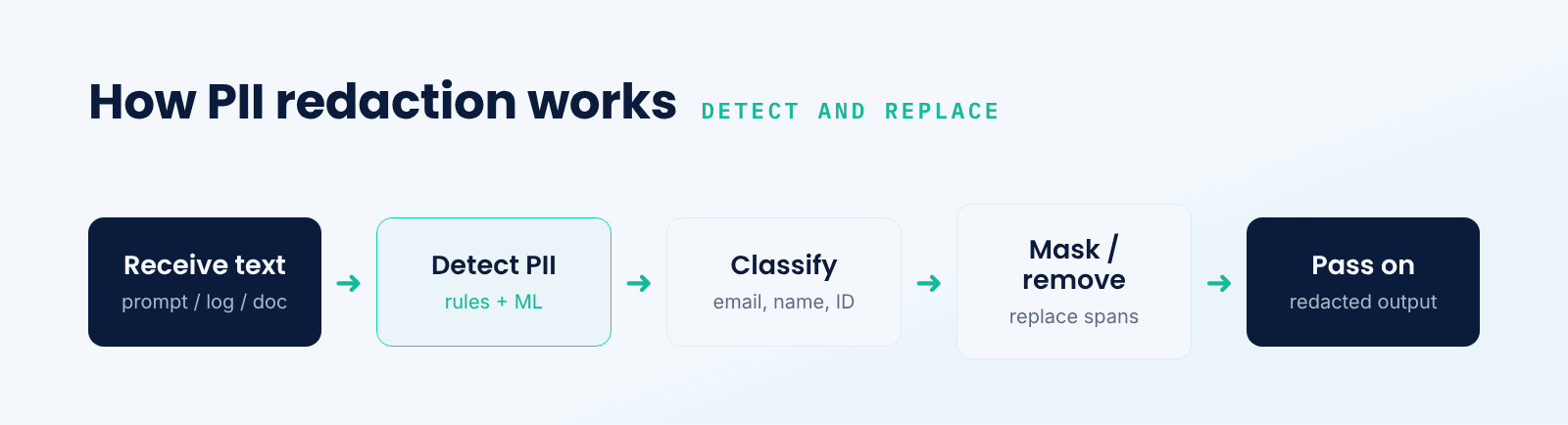
- Receive the text. A prompt, document, or log line enters the redaction step.
- Detect PII. Pattern rules, named-entity recognition, or classifiers find personal data.
- Classify it. Each match is labeled by type, email, phone, name, account number.
- Replace or mask. The sensitive spans are removed, masked, or swapped for placeholders.
- Pass it on. The redacted text continues to the model, log, or store, free of raw PII.
Detection combines methods because PII takes many forms. Regular expressions catch structured data like emails and card numbers, while machine-learning models catch names and addresses that have no fixed pattern. Layering both improves coverage.
Redaction vs. masking vs. tokenization
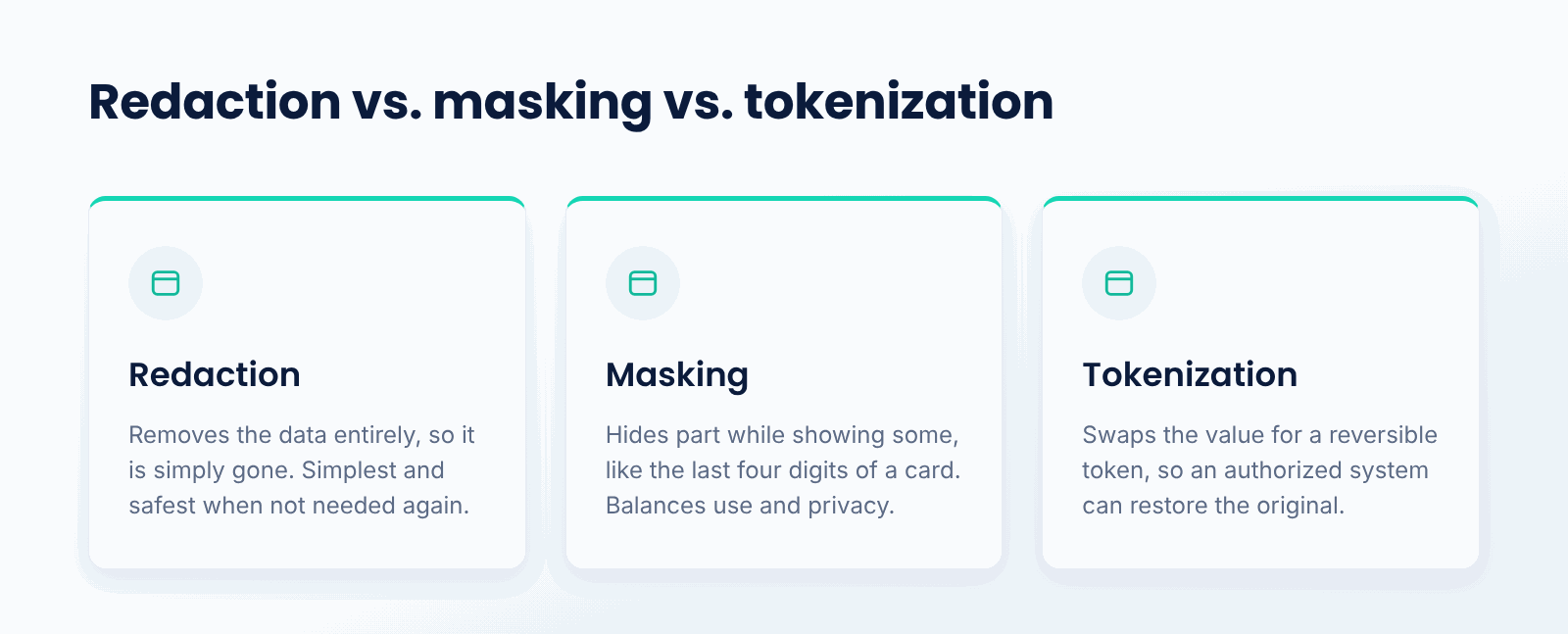
There are a few ways to handle detected PII. Redaction removes or blacks out the data entirely, so it is simply gone. Masking replaces part of it with symbols while leaving some visible, like showing only the last four digits of a card. Tokenization swaps the value for a reversible token, so the original can be restored later by an authorized system.
Which you choose depends on whether the original is ever needed again. Redaction is simplest and safest when the data is not needed, masking balances usability and privacy, and tokenization preserves recoverability for systems that must reverse it.
Why does PII redaction matter?
- Protects privacy. It keeps personal data from being exposed where it is not needed.
- Supports compliance. It helps meet GDPR, HIPAA, and other data-protection rules.
- Reduces breach impact. Redacted logs and stores hold less sensitive data to leak.
- Enables safe AI use. It lets you send prompts to models without exposing raw PII.
- Builds trust. It shows users and auditors that sensitive data is handled responsibly.
What are the challenges?
- Accuracy. Missing PII leaks data; over-redaction destroys useful information.
- Context. Whether a value is sensitive can depend on context that is hard to detect.
- Languages and formats. PII varies across languages, regions, and data formats.
- Latency. In real-time LLM paths, redaction must be fast enough not to slow responses.
When do you need PII redaction?
You need it whenever text containing personal data flows through systems that log, store, or send it onward, which is most real applications. For LLM apps, it is especially important before prompts reach a third-party model or are written to logs you keep.
A closed system processing only non-personal data has less need for it. But as soon as user data enters the picture, redaction becomes a key control for privacy and compliance.
Best practices for PII redaction
- Combine pattern rules and ML detection to catch both structured and unstructured PII.
- Redact on both prompts and responses in LLM applications.
- Choose redaction, masking, or tokenization based on whether the data is needed again.
- Tune for your languages, regions, and data formats to avoid missed or over-redaction.
- Keep redaction fast enough for real-time paths without blocking responses.
- Apply redaction centrally at a gateway so every model call is covered consistently.
Conclusion
PII redaction automatically detects and removes personal data from text before it is stored, logged, or sent to a model. By stripping out just the sensitive parts, it protects privacy, supports compliance, and lets you use LLMs without exposing raw user data. Combined with masking and tokenization where recoverability is needed, it is a core control for handling data responsibly.
TrueFoundry's AI Gateway can run PII detection and redaction as a guardrail on prompts and responses, so personal data is stripped before it reaches a model or a log. As LLM applications handle more user data, redaction at the gateway is how teams keep that data private and compliant.
Steuern, implementieren und verfolgen Sie KI in Ihrer eigenen Infrastruktur
Frequently Asked Questions
What is PII redaction in simple terms?
It automatically detects personal data such as names, email addresses, and account numbers in text and removes or masks it. That way sensitive data does not end up in log files, stores, or model prompts where it should not be.
What counts as PII?
Any information that identifies an individual: names, emails, phone numbers, addresses, government ID numbers, account numbers, and more. Some information identifies a person only when combined with other pieces, which is part of what makes detection tricky.
What is the difference between redaction, masking, and tokenization?
In redaction, the information is stripped away entirely. With masking, part of it is covered while some is left visible, such as the last four digits. With tokenization, the value is replaced by a reversible token so an authorized system can restore the original later.
Why is PII redaction important for LLM apps?
Because prompts often carry user data and responses can echo it back. Redacting before a prompt reaches a third-party model or is written to a log keeps personal data from being exposed and helps meet privacy regulations.
How is PII detected automatically?
With a mix of pattern rules and machine-learning models. Structured fields like emails and card numbers follow fixed patterns, while names and addresses do not, so layering both approaches improves how much is caught.

GenAI infra- einfach, schneller, günstiger
Top-Teams vertrauen uns bei der Skalierung von GenAI

- © 2022 ENSEMBLE Technologies



Abonnieren Sie unseren Newsletter
Die neuesten Nachrichten, Artikel und Ressourcen werden in Ihren Posteingang gesendet


