


Erhalten Sie sofortigen Zugriff auf eine TrueFoundry-Live-Umgebung. Stellen Sie Modelle bereit, leiten Sie den LLM-Verkehr weiter und erkunden Sie die gesamte Plattform — Ihre Sandbox ist in Sekundenschnelle einsatzbereit, ohne dass eine Kreditkarte erforderlich ist.


What Is MLOps and How Does It Work?

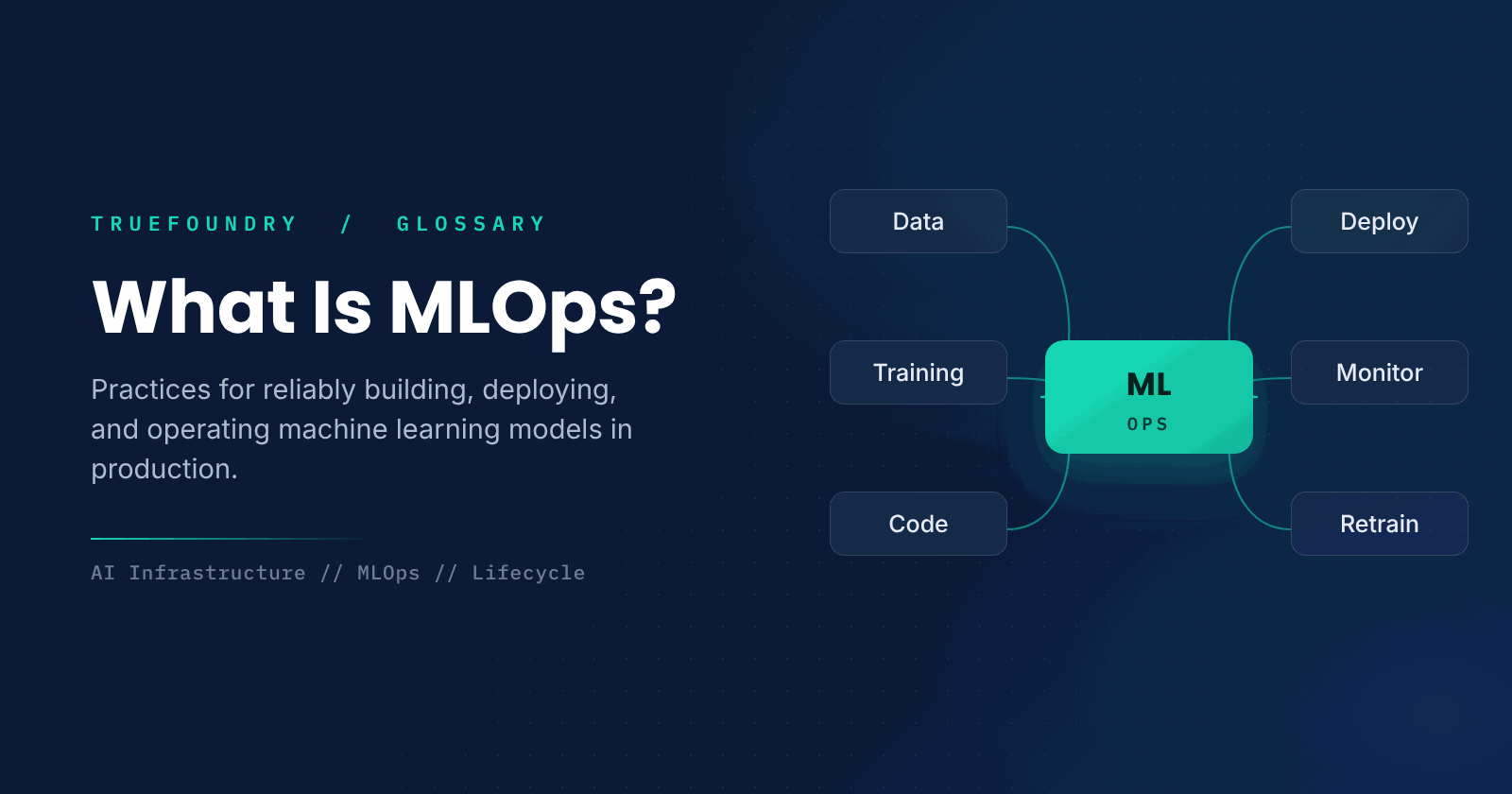
Building a model in a notebook is one thing; running it reliably in production for months is another. The gap between the two is where most ML projects stall. MLOps is the discipline that closes it, bringing the automation, versioning, and monitoring of modern software engineering to the messier, data-driven world of machine learning.
Without MLOps, teams retrain by hand, deploy models inconsistently, and discover problems only when results go wrong. With it, the path from experiment to production becomes repeatable, and models in production are watched and maintained rather than left to drift.
This guide explains what MLOps is, how it works, what it covers, and why it matters for any team running ML in production.
What is MLOps?
MLOps, short for machine learning operations, is a set of practices that combines machine learning, software engineering, and operations to deploy and maintain ML models in production reliably and at scale. It applies DevOps principles, automation, continuous delivery, versioning, and monitoring, to the specific challenges of the ML lifecycle, which includes data and models, not just code.
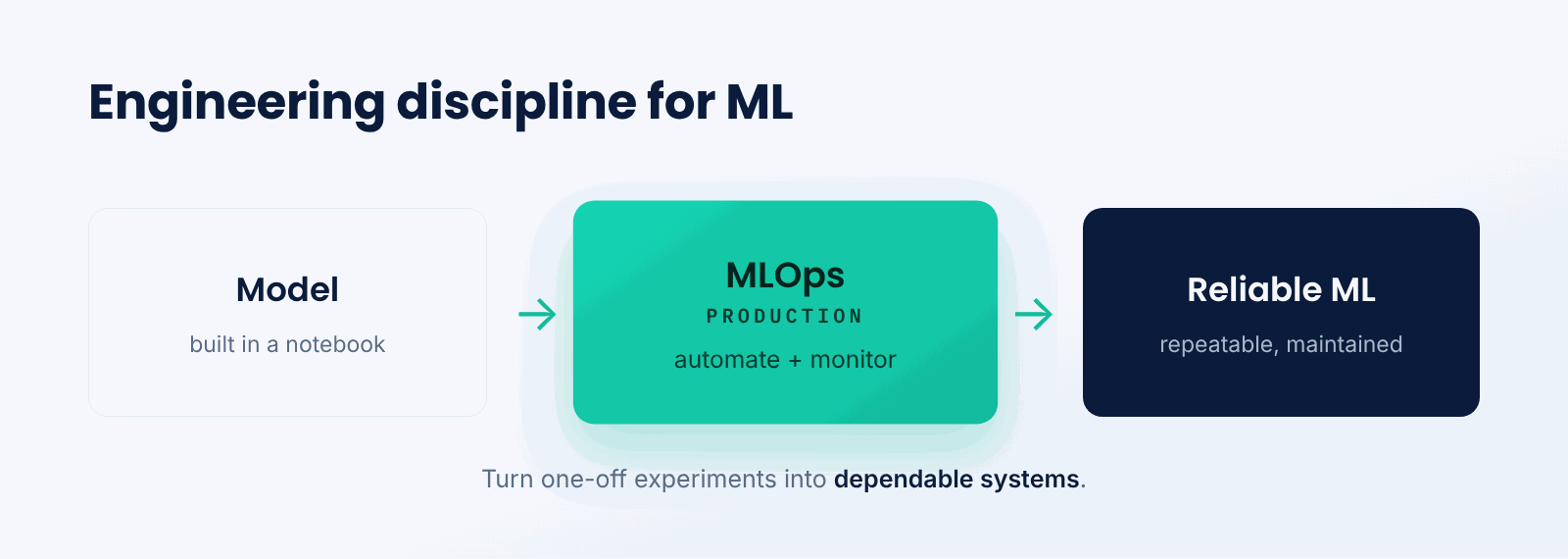
Think of it like a factory production line for models. Rather than hand-crafting each deployment, MLOps builds a repeatable pipeline that takes data and code in and produces tested, deployed, monitored models out. The line can be rerun whenever the data or model changes, consistently each time.
The key idea is that ML in production is an engineering discipline, not a one-off analysis. Treating it that way, with pipelines and monitoring, is what makes ML dependable at scale.
How does MLOps work?
MLOps builds an automated lifecycle that takes a model from data to production and back.
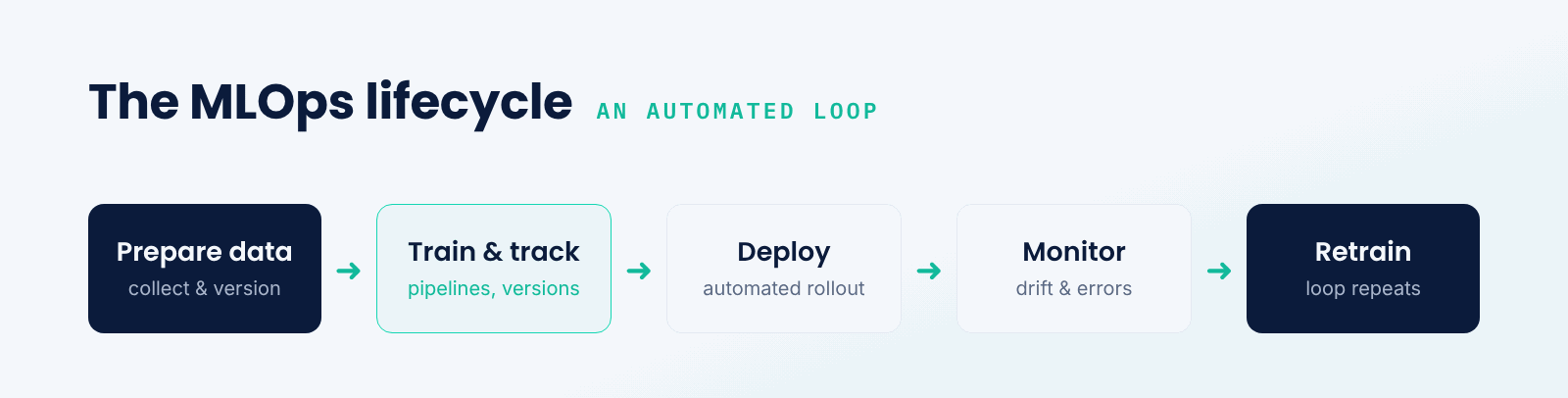
- Prepare data. Data is collected, versioned, and validated as a tracked input.
- Train and track. Models are trained in pipelines, with experiments and versions recorded.
- Deploy. Validated models are rolled out to production through automated steps.
- Monitor. Live performance, drift, and errors are tracked after deployment.
- Retrain. Monitoring signals trigger retraining, and the cycle repeats.
The loop is what matters. Because data and the world change, MLOps is not a straight line but a cycle: deploy, monitor, learn, retrain. Automating that loop is what keeps models accurate over time.
MLOps vs. DevOps
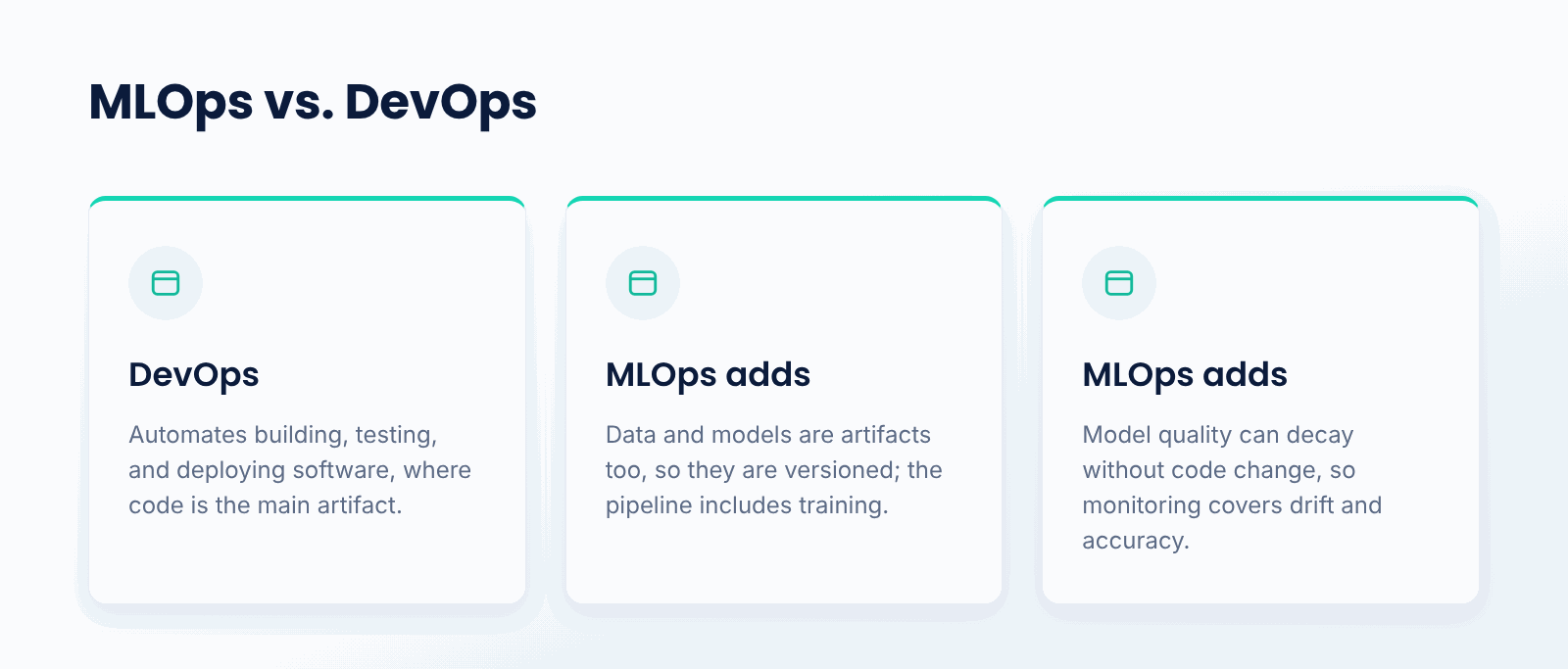
MLOps extends DevOps rather than replacing it. DevOps automates building, testing, and deploying software, where the code is the main artifact. MLOps adds the dimensions that ML introduces: data and models are artifacts too, so they must be versioned; model quality can decay even when code does not, so monitoring includes drift and accuracy; and the pipeline includes training, not just building.
The shared foundation is automation, versioning, and continuous delivery. MLOps takes those proven ideas and adapts them to the reality that an ML system is code plus data plus a model, all of which change.
Why does MLOps matter?
- Reliable deployment. It makes moving models to production repeatable, not ad hoc.
- Reproducibility. Versioning data, code, and models lets you recreate any result.
- Faster iteration. Automated pipelines speed up the path from idea to production.
- Sustained accuracy. Monitoring and retraining keep models working as data shifts.
- Collaboration. Shared pipelines align data scientists, engineers, and operations.
What are the challenges?
- Complexity. ML systems have more moving parts, data, models, code, than plain software.
- Tooling. The MLOps tool landscape is large and still maturing.
- Data dependence. Pipelines are only as reliable as the data feeding them.
- Skills. MLOps spans data science, engineering, and operations expertise.
When do you need MLOps?
You need it once ML moves from a one-off experiment to something that runs in production, serves real users, or must be maintained over time. The more models you run and the longer they must stay accurate, the more MLOps matters.
A single analysis that is run once and discarded does not need it. But any model that ships and must keep working benefits from the automation, versioning, and monitoring that MLOps provides.
Best practices for MLOps
- Version data, code, and models together so results are reproducible.
- Automate training and deployment with pipelines rather than manual steps.
- Monitor models in production for drift, accuracy, and operational health.
- Set up retraining triggered by monitoring signals, not just a calendar.
- Standardize environments so training and serving match.
- Centralize deployment and monitoring so many models are managed consistently.
Conclusion
MLOps is the discipline of building, deploying, and operating machine learning models reliably in production. By applying automation, versioning, and monitoring to the full ML lifecycle, data and models included, it turns one-off experiments into dependable systems that keep working as conditions change. It is to machine learning what DevOps is to software: the practices that make production real.
TrueFoundry gives teams a platform to run MLOps on their own infrastructure, with pipelines for deployment, versioning, and monitoring in one place. As ML moves into production across a business, MLOps is how teams keep those models reliable and maintainable.
Steuern, implementieren und verfolgen Sie KI in Ihrer eigenen Infrastruktur
Frequently Asked Questions
What is MLOps in simple terms?
It is essentially the use of software engineering principles, automation, version control, and monitoring, in machine learning, so that models are deployed and continuously run in production rather than built once by hand and left to drift.
How is MLOps different from DevOps?
DevOps automates building and deploying software, where the code is the artifact. MLOps extends it to ML, where data and models are artifacts too and must be versioned, and where model quality must be monitored for drift, not just uptime.
Why is MLOps important?
Since ML models tend to degrade as data evolves, and deploying them by hand is error-prone, MLOps makes deployment repeatable and results reproducible, and keeps models accurate through monitoring and retraining.
What does the MLOps lifecycle include?
Preparing and versioning data, training models in tracked pipelines, deploying them through automated steps, monitoring them in production for drift and errors, and retraining when signals call for it, then repeating the loop.
How is MLOps related to LLMOps?
LLMOps is MLOps specialized for large language models. It shares the same goals of reliable deployment and monitoring but adds concerns specific to LLMs, like prompts, tokens, cost, and guardrails.

GenAI infra- einfach, schneller, günstiger
Top-Teams vertrauen uns bei der Skalierung von GenAI

- © 2022 ENSEMBLE Technologies



Abonnieren Sie unseren Newsletter
Die neuesten Nachrichten, Artikel und Ressourcen werden in Ihren Posteingang gesendet


