


Erhalten Sie sofortigen Zugriff auf eine TrueFoundry-Live-Umgebung. Stellen Sie Modelle bereit, leiten Sie den LLM-Verkehr weiter und erkunden Sie die gesamte Plattform — Ihre Sandbox ist in Sekundenschnelle einsatzbereit, ohne dass eine Kreditkarte erforderlich ist.


What Is Model Context Protocol and How Does It Work?

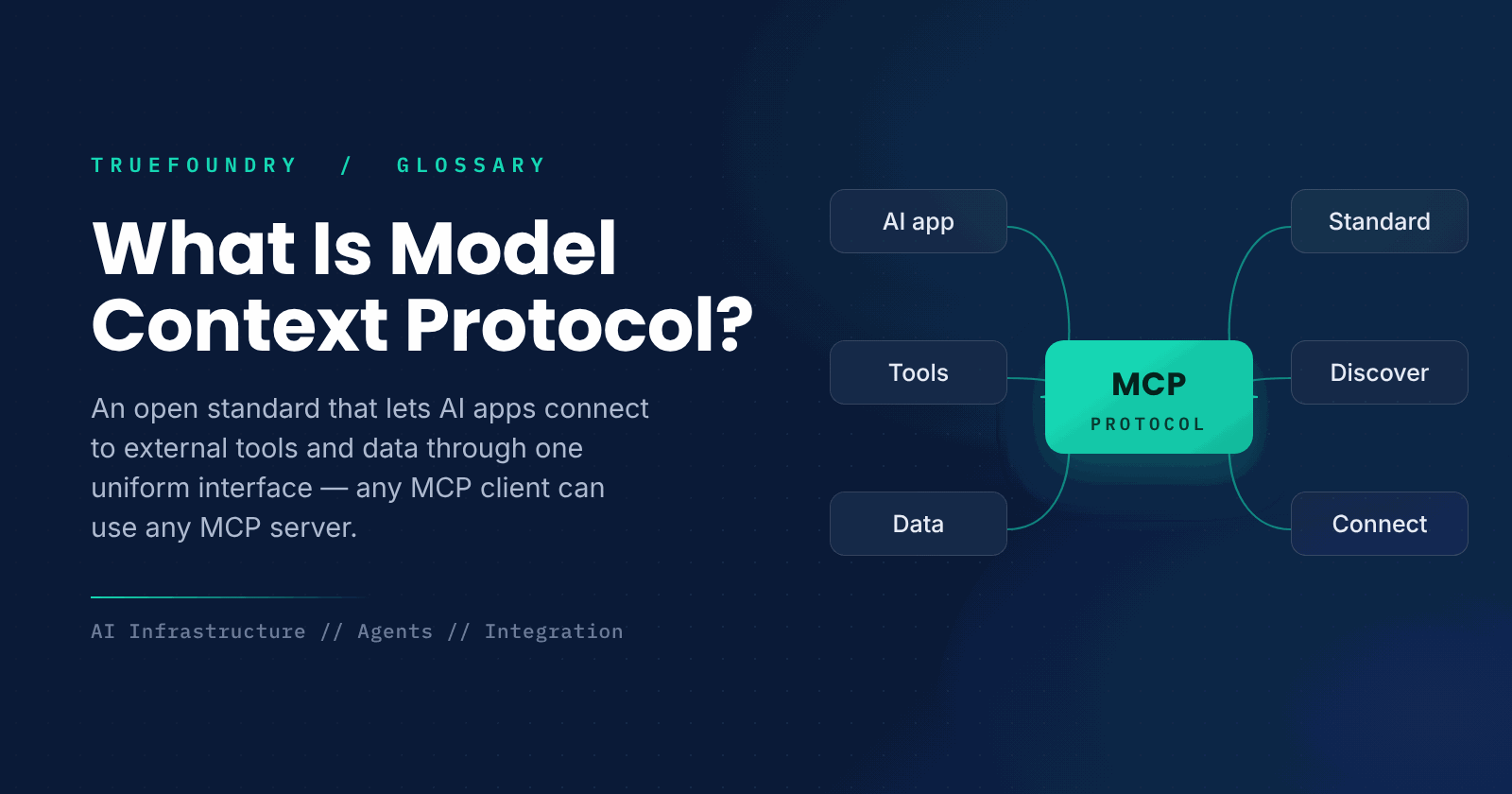
AI models are powerful on their own, but they become far more useful when they can reach the outside world, querying a database, calling an API, reading a file store. The problem is that every such connection used to be a custom integration, rebuilt for each model and each tool. The Model Context Protocol was created to end that fragmentation.
MCP is an open standard that defines a common way for AI applications to connect to tools and data. Instead of building a bespoke bridge for every combination, you build to the protocol once, and any compatible client can talk to any compatible server. It is often described as a universal connector for AI.
This guide explains what the Model Context Protocol is, how it works, how it compares with custom integrations, and why it matters.
What is the Model Context Protocol?
The Model Context Protocol is an open standard that specifies how AI applications exchange context with external systems. It defines two roles: MCP clients, which are the AI applications, and MCP servers, which expose tools, data resources, and prompt templates. The protocol standardizes how a client discovers and uses what a server offers.
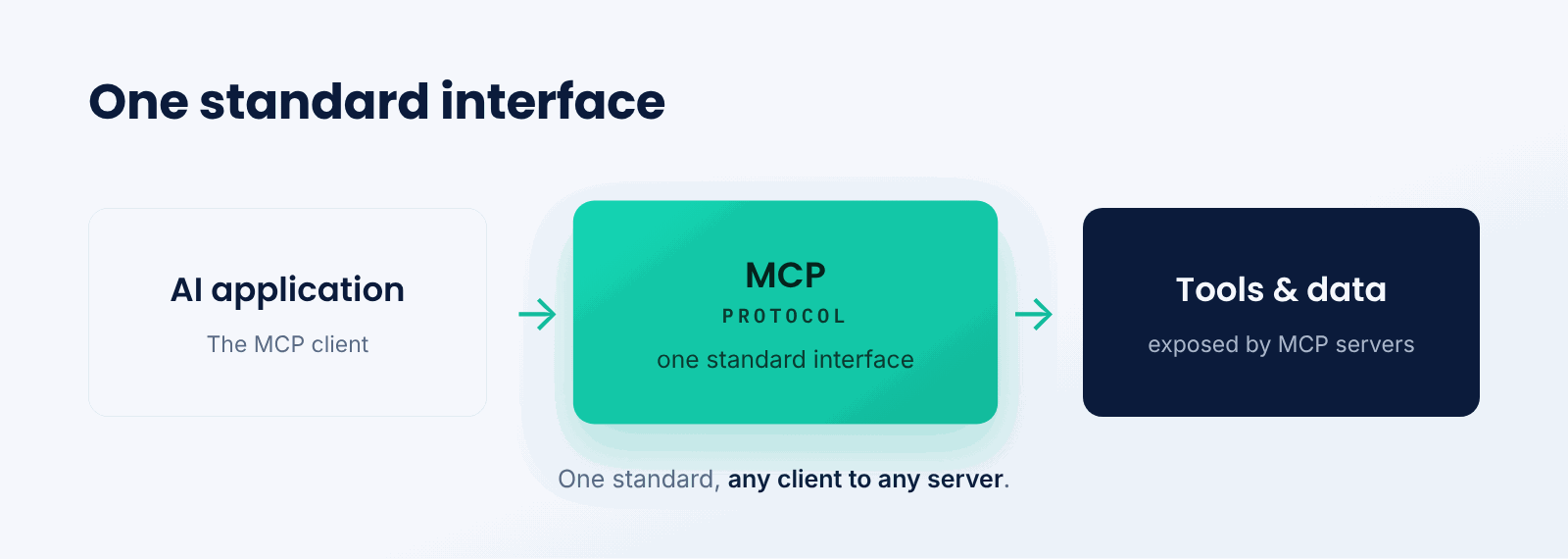
Think of it like a standard power socket. Before standards, every device needed its own custom outlet; with a common socket, any plug fits any wall. MCP is that common socket between AI applications and the tools and data they need, so a connection built once works everywhere.
The key idea is standardization. By agreeing on one interface, MCP turns an N-by-M integration problem, every app wired to every tool, into a simpler one where each side only has to speak the protocol.
How does the Model Context Protocol work?
A request for external context flows between a client and a server through the protocol.
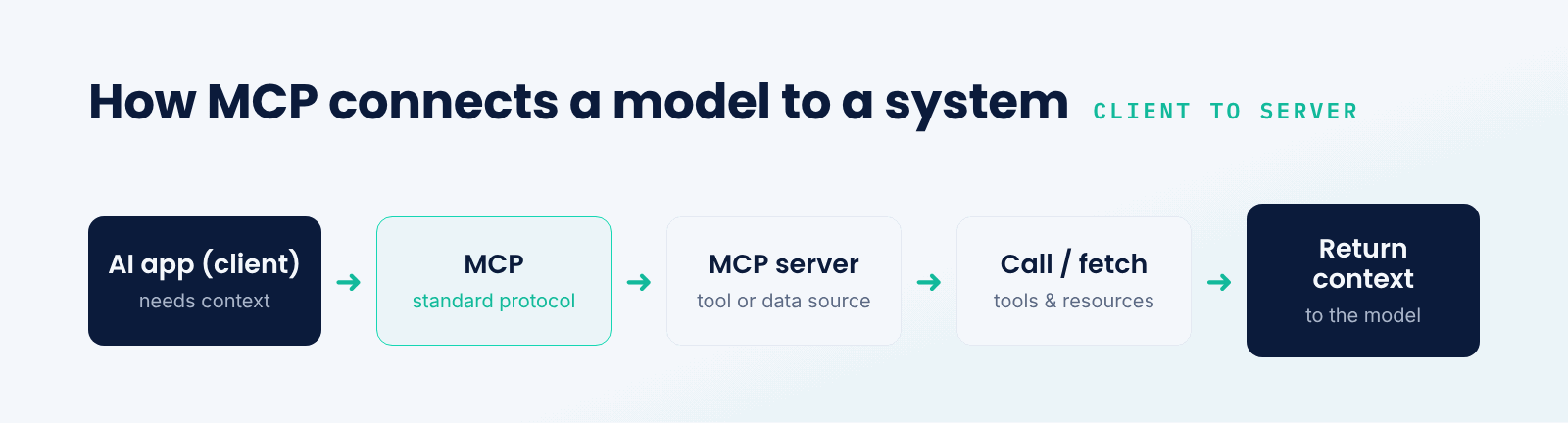
- The client connects. An AI application, the MCP client, opens a connection to an MCP server.
- Discover capabilities. The client asks what the server offers: its tools, data resources, and prompts.
- Call a tool or read a resource. When the model needs something, the client invokes a tool or fetches a resource through the protocol.
- The server acts. The server runs the action against the real system, such as querying a database or calling an API.
- Return the context. The result flows back through the protocol into the model's context, where it informs the response.
Because the protocol is uniform, the same client can use many servers and the same server can serve many clients. That interoperability is what makes MCP more than just another integration format.
MCP vs. custom integrations and plugins
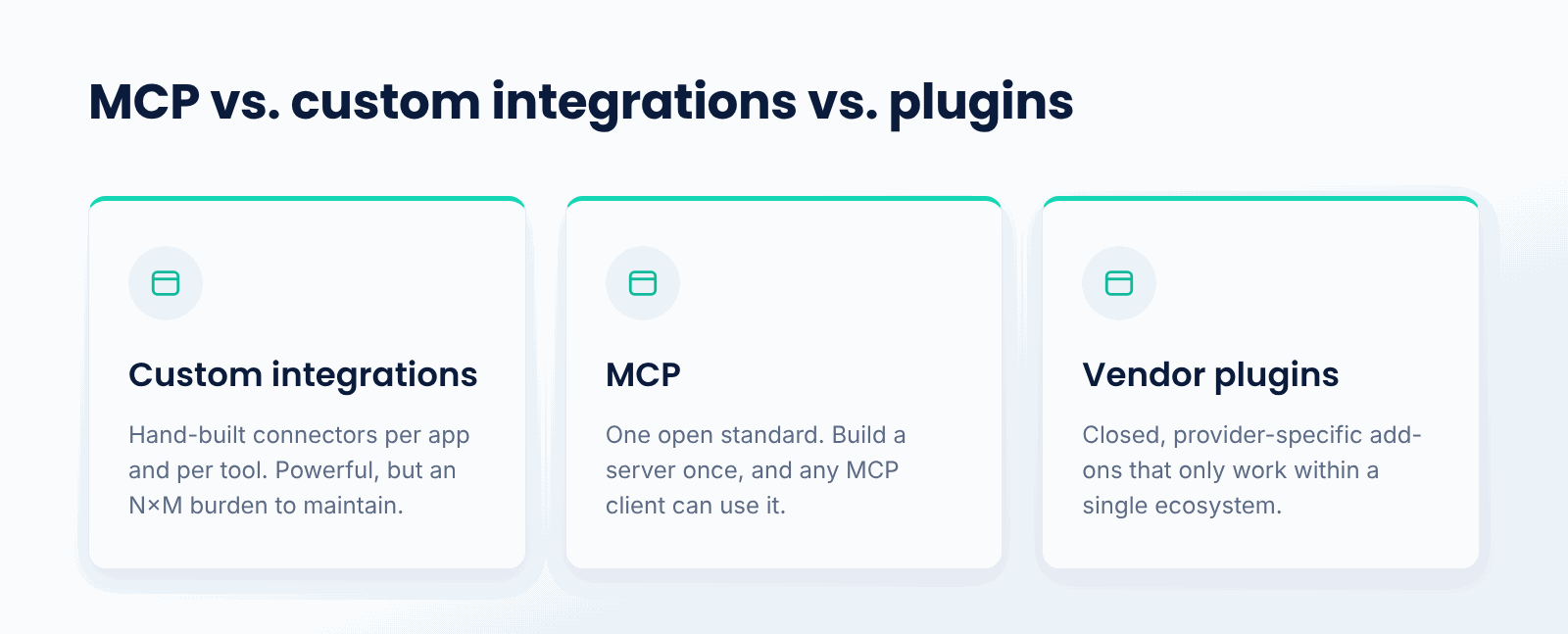
These approaches solve the same need differently. Custom integrations are hand-built connectors for each app and each tool; they are powerful but become an N-by-M maintenance burden as both sides multiply. MCP replaces that with one open standard: build a server once, and any MCP client can use it. Vendor plugins are closed, provider-specific add-ons that work only inside one ecosystem, which limits reuse across tools and models.
The advantage of MCP is reach and reuse. Because it is open and standard, a server written for it works with any compatible client, which is why it has gained traction as a shared layer rather than a single vendor's feature.
What does MCP provide?
- Tools. Actions a model can invoke through a server, such as running a query or sending a message.
- Resources. Data a model can read, such as files, records, or documents exposed by a server.
- Prompts. Reusable prompt templates a server can offer to guide how its tools are used.
- Discovery. A standard way for a client to learn what a server offers at connection time.
- Interoperability. Any compatible client and server can work together without bespoke code.
What are the considerations?
- Security. Giving a model access to tools and data means carefully controlling what each server can do.
- Authentication. Servers must handle credentials to the systems they wrap, securely and per user.
- Trust. A client should connect only to servers it trusts, since they can take real actions.
- Maturity. As an evolving standard, tooling and best practices are still settling.
When should you use MCP?
MCP fits whenever you want AI applications to use external tools and data without building a custom integration for every pairing. If you are connecting models to internal systems, or want your tools usable across different AI clients, the protocol saves significant integration work.
For a single, simple, one-off connection, a direct integration may be quicker. The value of MCP grows with the number of tools and clients you need to connect, which is exactly where custom integrations become painful.
Best practices for MCP
- Expose only the tools and resources a model actually needs, following least privilege.
- Handle authentication and authorization carefully within each server.
- Connect clients only to trusted servers, since servers can take real actions.
- Keep tool definitions clear so the model knows when and how to use them.
- Add observability so you can see what tools were called and with what results.
- Put MCP access behind a gateway so security, routing, and monitoring are centralized.
Conclusion
The Model Context Protocol is an open standard that connects AI applications to external tools and data through one uniform interface. By standardizing how clients discover and use what servers offer, it replaces a tangle of custom integrations with a shared layer where any compatible client can use any compatible server. It has quickly become a common way to give models access to the outside world.
TrueFoundry's AI Gateway helps teams connect models to tools and data securely, with centralized access control, routing, and observability over how those connections are used. As MCP becomes a standard layer for AI, managing it through one governed gateway is how teams keep that access both powerful and safe.
Steuern, implementieren und verfolgen Sie KI in Ihrer eigenen Infrastruktur
Frequently Asked Questions
What is the Model Context Protocol in simple terms?
It is an open standard that allows AI software to connect to tools and datasets using a common interface. Rather than a unique integration between each pairing, any MCP client can talk to any MCP server.
What is the difference between an MCP client and server?
The client is the AI program that requires tools or data. The server provides the tools, data resources, and prompts for a specific system. The protocol is responsible for standardizing the way the client discovers and uses the services offered by the server.
Why is MCP useful?
This method replaces numerous custom integrations with one standardized approach. By building a server only once and allowing any compatible client to use it, what was an N-by-M integration challenge becomes a much simpler one, and tools become reusable across AI apps.
Is MCP secure?
It can be, but it needs caution. Since servers can take real actions and access information, you must control exactly what each server exposes, handle authentication appropriately, and connect only to trusted servers, ideally behind a gateway.
What does an MCP server expose?
Three main components are involved: tools (actions the model can perform), resources (data the model can access), and prompts (reusable templates). A client learns about them once it connects to the server.

GenAI infra- einfach, schneller, günstiger
Top-Teams vertrauen uns bei der Skalierung von GenAI

- © 2022 ENSEMBLE Technologies



Abonnieren Sie unseren Newsletter
Die neuesten Nachrichten, Artikel und Ressourcen werden in Ihren Posteingang gesendet


