


Erhalten Sie sofortigen Zugriff auf eine TrueFoundry-Live-Umgebung. Stellen Sie Modelle bereit, leiten Sie den LLM-Verkehr weiter und erkunden Sie die gesamte Plattform — Ihre Sandbox ist in Sekundenschnelle einsatzbereit, ohne dass eine Kreditkarte erforderlich ist.


What Is LLM as a Judge and How Does It Work?

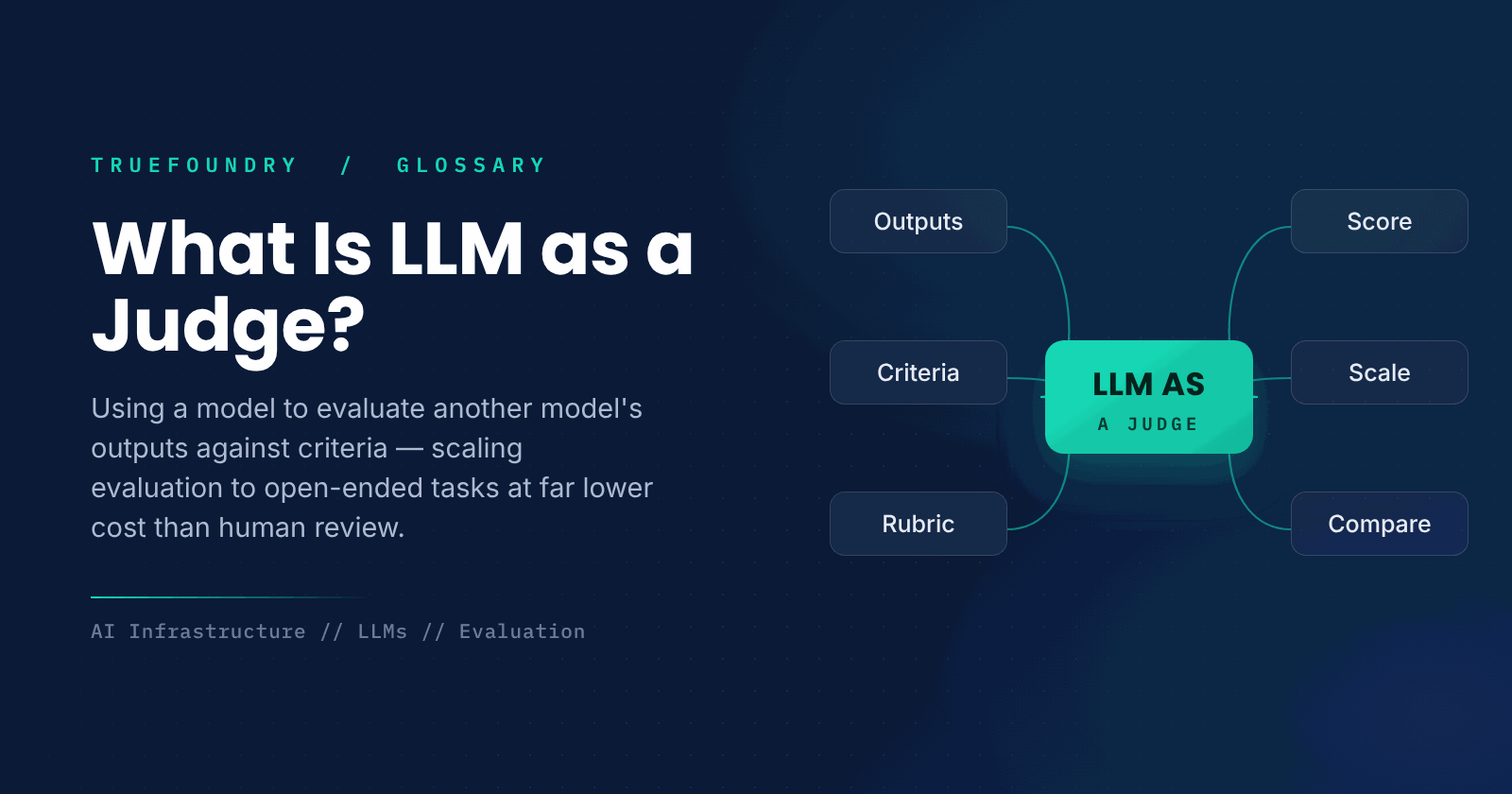
Scoring a model's output is easy when there is one correct answer, you just check it. But most interesting LLM tasks, summaries, explanations, chat replies, have no single right answer, only better and worse ones. Judging those at scale with humans is slow and expensive. LLM-as-a-judge offers a middle path: use a capable model to do the judging.
The idea is simple but powerful. Give a model the output to evaluate and a clear rubric, and it can rate quality or pick the better of two options, cheaply and in seconds. That makes it possible to evaluate open-ended tasks across thousands of cases, which is exactly where exact-match scoring fails and human review does not scale.
This guide explains what LLM-as-a-judge is, how it works, how it compares with human and exact-match evaluation, and its limits.
What is LLM as a judge?
LLM-as-a-judge is an evaluation technique that uses a language model to assess the quality of outputs, usually from another model, against defined criteria. Instead of a human rater or a rigid rule, the judge model reads the output and a rubric and produces a score, a label, or a preference between options.
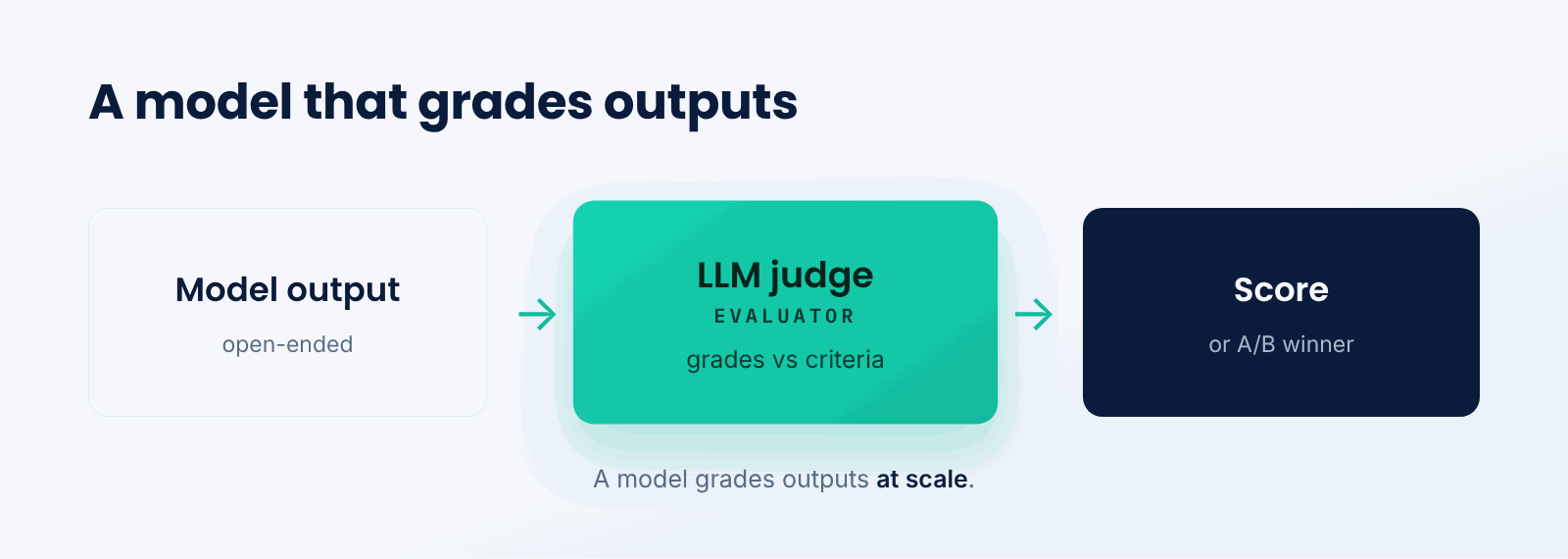
Think of it as an automated grader. A teacher cannot mark ten thousand essays by hand quickly, but a well-briefed assistant working from a clear rubric can get through them fast and consistently. The judge model is that assistant, applying your criteria to every output at a scale humans cannot match.
The key idea is scalable judgment. For tasks where quality is a matter of degree rather than a fixed answer, a model judge brings evaluation within reach of automation.
How does LLM as a judge work?
A judge model is given the output and a rubric and asked to evaluate it.
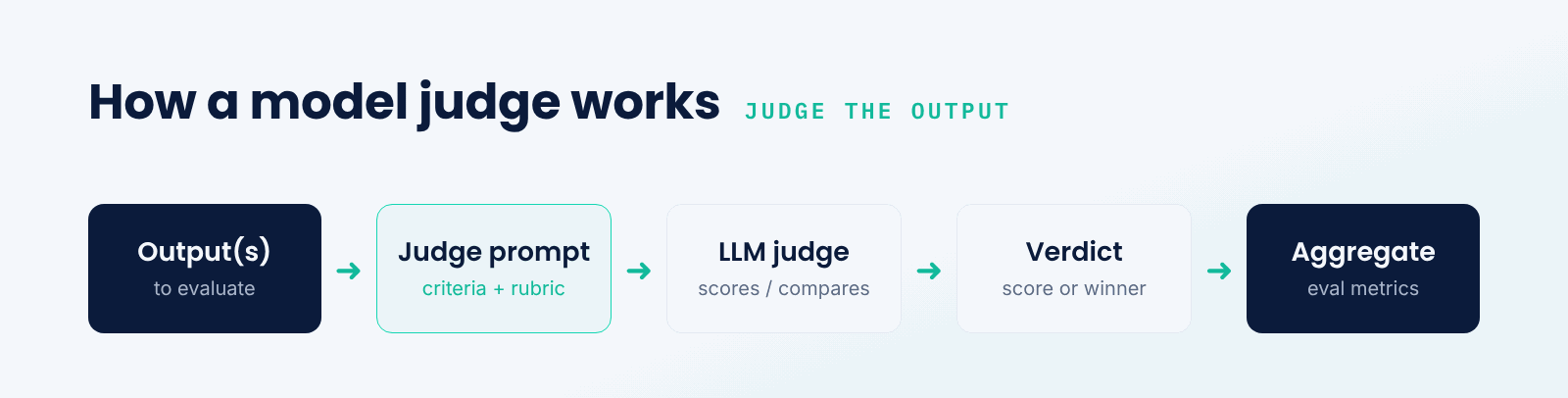
- Take the output. The response to be evaluated, from one model or two to compare, is the input.
- Write the judge prompt. A prompt sets the criteria and rubric for what good looks like.
- The judge scores. The judge model reads the output against the rubric and produces a score or preference.
- Return a verdict. The result is a rating, a pass or fail, or the winner of an A/B comparison.
- Aggregate. Verdicts across many cases combine into evaluation metrics.
Two common modes are scoring a single output against a rubric, and pairwise comparison, where the judge picks the better of two responses. Pairwise judging is often more reliable, since relative choices are easier than absolute scores.
Human vs. LLM judge vs. exact-match
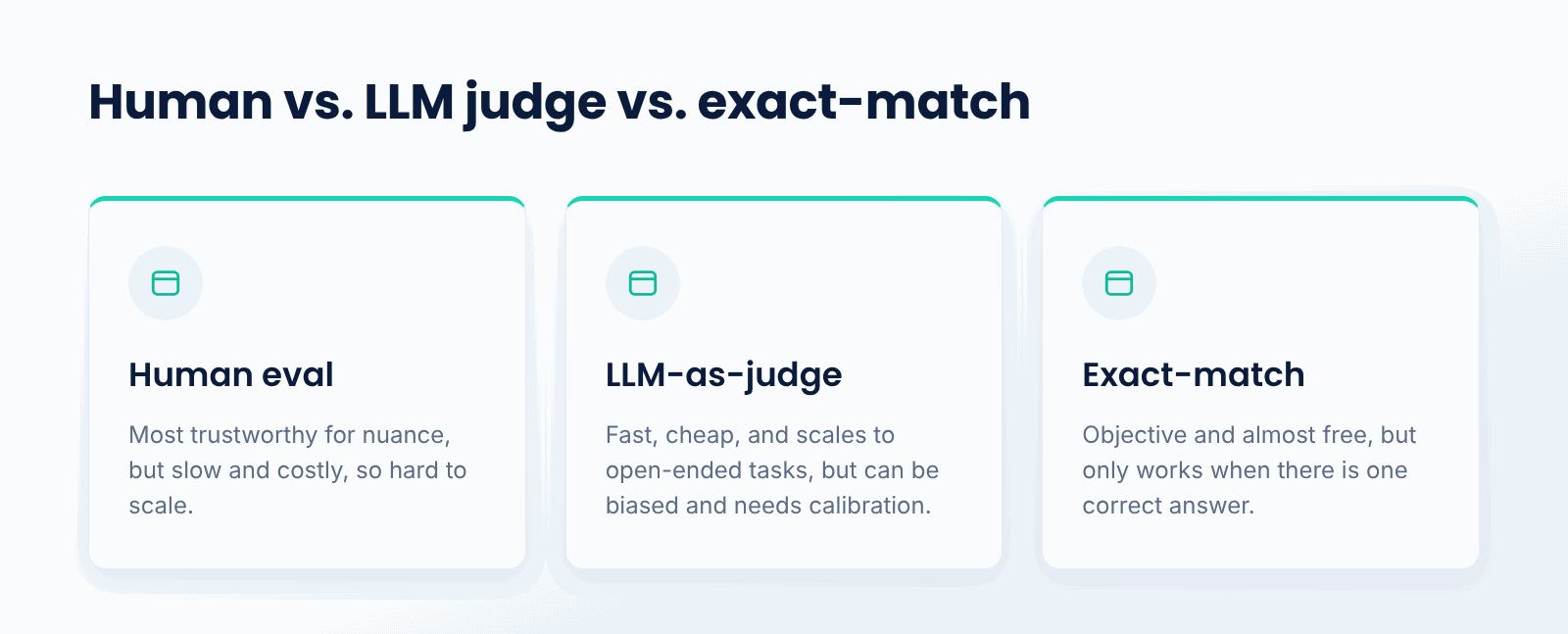
These are the three ways to evaluate, trading cost against trustworthiness. Human evaluation is the most reliable for nuance and the ultimate reference, but it is slow and expensive, so it cannot cover everything. LLM-as-a-judge is fast and cheap and scales to open-ended tasks, but it can be biased and needs calibration against human judgment. Exact-match scoring is objective and almost free, but only works when there is a single correct answer.
The practical pattern is to use a model judge for scale, exact-match where answers are precise, and human review to spot-check and calibrate. The judge handles the volume; humans keep it honest.
What are the benefits of LLM as a judge?
- Scale. It evaluates thousands of open-ended outputs that humans could not cover.
- Speed. Verdicts come back in seconds, so evals can run on every change.
- Low cost. It is far cheaper than paying humans to rate every output.
- Flexibility. A rubric can capture nuanced criteria beyond exact matching.
- Consistency. Applied carefully, a judge grades every case the same way.
What are the limits and biases?
- Bias. Judges can favor longer answers, their own style, or the first option shown.
- Not ground truth. A model judge is an approximation of human judgment, not a perfect one.
- Prompt sensitivity. The rubric and wording strongly affect the verdicts.
- Needs calibration. Judges should be checked against human ratings to confirm they agree.
When should you use LLM as a judge?
Use it when you need to evaluate open-ended outputs at a scale humans cannot reach: grading summaries, comparing model versions, or running automated evals on every change. For these, a model judge is the only practical way to get frequent, broad coverage.
For tasks with exact answers, rule-based scoring is simpler and more reliable. And for the highest-stakes judgments, human review should remain in the loop, with the model judge handling the bulk.
Best practices for LLM as a judge
- Write a clear, specific rubric so the judge knows exactly what to score.
- Prefer pairwise comparison over absolute scoring when you can, as it is more reliable.
- Calibrate the judge against human ratings and measure how well they agree.
- Watch for known biases, like favoring length or position, and counter them.
- Use a strong model as the judge, since weaker ones grade less reliably.
- Run judging behind a gateway so eval calls, cost, and results are tracked in one place.
Conclusion
LLM-as-a-judge uses a model to evaluate outputs against criteria, making it possible to score open-ended tasks at a scale and cost humans cannot match. It is not a perfect substitute for human judgment, it carries biases and needs calibration, but used well, with clear rubrics and human spot-checks, it is the practical backbone of automated evaluation. It is what lets teams run broad evals on every change.
TrueFoundry's AI Gateway helps teams run model-graded evaluation across providers, capturing the data and tracking the cost of judging in one layer. As evaluation becomes continuous, a reliable model judge, kept honest by human calibration, is how teams measure quality at the speed they ship.
Steuern, implementieren und verfolgen Sie KI in Ihrer eigenen Infrastruktur
Frequently Asked Questions
What is LLM as a judge in simple terms?
It is evaluating the responses generated by one language model using another language model as the scorer. Rather than having a person rate each response, the judging model scores the quality or selects between two responses, cheaply and at scale.
Why use a model to judge instead of humans?
Because humans are costly and slow evaluators and cannot cover thousands of open-ended outputs. A model judge can evaluate each case and each change, far more cheaply, although it requires calibration against human evaluations.
Is LLM-as-a-judge reliable?
Reasonably, if done judiciously. It is a good approximation of human judgment with a proper rubric; however, biases are involved, like a preference for long answers, which needs to be balanced by calibration against human scoring.
What is pairwise comparison?
It involves making the judge select the better of two outputs rather than scoring an individual output. Relative comparisons are usually more reliable than absolute scoring, so pairwise judging often gives more trustworthy results.
What are the main biases of a model judge?
These include a preference for more extensive replies, an inclination toward outputs in its own style, and a bias toward whatever is presented first. Good judge prompts and calibration with humans help detect and reduce such biases.

GenAI infra- einfach, schneller, günstiger
Top-Teams vertrauen uns bei der Skalierung von GenAI

- © 2022 ENSEMBLE Technologies



Abonnieren Sie unseren Newsletter
Die neuesten Nachrichten, Artikel und Ressourcen werden in Ihren Posteingang gesendet


