


Erhalten Sie sofortigen Zugriff auf eine TrueFoundry-Live-Umgebung. Stellen Sie Modelle bereit, leiten Sie den LLM-Verkehr weiter und erkunden Sie die gesamte Plattform — Ihre Sandbox ist in Sekundenschnelle einsatzbereit, ohne dass eine Kreditkarte erforderlich ist.


What Is AgentOps and How Does It Work?

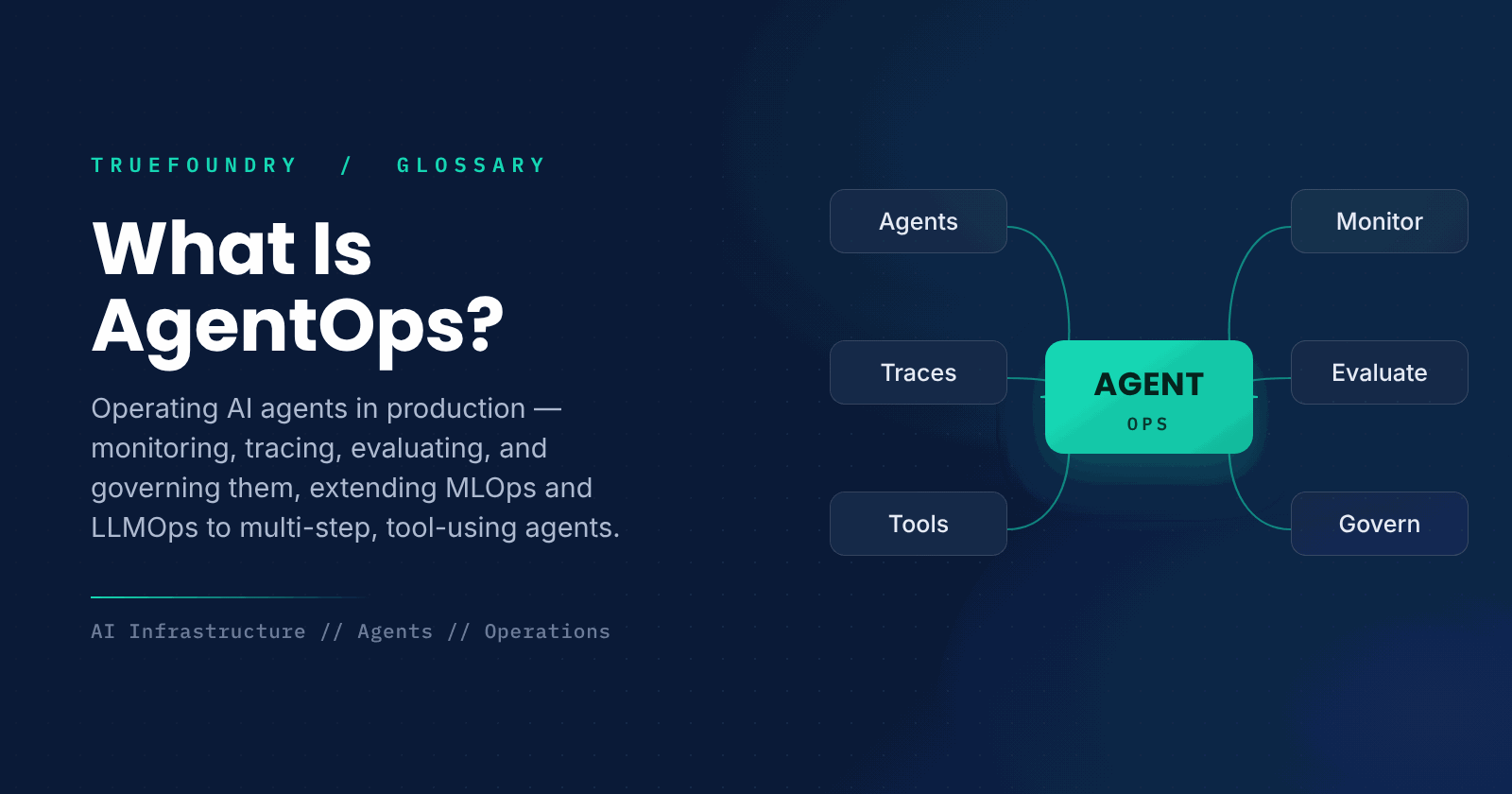
Building an agent that works in a demo is one thing; running it reliably in production is another. Agents reason over many steps, call tools, make decisions, and sometimes go wrong in ways that are hard to see. Operating them, knowing what they did, why, at what cost, and whether it was correct, is its own discipline. That discipline is AgentOps.
AgentOps extends the ideas of MLOps and LLMOps to the particular demands of agents. Where a single model call is relatively simple to monitor, an agent's run is a branching sequence of reasoning and actions that needs tracing, evaluation, cost control, and guardrails to run dependably at scale.
This guide explains what AgentOps is, how it works, how it differs from MLOps and LLMOps, and why it matters.
What is AgentOps?
AgentOps is the set of practices and tools for deploying, monitoring, debugging, evaluating, and governing AI agents in production. It gives teams visibility into what an agent did at each step, the ability to measure whether it is doing its job well, and the controls to keep its cost, behavior, and safety in bounds.
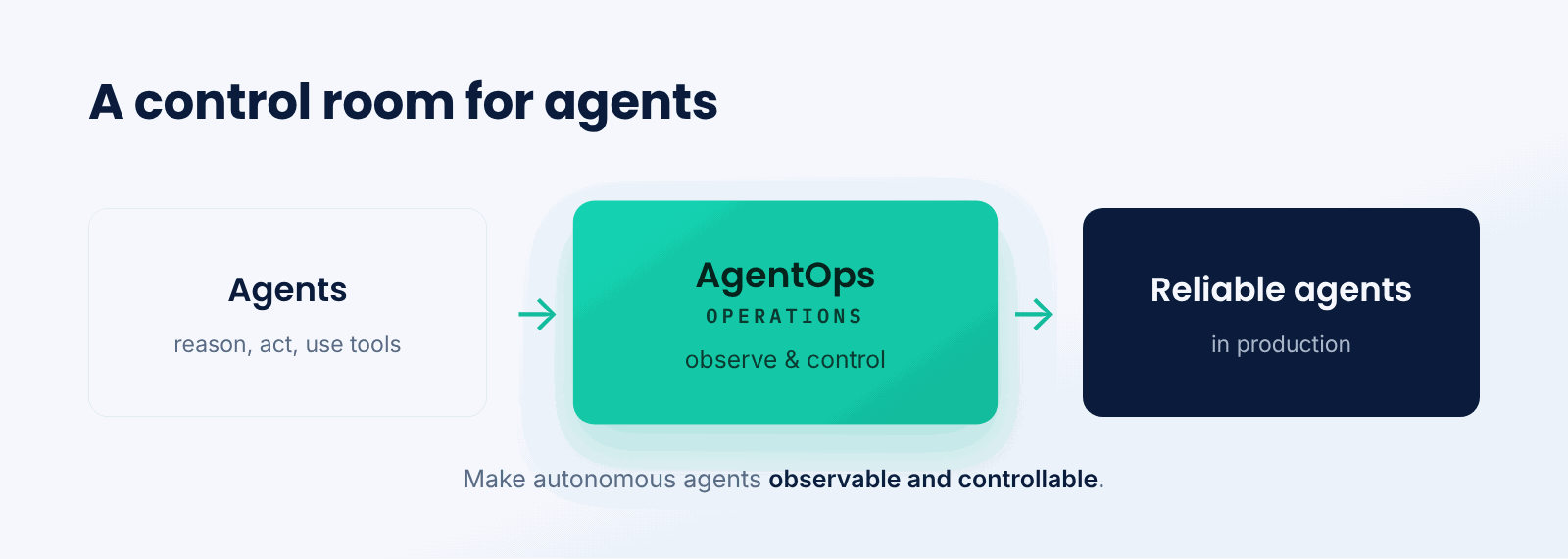
Think of running a fleet of autonomous workers rather than a single tool. You need to see what each one is doing, catch when one goes off track, measure their performance, and set rules they must follow. AgentOps is the control room for a fleet of AI agents, turning unpredictable autonomy into something you can operate.
The key point is operability. An agent is only useful in production if you can observe it, trust it, and control it, and AgentOps is what provides that.
How does AgentOps work?
AgentOps wraps an agent in observation, evaluation, and control across its lifecycle.
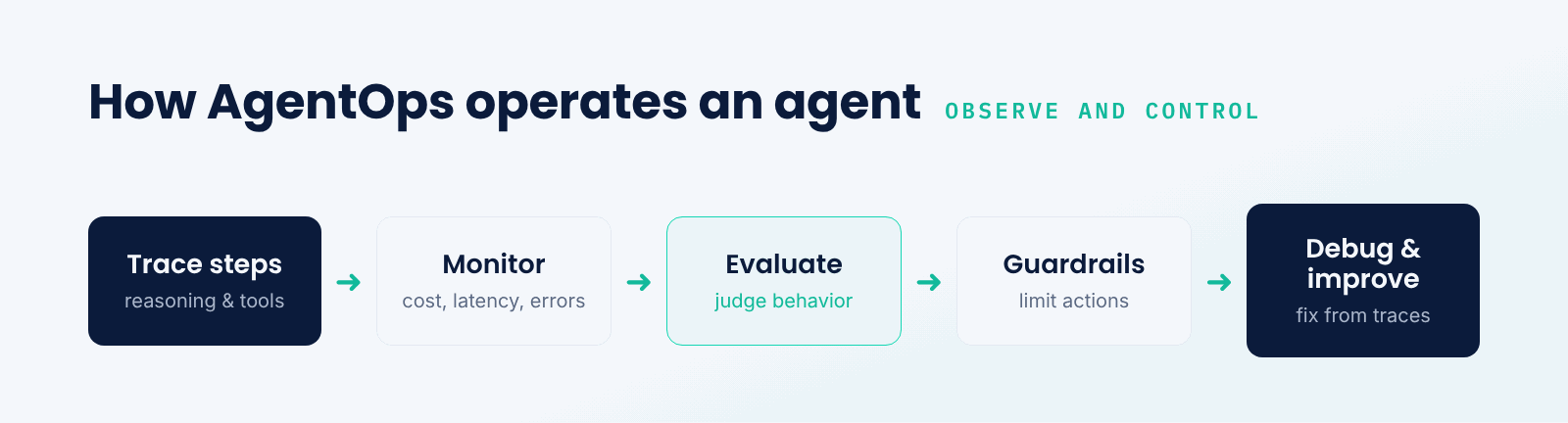
- Trace every step. Each reasoning step, tool call, and decision an agent makes is recorded.
- Monitor in production. Latency, cost, errors, and tool usage are tracked as the agent runs.
- Evaluate behavior. The agent's outputs and actions are judged against what good looks like.
- Apply guardrails. Rules and limits constrain what the agent is allowed to do and spend.
- Debug and improve. Traces and evaluations reveal failures, which feed fixes to prompts, tools, or logic.
The through-line is the trace. Because an agent's behavior is a multi-step path, being able to replay exactly what it did, and why, is what makes debugging and improvement possible rather than guesswork.
AgentOps vs. MLOps and LLMOps
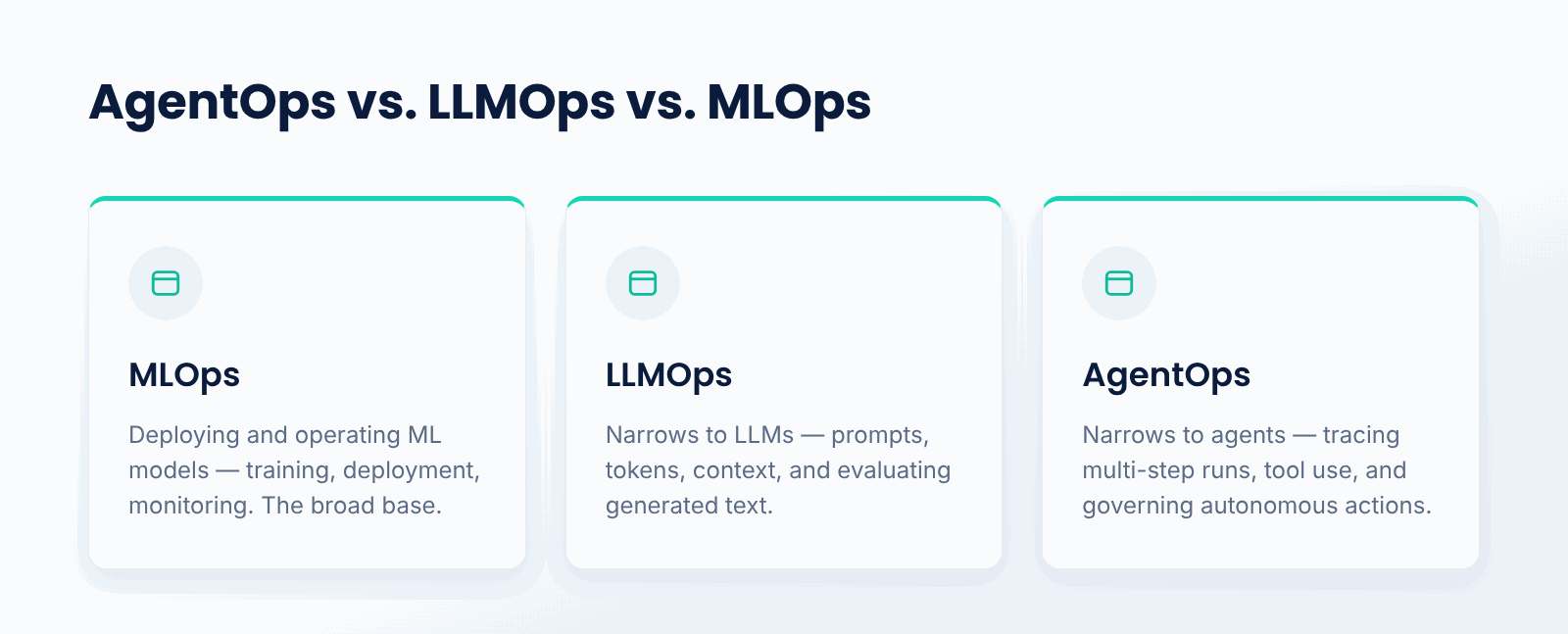
These are layers of the same lineage. MLOps is the broad practice of deploying and operating machine learning models in production, covering training, deployment, and monitoring. LLMOps narrows that to the specifics of large language models: prompts, tokens, context, and evaluation of generated text. AgentOps narrows further to agents, adding the hard parts that come with multi-step reasoning, tool use, and autonomous actions, such as tracing an agent's whole run and governing what it can do.
In other words, each builds on the last. AgentOps assumes the model is served and the prompts are managed, and focuses on operating the autonomous behavior layered on top, which is where agents are hardest to run reliably.
Why does AgentOps matter?
- Visibility. Tracing shows exactly what an agent did and why, instead of a black box.
- Reliability. Monitoring and guardrails catch failures and keep behavior in bounds.
- Cost control. Agents can make many model calls, so tracking and capping spend is essential.
- Safety. Governance limits what actions an agent can take and what it can access.
- Improvement. Evaluations and traces turn failures into concrete fixes over time.
What are the challenges?
- Non-determinism. Agents can behave differently run to run, making issues hard to reproduce.
- Complex traces. A single run can span many steps and tool calls, which is a lot to follow.
- Evaluation is hard. Judging whether a multi-step agent did a good job is harder than scoring one answer.
- Runaway cost. Without limits, an agent loop can rack up many expensive calls quickly.
When do you need AgentOps?
You need it as soon as agents move from experiments into production, especially when they take real actions, run at scale, or must be trusted. Any agent that matters operationally needs tracing, monitoring, evaluation, and guardrails to run dependably.
For a throwaway prototype, lightweight logging may be enough. The need for full AgentOps grows with how much the agent is relied upon and how much it can do.
Best practices for AgentOps
- Trace every reasoning step and tool call so runs can be replayed and debugged.
- Monitor cost, latency, and errors continuously, and alert on anomalies.
- Set guardrails and limits on what an agent can do and spend.
- Evaluate agents against real tasks regularly, not just at launch.
- Cap loops and tool calls so a stuck agent cannot run away in cost.
- Centralize observability and control behind a gateway across all your agents.
Conclusion
AgentOps is the discipline of operating AI agents in production, covering the tracing, monitoring, evaluation, and governance that multi-step, tool-using agents demand. It extends MLOps and LLMOps to the harder problem of autonomous behavior, where a trace of what the agent did is central to debugging and improving it. As agents take on real work, AgentOps is what makes them dependable rather than unpredictable.
TrueFoundry's AI Gateway gives teams observability, cost control, and governance over the models and tools their agents use, all in one layer. As organizations move agents into production, operating them through a governed gateway is how they keep autonomy observable, affordable, and safe.
Steuern, implementieren und verfolgen Sie KI in Ihrer eigenen Infrastruktur
Frequently Asked Questions
What is AgentOps in simple terms?
This is the process of deploying AI agents to run reliably in production, observing their actions, debugging them, measuring their performance, and controlling their cost and behavior. It is operations for autonomous agents.
How is AgentOps different from LLMOps?
LLMOps includes the operations involved in handling large language models, such as prompts, tokens, context, and evaluating the output generated. AgentOps adds the difficult aspects of agents, like tracing multi-step runs, tool use, and governing autonomous actions. AgentOps builds on top of LLMOps.
Why is operating agents harder than single model calls?
Because an agent's run is a branching tree of reasoning and actions, rather than a single call, it may behave differently each attempt, make many tool calls, and fail in unexpected ways, which makes tracing, assessment, and cost control difficult.
Why is tracing important in AgentOps?
Because an agent's behavior is composed of several steps, only by replaying exactly what it did and the reasoning behind it can you find and fix its errors. Without traces, an agent is a closed system that is difficult to understand and repair.
When do I need AgentOps?
Once agents make the transition from prototypes to actual production, especially if they take real actions, run at scale, or must be trusted. That is when tracing, monitoring, evaluation, and guardrails become necessary for reliable execution.

GenAI infra- einfach, schneller, günstiger
Top-Teams vertrauen uns bei der Skalierung von GenAI

- © 2022 ENSEMBLE Technologies



Abonnieren Sie unseren Newsletter
Die neuesten Nachrichten, Artikel und Ressourcen werden in Ihren Posteingang gesendet


