


.webp)
October 21, 2026
|
5 min read


Blazingly fast way to build, track and deploy your models!
If you have been playing with Anthropic’s Model Context Protocol (MCP), you have likely hit the "localhost wall."
You clone a repository, run npx @modelcontextprotocol/server-postgres, connect it to Claude Desktop, and it feels like magic. Your LLM can suddenly talk to your database. But the moment you try to take that architecture into production -- where you have fifty agents, twenty data sources, and strict IAM roles -- the "magic" turns into a distributed systems nightmare.
You don't just need a protocol. You need a phonebook. You need a broker that knows where every tool lives, who is allowed to call it, and if it's currently healthy.
In the industry, this concept is solidifying as the MCP Registry.
At TrueFoundry, we don't just treat the registry as a static list of URLs. We implement it as an active, routing infrastructure layer using what we call Virtual MCP Servers. Here is a deep dive into why the registry is the most critical component you are probably ignoring.
Without a central registry, the topology of an agentic system is a mess.
Let’s say you have three Agents (Support, Sales, DevOps) and three Tools (Jira, Salesforce, AWS). If you connect them directly, you have to hardcode the endpoints and authentication for every tool into every agent's configuration.
If the DevOps team moves the Jira tool to a new cluster, every single agent breaks. If you rotate the API key for Salesforce, you have to redeploy every agent.
The MCP Registry solves this by decoupling the consumer (the Agent) from the provider (the Tool). The Agent connects to the Registry, and the Registry routes the request to the right tool.
Here is the difference in topology.
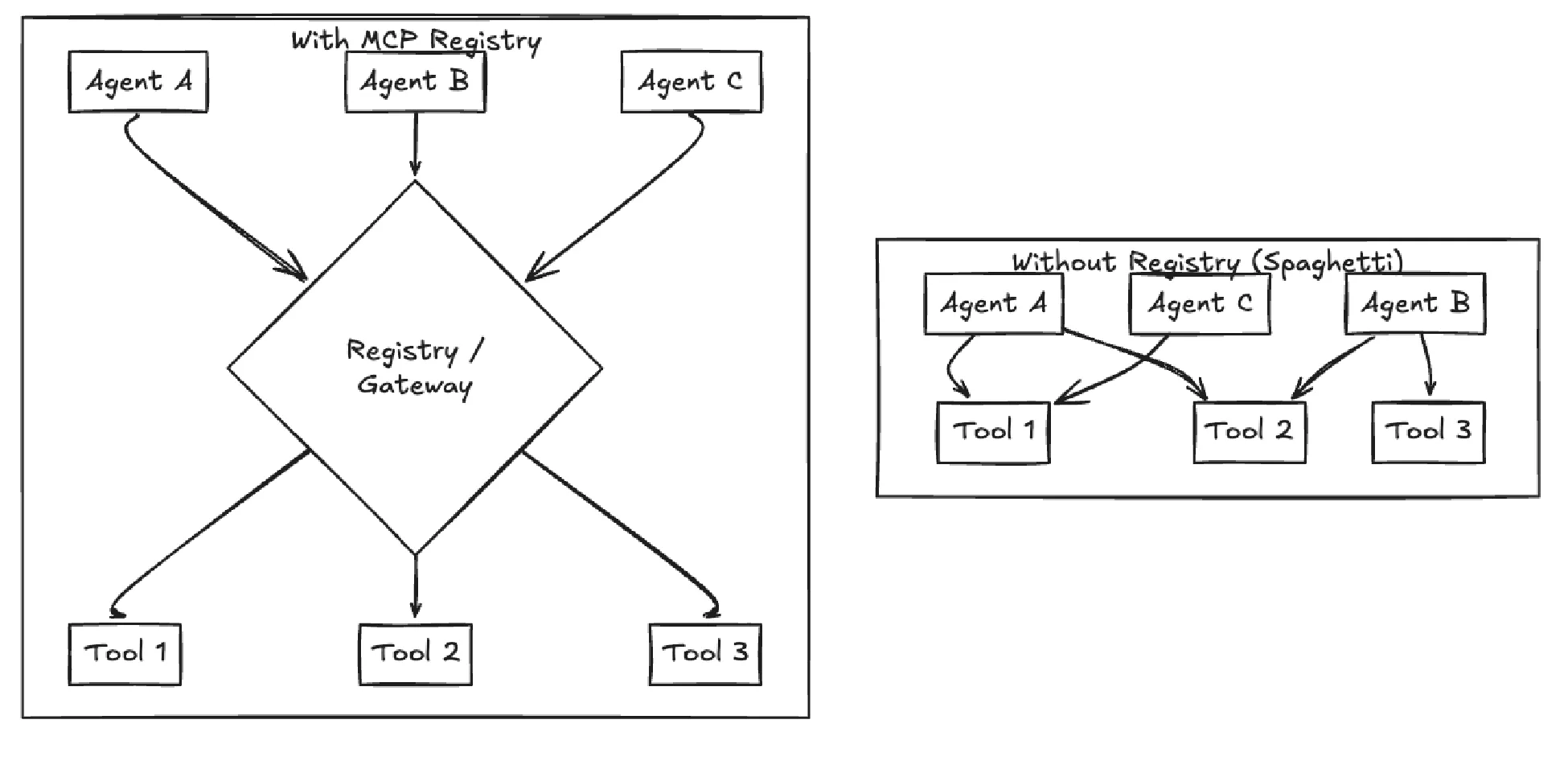
Fig 1: Workflow of Direct Connections vs. Registry Topology
We implemented the registry pattern using a feature called the Virtual MCP Server.This effectively turns the Gateway into a unified MCP registry and ai gateway, combining discovery, security, and runtime routing into a single control plane for agentic systems.
Instead of building a separate "catalog" database that agents have to query, we built the registry directly into the network path. The TrueFoundry AI Gateway acts as a "Virtual" MCP server that sits in front of your actual backend services.
As explained in the TrueFoundry documentation on Virtual MCP Servers:
"A Virtual MCP Server aggregates multiple MCP Servers into a single MCP Server. This allows an MCP Client to connect to a single endpoint and access tools/prompts/resources from multiple MCP Servers."
This is a subtle but massive shift. To your Agent, the Gateway looks like one giant MCP server with infinite capabilities. Behind the scenes, the Gateway is routing traffic to a postgres-mcp pod in Cluster A and a slack-mcp pod in Cluster B.
A proper registry does more than just list tools. It manages the lifecycle of the interaction.
When an agent connects to the TrueFoundry Gateway, it doesn't need to know what tools exist beforehand. The connection uses Server-Sent Events (SSE). Upon handshake, the Gateway inspects the Agent’s identity and dynamically constructs a list of tools it is allowed to see.
If you deploy a new Vector Search Tool tomorrow, you just add it to the Gateway config. The next time the Agent connects, the new tool is automatically available. No code changes required on the Agent side.
This is the part that keeps InfoSec happy. If you run raw MCP, your agent needs the database credentials. That is a security non-starter.
With a registry-based approach, we leverage Gateway Auth & Security. The Agent only holds a TrueFoundry API Key. The Gateway holds the secrets for the actual downstream services.
"The Gateway validates the client's API key... and then proxies the request to the backend MCP server using secure headers."
Because every tool call flows through the Registry (the Gateway), you get a centralized audit log. You can see exactly which agent called the delete_user tool and when. You can also enforce rate limits so a runaway loop in an agent doesn't crash your production database.
Table 1: This is the Comparison of Registry Types
The beauty of this abstraction is how clean the client code becomes. You stop worrying about infrastructure.
As detailed in the guide on using the MCP Gateway in an Agent, you simply point your MCP client to the virtual endpoint.
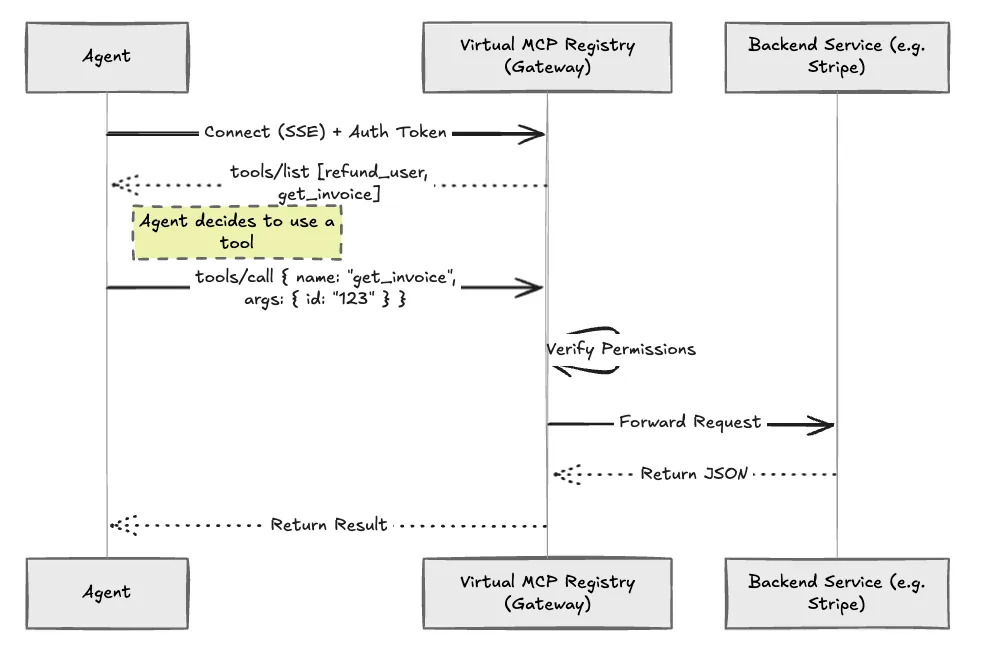
We are moving past the "chatbot" phase of AI and into the "agentic" phase. In practice, this means LLM agents now depend on infrastructure layers like MCP registries to discover tools, enforce permissions, and execute reliably across environments. In this new world, your internal APIs are the most valuable assets you have.
Exposing them safely to LLMs is an infrastructure problem, not a modeling problem. This is one reason MCP vs RAG matters when designing enterprise agent workflows.
By treating the MCP Registry as a core piece of infrastructure -- managed via TrueFoundry’s Virtual MCP Servers -- we gain the ability to treat tools like microservices. We can deploy, scale, secure, and deprecate them without breaking the agents that depend on them.
It turns a spaghetti mess of Python scripts into a composable enterprise architecture.
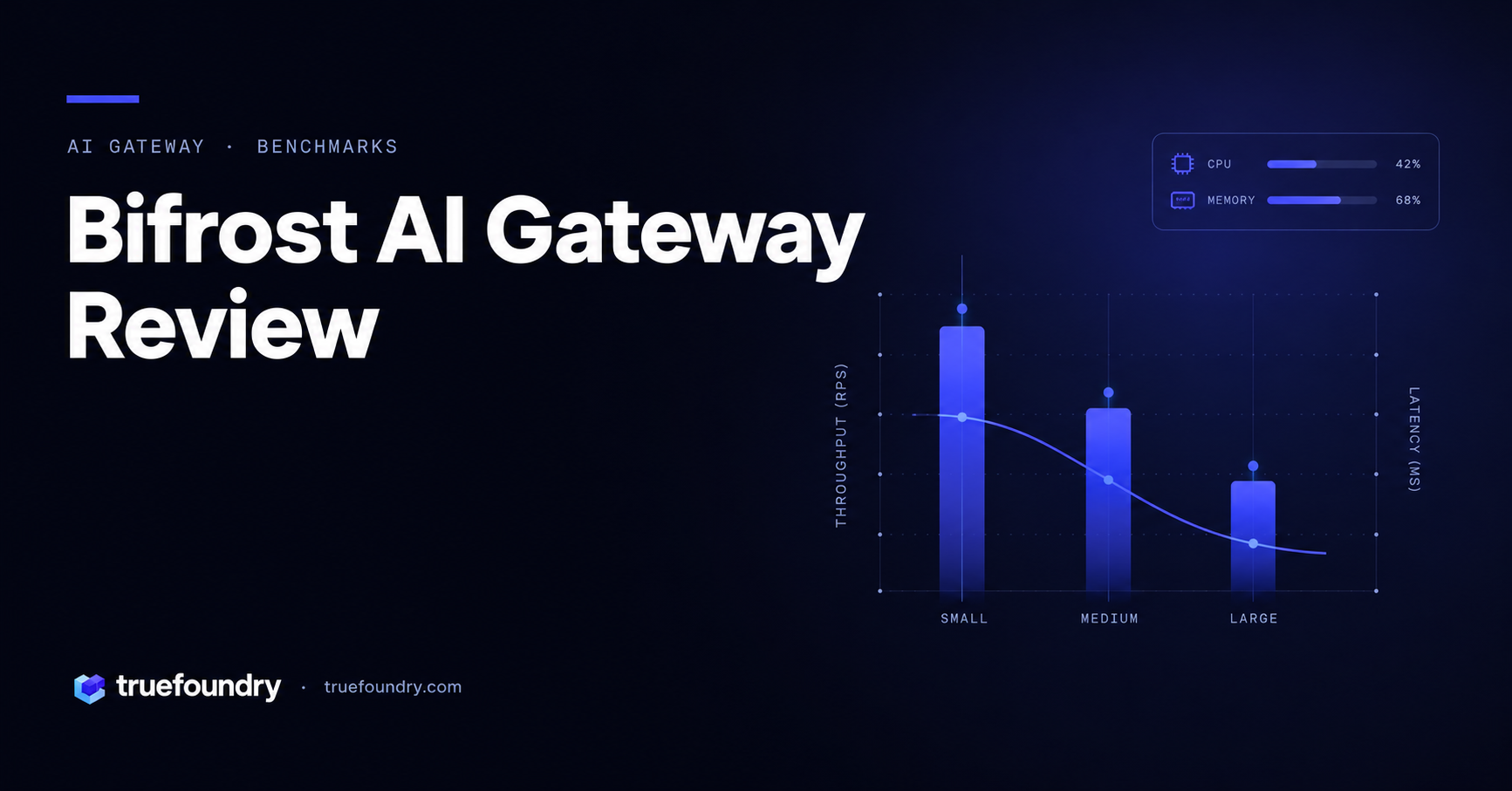
TrueFoundry AI Gateway delivers ~3–4 ms latency, handles 350+ RPS on 1 vCPU, scales horizontally with ease, and is production-ready, while LiteLLM suffers from high latency, struggles beyond moderate RPS, lacks built-in scaling, and is best for light or prototype workloads.






The latest news, articles, and resources sent to your inbox


.png)
.png)
.png)
.png)
.png)
.png)
.png)
.png)
.png)
.png)
.png)


