


September 22, 2026
|
5 min read


Published: September 14, 2026

Blazingly fast way to build, track and deploy your models!
On April 30th, when Palo Alto Networks announced its intention to acquire Portkey, I had two reactions.
The first was genuine: congratulations to the Portkey team. They moved fast, built with conviction, and earned this outcome. We've competed directly with them in the AI Gateway space and seen them grow from a clean LLM observability tool into a full platform. That kind of trajectory in this short a window doesn't happen without sharp product instincts and relentless execution. Well deserved.
The second reaction was more strategic: this is the clearest signal yet that AI Gateways have graduated from "interesting infrastructure experiment" to "category-defining enterprise requirement." And if you're a software engineering leader or platform team who doesn't have an AI Gateway strategy today, this acquisition is your wake-up call.
We've been building in the AI Gateway space for a while now, and the honest truth is that for a long time, we had to explain what an AI Gateway even was. Not anymore.
Gartner first identified AI Gateways as an emerging category in 2024. They published the Market Guide and Innovation Insight in 2025. And in 2026, they're publishing their first Magic Quadrant for AI Gateways — formally establishing it as a major enterprise requirement. That's two years from "watch this space" to a full Magic Quadrant. I've been in infrastructure long enough to know that this is an extraordinarily fast graduation for a core infra category.
The Palo Alto acquisition is particularly telling. When one of the world's largest cybersecurity platforms makes a bet like this, it's not a hedge. It's a statement. AI Gateways, the control layer between your teams and every model, agent, and AI API they interact with, are now considered essential infrastructure.
Just as API gateways became non-negotiable for managing microservices, AI Gateways are becoming the control plane for every model, agent, and AI workflow running in your organization. The category is real. The urgency is real.
I discussed this at length in a recent podcast episode with Tesseract Talks.
Palo Alto is a security company. That's their core thesis, their platform strategy, and the lens through which they'll orient Portkey going forward. And that's fine, it's logical for them.
But it's not the whole picture, and this is where I want to be direct with AI engineering and platform leaders evaluating their own AI infrastructure strategy.
AI Gateways are not just a security tool.
They are cross-cutting middleware that every team in your organization touches for entirely different reasons:
Gartner's latest research puts this clearly: AI gateways sit at the crossroads of multiple teams, with each viewing them through a different functional lens. API teams see them as extended API gateways. AI engineers see them as model routers. Finance sees them as cost controls. Every lens is valid and that breadth is precisely why an AI Gateway embedded inside a security platform will always be shaped by that platform's priorities, not yours.
Gartner's own recommendation on the Portkey acquisition is worth quoting directly:
"Organizations must manage their AI gateway strategy independent of the AI gateways embedded within larger platforms, due to the likely limitations of embedded AI gateways." — Gartner First Take: Palo Alto Network’s Portkey Deal Signals the Importance of AI Gateways
(1 May 2026)
This isn't a knock on Palo Alto Networks or Portkey. It's a structural reality of how platform consolidation works. When a security vendor acquires an infrastructure tool, that tool gets optimized for the security use case. That may cover part of what you need. It won't cover all of it.
There's a deeper point underneath all of this that I think gets lost in the acquisition headline: who owns your AI control plane?
As AI traffic scales across your organization (inbound prompts, outbound model calls, agent-to-agent workflows, MCP interactions) you will not have a single chokepoint where one gateway can sit. This isn't a theoretical future state. It's already true for most organizations building seriously with AI today. You need a distributed AI Gateway architecture managed by a unified control plane.
And that control plane must be owned by your platform team, not buried inside your LLM provider, and definitely not embedded inside your security vendor.
The parallel I keep coming back to is what happened with API gateways. Early on, teams let API gateway capabilities get absorbed into adjacent platforms: load balancers, service meshes, cloud providers. And then they spent years untangling that, because the embedded gateway was always optimized for the host platform's priorities, not the developer platform team's. AI Gateways are at exactly that inflection point right now.
Gartner's recommendation is to adopt a federated AI gateway approach with a centralized control plane — one that gives you consistent standards and governance across the organization, independently of any single vendor.
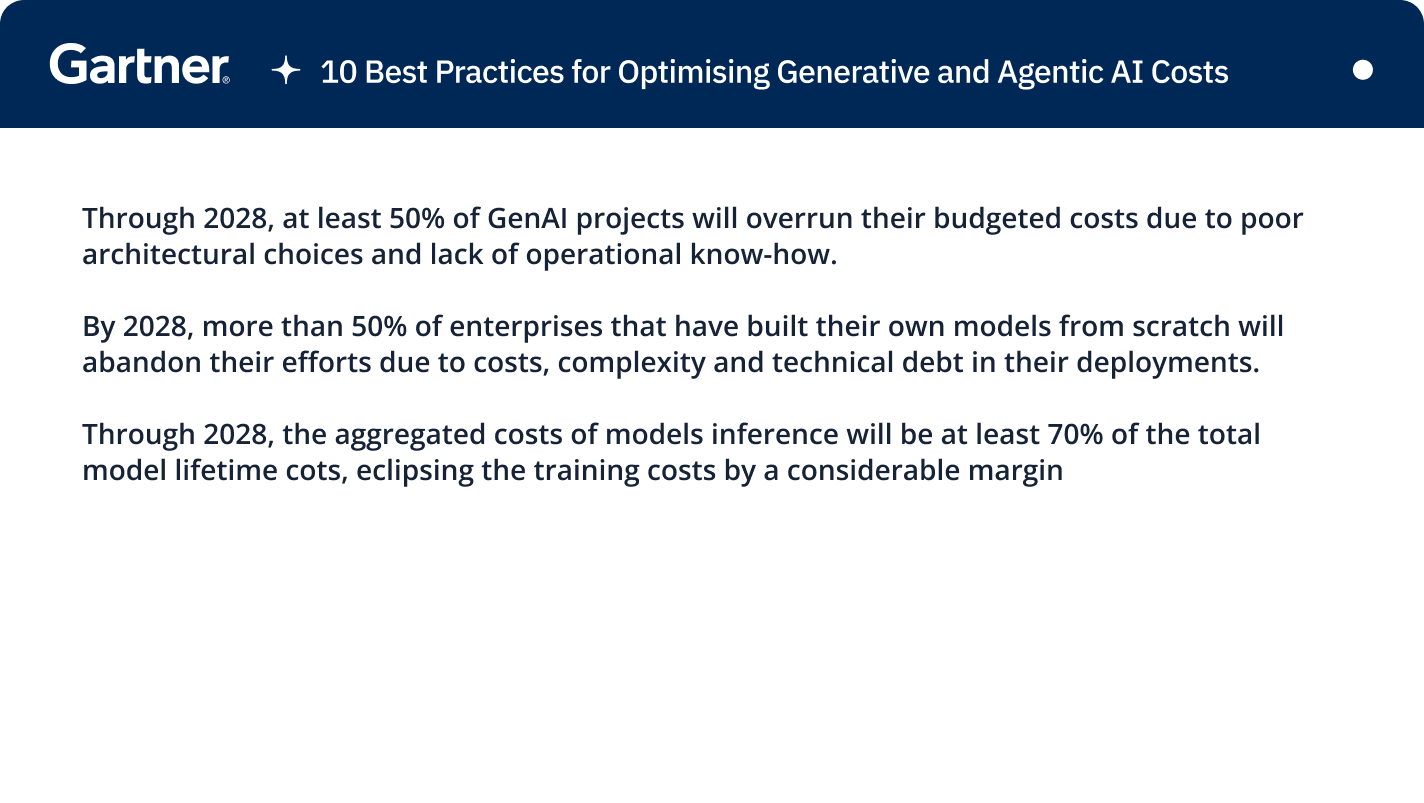
If you’d like to read more on Gartner’s research on AI Gateways, we’re offering complimentary access to its 2026 10 Best Practices for Optimizing Generative & Agentic AI Costs report.
We've been building in this space because we believe deeply that platform teams deserve a control plane for AI that is genuinely theirs. Not something inherited from a security platform. Not something that lives inside a hyperscaler's managed offering. A unified AI Gateway that gives engineering teams full visibility and control over every AI interaction, across models, agents, and teams, that they can run and govern on their own terms.
TrueFoundry is listed as a specialist AI Gateway vendor in multiple Gartner reports, and we've watched this category mature from the inside. The Palo Alto acquisition validates everything we've believed about where it was heading.
The category is here. The Magic Quadrant is coming. The question now is who owns it inside your organization.
If you don't have an AI Gateway strategy, start now.
When you evaluate options, don't just evaluate for today's use case (which, for most teams, starts with security and observability). Evaluate for the full cross-cutting surface: cost management, model routing, governance, integration, reliability. An AI Gateway that only covers one of those will leave you rebuilding the strategy in 18 months.
And most importantly: own your control plane. It should be centrally governed by your platform team, independent of the vendors whose tools pass through it.
The category just got a very loud validation. Make sure your strategy is broader than any single platform can give you.
TrueFoundry AI Gateway delivers ~3–4 ms latency, handles 350+ RPS on 1 vCPU, scales horizontally with ease, and is production-ready, while LiteLLM suffers from high latency, struggles beyond moderate RPS, lacks built-in scaling, and is best for light or prototype workloads.






The latest news, articles, and resources sent to your inbox
.png)
.png)
.png)
.png)
.png)
.png)


