October 19, 2026
|
5 min read


Obtenha acesso instantâneo a um ambiente TrueFoundry ao vivo. Implante modelos, direcione o tráfego de LLM e explore a plataforma completa — seu sandbox estará pronto em segundos, sem necessidade de cartão de crédito.



Published: October 19, 2026
Blazingly fast way to build, track and deploy your models!
TrueFoundry AI Gateway delivers ~3–4 ms latency, handles 350+ RPS on 1 vCPU, scales horizontally with ease, and is production-ready, while LiteLLM suffers from high latency, struggles beyond moderate RPS, lacks built-in scaling, and is best for light or prototype workloads.

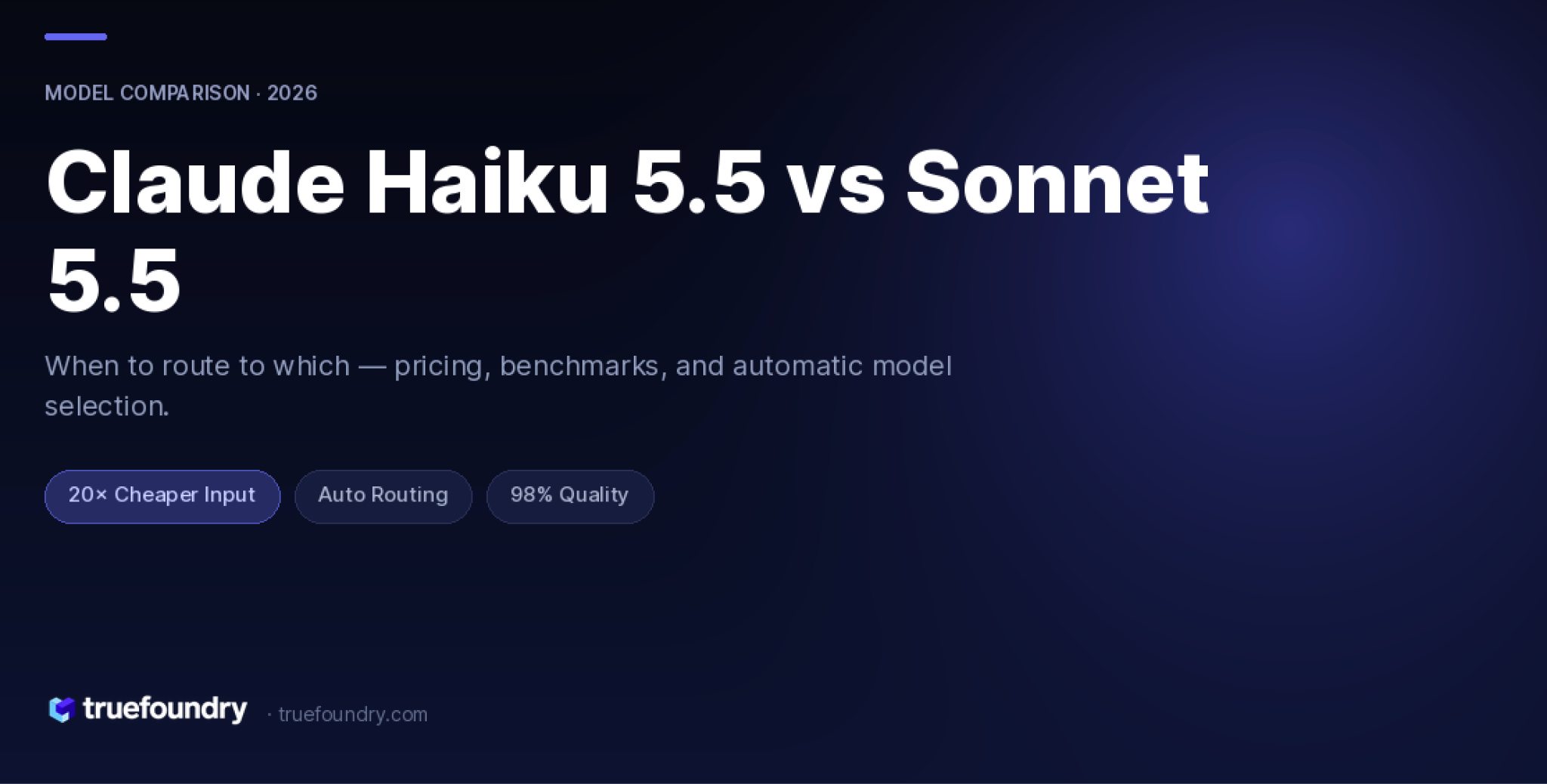
They are Claude tiers trading capability for price. Haiku 5.5 is the fastest and cheapest for high-volume tasks; Sonnet 5.5 balances speed and intelligence; Opus 5.5 is the recommended default for most workloads. Fable 5.1 sits above them for the most demanding reasoning. All share a 1M-token context window.
Haiku 5.5, starting around $0.10 input / $0.50 output per million tokens as of October 2026. Fable 5.1 is the most expensive at $10 / $50. Confirm current rates on Anthropic’s pricing page.
Usually not — most requests don’t need it, and the price spread from Haiku to Fable is roughly 100x. Route easy, high-volume work to cheaper tiers and reserve the top tiers for hard tasks.
Point the app at a logical model name backed by a tier, or use a gateway’s automatic routing to score each request and pick a tier. The application calls one endpoint; the routing lives in configuration.
Not here — all four tiers share the same 1M-token window. Choose on reasoning depth and latency, not context size.



As últimas notícias, artigos e recursos enviados para sua caixa de entrada