


Accédez instantanément à un environnement TrueFoundry en direct. Déployez des modèles, acheminez le trafic LLM et explorez la plateforme complète : votre sandbox est prête en quelques secondes, aucune carte de crédit n'est requise.


What is AI automation, and why is it used?

.webp)
In modern AI systems, especially those powered by large language models, data is no longer just stored as rows, columns, or simple text records. Instead, machines now need a way to understand meaning, not just exact keywords. This is where vector databases come in.
Vector databases are becoming a core part of how AI applications search, retrieve, and reason over information. If you’ve ever used semantic search, recommendation systems, or AI assistants that “understand” your query, you’ve already seen them in action.
In this guide, you’ll understand what vector databases are, how they work, and why they matter in the age of AI.
H2: What are Vector databases?
Alt text: vector database meaning
A vector database is a type of database that stores and searches data in the form of vectors, mathematical representations of information.
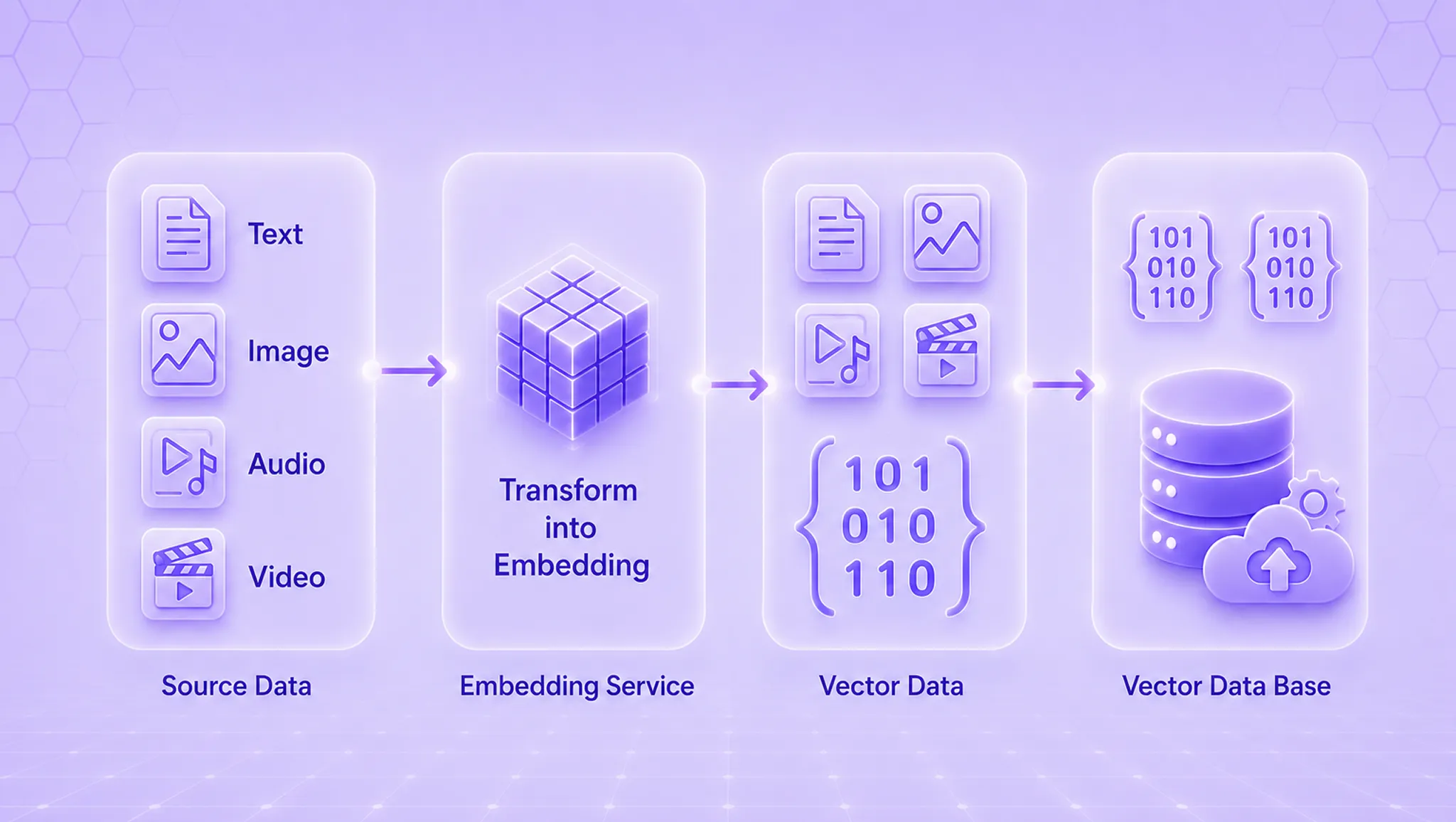
Instead of storing data only as text or numbers, it converts content into high-dimensional vectors (also called embeddings). These vectors capture the meaning of the data, not just the words themselves.
In simple terms, a vector database helps machines understand similarity between pieces of information, even if they don’t match exactly in words.
For example:
- “How to fix a slow laptop”
- “Why is my computer running slowly?”
These sentences are different in wording but similar in meaning. A vector database can recognize that similarity and return relevant results
H2: How does a Vector database work?
A vector database works by converting data into embeddings, storing them in a structured index, and then retrieving the most similar results when a query is made. Instead of matching keywords, it finds meaning-based similarity between data points.
At a high level, the process looks like this:
- An embedding model converts data such as text, images, or audio into numerical vectors.
- These vectors are stored in the database along with metadata or references to the original content.
- A user query is also converted into a vector using the same or a compatible model.
- The system compares the query vector with stored vectors to find the closest matches.
- Optional filtering and reranking steps refine results before they are returned.
To understand this more clearly, it helps to look at the core mechanisms behind vector search
Nearest Neighbor Search (KNN)
Nearest Neighbor Search, or KNN, is the core idea behind vector retrieval. It works by comparing the query vector with all stored vectors and identifying the closest matches based on distance or similarity.
These distances are calculated using methods like cosine similarity, Euclidean distance, or dot product. While KNN is highly accurate because it evaluates every possible comparison, it becomes slow and resource-intensive as datasets grow larger.
Approximate Nearest Neighbors (ANN)
To make vector search scalable, most systems use Approximate Nearest Neighbor (ANN) methods instead of full KNN. ANN reduces computation by narrowing the search space and focusing only on likely matches, rather than checking every vector in the database.
This makes the process much faster while still maintaining high relevance. Although it slightly reduces precision compared to exact search, the speed benefits make it ideal for real-time applications.
Vector Indexing
Vector indexing is the structure that allows efficient search across large volumes of embeddings. Instead of scanning every vector, the index organizes data in a way that makes retrieval faster and more scalable.
Different systems use techniques like graph-based structures, clustering, or partitioning to achieve this. Indexing helps reduce latency, control compute costs, and ensure that similarity search works effectively even at massive scale.
Metadata Filtering
Metadata filtering adds business context to vector search by restricting results based on additional attributes attached to each vector. These attributes can include category, language, user ID, date, or location.
For example, a system may find products similar to a query image but only return items that are in stock, within a certain price range, or available in a specific region. This combination of semantic search and filtering makes results more precise and useful in real-world applications.
H2: What are the use cases for vector databases?
Vector databases are used in AI systems where understanding meaning and similarity is more important than exact keyword matching.
Retrieval-augmented generation (RAG)
Vector databases are a key part of Retrieval-augmented generation (RAG) systems, where they help large language models retrieve relevant external information before generating answers.
Instead of relying only on trained data, the model searches a vector database for semantically similar documents and uses that context to produce more accurate and grounded responses. This improves factual reliability and reduces hallucinations in AI outputs.
Real-time recommendation engines
In recommendation systems, vector databases match users with relevant items by comparing embeddings that represent user behavior and item features. This allows platforms to suggest products, videos, or content that are semantically similar to user interests.
Because retrieval happens quickly at scale, it enables real-time personalization in e-commerce, streaming platforms, and social media feeds.
Semantic and multimodal search
Vector databases enable search systems that understand meaning rather than relying on exact keywords. In semantic search, a query like “affordable laptop for students” can return relevant results even if those exact words are not present.
In multimodal search, the same embedding space allows text, images, audio, and video to be searched together, creating more flexible and intelligent search experiences.
Anomaly and fraud detection
Vector databases are used to identify unusual patterns by comparing new data points with historical behavior stored as embeddings. When a transaction, login attempt, or system event is significantly different from normal patterns, it can be flagged as suspicious.
This makes vector-based systems useful in fraud detection, cybersecurity monitoring, and operational risk analysis.
Entity resolution and data deduplication
Organizations often face duplicate or inconsistent data across multiple systems. Vector databases help resolve this by identifying semantically similar records even when they are written differently.
For example, variations like “Google LLC” and “Google Inc.” can be matched as the same entity. This improves data consistency, reduces redundancy, and strengthens overall data quality across systems.
Also read: What is the Semantic Layer And How Does It Work?
H2: What’s the difference between a vector index and a vector database?
A vector index is the search mechanism. A vector database is the full system around that mechanism.
A vector index is mainly responsible for organising embeddings so nearest-neighbour search can run quickly. It focuses on search speed and similarity retrieval. Tools like FAISS are often used for this purpose. However, a vector index by itself usually does not provide everything needed for a production application.
A vector database includes the vector index, but also adds broader database capabilities. These often include persistent storage, CRUD operations, metadata filtering, replication, access control, monitoring, APIs, SDKs, and scaling features. In other words, the vector index is a core component, while the vector database is the operational platform that makes vector search practical in real-world systems.
So, if you only need raw similarity search in a controlled environment, a vector index might be enough. If you need reliability, filtering, updates, security, and scale, a vector database is usually the better choice.
H2: Vector databases vs. graph databases
Alt text: Vector databases vs. graph databases
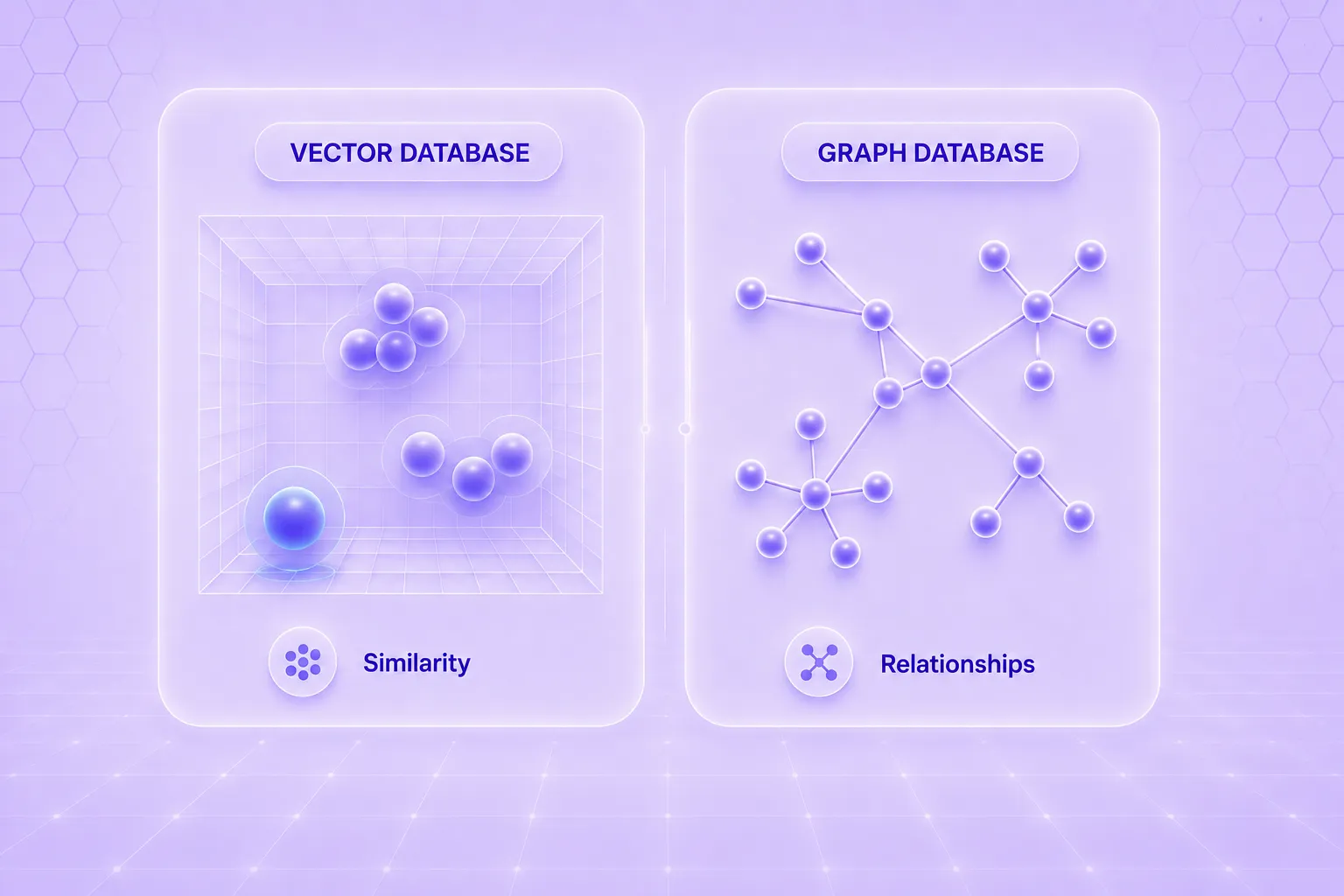
A vector database and a graph database solve different problems, even though both can model relationships.
A vector database is designed to find items that are similar in meaning or features by comparing embeddings in high-dimensional space. It is ideal for semantic search, recommendations, image similarity, and RAG applications. Its main strength is similarity retrieval.
A graph database, by contrast, is designed to represent and query explicit relationships between entities. It stores nodes and edges, making it well suited for connected data such as social networks, supply chains, fraud rings, knowledge graphs, or dependency mapping. Its main strength is traversing known relationships.
The difference is important: vector databases uncover implicit similarity, while graph databases model explicit connections.
In practice, they can even work together. For example, a system might use a vector database to retrieve semantically similar documents and a graph database to explore how those documents, people, or entities are connected.
Also read: What Is Risk Mitigation?
H2: What are the advantages of using a vector database?
The key advantages of using a vector database come from its ability to understand meaning, scale efficiently, and support modern AI-driven applications.
- Semantic search at scale by retrieving results based on meaning and context rather than exact keyword matches, making search far more intelligent and relevant.
- Fast similarity retrieval across large, high-dimensional datasets using optimized indexing and nearest-neighbor search techniques.
- Support for unstructured data such as text, images, audio, and video by converting them into embeddings that capture their underlying meaning.
- Improved AI application performance in use cases like retrieval-augmented generation (RAG), recommendation systems, semantic search, and classification tasks.
- Metadata filtering capabilities that allow results to be refined using business rules such as category, location, user type, or availability.
- Real-time or near real-time updates in many production systems, enabling fresh data to be indexed and queried quickly.
- Operational features for production use, including scalability, security controls, monitoring, replication, and API support.
- High scalability to handle continuously growing datasets and increasing query loads without significant performance loss.
- Better user experience by delivering more relevant, personalized, and context-aware results in search and recommendation systems.
- Multimodal capabilities that allow applications to work across different data types like text, images, and audio within a unified search system.
H2: Conclusion
Vector databases are specialised systems designed to store and search embeddings efficiently, enabling retrieval based on similarity, context, and meaning rather than exact matches.
This makes them a key part of modern AI infrastructure, powering use cases like RAG-based chatbots, recommendation systems, semantic search, and fraud detection.
In simple terms, traditional databases find exact matches, while vector databases find the most meaningful ones. As AI applications expand, they are becoming a foundational technology rather than a niche tool.
H2: FAQ
What are some examples of vector databases?
Some popular vector databases include Pinecone, Weaviate, Milvus, Chroma, and FAISS. These systems are designed to store embeddings and perform fast similarity search for AI applications like RAG, recommendation engines, and semantic search.
Is there a free vector database?
Yes, several vector databases are free and open-source, such as FAISS, Milvus, and Chroma. They can be used locally or in self-hosted environments, while some managed platforms also offer free tiers with limited usage.
Why would you use a vector database?
You use a vector database to find results based on meaning instead of exact keywords. It helps AI systems retrieve relevant information quickly, especially for unstructured data like text, images, audio, and large knowledge bases.
Is MongoDB a vector database?
MongoDB is not a native vector database, but it has added vector search capabilities. It can store embeddings and perform similarity search, though dedicated vector databases are typically more optimized for large-scale AI workloads.
Is MySQL a vector database?
No, MySQL is a traditional relational database and is not designed for vector search. However, embeddings can be stored in it, but it lacks efficient similarity search features compared to dedicated vector databases.
Gouvernez, déployez et suivez l'IA dans votre propre infrastructure

GenAI infra- simple, plus rapide et moins cher
Les meilleures équipes lui font confiance pour faire évoluer GenAI

- © 2022 ENSEMBLE Technologies



Abonnez-vous à notre newsletter
Les dernières nouvelles, articles et ressources envoyés dans votre boîte de réception


