


Accédez instantanément à un environnement TrueFoundry en direct. Déployez des modèles, acheminez le trafic LLM et explorez la plateforme complète : votre sandbox est prête en quelques secondes, aucune carte de crédit n'est requise.


What Is a Reasoning Model and How Does It Work?

.png)
Ask a standard language model a hard multi-step question and it often answers in a single breath, committing to the first path that comes to mind. Sometimes that works; on genuinely hard problems it frequently does not. Reasoning models take a different approach: before answering, they think, working through the problem in steps the way a careful person would.
This shift, spending extra compute at inference time to reason rather than answer immediately, has produced large jumps in accuracy on math, coding, and logic. It is one of the most important recent developments in how models are built and used.
This guide explains what a reasoning model is, how it works, how it differs from a standard model, and when the extra thinking is worth it.
What is a reasoning model?
A reasoning model is a language model trained to produce an explicit chain of thought, a sequence of intermediate steps, before committing to a final answer. Rather than mapping a question straight to a response, it generates reasoning tokens that explore the problem, check work, and build toward a solution, then produces a concise answer.
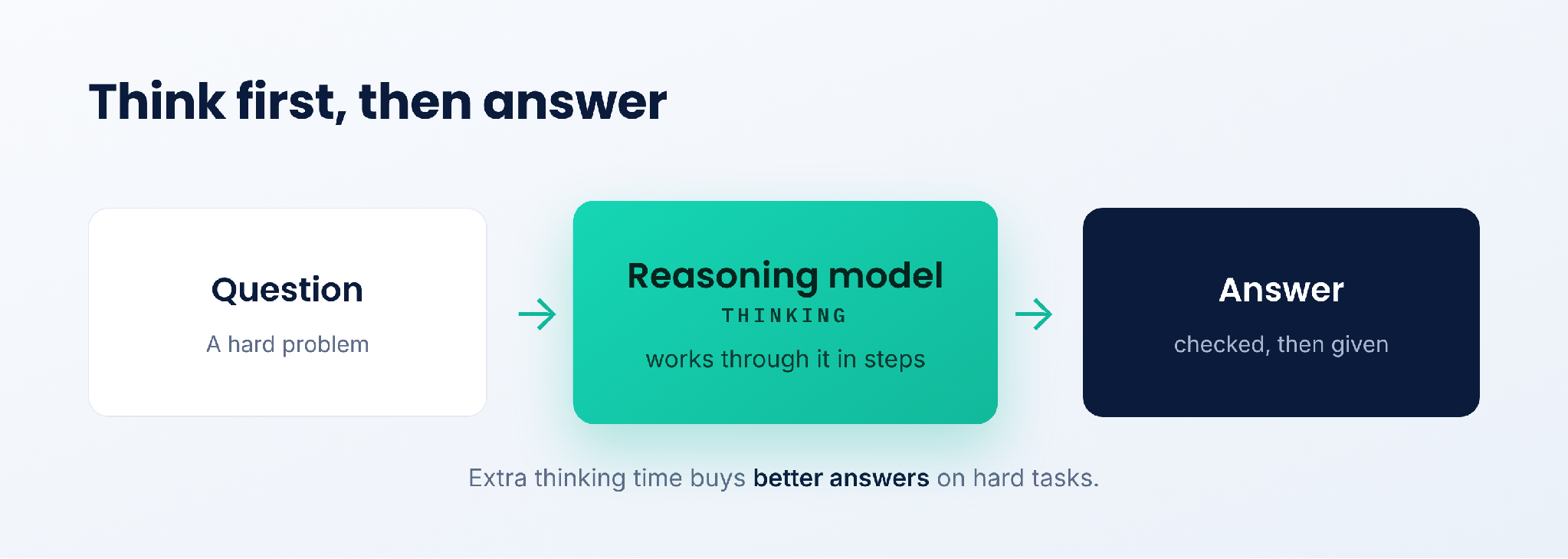
Think of two students taking a math test. One writes down the first answer that occurs to them. The other works the problem on scratch paper, checks each step, and only then writes the final answer. The second usually scores higher on hard questions. A reasoning model is the second student, and its chain of thought is the scratch paper.
The key idea is that thinking takes compute. A reasoning model deliberately spends more compute at inference, generating and weighing steps, in exchange for more reliable answers on problems that need it.
How does a reasoning model work?
A reasoning model is trained to reason, then given room to do so at inference time.
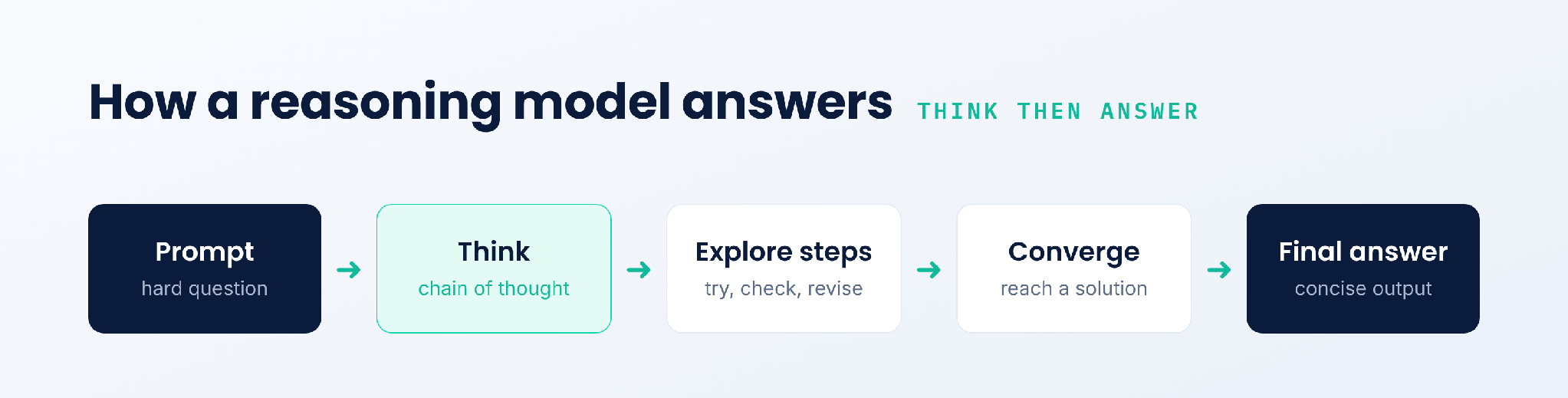
- Receive the problem. A question, often one needing several steps, arrives at the model.
- Generate a chain of thought. The model produces intermediate reasoning steps, working through the problem internally.
- Explore and check. It can try approaches, spot errors, and revise, rather than committing to the first path.
- Converge on a solution. The reasoning narrows toward an answer the model has effectively checked against its own steps.
- Return a final answer. It gives a concise response, with the long reasoning often hidden from the user.
Crucially, this ability is learned. Reinforcement learning rewards reasoning that reaches correct answers, so the model improves at thinking rather than merely imitating text that looks like reasoning. That training is what separates a true reasoning model from prompting a standard one to think out loud.
Reasoning models vs. standard models
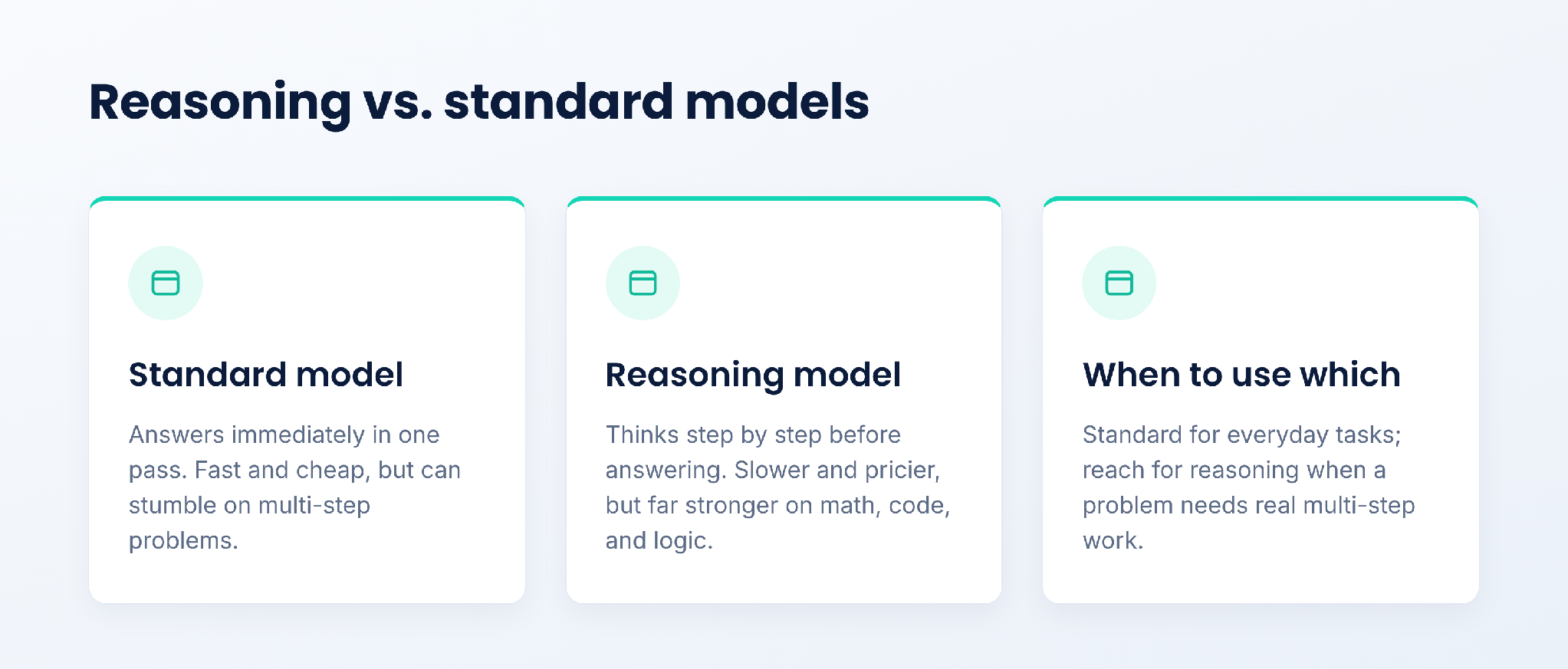
A standard model answers in a single forward pass, which is fast and cheap and perfectly good for most everyday tasks. A reasoning model spends extra tokens and time thinking before it answers, which makes it slower and more expensive but far more accurate on problems that require multiple steps, careful logic, or self-correction.
The practical rule is to match the model to the task. For summaries, chat, and simple questions, a standard model is the better value. For competition math, complex coding, scientific analysis, or tricky logic, the extra cost of a reasoning model usually pays for itself in correctness.
What are the benefits of reasoning models?
- Higher accuracy on hard tasks. Step-by-step work lifts performance on math, coding, and logic sharply.
- Self-correction. The model can catch and fix its own mistakes mid-reasoning instead of committing to them.
- Better on multi-step problems. Tasks that need a chain of deductions benefit most from explicit reasoning.
- More reliable structure. Working through steps tends to produce more consistent, well-organized answers.
- Tunable effort. Many reasoning models let you dial how much thinking to spend per request.
What are the limits and trade-offs?
- Higher latency. Generating reasoning tokens takes time, so responses are slower than a direct answer.
- Higher cost. More tokens generated per request means more compute and a bigger bill.
- Overkill for simple tasks. On easy questions the extra thinking adds cost without improving the answer.
- Not infallible. Reasoning reduces errors but does not eliminate them, and long chains can still go wrong.
When should you use a reasoning model?
Reach for a reasoning model when correctness on a hard problem matters more than speed or cost. Competition-level math, complex software tasks, scientific or financial analysis, and multi-step planning are where the thinking stage earns its keep.
For high-volume, latency-sensitive, or simple work, a standard model is usually the right call. Many teams route easy requests to a fast model and reserve a reasoning model for the hard ones, getting accuracy where it counts without paying for it everywhere.
Best practices for using reasoning models
- Reserve reasoning models for genuinely hard, multi-step tasks rather than every request.
- Route simple queries to a fast standard model and escalate only when a problem needs it.
- Tune the reasoning effort where the model allows, matching thinking depth to difficulty.
- Budget for higher token usage, since reasoning tokens add to both latency and cost.
- Evaluate on your own hard cases to confirm the accuracy gain is worth the extra spend.
- Use a gateway to route between fast and reasoning models and track their cost separately.
Conclusion
A reasoning model thinks before it answers, spending extra inference-time compute to work through a problem step by step. That stage, learned through reinforcement learning, produces large accuracy gains on math, coding, and logic, at the cost of more latency and more tokens. The art of using one is knowing which problems deserve the extra thinking.
TrueFoundry's AI Gateway lets teams route between fast and reasoning models, apply budgets, and track cost per task in one layer, so you can send hard problems to a reasoning model and everyday work to a cheaper one. As reasoning models spread, routing intelligently between them is how teams keep both quality and cost in check.
Gouvernez, déployez et suivez l'IA dans votre propre infrastructure
Frequently Asked Questions
What is a reasoning model in simple terms?
It is an AI model that uses reasoning to solve problems step by step before giving a response, rather than replying instantly. This way of thinking internally makes the model much more accurate on complex questions like math, coding, and logic.
How is a reasoning model different from a standard model?
The standard approach provides its output in one step, which makes the process fast and cheap. A reasoning-based approach produces intermediate steps first; although slower and costlier, it is much stronger on tasks that need multiple steps or self-correction.
What is a chain of thought?
A chain of thought refers to the sequence of reasoning steps a model performs before reaching its final output. It lets the model reconsider its earlier assumptions and revise its conclusions rather than committing to the first response.
Are reasoning models always better?
Not really. These are more expensive and slower, and on simple problems the additional thought process is an added cost that does not result in a better answer. The payoff comes when solving difficult, multi-step problems where accuracy matters most.
Why do reasoning models cost more?
They create many additional tokens of reasoning before providing an answer, taking up more computing power and time. More tokens per request result in slower processing and higher costs compared with an answer provided directly.

GenAI infra- simple, plus rapide et moins cher
Les meilleures équipes lui font confiance pour faire évoluer GenAI

- © 2022 ENSEMBLE Technologies



Abonnez-vous à notre newsletter
Les dernières nouvelles, articles et ressources envoyés dans votre boîte de réception


