


Accédez instantanément à un environnement TrueFoundry en direct. Déployez des modèles, acheminez le trafic LLM et explorez la plateforme complète : votre sandbox est prête en quelques secondes, aucune carte de crédit n'est requise.


What Is a Mixture of Experts Model and How Does It Work?

.png)
Making a language model more capable usually means making it bigger, and bigger models cost more to run. Every extra parameter is more math on every token. Mixture of Experts is a way out of that bind: it lets a model hold far more parameters without paying to use all of them on every token.
The idea is to replace one large dense network with many smaller expert networks and a router that decides which experts each token should use. Most experts sit idle for any given token, so the model has enormous total capacity but only runs a fraction of it at a time.
This guide explains what a Mixture of Experts model is, how it works, how it compares with a dense model, and the trade-offs it brings.
What is a Mixture of Experts model?
A Mixture of Experts model is a neural network whose layers contain many parallel sub-networks, called experts, plus a router that chooses which experts to use for each input. Instead of sending every token through the whole network, the router activates only a small number of experts per token, so computation is sparse.
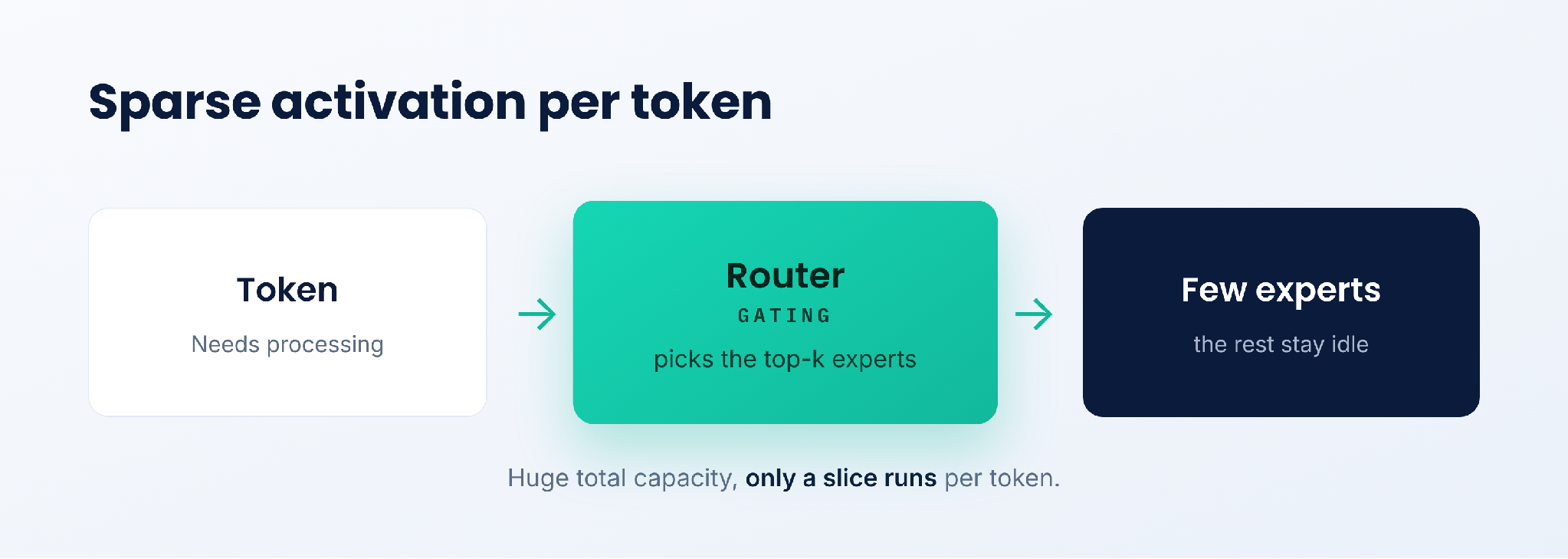
Think of a large consulting firm. You do not ask every consultant to work on every question. A coordinator routes each question to the two or three specialists best suited to it, while the rest stay free for other work. The firm has deep total expertise, but any single question only uses a slice of it. The router is that coordinator, and the experts are the specialists.
The key insight is that total capacity and per-token cost are decoupled. A model can have hundreds of billions of parameters across its experts while only a few billion run for any given token.
How does a Mixture of Experts model work?
At each MoE layer, a token is routed to a chosen few experts rather than through one shared network.
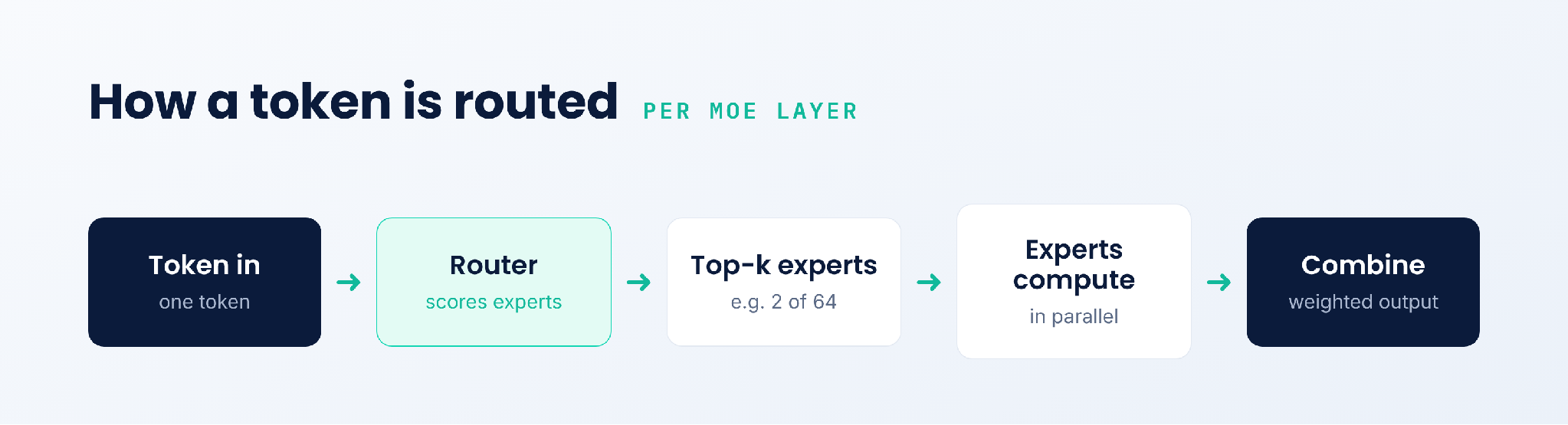
- A token arrives. The representation of a token reaches a Mixture of Experts layer.
- The router scores experts. A small gating network scores how well each expert suits this token.
- Top experts are selected. The router picks the top few experts, for example two out of sixty-four.
- Chosen experts compute. Only the selected experts process the token, in parallel, while the rest stay idle.
- Outputs are combined. Their results are blended, weighted by the router's scores, into the layer's output.
Because only a handful of experts run per token, the compute per forward pass stays close to that of a much smaller dense model, even though the full model holds far more parameters. Training also has to keep the router balanced so experts are used evenly.
Mixture of Experts vs. dense models
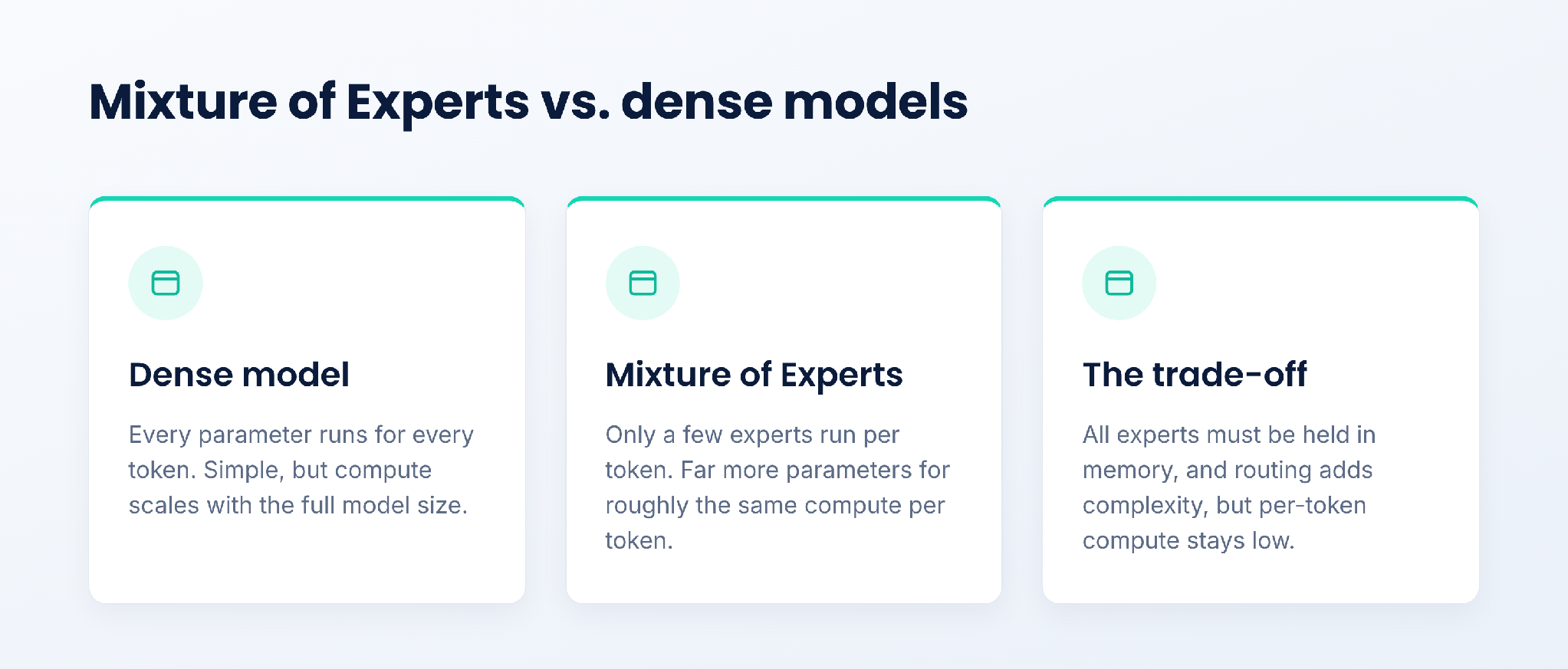
In a dense model, every parameter runs for every token, so compute scales directly with model size. Doubling the parameters doubles the work per token. A Mixture of Experts model breaks that link: it can hold many more parameters in its experts, but because only a few run per token, the compute per token barely changes. You get the knowledge capacity of a huge model at the running cost of a small one.
The catch is memory. All the experts must be loaded even though most are idle, so an MoE model needs a lot of memory for its size. It also adds routing complexity. The trade is more memory and complexity in exchange for cheaper compute at large scale.
What are the benefits of Mixture of Experts?
- More capacity, same compute. Experts add parameters and knowledge without raising per-token compute much.
- Cheaper inference at scale. A large MoE can run at the cost of a far smaller dense model per token.
- Specialization. Different experts can learn to handle different kinds of input.
- Efficient scaling. It is a practical path to very large models without a matching rise in compute.
- Strong quality per FLOP. For a given amount of compute, MoE often reaches higher quality than a dense model.
What are the challenges and limits?
- High memory footprint. All experts must be loaded even though only a few run per token.
- Routing complexity. The router must stay balanced, or some experts get overused and others starve.
- Harder to serve. Sparse routing and large memory make deployment trickier than a dense model.
- Training instability. MoE models can be more finicky to train and tune than dense equivalents.
When should you use a Mixture of Experts model?
MoE shines when you want the quality of a very large model but cannot afford the compute of running it densely. At frontier scale, where parameter counts are enormous, MoE makes serving feasible by keeping the per-token cost down. Several leading open and closed models use it for exactly this reason.
It is less compelling when memory is the tight constraint rather than compute, since you still have to hold every expert. For smaller models that fit comfortably, a dense design is simpler to train and serve.
Best practices for working with MoE models
- Size your hardware for total parameters, not active ones, since all experts must be loaded.
- Use a serving engine that supports MoE routing efficiently rather than a naive setup.
- Watch router balance so load spreads evenly across experts instead of a few hotspots.
- Quantize experts where accuracy allows to fit the large memory footprint on less hardware.
- Benchmark cost per token in practice, since active parameters, not total, drive compute.
- Serve MoE models behind a gateway so routing, scaling, and observability stay in one layer.
Conclusion
A Mixture of Experts model scales a model's knowledge without scaling its per-token compute. By holding many experts and running only a few per token through a router, it decouples total capacity from the cost of a forward pass, which is why it underpins several of the largest models today. The price is memory and complexity, since every expert must be loaded and routing must stay balanced.
TrueFoundry helps teams serve large models, including Mixture of Experts architectures, on their own infrastructure with efficient engines, autoscaling, and observability behind one gateway. As models keep growing, MoE is one of the main ways the industry keeps serving them affordable.
Gouvernez, déployez et suivez l'IA dans votre propre infrastructure
Frequently Asked Questions
What is a Mixture of Experts model in simple terms?
The model is constructed using a number of expert networks and a router. The router selects only a few experts for each token, so while the model has extremely high capacity overall, it actually uses only a fraction of that capacity at any one point.
What does the router do?
The router, or gating network, ranks how well each expert suits a given token and chooses a few of the most suitable ones to run. This is why the model is sparse: tokens are assigned only to the experts best suited to them.
How is MoE different from a dense model?
In a dense setup, each parameter is used for each token. In the MoE architecture, only a couple of experts are used for each token, making it possible to hold far more parameters without much more compute per token.
What is the main downside of MoE?
Memory. While only a small number of experts run per token, all of them have to be loaded, so MoE models require a huge amount of memory for their size. Routing also adds complexity to training and serving.
Why do frontier models use MoE?
Because it allows them to scale quality and parameters without a matching increase in compute per token. That makes very large models feasible to serve, which is why many leading models use this architecture.

GenAI infra- simple, plus rapide et moins cher
Les meilleures équipes lui font confiance pour faire évoluer GenAI

- © 2022 ENSEMBLE Technologies



Abonnez-vous à notre newsletter
Les dernières nouvelles, articles et ressources envoyés dans votre boîte de réception


