


Accédez instantanément à un environnement TrueFoundry en direct. Déployez des modèles, acheminez le trafic LLM et explorez la plateforme complète : votre sandbox est prête en quelques secondes, aucune carte de crédit n'est requise.


What Is Time to First Token and Why Does It Matter?

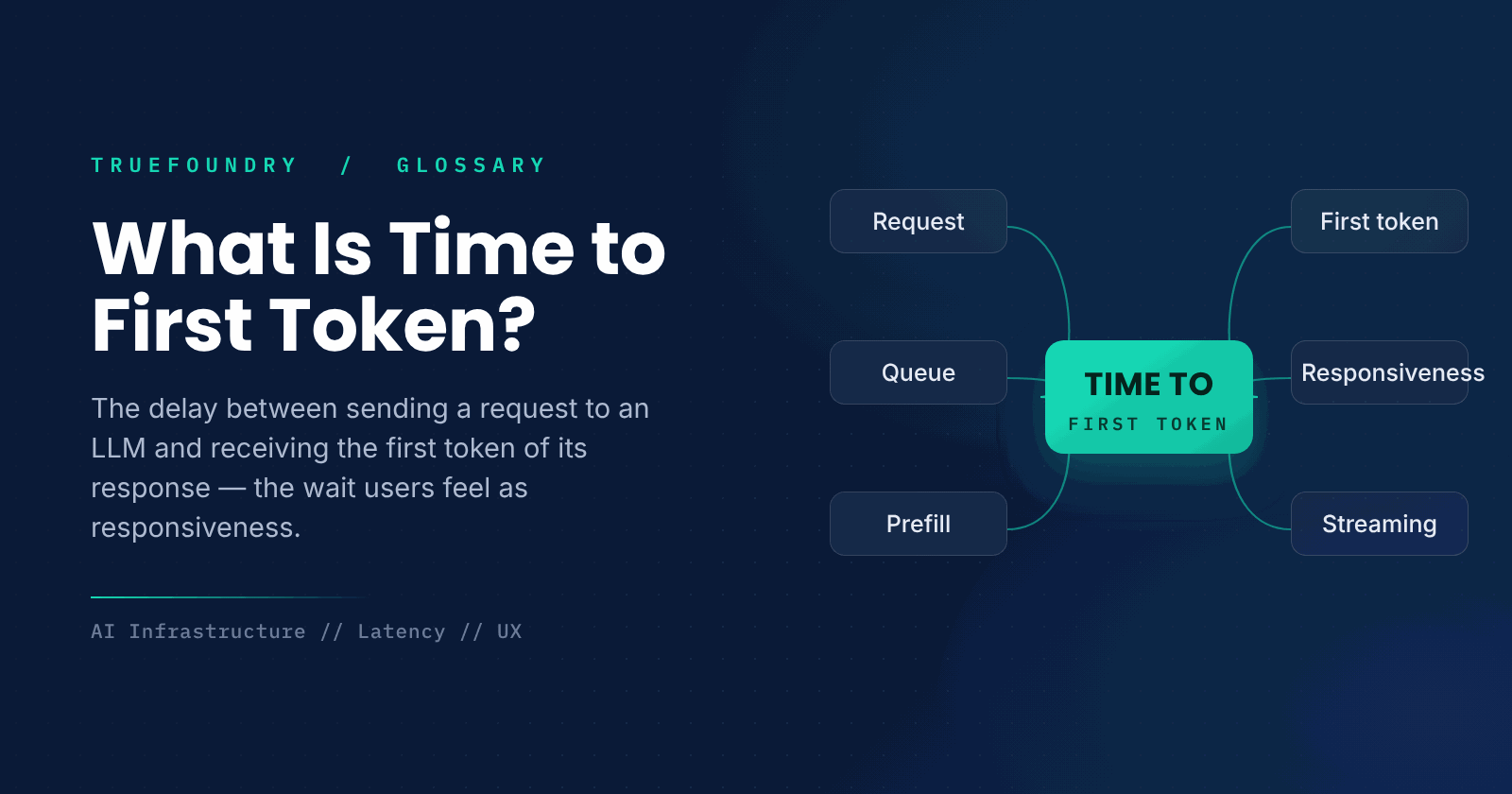
When someone sends a prompt to an LLM, the response does not appear instantly. First the model has to read and process the entire prompt, and only then can it start producing output. Time to first token measures exactly that initial wait, the gap before the first word of the answer shows up.
It matters because it is what users feel as responsiveness. A long total generation is tolerable if text starts streaming quickly, but a long pause before anything appears feels broken. That is why TTFT is one of the most important latency metrics for interactive LLM applications.
This guide explains what time to first token is, what drives it, how it differs from other latency metrics, and how to reduce it.
What is time to first token?
Time to first token is the elapsed time between when a request is sent to a language model and when the first token of the generated response is returned. It captures the latency of everything that must happen before generation can begin: queuing, prompt processing, and producing that initial token.
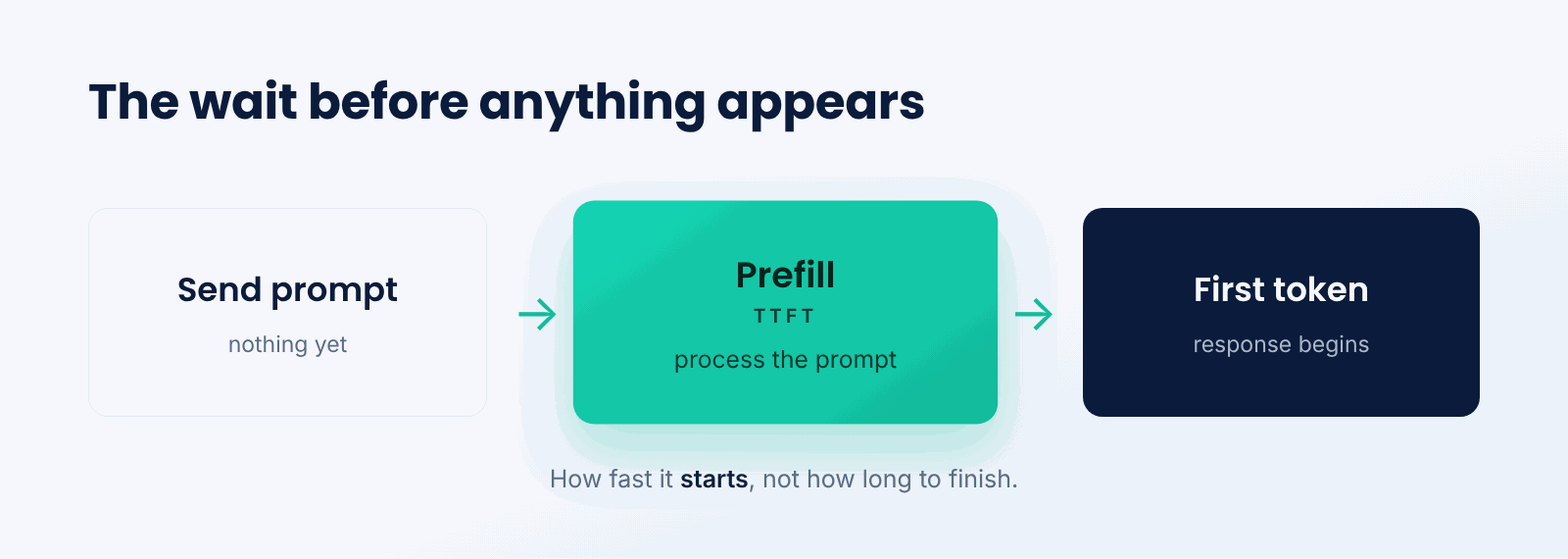
Think of it like ordering at a counter. Total time includes preparing the whole order, but what you notice first is how long before the server even acknowledges you and starts. TTFT is that first acknowledgement for an LLM: how quickly the response begins, separate from how long it takes to finish.
The key idea is that responsiveness and total time are different. A low TTFT makes an application feel fast even when the full answer is long, because the user sees progress almost immediately.
What drives time to first token?
TTFT is dominated by the work done before the first token: queuing and processing the prompt.
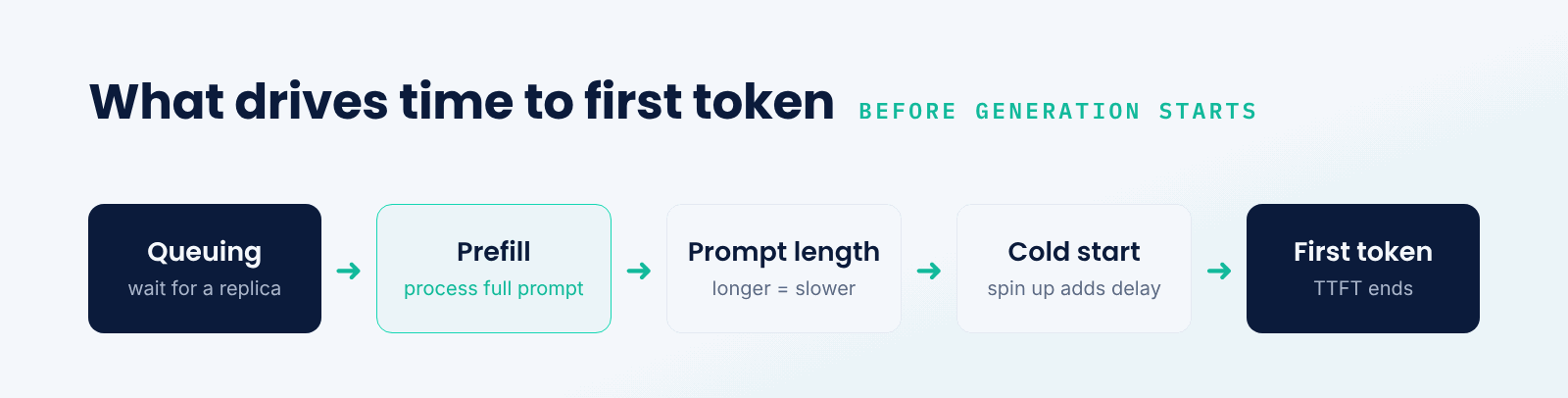
- Queuing. The request may wait for an available model replica before anything starts.
- Prefill. The model processes the full prompt to build its internal state, the prefill step.
- Prompt length. Longer prompts take longer to prefill, raising TTFT.
- Cold start. If a replica must spin up first, that delay adds to TTFT.
- First token. The model produces the initial token, ending the TTFT measurement.
Because prefill scales with prompt length, long contexts are the biggest driver of TTFT. Reusing prefill work through prompt caching, or keeping replicas warm, directly cuts the wait before generation.
TTFT vs. other latency metrics
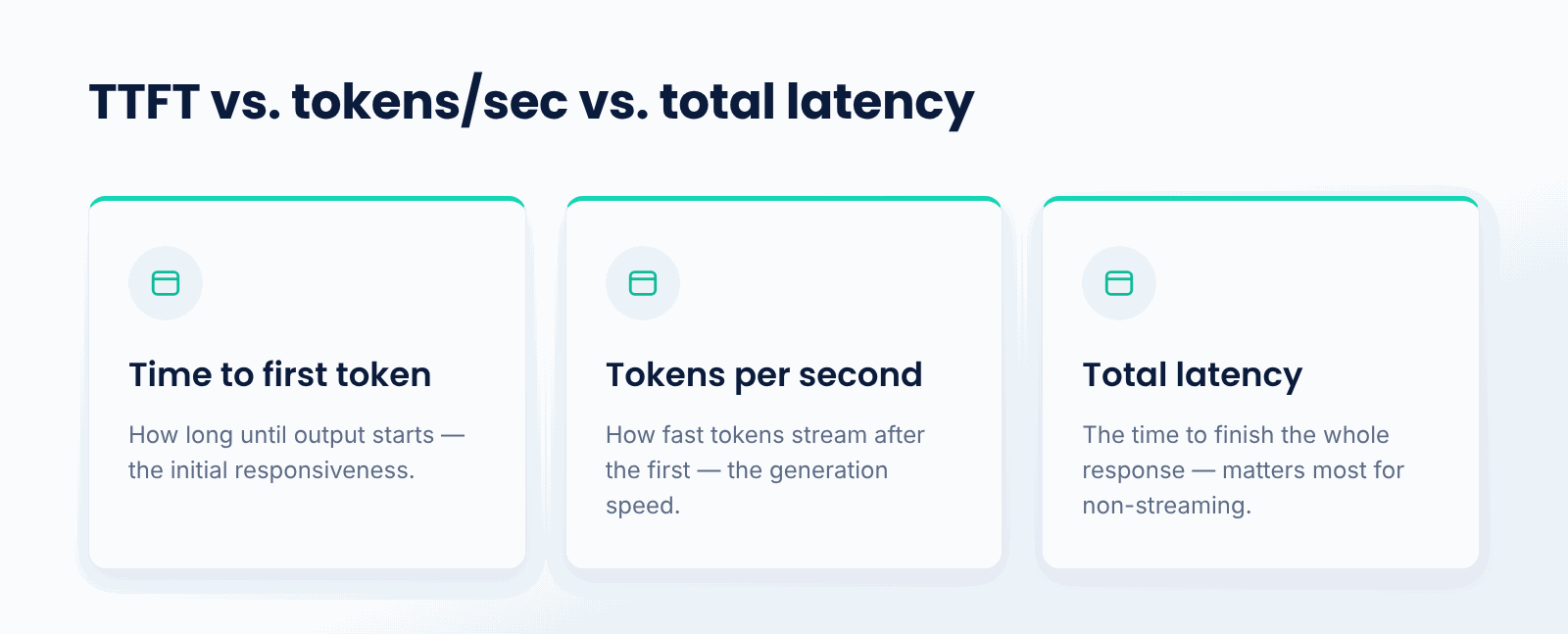
A few metrics describe LLM latency together. Time to first token is how long until output starts. Tokens per second, or inter-token latency, is how fast tokens stream after the first. Total latency is the time to finish the whole response. They are related but distinct: an application can have a low TTFT but slow streaming, or fast streaming after a slow start.
For interactive experiences, TTFT often matters most because it governs the perceived responsiveness. Once text is flowing, a steady tokens-per-second rate keeps it feeling smooth, and total latency matters most for non-streaming use.
Why does time to first token matter?
- Perceived speed. It is what users feel as how fast the app responds.
- Engagement. A quick first token keeps users from thinking it has stalled.
- Streaming UX. It sets how soon streamed responses begin appearing.
- SLA metric. It is a common target for interactive LLM services.
- Diagnostics. A high TTFT points to prefill or queuing problems.
How do you reduce time to first token?
- Prompt caching. Reuse processed prefixes so prefill is largely skipped.
- Shorter prompts. Trim unnecessary context to reduce prefill work.
- Warm replicas. Avoid cold starts by keeping capacity ready.
- Good load balancing. Reduce queuing by routing to available replicas.
- Efficient serving. Use engines optimized for fast prefill.
When should you focus on TTFT?
Focus on it for any interactive, user-facing LLM application, chat, assistants, copilots, where people wait for a response in real time. The more interactive the experience and the longer the prompts, the more TTFT shapes how fast the product feels.
For batch or background jobs where no one is watching a live response, total latency and throughput matter more than TTFT. But wherever a human is waiting for text to appear, TTFT is a metric worth optimizing.
Best practices for time to first token
- Measure TTFT separately from total latency and tokens per second.
- Use prompt caching to cut prefill for repeated contexts.
- Keep prompts as short as the task allows.
- Keep replicas warm to avoid cold-start delays.
- Balance load to minimize queuing before prefill.
- Track TTFT as a user-facing latency SLA.
Conclusion
Time to first token is the delay before an LLM's response begins, and it is what users experience as responsiveness. Driven mainly by queuing and prompt prefill, it grows with prompt length and cold starts, and it shrinks with prompt caching, warm replicas, and efficient serving. Because a fast first token makes an application feel fast, TTFT is a key metric for any interactive LLM product.
TrueFoundry's AI Gateway and serving help teams lower time to first token through caching, routing, and efficient inference, with latency visible in one place. For interactive AI, keeping TTFT low is central to a responsive user experience.
Gouvernez, déployez et suivez l'IA dans votre propre infrastructure

GenAI infra- simple, plus rapide et moins cher
Les meilleures équipes lui font confiance pour faire évoluer GenAI

- © 2022 ENSEMBLE Technologies



Abonnez-vous à notre newsletter
Les dernières nouvelles, articles et ressources envoyés dans votre boîte de réception


