


Accédez instantanément à un environnement TrueFoundry en direct. Déployez des modèles, acheminez le trafic LLM et explorez la plateforme complète : votre sandbox est prête en quelques secondes, aucune carte de crédit n'est requise.


What Is Temperature in LLMs and Why Does It Matter?

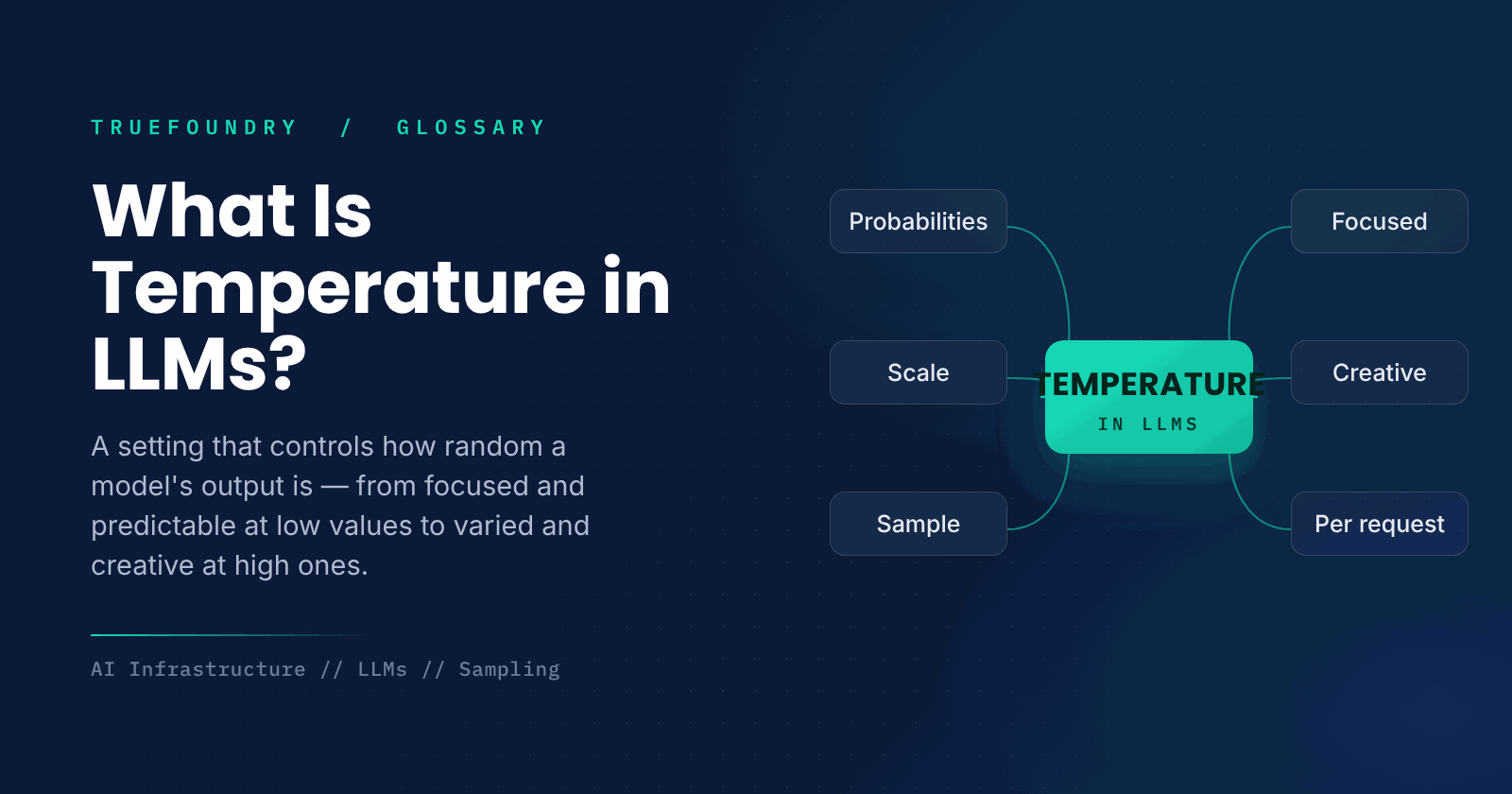
Ask a language model the same question twice and you may get two different answers, or nearly identical ones, depending on a single setting: temperature. It is the dial that decides whether a model plays it safe with the most likely words or takes more chances, and it quietly shapes the feel of almost every response.
Understanding temperature is one of the most practical pieces of knowledge for anyone using LLMs. The same model can feel rigidly predictable or loosely creative depending on how this one parameter is set, and choosing it well is often the difference between output that fits your use case and output that frustrates it.
This guide explains what temperature is, how it affects output, how it relates to other sampling settings, and how to choose a value.
What is temperature?
Temperature is a parameter that controls the randomness of a language model's token selection. At each step, the model produces a probability distribution over possible next tokens, and temperature scales that distribution before a token is sampled. A low value sharpens the distribution toward the most likely tokens; a high value flattens it, giving less likely tokens a better chance.
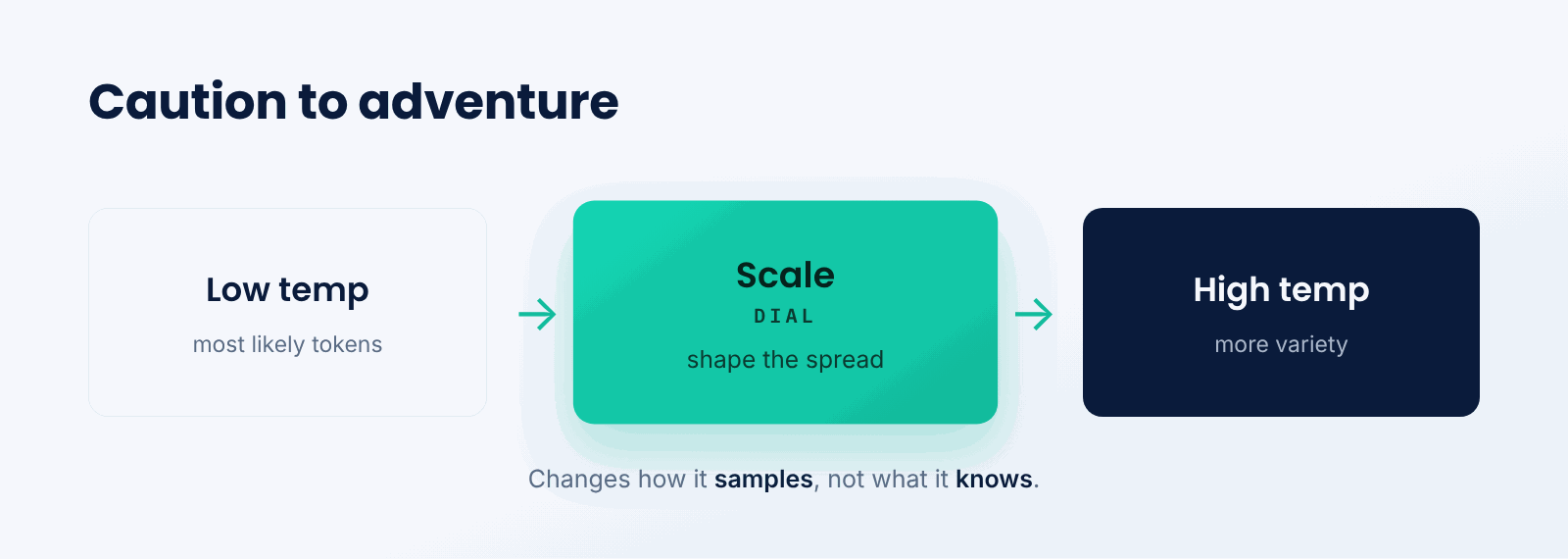
Think of it like a dial between caution and adventure. Turned low, the model almost always picks the single most probable word, so it stays on the safest, most predictable path. Turned high, it is willing to wander, choosing less obvious words more often, which brings variety but also more risk of going off track.
The key idea is that temperature does not change what the model knows, only how boldly it samples from what it knows. The underlying probabilities are the same; temperature decides how strictly the model sticks to the top of them.
How does temperature affect output?
Different temperature ranges produce noticeably different behavior.
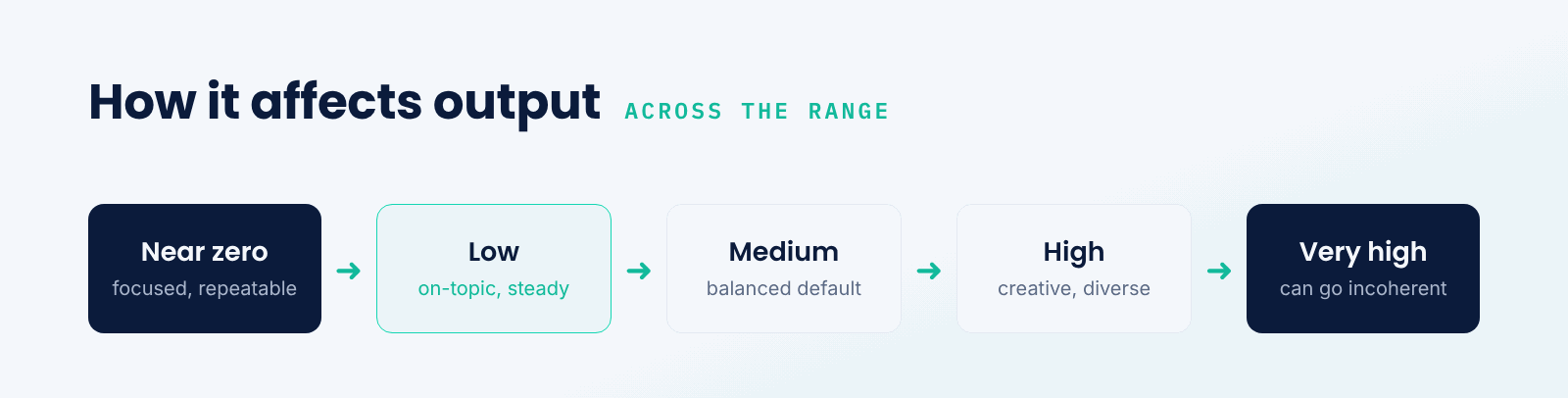
- Near zero. Output is focused and repeatable, picking the most likely tokens.
- Low. Responses stay on-topic and consistent, with little variation.
- Medium. A balance of coherence and variety, a common general-purpose setting.
- High. More creative and diverse, but less predictable and more error-prone.
- Very high. Output can become incoherent as unlikely tokens are chosen too often.
There is no universally correct value; it depends on the task. The same prompt will feel tightly deterministic at a low temperature and loose and inventive at a high one, so the right setting follows from whether you want reliability or creativity.
Temperature vs. top-p and other settings
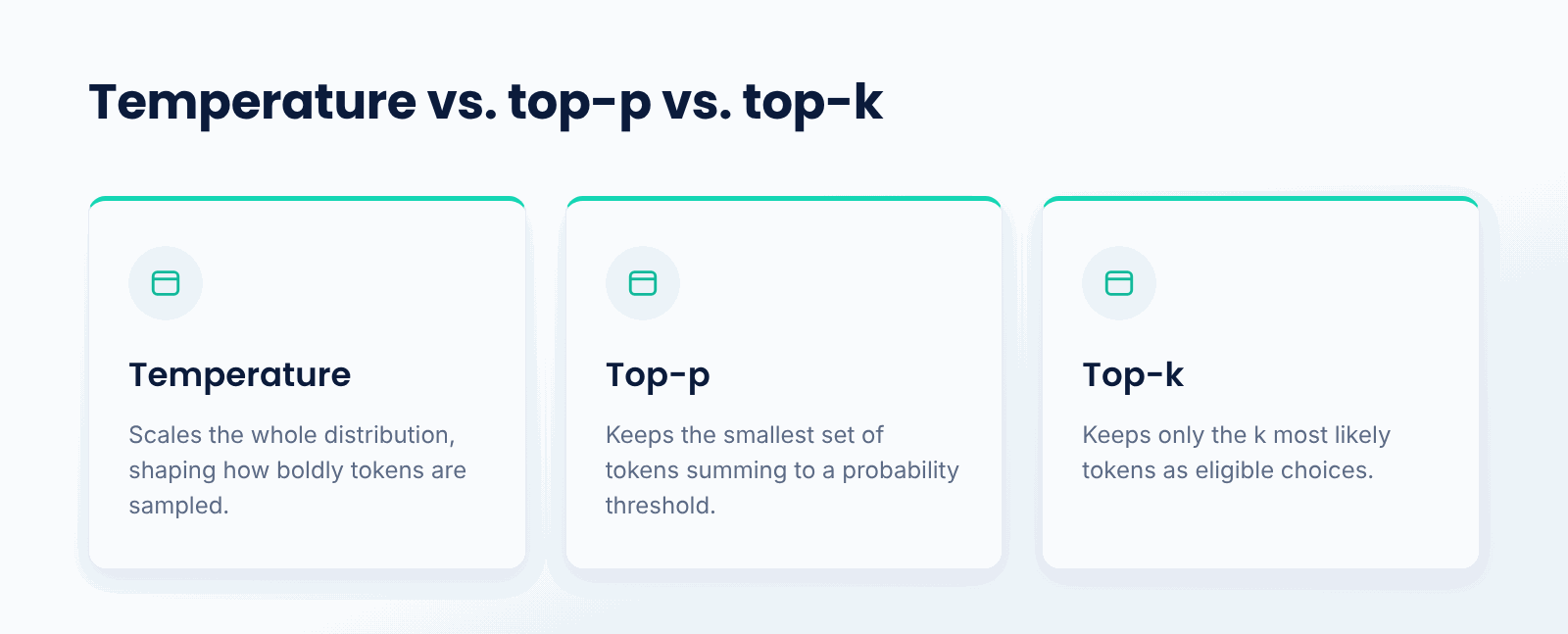
Temperature is one of several sampling controls. Top-p, or nucleus sampling, limits choices to the smallest set of tokens whose probabilities add up to a threshold, cutting off the long tail. Top-k keeps only the k most likely tokens. These control which tokens are eligible, while temperature controls how the probabilities among them are shaped.
They are often used together. A common approach is a moderate temperature with top-p to both shape the distribution and trim unlikely tokens. The goal is the same: balance coherence against diversity, with each setting offering a slightly different handle on that tradeoff.
Why does temperature matter?
- Task fit. It tunes output between reliable and creative for your use case.
- Consistency. Low temperature gives repeatable, predictable responses.
- Creativity. High temperature produces more varied and original output.
- Control. It is a simple, per-request way to shape behavior.
- Quality. The wrong setting can make good models feel rigid or erratic.
What are the tradeoffs?
- Reliability vs. variety. Lower is more reliable, higher is more diverse.
- Repeatability. Higher temperature makes outputs harder to reproduce.
- Error risk. High values raise the chance of incoherent or off-task output.
- No single value. The best setting depends entirely on the task.
How should you choose a temperature?
For tasks that need accuracy and consistency, such as factual answers, classification, data extraction, or code, use a low temperature so the model stays focused and repeatable. For creative tasks like brainstorming, story writing, or generating varied options, a higher temperature gives the diversity you want.
A moderate value is a reasonable default for general use. The practical approach is to start from the kind of output you need, reliable or creative, pick a value accordingly, and adjust based on whether the results feel too rigid or too random.
Key points about temperature
- It controls the randomness of token selection.
- Low values give focused, repeatable output; high values give variety.
- It scales the probability distribution before sampling.
- It is often combined with top-p or top-k.
- It is set per request, independent of the model.
- Choose low for accuracy, higher for creativity.
Conclusion
Temperature controls how random a language model's output is by scaling the token probability distribution before sampling. Low values produce focused, consistent responses, while high values produce varied, creative ones, which makes temperature one of the most important dials for fitting model behavior to a task. It changes how boldly the model samples, not what it knows.
TrueFoundry helps teams serve and configure LLMs, exposing settings like temperature so each application gets the behavior it needs. Choosing the right temperature is a simple but powerful way to make a model work the way you intend.
Gouvernez, déployez et suivez l'IA dans votre propre infrastructure
Frequently Asked Questions
What is temperature in an LLM in simple terms?
This is a setting that determines the randomness of a model's output. The lower the temperature, the more the model chooses the likely words to give focused, predictable answers. The higher the temperature, the more often it chooses less likely words, giving more varied and creative output.
What temperature should I use?
Apply a low value if the task requires precision, such as providing facts, classification, or code. If the task involves creativity, such as idea generation and storytelling, a higher value can be used. A moderate value is a reasonable default choice for general use.
Does temperature change what the model knows?
No. It simply alters the extent to which the model samples from the distribution it already generates. The basic knowledge and the distribution itself remain the same; the temperature determines how rigidly the model adheres to the highest-probability tokens.
How is temperature different from top-p?
Temperature scales the entire probability distribution, whereas top-p restricts token selection to the minimum number of tokens whose probabilities sum past a threshold, thereby chopping off the improbable tail. They are complementary and often used together to balance coherence and diversity.
Why do I get different answers to the same prompt?
The reason is that for any temperature above zero, the model samples tokens based on probability rather than always choosing the single most likely one at every step. The higher the temperature, the greater the variability, so the same prompt can yield different responses each time.

GenAI infra- simple, plus rapide et moins cher
Les meilleures équipes lui font confiance pour faire évoluer GenAI

- © 2022 ENSEMBLE Technologies



Abonnez-vous à notre newsletter
Les dernières nouvelles, articles et ressources envoyés dans votre boîte de réception


