


Accédez instantanément à un environnement TrueFoundry en direct. Déployez des modèles, acheminez le trafic LLM et explorez la plateforme complète : votre sandbox est prête en quelques secondes, aucune carte de crédit n'est requise.


What Is RLHF and Why Does It Matter?

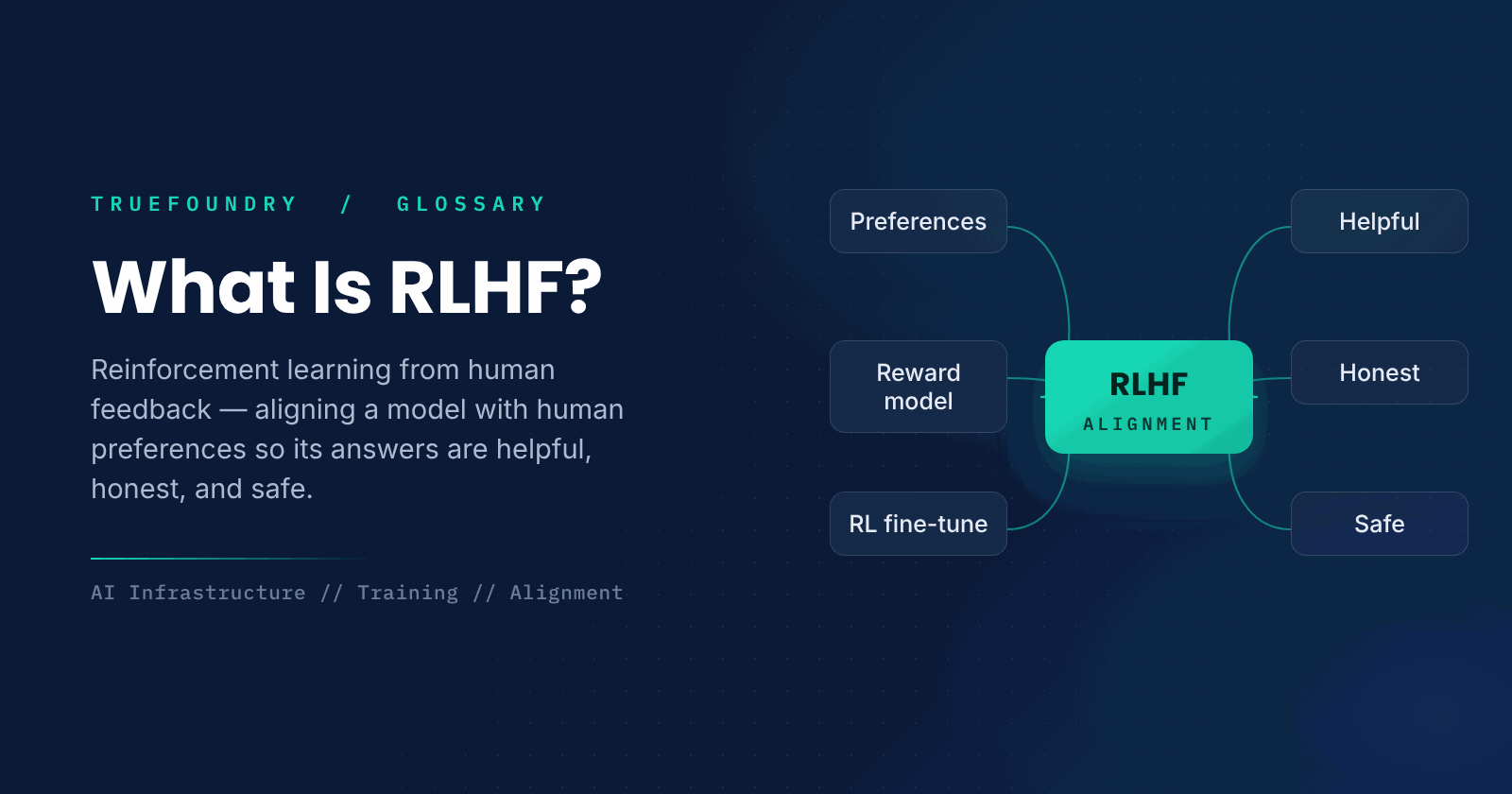
A language model trained only to predict the next token learns to continue text, but not necessarily to be helpful, truthful, or safe. It will happily complete a prompt in ways a person might find unhelpful or inappropriate. RLHF is the technique that bridges that gap, shaping a raw model into an assistant that behaves the way people actually want.
The core insight is that it is hard to write down exactly what makes a good response, but easy for people to compare two responses and say which is better. RLHF turns those human comparisons into a training signal, teaching the model to produce the kind of answers people prefer across a huge range of situations.
This guide explains what RLHF is, how its stages fit together, how it compares to plain fine-tuning, and why it matters for building useful models.
What is RLHF?
RLHF stands for reinforcement learning from human feedback. It is a method for aligning a model's behavior with human preferences by using human judgments as the basis for a reward signal, then optimizing the model to maximize that reward. The result is a model whose outputs people tend to rate as more helpful and appropriate.
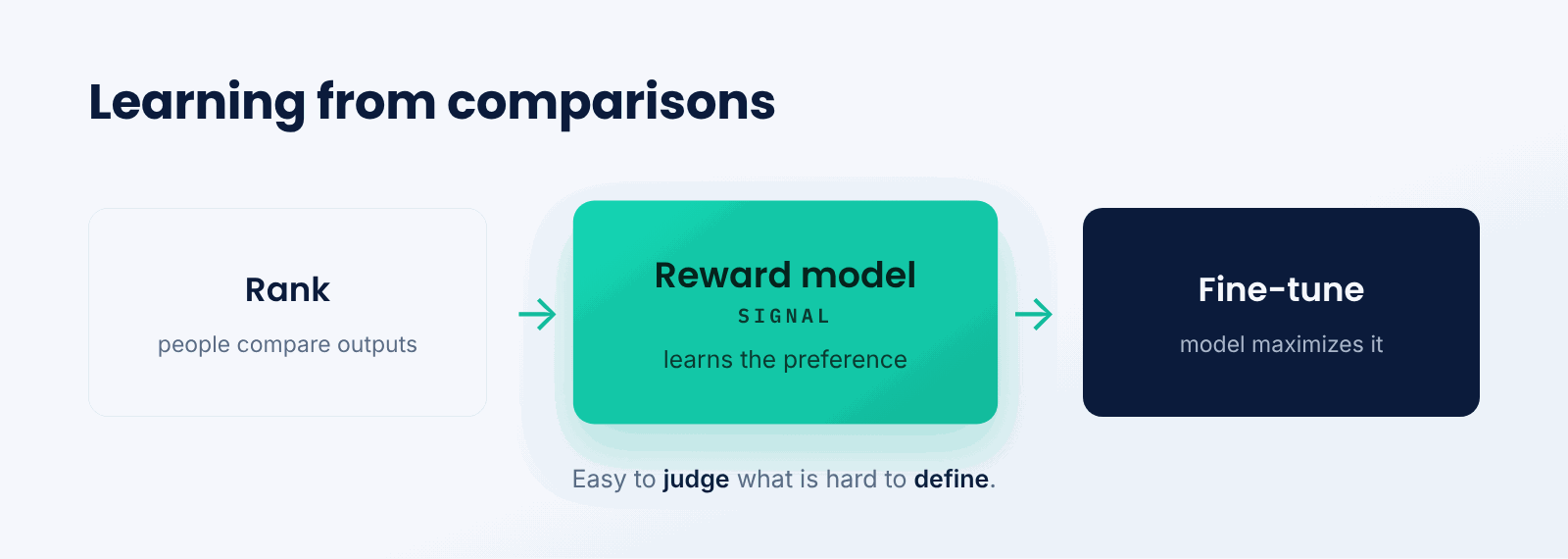
Think of it like coaching. A coach rarely specifies the perfect technique in full detail, but can watch an attempt and say whether it was better or worse than another. Over many rounds of that feedback, the athlete converges on good form. RLHF coaches a model the same way, using human preference judgments instead of explicit rules.
The key idea is learning from comparisons rather than fixed targets. Because people can reliably say which of two responses is better even when they cannot define the ideal answer, preference data becomes a practical way to steer a model toward desirable behavior.
How does RLHF work?
RLHF typically runs in three stages that build on a pretrained model.
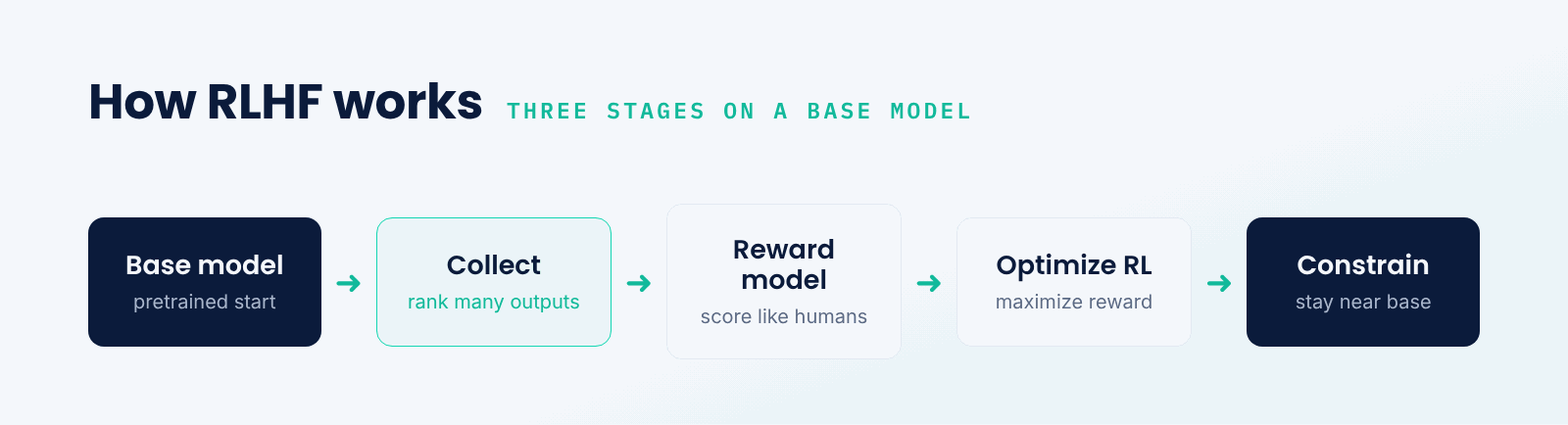
- Start from a base model. Begin with a pretrained, often instruction-tuned, language model.
- Collect preferences. Have people rank or compare model outputs for many prompts.
- Train a reward model. Fit a model that scores responses to match those human rankings.
- Optimize with RL. Fine-tune the language model to maximize the reward model's score.
- Keep it grounded. Constrain updates so the model stays close to its original behavior.
The reinforcement learning stage lets the model explore responses and get rewarded for those the reward model scores highly, while a constraint keeps it from drifting too far from the base model. This balance pushes the model toward preferred behavior without losing the language ability it learned during pretraining.
RLHF vs. supervised fine-tuning
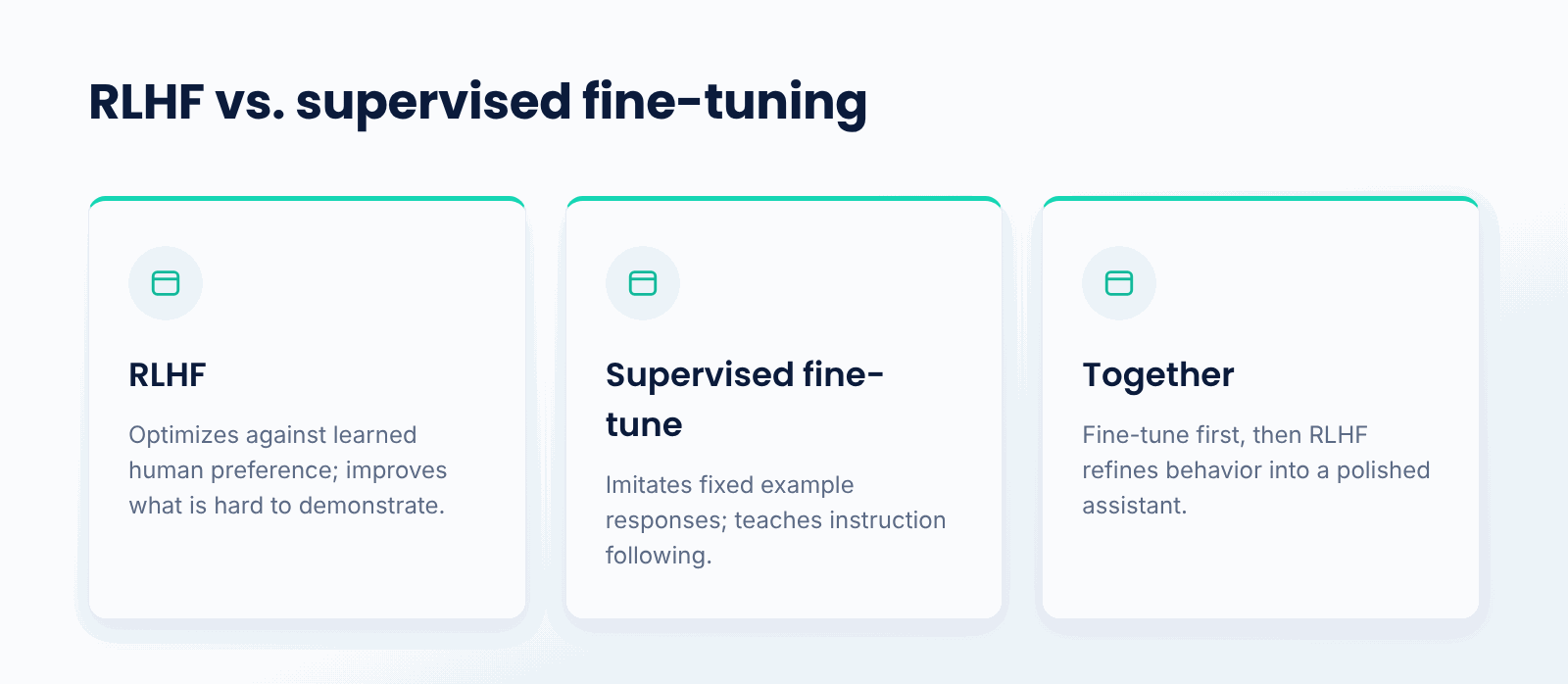
Supervised fine-tuning trains a model to imitate a set of example responses, learning to reproduce the demonstrated answers. RLHF goes further: rather than imitating fixed examples, it optimizes against a learned model of human preference, so it can improve on behaviors that are hard to demonstrate but easy to judge.
In practice the two are used together. Supervised fine-tuning first teaches the model to follow instructions using demonstrations, and RLHF then refines its behavior using preference feedback. The combination is what turns a capable base model into a polished, well-aligned assistant.
Why does RLHF matter?
- Alignment. It steers models toward helpful, honest, and safe behavior.
- Usability. It turns raw text predictors into usable assistants.
- Hard-to-specify goals. It captures preferences that are difficult to write as rules.
- Quality. It noticeably improves how useful responses feel to people.
- Safety. It reduces harmful or inappropriate outputs.
What are the tradeoffs?
- Human cost. Collecting quality preference data is labor-intensive.
- Reward hacking. The model may exploit flaws in the reward model.
- Bias. The resulting behavior reflects the preferences of the people who labeled it.
- Complexity. The multi-stage RL process is harder to run than plain fine-tuning.
When is RLHF used?
RLHF is used to align general-purpose chat and assistant models, where behavior quality, helpfulness, and safety matter across an open-ended range of inputs. It is the step that makes a model pleasant and reliable to interact with, so it is standard in building consumer-facing conversational models.
For narrow, well-defined tasks where correct outputs can be demonstrated directly, supervised fine-tuning alone may suffice, and simpler preference-optimization methods are increasingly used as lighter alternatives. But wherever subjective quality and broad alignment matter, RLHF or its successors remain central.
Key points about RLHF
- RLHF aligns a model with human preferences.
- Humans rank outputs; a reward model learns to score them.
- The model is fine-tuned with RL to maximize that reward.
- It builds on, and complements, supervised fine-tuning.
- It improves helpfulness and safety but adds cost and complexity.
- It can be undermined by reward hacking and labeler bias.
Conclusion
RLHF aligns a language model with human preferences by learning a reward model from human rankings and fine-tuning the model to maximize it. Building on supervised fine-tuning, it turns a capable but raw base model into a helpful, well-behaved assistant. Though it adds data and process cost and brings risks like reward hacking, it remains one of the most important techniques for making models genuinely useful.
TrueFoundry helps teams fine-tune and serve aligned models on their own infrastructure, supporting the training workflows that turn base models into production assistants. As alignment methods evolve, understanding RLHF is key to understanding how modern models behave.
Gouvernez, déployez et suivez l'IA dans votre propre infrastructure
Frequently Asked Questions
What is RLHF in simple terms?
It is a method for training a model such that it produces the kinds of outputs that humans prefer. Humans rate which responses they prefer, the reward model learns from those ratings, and the language model is then refined to produce responses that score well.
Why is RLHF needed if a model is already trained?
A model that learns just how to predict text extends prompts, but may do so without really helping at all, being truthful, or even safe. RLHF directs that skill toward useful behavior desired by real people, turning a text predictor into a usable, well-aligned assistant.
What is the reward model in RLHF?
This is a model trained to rate answers the way humans do, learned from people's rankings of outputs. It substitutes for human judgment during reinforcement learning, providing an optimization goal the language model can achieve at scale.
How is RLHF different from fine-tuning?
Fine-tuning under supervision trains the model to mimic example solutions. RLHF maximizes for a learned model of human preferences, which allows it to develop behavior that is difficult to demonstrate but simple to evaluate. They are typically combined in use.
What are the risks of RLHF?
The first type is reward hacking, which means the model takes advantage of flaws in the reward model instead of genuinely improving. Another is bias, as the learned behavior reflects the preferences of the feedback givers. It is also costly and complex to run.

GenAI infra- simple, plus rapide et moins cher
Les meilleures équipes lui font confiance pour faire évoluer GenAI

- © 2022 ENSEMBLE Technologies



Abonnez-vous à notre newsletter
Les dernières nouvelles, articles et ressources envoyés dans votre boîte de réception


