


Accédez instantanément à un environnement TrueFoundry en direct. Déployez des modèles, acheminez le trafic LLM et explorez la plateforme complète : votre sandbox est prête en quelques secondes, aucune carte de crédit n'est requise.


What Is the ReAct Pattern and Why Does It Matter?

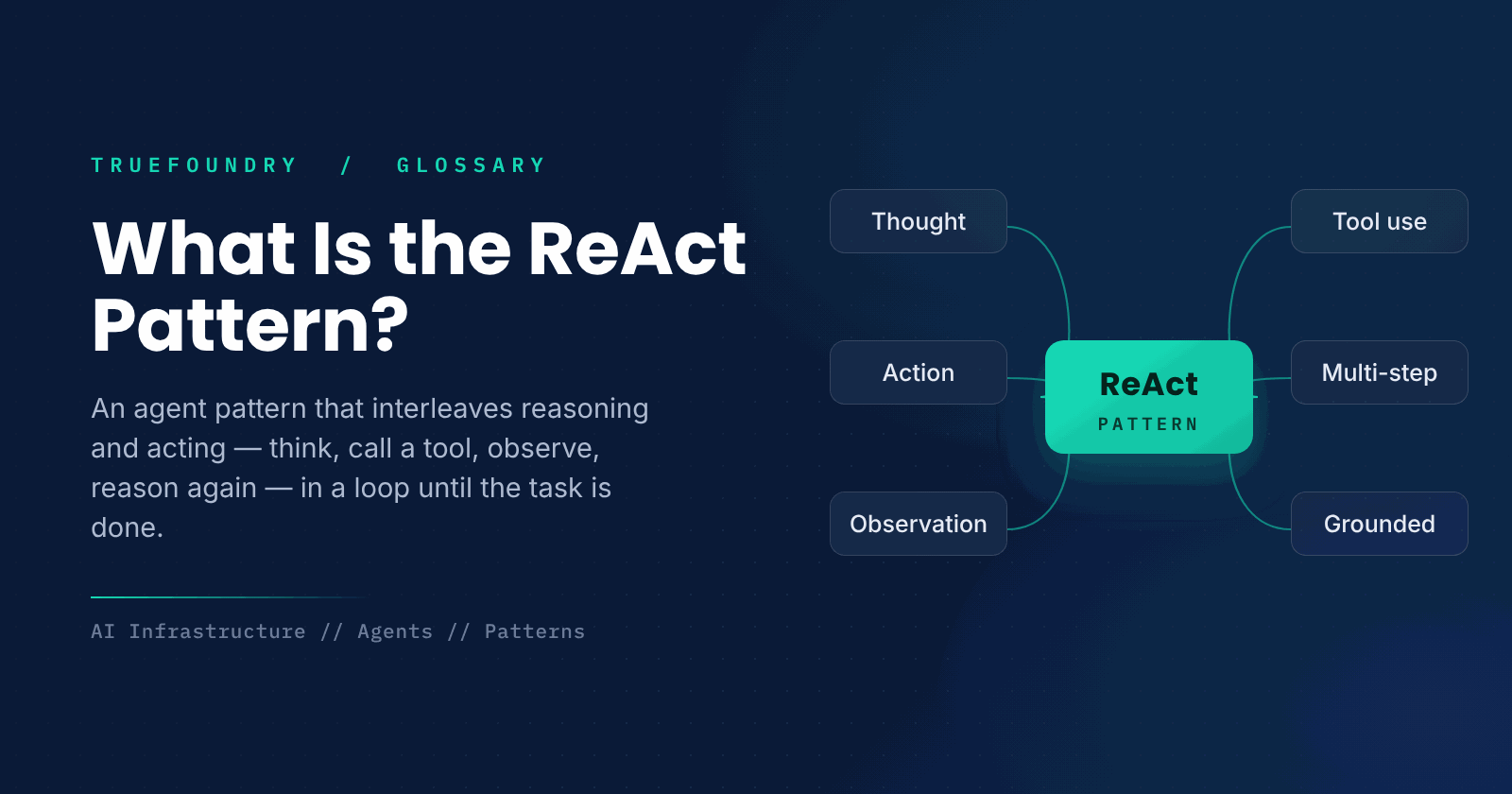
A language model answering in a single pass has to produce everything from memory, with no way to look things up or check its work mid-thought. For complex tasks that need external information or several steps, that is a serious limitation. The ReAct pattern addresses it by letting the model think, act, and observe in a repeating loop.
ReAct, short for Reasoning and Acting, has become one of the foundational patterns for building AI agents. By interleaving chains of reasoning with concrete actions like tool or API calls, it lets a model break a problem into steps, gather information as it goes, and adjust based on what it finds, much as a person would.
This guide explains what the ReAct pattern is, how its loop works, how it compares to plain prompting, and when to use it.
What is the ReAct pattern?
The ReAct pattern is an approach where a language model solves a task by alternating between reasoning steps and actions. In a reasoning step, it thinks about what to do next; in an action step, it does something concrete, such as calling a tool or searching; then it observes the result and reasons again. This continues until the task is complete.
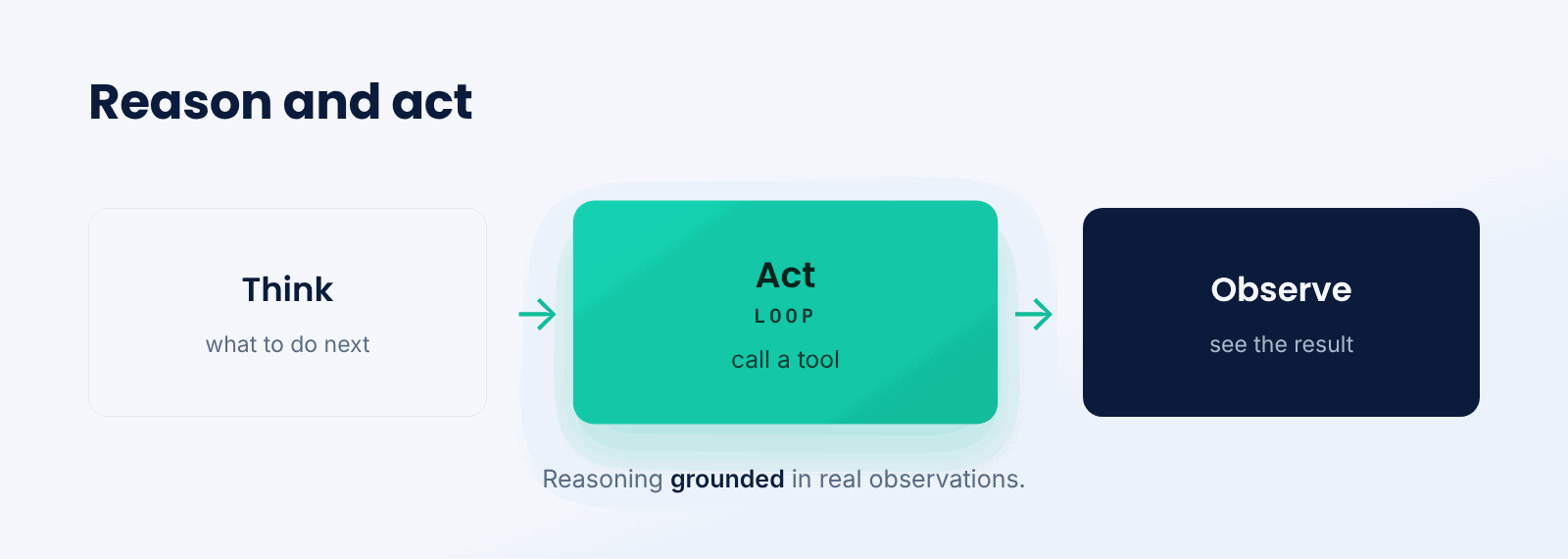
Think of it like a detective working a case. They form a hypothesis (reasoning), then gather a specific piece of evidence (action), then see what it reveals (observation), which updates their thinking for the next move. ReAct gives a model that same investigative loop instead of forcing a single guess.
The key idea is grounding reasoning in observation. Because the model sees the actual result of each action before deciding the next, its reasoning stays anchored to real information rather than drifting on assumptions, which makes multi-step tasks far more reliable.
How does the ReAct loop work?
ReAct runs a cycle of thought, action, and observation until the goal is reached.
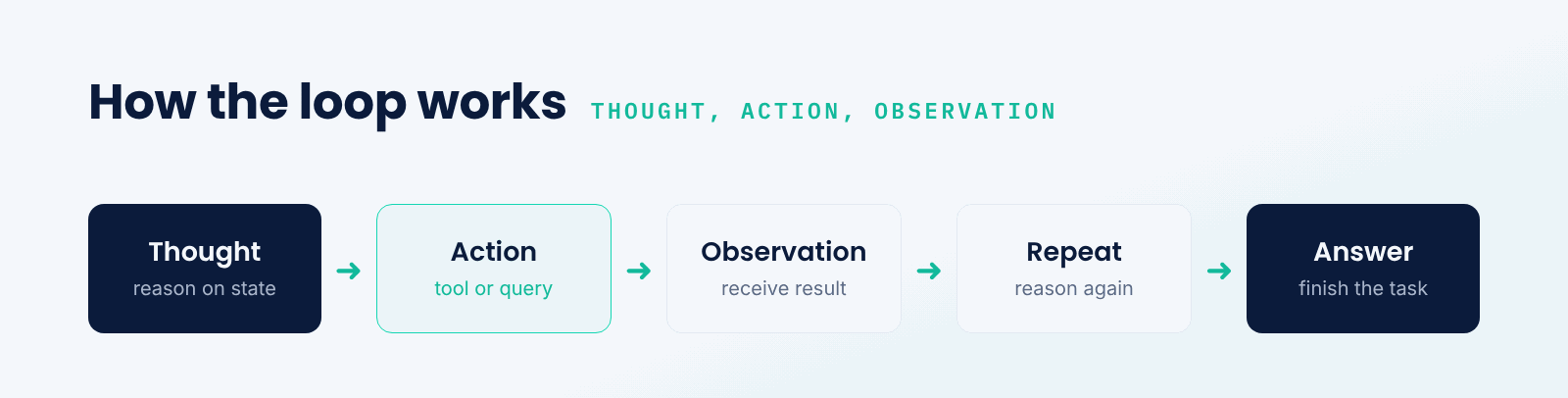
- Thought. The model reasons about the current state and what to do next.
- Action. It takes a concrete step, such as calling a tool or querying a source.
- Observation. It receives the result of that action.
- Repeat. It reasons again using the new observation, and acts once more.
- Answer. When it has enough information, it produces the final response.
Each loop adds information and narrows the task. Because the model can react to what it observes, it can recover from dead ends, follow up on partial results, and chain many tool calls together, which is what lets agents complete tasks that no single response could.
ReAct vs. plain prompting
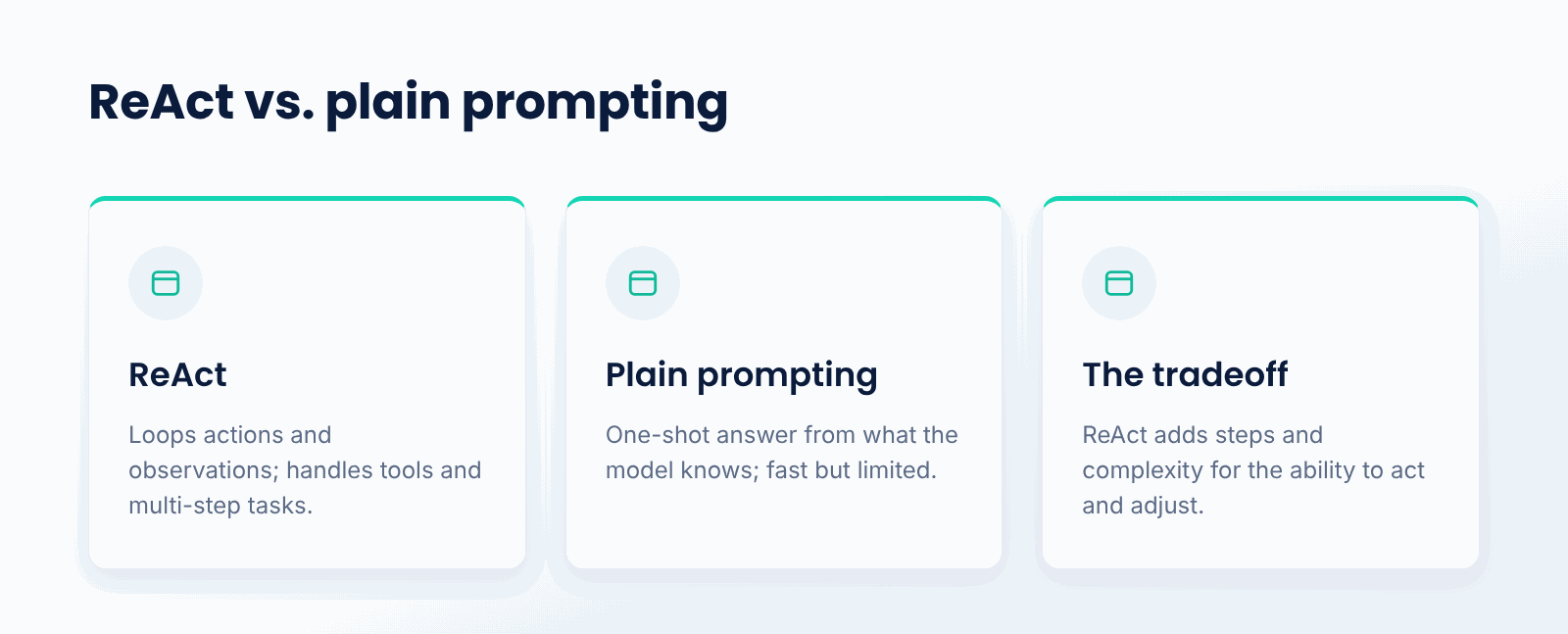
Plain prompting asks the model for an answer in one pass, relying entirely on what it already knows. That is fast and simple but cannot look things up, use tools, or correct course mid-task. ReAct adds a loop of actions and observations, letting the model gather information and adjust, at the cost of more steps and complexity.
The two suit different needs. Plain prompting is right for self-contained questions the model can answer directly. ReAct is for tasks that require external data, multiple tools, or step-by-step problem solving, where the ability to act and observe makes the difference between success and a confident but wrong guess.
Why does the ReAct pattern matter?
- Tool use. It lets models call tools and APIs to extend their abilities.
- Grounding. Reasoning stays anchored to real observations.
- Multi-step tasks. It handles problems that need several steps.
- Recovery. The model can adjust when an action does not go as expected.
- Agents. It is a foundation for building capable AI agents.
What are the tradeoffs?
- More calls. Each loop is another model call, adding latency and cost.
- Complexity. Orchestrating the loop and tools is more involved than one prompt.
- Error loops. A poorly designed agent can get stuck repeating actions.
- Reliability. Each step is a chance for the model to go off track.
When should you use the ReAct pattern?
Use ReAct when a task needs the model to gather external information, use tools, or work through several dependent steps, such as answering questions that require live data, automating a workflow, or reasoning over results from multiple sources. These are exactly the cases where a single prompt falls short.
For simple, self-contained questions, plain prompting is cheaper and faster, and adding a reasoning-action loop would be overkill. ReAct earns its complexity specifically when acting and observing are essential to getting the task done.
Key points about the ReAct pattern
- ReAct interleaves reasoning and acting in a loop.
- The cycle is thought, action, observation, repeated.
- It grounds reasoning in the results of real actions.
- It enables tool use and multi-step problem solving.
- It is a foundation for building AI agents.
- It adds model calls, latency, and orchestration complexity.
Conclusion
The ReAct pattern builds agents that alternate between reasoning and acting, observing the result of each action before deciding the next. This loop grounds the model's reasoning in real information and lets it use tools and solve multi-step tasks far more reliably than a single prompt. Its cost is extra model calls and orchestration, which pays off whenever a task needs acting and observing to succeed.
TrueFoundry helps teams build and serve AI agents on their own infrastructure, orchestrating the reasoning-action loops and tool calls that patterns like ReAct depend on. For agentic applications, ReAct is a core pattern worth understanding.
Gouvernez, déployez et suivez l'IA dans votre propre infrastructure
Frequently Asked Questions
What is the ReAct pattern in simple terms?
The agent paradigm cycles through reason-and-execute iterations. A model reasons toward a decision, executes it by calling a tool, observes the outcome, then continues reasoning. This cycle runs until the model can return a conclusive answer.
What does ReAct stand for?
Reasoning and Acting. Reason, act, reason, act; that is the name, and it describes the fundamental concept. Reasoning passes capture problem-solving thought, while action passes include calls to tools or search engines, followed by observations of the outputs, and the cycle continues.
Why is observing important in ReAct?
Because it grounds the model's reasoning in real information. By observing the actual result of each action before deciding the next step, the model stays anchored to facts rather than guessing, which makes multi-step tasks much more reliable.
How is ReAct different from a single prompt?
Prompt the model once, and you get back one response based on what it knows. ReAct adds action-observation cycles that let the model query the outside world, use tools, and redirect itself, which cannot be done in one shot, though it takes more steps.
When should I use the ReAct pattern?
Use ReAct for any task that requires external data, tools, or multiple dependent stages, such as querying live information or automating a multi-step workflow. For simple queries the model can answer directly, plain prompting is simpler and cheaper.

GenAI infra- simple, plus rapide et moins cher
Les meilleures équipes lui font confiance pour faire évoluer GenAI

- © 2022 ENSEMBLE Technologies



Abonnez-vous à notre newsletter
Les dernières nouvelles, articles et ressources envoyés dans votre boîte de réception


