


Accédez instantanément à un environnement TrueFoundry en direct. Déployez des modèles, acheminez le trafic LLM et explorez la plateforme complète : votre sandbox est prête en quelques secondes, aucune carte de crédit n'est requise.


What Is Prompt Engineering and How Does It Work?

The same model can give a vague, unusable answer or a precise, well-structured one depending entirely on how you ask. Because a language model responds to the input it is given, the wording, context, and structure of that input have an outsized effect on the output. Prompt engineering is the discipline of shaping that input deliberately.
It is the cheapest and fastest way to improve results from a model, since it requires no training and no infrastructure. A better prompt is often the difference between a feature that works and one that does not, which is why prompt engineering has become a core skill for building with LLMs.
This guide explains what prompt engineering is, how it works, the main techniques, and how it compares with other ways of steering a model.
What is prompt engineering?
Prompt engineering is the practice of crafting the text input, the prompt, given to a language model so that it produces the output you want. It covers the instructions you write, the context and examples you include, the role you assign the model, and the format you ask for, all chosen to make the response accurate, relevant, and well-structured.
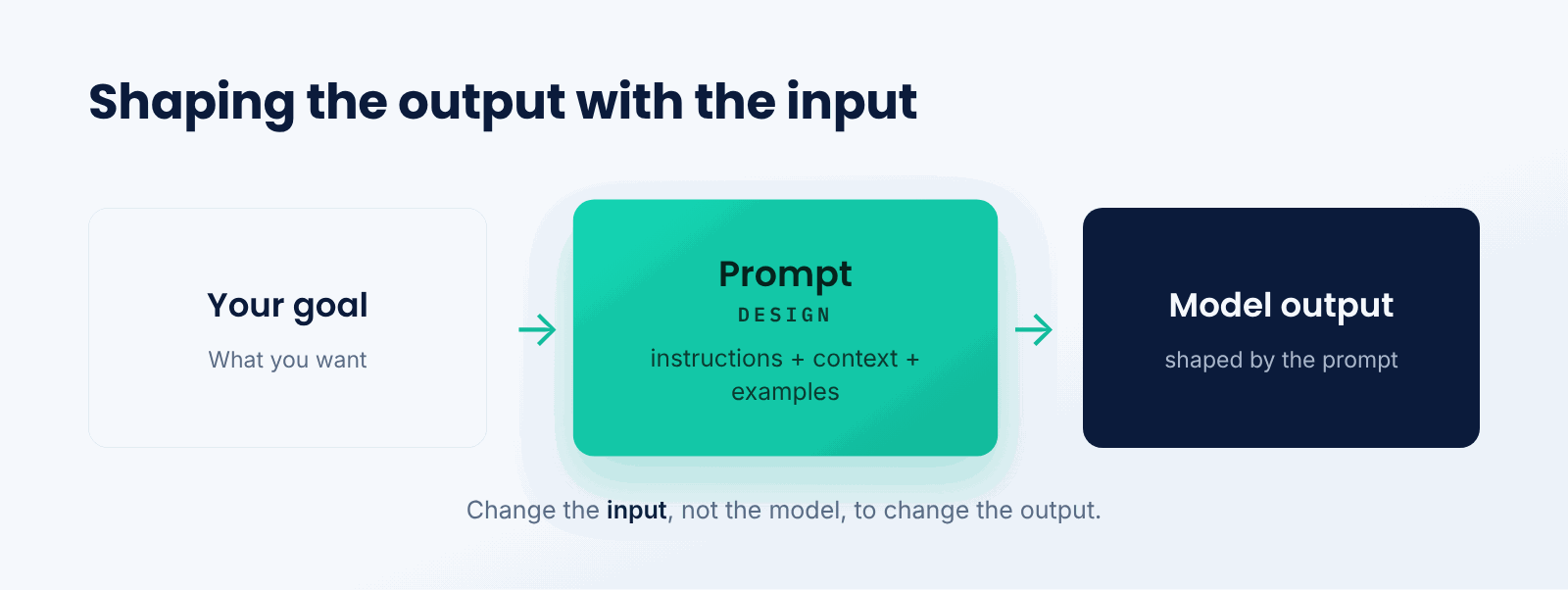
Think of briefing a capable new colleague. Give a vague request and you get a vague result; give clear goals, the relevant background, an example of what good looks like, and the format you need, and the work comes back right. A model is the same: the quality of the brief shapes the quality of the output.
The key point is that prompt engineering changes the input, not the model. You are steering a fixed model by giving it better instructions, not altering its weights.
How does prompt engineering work?
A strong prompt is built up from a few deliberate parts rather than a single line.
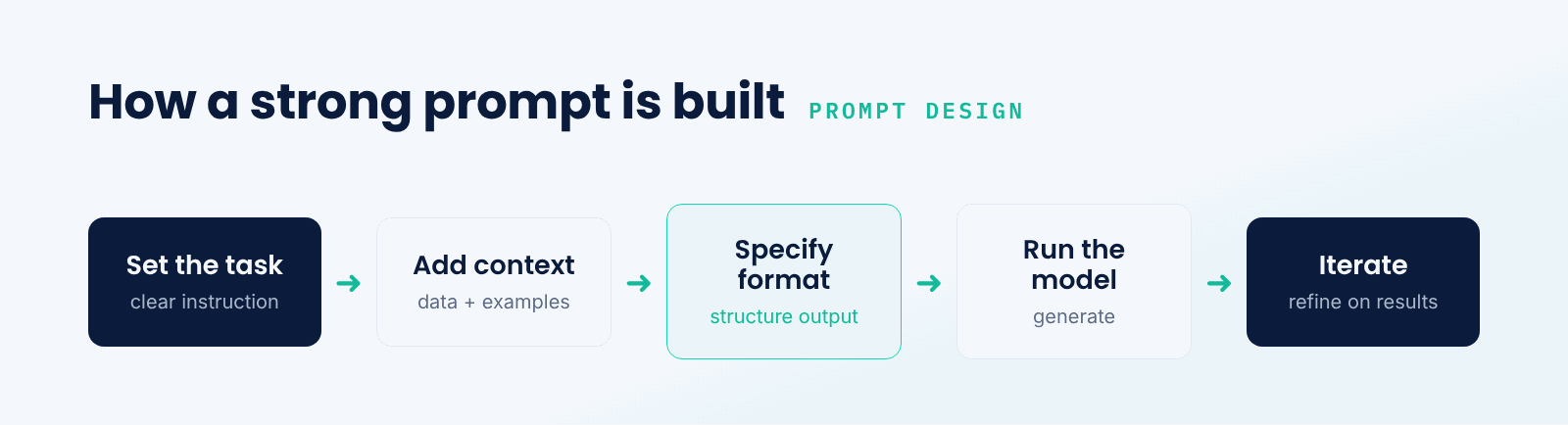
- State the task clearly. Say exactly what you want the model to do, specifically and unambiguously.
- Provide context. Include the background, data, or constraints the model needs to answer well.
- Show examples. A few examples of the input and desired output, known as few-shot prompting, guide the format and style.
- Specify the format. Ask for the structure you want, such as a list, JSON, or a fixed template.
- Iterate on results. Test the prompt on real cases, see where it fails, and refine it.
Other techniques layer on top: assigning the model a role, asking it to reason step by step, or breaking a complex task into smaller prompts. The common thread is reducing ambiguity so the model has less room to go wrong.
Prompt engineering vs. fine-tuning and RAG
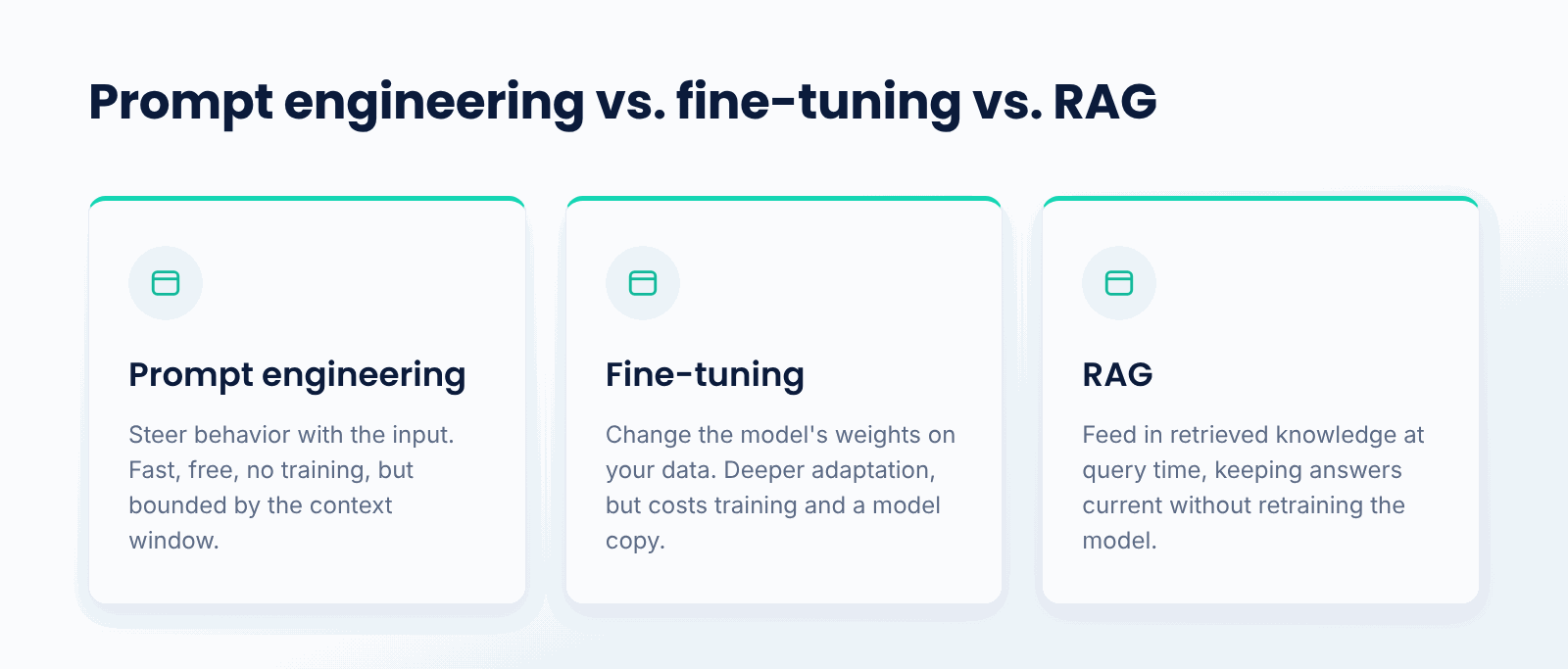
Prompt engineering is one of three main ways to steer a model, and they are complementary. Prompt engineering changes the input and is fast, free, and requires no training, but it is limited by the context window and cannot teach the model genuinely new skills. Fine-tuning changes the model's weights for deeper adaptation, at the cost of training and a model copy. Retrieval-augmented generation (RAG) feeds in relevant knowledge at query time, keeping answers current without retraining.
In practice you reach for prompt engineering first because it is the cheapest lever. You add RAG when the model needs knowledge it does not have, and fine-tuning when you need behavior that prompting cannot reliably produce.
What are common prompt engineering techniques?
- Few-shot prompting. Include examples of input and ideal output to steer format and style.
- Role prompting. Tell the model who to be, such as an expert editor, to set tone and depth.
- Chain-of-thought. Ask the model to reason step by step before answering on hard problems.
- Output formatting. Specify a structure like JSON or a template so results are easy to parse.
- Decomposition. Break a complex task into a sequence of smaller, focused prompts.
- Constraints and guardrails. State what to avoid and what rules to follow explicitly.
What are the limits of prompt engineering?
- Bounded by context. Everything must fit in the context window, which limits how much you can include.
- No new knowledge. Prompting cannot teach a model facts it never learned; that needs RAG or fine-tuning.
- Brittleness. Small wording changes can shift results, so prompts need testing and maintenance.
- Model-specific. A prompt tuned for one model may not transfer cleanly to another.
When should you invest in prompt engineering?
Always start here. For almost any task, a well-designed prompt is the fastest, cheapest way to improve results, and it is often enough on its own. Before considering retrieval or fine-tuning, it is worth getting the prompt right.
The investment grows with how much a feature depends on consistent output. Production features that run at scale deserve carefully tested, version-controlled prompts, treated as part of the system rather than an afterthought.
Best practices for prompt engineering
- Be specific and unambiguous about the task, the format, and the constraints.
- Put stable instructions first and variable input last, which also helps with prompt caching.
- Use examples to show, not just tell, the model what good output looks like.
- Test prompts against real, varied cases rather than a single happy path.
- Version and track prompts like code, since small changes affect behavior.
- Manage prompts behind a gateway so you can monitor, cache, and update them in one place.
Conclusion
Prompt engineering is the practice of designing a model's input to get reliable, high-quality output. By stating the task clearly, giving context and examples, specifying the format, and iterating, you steer a fixed model without any training. It is the first and cheapest lever for improving results, and it pairs naturally with retrieval and fine-tuning when a task needs more.
TrueFoundry's AI Gateway helps teams manage prompts in production with caching, observability, and versioning across every model, so the prompts your features depend on are easy to test, monitor, and improve. Good prompting is foundational to getting value from any LLM, and a gateway makes it manageable at scale.
Gouvernez, déployez et suivez l'IA dans votre propre infrastructure
Frequently Asked Questions
What is prompt engineering in simple terms?
It is the ability to write the input to a language model so that it generates the output you desire. It uses instructions, context, examples, and format, all without modifying the model.
Is prompt engineering the same as fine-tuning?
No. Prompt engineering alters the input and does not require training. Fine-tuning alters the weights of the model using your data. Prompting is cheaper and faster, while fine-tuning adapts the model more deeply but costs far more.
What is few-shot prompting?
Few-shot prompting involves adding a few examples of both the input and the intended output to the prompt. Through these examples, the model learns the format and style your preferred answer should take, which improves quality and consistency.
What is chain-of-thought prompting?
It asks the model to work through a problem step by step before coming to a conclusion. For complex, multi-step problems, this leads to more accurate results than simply posing the question to the model directly.
Can prompt engineering replace fine-tuning?
Often, but not always. Many times a good prompt alone will suffice. For cases where the required knowledge is not in the model, you add either retrieval or fine-tuning on top.

GenAI infra- simple, plus rapide et moins cher
Les meilleures équipes lui font confiance pour faire évoluer GenAI

- © 2022 ENSEMBLE Technologies



Abonnez-vous à notre newsletter
Les dernières nouvelles, articles et ressources envoyés dans votre boîte de réception


