


Accédez instantanément à un environnement TrueFoundry en direct. Déployez des modèles, acheminez le trafic LLM et explorez la plateforme complète : votre sandbox est prête en quelques secondes, aucune carte de crédit n'est requise.


What Is a Model Registry and How Does It Work?

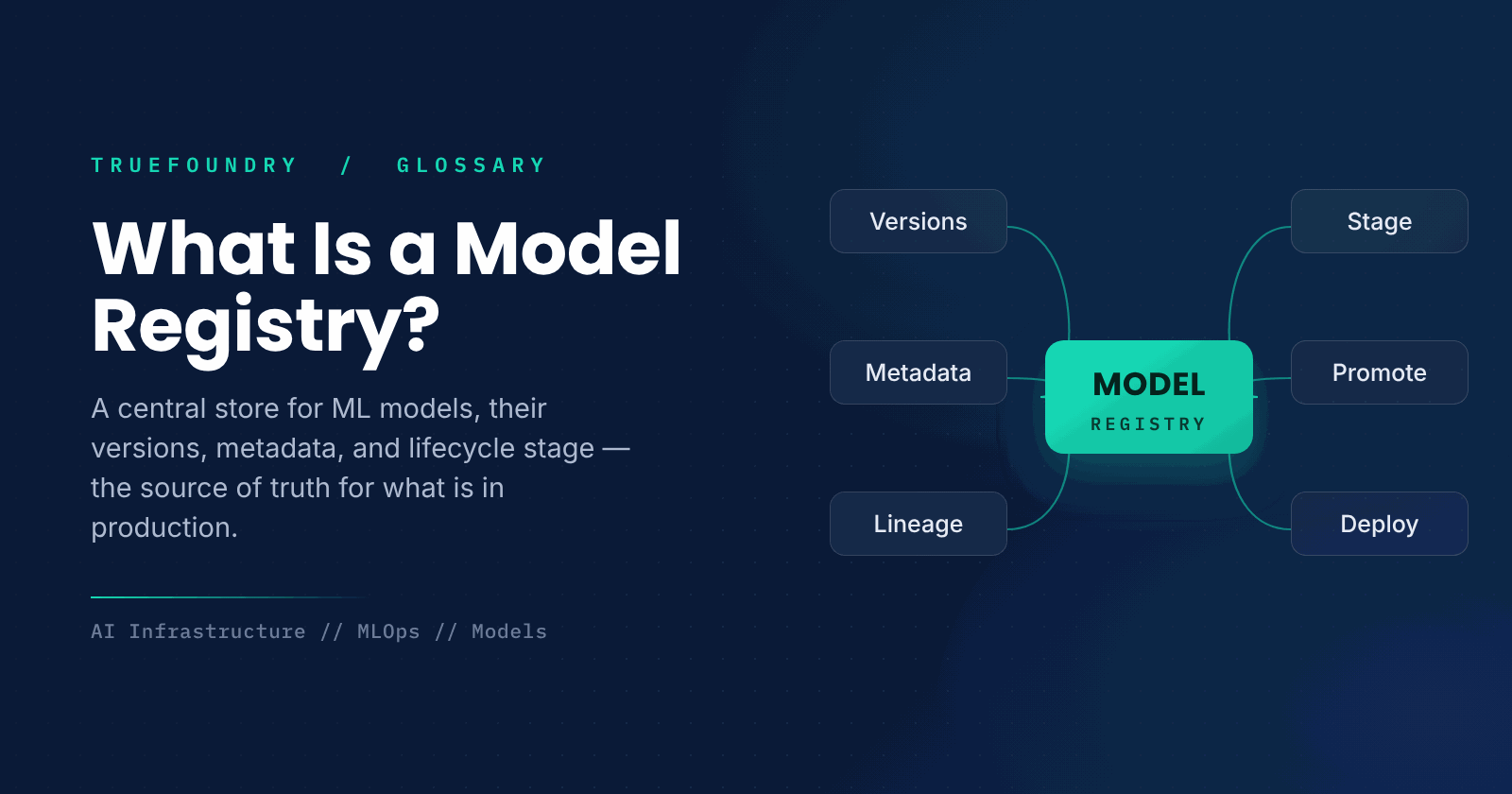
Once a team trains more than a handful of models, a question becomes urgent: which version is this, where did it come from, and which one is actually running in production? Without a system, the answers live in filenames, notebooks, and people's memories. A model registry solves that by giving every model a versioned home with its full history attached.
It is the model equivalent of a code repository or an artifact store. Instead of scattered files, you get a catalog where each model has versions, metadata, and a clear lifecycle stage, so promoting a model to production or rolling back is deliberate and traceable.
This guide explains what a model registry is, how it works, what it stores, and why it matters for operating ML reliably.
What is a model registry?
A model registry is a centralized repository for storing, versioning, and managing machine learning models throughout their lifecycle. It holds each model along with its versions and metadata, training details, performance metrics, lineage, and stage, and tracks which version is in development, staging, production, or archived.
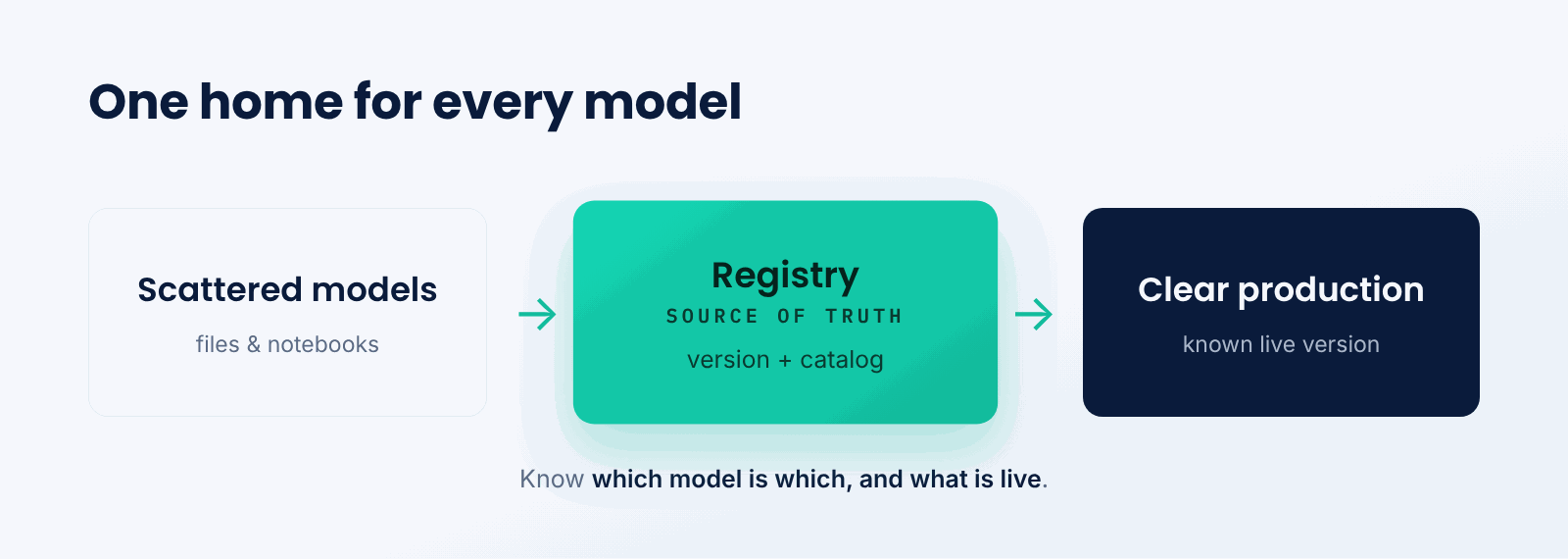
Think of it like a library catalog for models. Each model has an entry, each version is a distinct edition, and the catalog records where it came from, how good it is, and whether it is on the shelf for production use. Anyone can look up the authoritative answer rather than guessing from a filename.
The key idea is a single source of truth. Instead of models scattered across machines and notebooks, the registry is the one place that knows what exists and what is live.
How does a model registry work?
Models are registered, versioned, promoted through stages, and deployed from the registry.
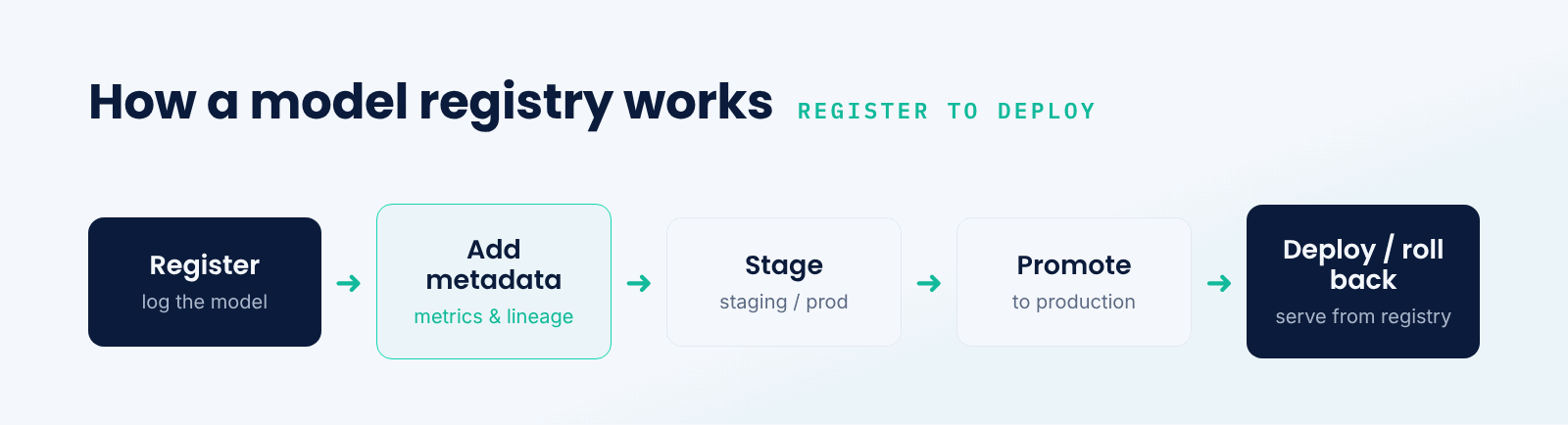
- Register. A trained model is logged to the registry as a new entry or version.
- Attach metadata. Metrics, training data, parameters, and lineage are recorded with it.
- Stage. The version is marked staging, production, or archived as it moves through its life.
- Promote. A validated version is promoted to production, becoming the deployed one.
- Deploy and roll back. Serving pulls from the registry, and you can revert to a prior version.
Because the registry tracks stages and versions, promotion and rollback become simple, controlled actions. You always know which version is live and can return to a known-good one if needed.
What does a model registry store?
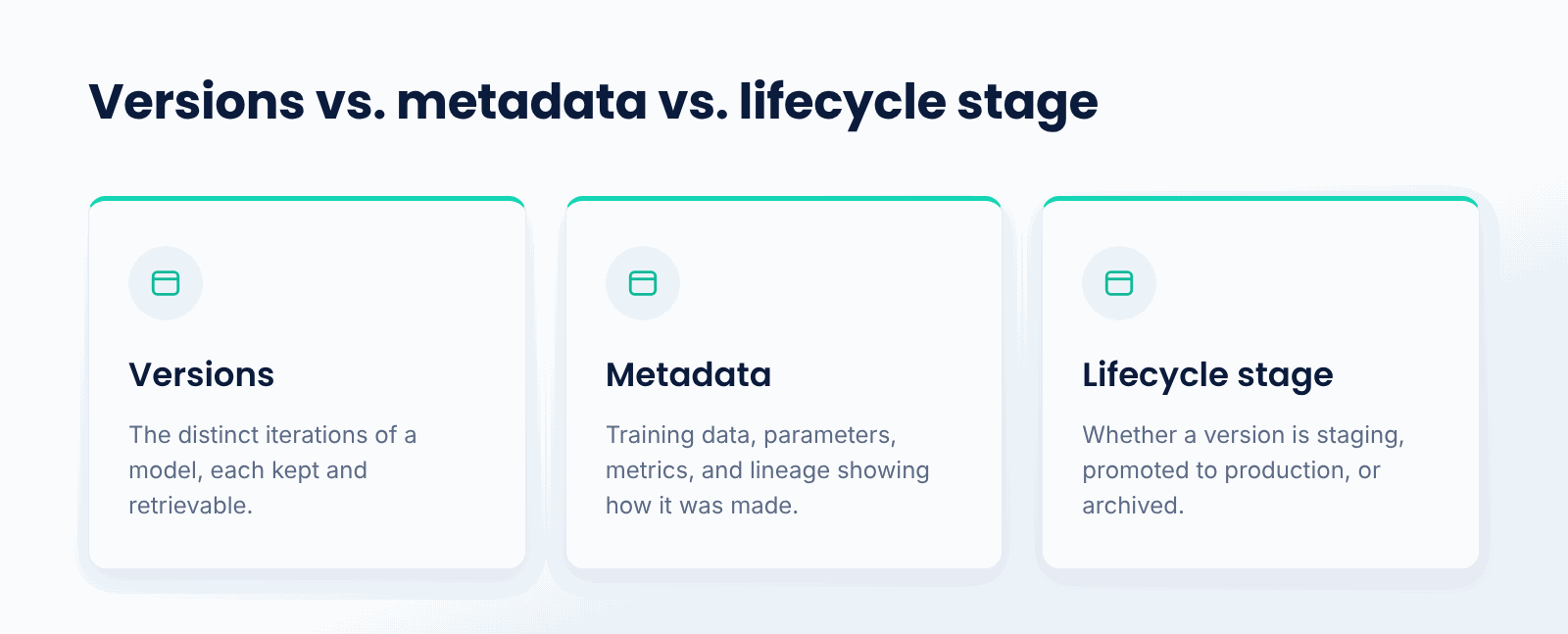
A registry holds more than the model file. Versions are the distinct iterations of a model, each kept and retrievable. Metadata is the context: training data, hyperparameters, metrics, and lineage showing how the model was produced. Lifecycle stage is the status, whether a version is in staging, promoted to production, or archived, so the deployed model is never in doubt.
Together these turn a model from an opaque file into a documented, versioned asset. You can compare versions, audit how one was made, and trust that what is in production is what you think it is.
Why does a model registry matter?
- Single source of truth. Everyone knows which model and version is live.
- Reproducibility. Metadata and lineage let you recreate and audit any model.
- Safe deployment. Staged promotion and rollback make releases controlled.
- Collaboration. Teams share and build on models through one catalog.
- Governance. Versioned, documented models support compliance and review.
What are the challenges?
- Discipline. The registry only helps if teams consistently log models to it.
- Metadata quality. Its value depends on capturing good metadata each time.
- Integration. It must connect to training pipelines and serving to be useful.
- Scale. Many models and versions need organization to stay navigable.
When do you need a model registry?
You need one once you have more than a couple of models or versions, multiple people working on them, or any model going to production. The more models you manage and the higher the stakes of deployment, the more a registry matters.
A single model in a quick experiment can live in a file. But as soon as versions multiply and models ship, a registry is what keeps track of what exists and what is live.
Best practices for a model registry
- Log every model and version to the registry, not just the final one.
- Capture rich metadata, metrics, data, parameters, and lineage, each time.
- Use clear lifecycle stages so the production version is unambiguous.
- Integrate the registry with training pipelines and serving.
- Enable rollback by keeping prior production versions available.
- Centralize the registry so all teams work from one source of truth.
Conclusion
A model registry is the central, versioned store for machine learning models and the metadata and lifecycle stage that go with them. By being the single source of truth for which model is which and what is in production, it makes deployment reproducible, controlled, and auditable. It is a foundational piece of running ML reliably, turning scattered model files into managed, trustworthy assets.
TrueFoundry gives teams a model registry alongside deployment and monitoring on their own infrastructure, so models are versioned, promoted, and served from one place. As the number of models grows, a registry is how teams keep deployment organized and dependable.
Gouvernez, déployez et suivez l'IA dans votre propre infrastructure
Frequently Asked Questions
What is a model registry in simple terms?
It is a central catalog for your machine learning models. Each model has versions and metadata, and the registry tracks which version is in staging, production, or archived, so you always know what exists and what is deployed.
What does a model registry store?
The model versions themselves, plus metadata like training data, parameters, metrics, and lineage, and each version's lifecycle stage. Together these document how each model was made and which one is currently in production.
Why do teams need a model registry?
Because without one, models live in scattered files and nobody is sure which version is live. A registry gives a single source of truth, enables reproducibility and rollback, and makes deployment controlled and auditable.
How does a model registry support deployment?
Serving pulls the production-stage version from the registry, and promotion or rollback is a controlled change of stage. You always know which version is live and can revert to a known-good one if a release goes wrong.
How does a model registry fit into MLOps?
It is a core MLOps component. Training pipelines log models to it, metadata makes them reproducible, and serving deploys from it, so the registry ties the ML lifecycle together as the source of truth for models.

GenAI infra- simple, plus rapide et moins cher
Les meilleures équipes lui font confiance pour faire évoluer GenAI

- © 2022 ENSEMBLE Technologies



Abonnez-vous à notre newsletter
Les dernières nouvelles, articles et ressources envoyés dans votre boîte de réception


