


Accédez instantanément à un environnement TrueFoundry en direct. Déployez des modèles, acheminez le trafic LLM et explorez la plateforme complète : votre sandbox est prête en quelques secondes, aucune carte de crédit n'est requise.


What Is Model Monitoring and How Does It Work?

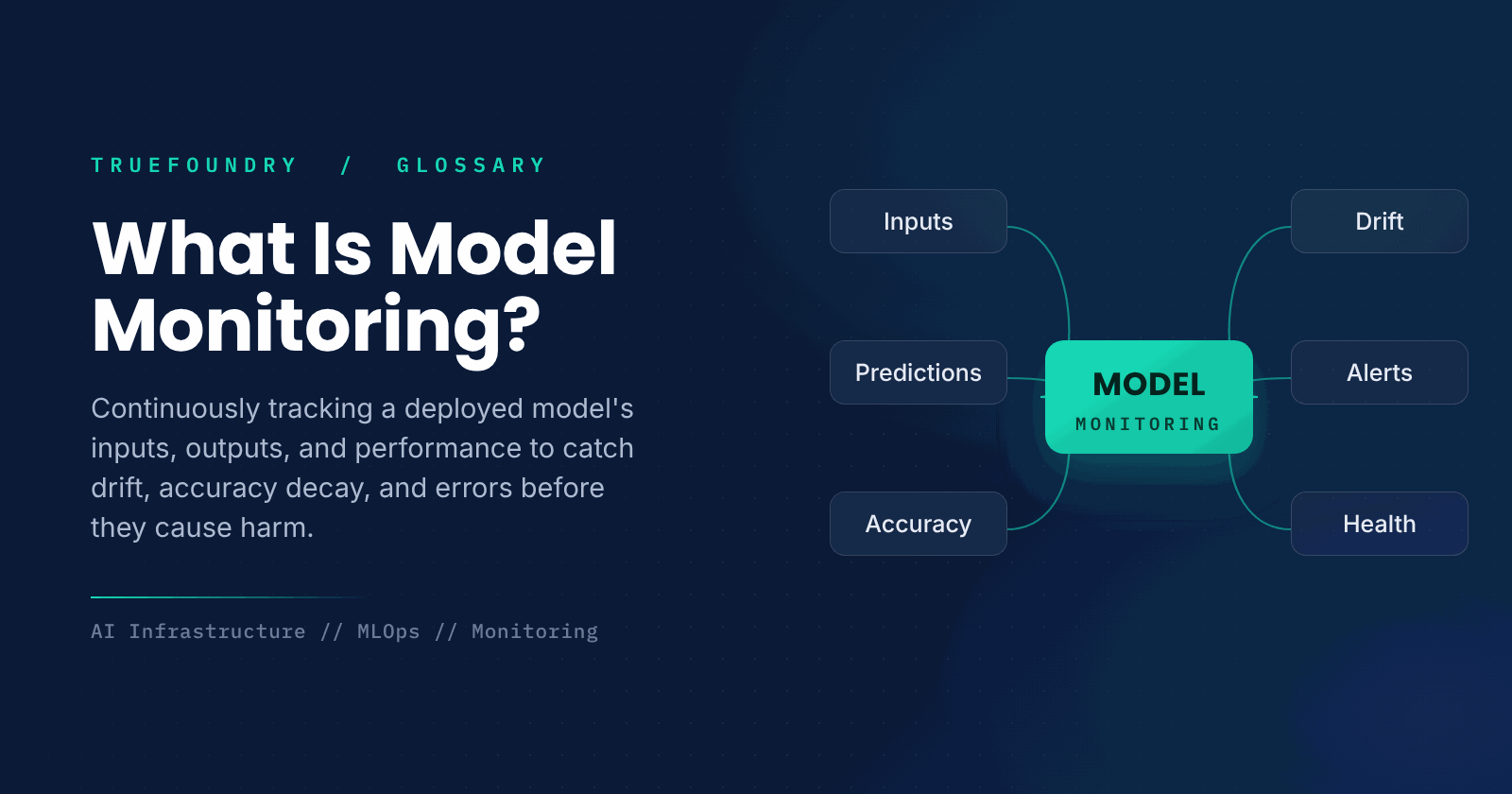
A model is not done when it ships. The world it operates in keeps changing, user behavior shifts, data moves, conditions evolve, and a model that was accurate at launch can quietly get worse. The danger is that it fails silently: it keeps returning predictions that look fine but are increasingly wrong. Model monitoring is how you catch that before it costs you.
By continuously watching what goes into a model and what comes out, monitoring surfaces drift, accuracy drops, and operational problems while there is still time to act. It turns a deployed model from a black box you hope is working into a system you can actually trust.
This guide explains what model monitoring is, how it works, the kinds of problems it catches, and why it matters.
What is model monitoring?
Model monitoring is the ongoing tracking of a deployed machine learning model's inputs, predictions, and performance to ensure it keeps working as intended. It watches for statistical drift in the data, degradation in accuracy, and operational issues like latency and errors, and alerts teams when something goes wrong.
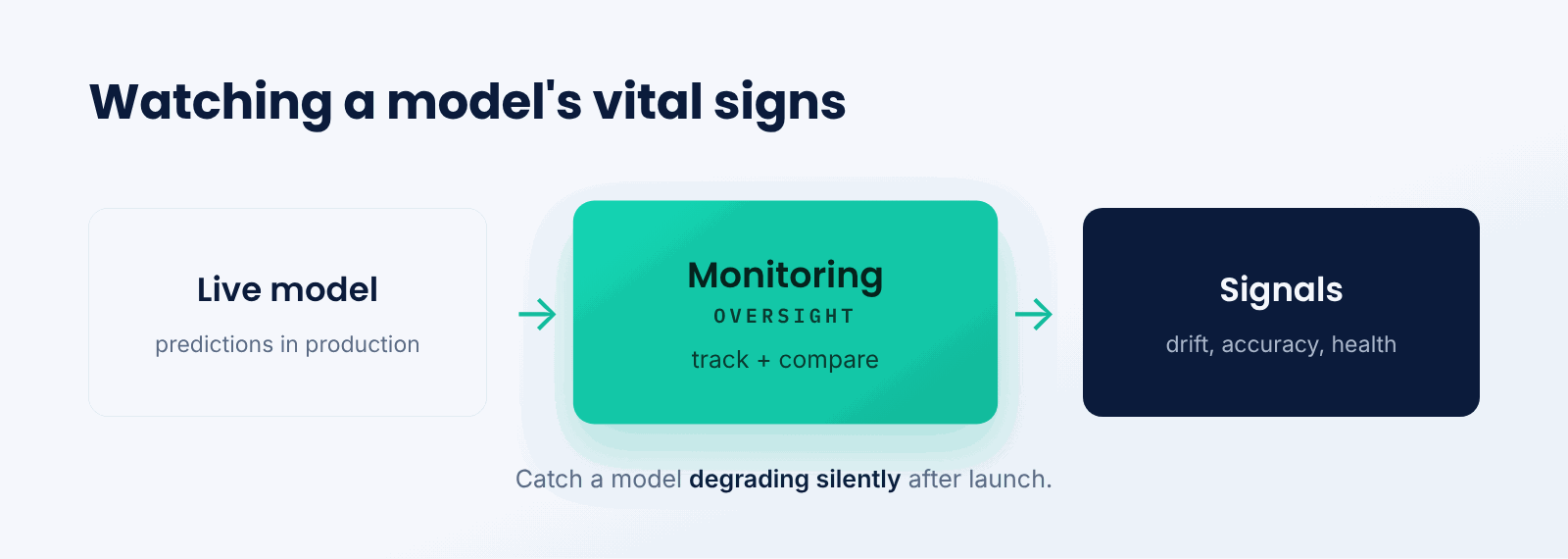
Think of it like health monitoring for a patient after surgery. The operation may have gone well, but you keep checking vital signs because problems can appear later. Model monitoring watches a model's vital signs in production, so a developing problem is caught early rather than discovered after it has done damage.
The key idea is that deployment is the start, not the end. A model's quality in production can change even though its code and weights do not, which is why continuous monitoring is necessary.
How does model monitoring work?
Monitoring captures what the live model does and compares it against expectations.
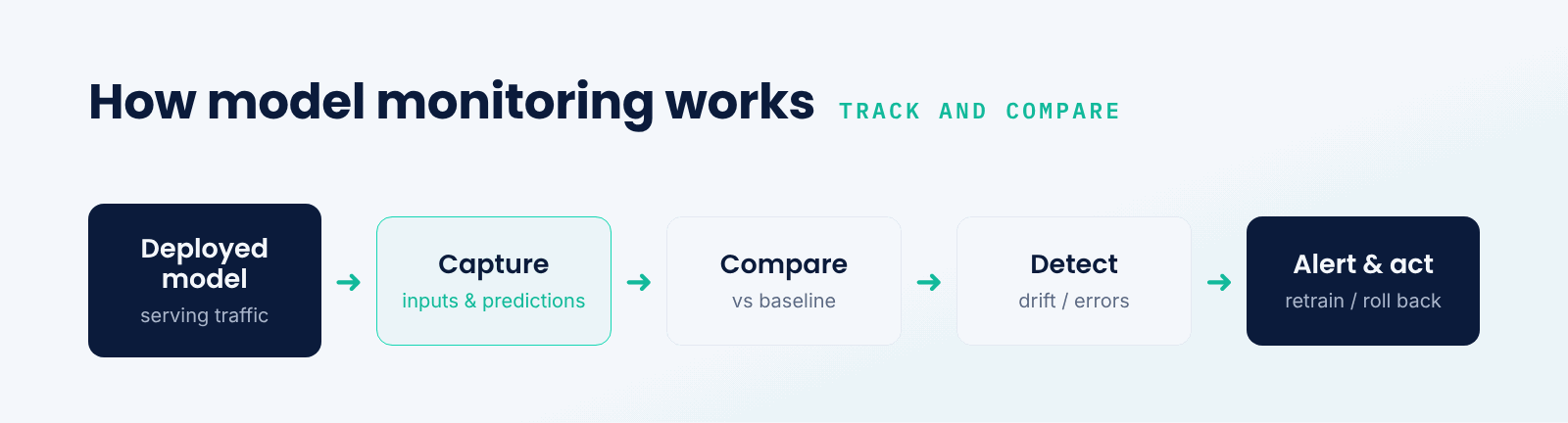
- Observe the live model. Inputs and predictions from the deployed model are captured as it serves traffic.
- Compare to a baseline. The current data and performance are checked against training data or past behavior.
- Detect problems. Drift, accuracy drops, or operational errors are identified from the comparison.
- Alert. When a metric crosses a threshold, the team is notified that something needs attention.
- Act. Depending on the issue, you retrain the model, roll back, or fix the data or serving.
Measuring accuracy in production can be tricky, since the true answer is often not known immediately. So monitoring also leans on proxy signals, like drift in the input data, that warn of trouble before accuracy numbers confirm it.
Data drift vs. concept drift vs. operational health
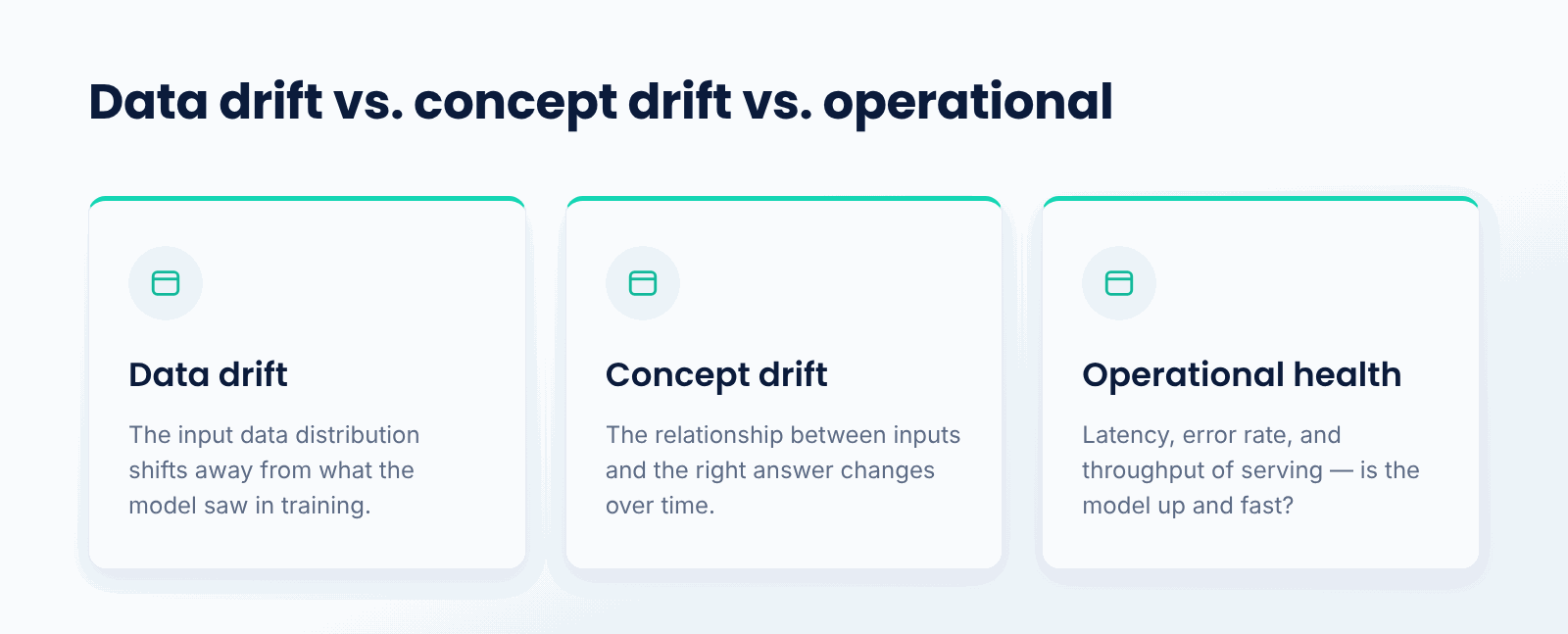
Monitoring watches for a few distinct kinds of problem. Data drift is when the input data distribution shifts away from what the model saw in training, so it faces inputs it was not prepared for. Concept drift is when the relationship between inputs and the correct answer changes over time, so even unchanged inputs now need different predictions. Operational health is the serving layer, latency, error rate, and throughput, is the model up, fast, and responding correctly?
These require different responses. Drift often calls for retraining on fresh data, while operational issues call for fixing the serving infrastructure. Good monitoring tracks all three so you can tell which kind of problem you have.
Why does model monitoring matter?
- Catches silent failure. It surfaces accuracy decay that would otherwise go unnoticed.
- Detects drift. It warns when the data or the world has shifted away from training.
- Protects outcomes. Catching problems early prevents bad predictions from causing harm or cost.
- Guides retraining. Monitoring signals tell you when a model needs refreshing.
- Ensures reliability. Tracking operational health keeps the model available and fast.
What are the challenges?
- Delayed ground truth. The true outcome often arrives late, so accuracy is hard to measure live.
- Setting thresholds. Deciding what counts as significant drift or degradation is not obvious.
- Alert fatigue. Too many alerts get ignored; too few miss real problems.
- Scale. Monitoring many models and features generates a lot of data to track.
When do you need model monitoring?
You need it for any model that is in production and whose predictions matter. Once a model is making real decisions, you cannot assume it stays accurate; the environment will shift, and monitoring is what tells you when it has.
For a one-off analysis or a model that never ships, monitoring does not apply. But for anything serving live traffic, it is a basic part of operating the model responsibly.
Best practices for model monitoring
- Track both model quality, like drift and accuracy, and operational health, like latency and errors.
- Use drift and proxy signals when true labels arrive too late to measure accuracy directly.
- Set sensible thresholds and alerts so you catch real problems without alert fatigue.
- Compare live behavior against a clear baseline from training or a known-good period.
- Have a plan for what to do on an alert, retrain, roll back, or fix the data.
- Centralize monitoring so all your models are watched consistently in one place.
Conclusion
Model monitoring continuously tracks a deployed model's inputs, outputs, and performance to catch drift, accuracy decay, and operational problems before they cause harm. Because a model can degrade silently as the world changes around it, monitoring is what turns a shipped model into one you can keep trusting. It watches both the model's quality and the health of its serving.
TrueFoundry helps teams deploy and monitor models on their own infrastructure, with performance, drift signals, and operational health tracked alongside cost in one place. Shipping a model is only the beginning, and monitoring is how teams make sure it keeps doing its job.
Gouvernez, déployez et suivez l'IA dans votre propre infrastructure
Frequently Asked Questions
What is model monitoring in simple terms?
It involves constantly watching the inputs, outputs, and performance of a deployed model to make sure it stays working. Issues such as data drift and accuracy decay, which can quietly degrade a model after launch, are caught through monitoring.
What is data drift?
Data drift occurs when the input data a model is fed in a live environment differs from the data used to train it. The model then faces inputs it was not prepared for, which can quietly degrade its accuracy even though the model itself has not changed.
What is the difference between data drift and concept drift?
Data drift is a shift in the distribution of the inputs. Concept drift is a change in the input-output relationship. Both hurt accuracy but are detected and dealt with in different ways, which is why monitoring tracks both.
Why can a model get worse after deployment?
Because the environment it operates in keeps changing. User behavior, data, and conditions shift over time, so a model that was accurate at launch can drift out of step with reality and make poor predictions even though its code and weights are unchanged.
How is monitoring different from evaluation?
Evaluation tests a model against known cases, usually before deployment. Monitoring watches the model continuously after deployment, where true answers often arrive late, so it relies on drift and operational signals as well as accuracy to catch problems.

GenAI infra- simple, plus rapide et moins cher
Les meilleures équipes lui font confiance pour faire évoluer GenAI

- © 2022 ENSEMBLE Technologies



Abonnez-vous à notre newsletter
Les dernières nouvelles, articles et ressources envoyés dans votre boîte de réception


