


Accédez instantanément à un environnement TrueFoundry en direct. Déployez des modèles, acheminez le trafic LLM et explorez la plateforme complète : votre sandbox est prête en quelques secondes, aucune carte de crédit n'est requise.


What Is an MCP Server and How Does It Work?

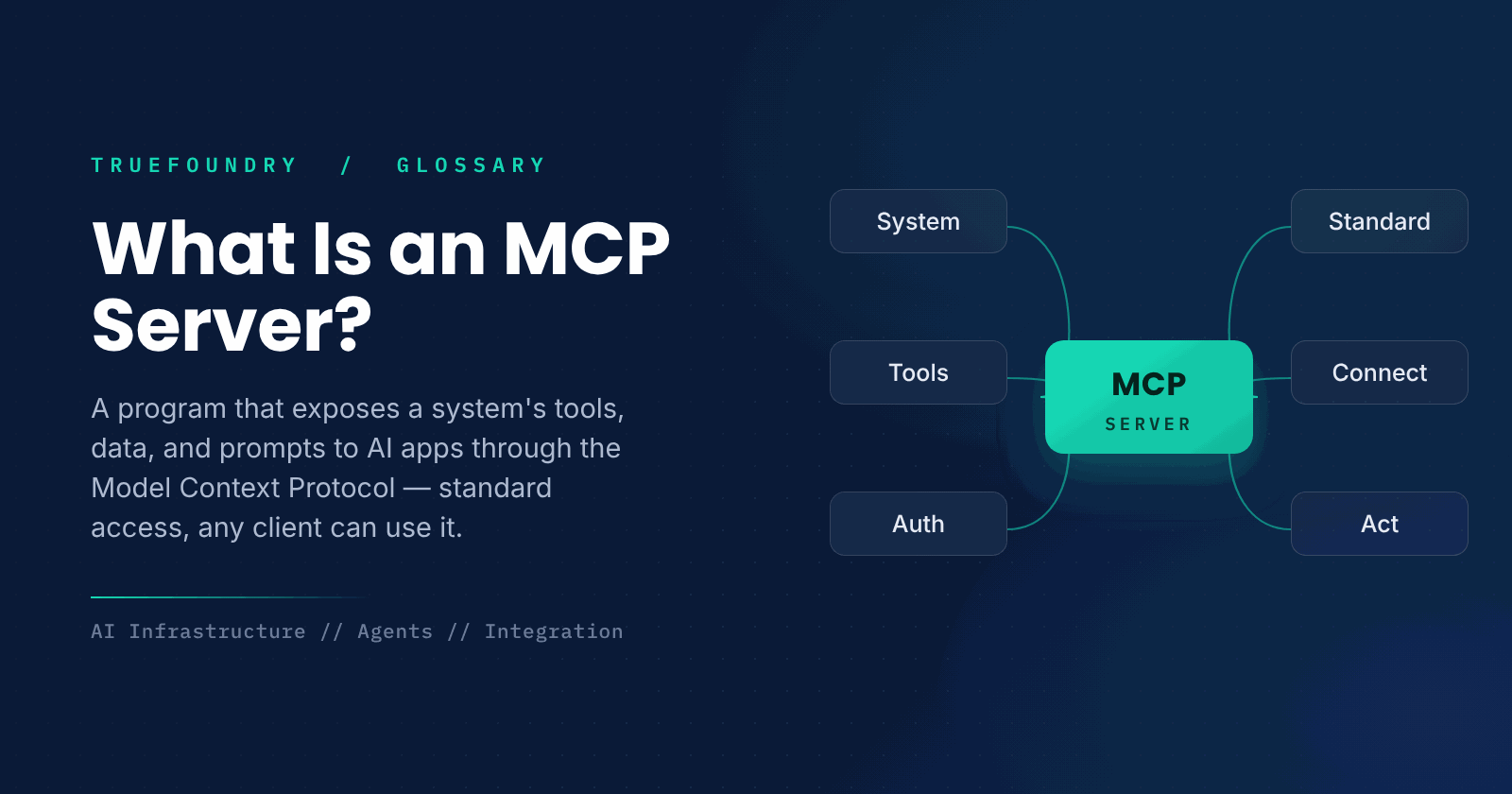
The Model Context Protocol defines how AI applications connect to the outside world, but the protocol alone does nothing. Something has to sit between it and a real system, a database, an email service, a code repository, and translate the model's requests into real actions. That something is an MCP server.
An MCP server is the concrete building block that gives a model a capability. Write one that wraps your database, and suddenly any MCP-compatible AI application can query that database safely, without a custom integration. Servers are how abstract protocol support turns into things a model can actually do.
This guide explains what an MCP server is, how it works, what it exposes, and how to build and run one well.
What is an MCP server?
An MCP server is a program that implements the Model Context Protocol to expose the capabilities of a specific system to AI applications. It advertises a set of tools the model can call, resources it can read, and prompts it can use, and it handles the real work of talking to the underlying system when those are invoked.
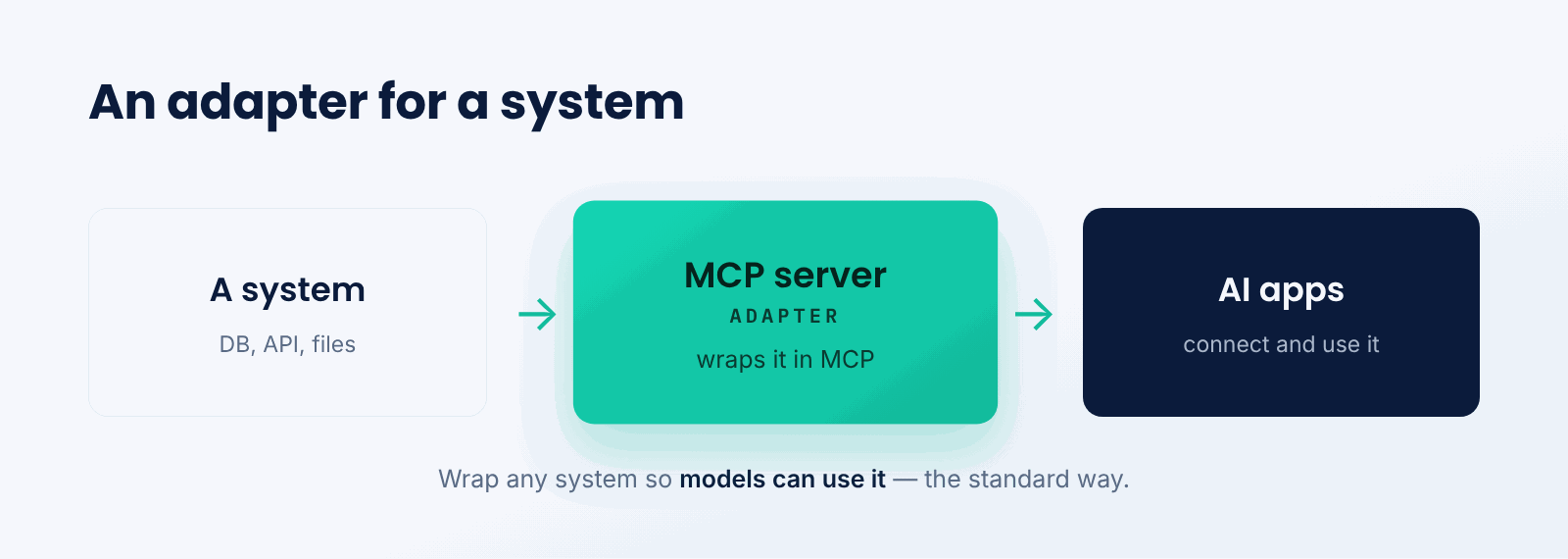
Think of it as an adapter or an API wrapper designed for AI. On one side it speaks the standard protocol that any client understands; on the other it speaks to a particular system, a database, a SaaS API, a filesystem. It translates between the two, so the model gets a clean, standard way to use something that would otherwise need bespoke code.
The key point is that an MCP server is scoped to a system and a set of capabilities. It decides exactly what a connected model is allowed to see and do, which makes it the natural place to enforce access control.
How does an MCP server work?
An MCP server waits for clients to connect and then serves their requests over the protocol.
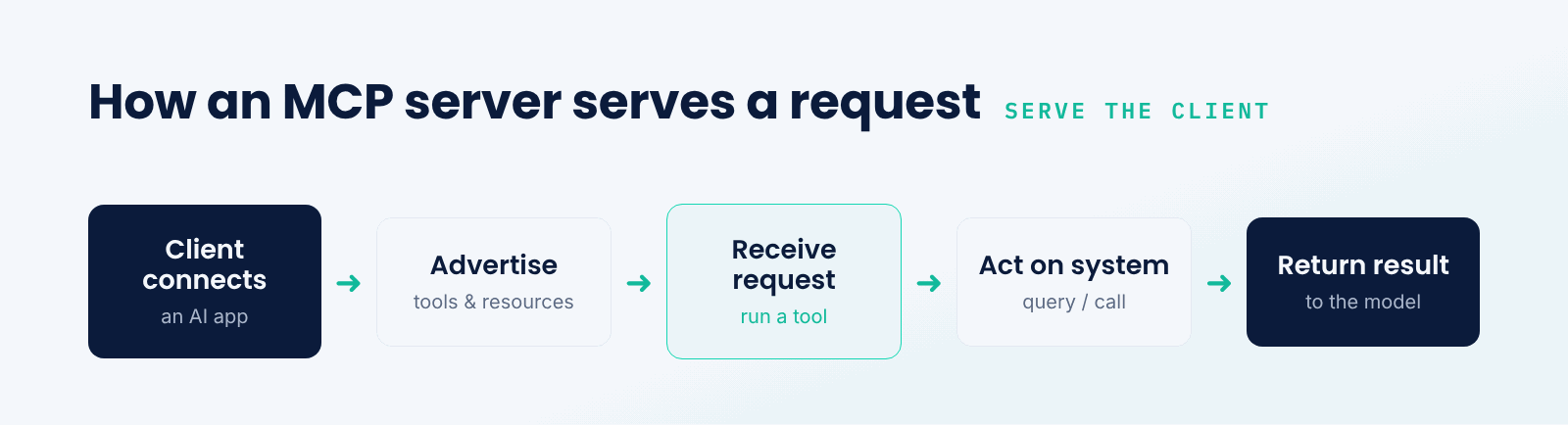
- A client connects. An AI application opens a connection to the server over the Model Context Protocol.
- Advertise capabilities. The server tells the client which tools, resources, and prompts it offers.
- Receive a request. When the model needs something, the client asks the server to run a tool or return a resource.
- Act on the system. The server authenticates and performs the real operation, like querying a database or calling an API.
- Return the result. The output goes back through the protocol into the model's context.
Because the server owns the connection to the real system, it is also where credentials live and where you decide what is permitted. A well-built server exposes only what it should and guards the rest.
Tools vs. resources vs. prompts
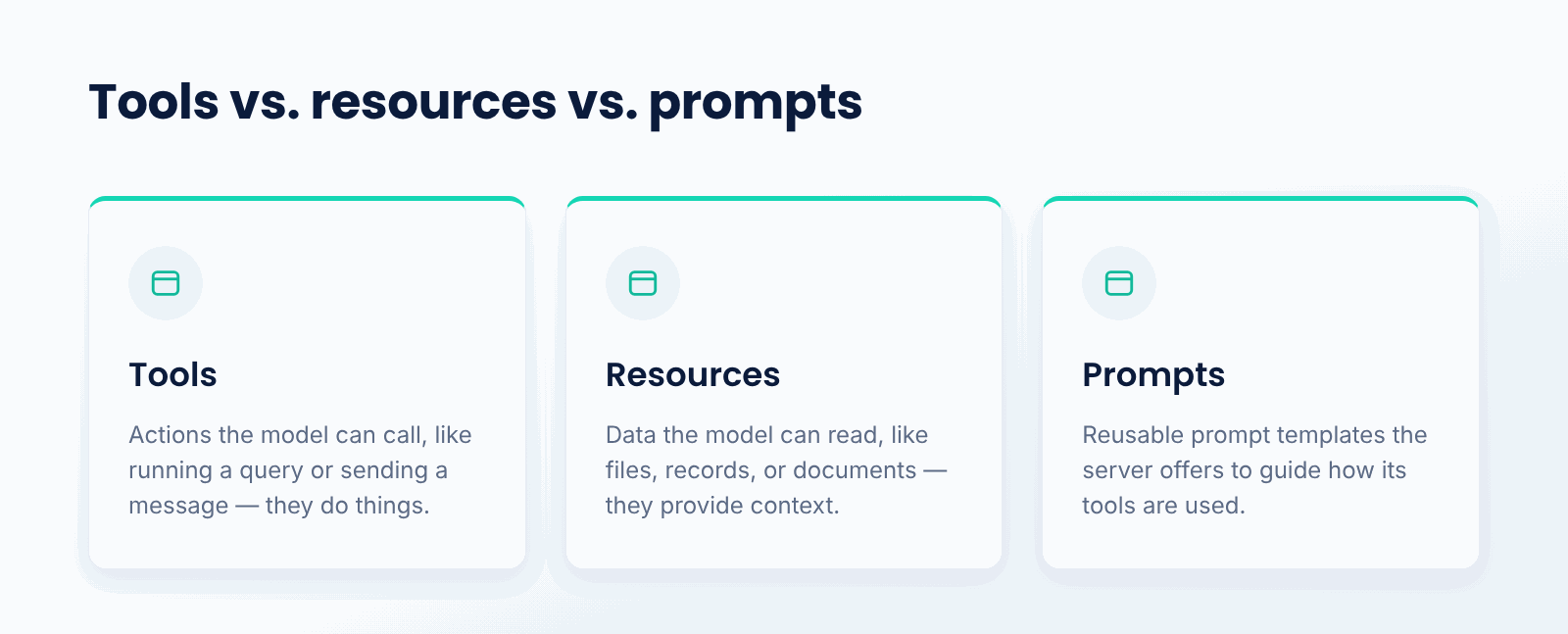
An MCP server can expose three kinds of capability. Tools are actions the model can call, such as running a query, creating a record, or sending a message; they do things. Resources are data the model can read, such as files, documents, or database records; they provide context. Prompts are reusable templates the server offers to guide how its tools and resources are used.
Together these cover reading, acting, and guidance. A single server might expose all three, letting a model both pull in the data it needs and take actions against the system it wraps.
Why build an MCP server?
- Reuse. Write it once, and any MCP-compatible client can use your system, not just one AI app.
- Standard access. It gives models a clean, uniform way to reach a system without bespoke code.
- Access control. The server decides exactly what tools and data are exposed and to whom.
- Real capabilities. It turns a model into something that can query, create, and act in your systems.
- Separation of concerns. The integration logic lives in the server, not scattered across every app.
What are the considerations?
- Security. A server can take real actions, so what it exposes must be tightly controlled.
- Authentication. It must handle credentials to the underlying system securely and per user.
- Scope. Exposing too much gives a model more power than it needs; follow least privilege.
- Reliability. Since models depend on it, the server needs to be available and well monitored.
When should you build an MCP server?
Build one whenever you want to give AI applications access to a particular system in a reusable, standard way. If more than one AI client needs to use your database, API, or internal tool, an MCP server saves you from writing a separate integration for each.
For a quick, single-use connection inside one application, a direct call may be simpler. The server pays off when the capability should be reusable, governed, and available to multiple clients.
Best practices for MCP servers
- Expose only the tools and resources that are actually needed, following least privilege.
- Handle authentication and per-user authorization securely inside the server.
- Write clear tool descriptions so the model knows when and how to use each one.
- Validate inputs and guard destructive actions behind confirmation or scoping.
- Add logging and observability so tool calls and their results can be audited.
- Run servers behind a gateway so access, credentials, and monitoring are centralized.
Conclusion
An MCP server is the program that gives a model a real capability, exposing a system's tools, data, and prompts through the Model Context Protocol. It acts as an AI-ready adapter: standard on the client side, specific on the system side, and the place where access control and credentials live. Servers are how the protocol turns into things a model can actually do.
TrueFoundry's AI Gateway helps teams connect and govern MCP servers, centralizing authentication, access control, and observability over what models can reach and do. As models gain the ability to act through MCP servers, running them behind a governed gateway is what keeps that power safe and auditable.
Gouvernez, déployez et suivez l'IA dans votre propre infrastructure
Frequently Asked Questions
What is an MCP server in simple terms?
It is a service that makes a system accessible to AI applications via the Model Context Protocol. The protocol lets the model use the system in a standardized manner, rather than requiring a separate integration for each application.
What is the difference between an MCP server and client?
The client is the AI program that requires the tools or data. The server is an encapsulation of a particular system that offers its tools, resources, and prompts. The client communicates with the server using the protocol to make use of them.
What does an MCP server expose?
Three main components are involved: tools (actions the model can perform), resources (data the model can access), and prompts (reusable templates). A client learns about them once it connects to the server.
Is it safe to connect to an MCP server?
Only if you trust it, since a server can take real actions and access data. A server should reveal only what is necessary, manage authentication correctly, and ideally be governed via a gateway that logs and controls access.
Do I need to build my own MCP server?
Not necessarily. Many servers are readily available for standard systems. You build your own when you need to interface a particular internal system in your company to AI applications, in a reusable, controlled way.

GenAI infra- simple, plus rapide et moins cher
Les meilleures équipes lui font confiance pour faire évoluer GenAI

- © 2022 ENSEMBLE Technologies



Abonnez-vous à notre newsletter
Les dernières nouvelles, articles et ressources envoyés dans votre boîte de réception


