


Accédez instantanément à un environnement TrueFoundry en direct. Déployez des modèles, acheminez le trafic LLM et explorez la plateforme complète : votre sandbox est prête en quelques secondes, aucune carte de crédit n'est requise.


What Is an LLM Jailbreak and How Does It Work?

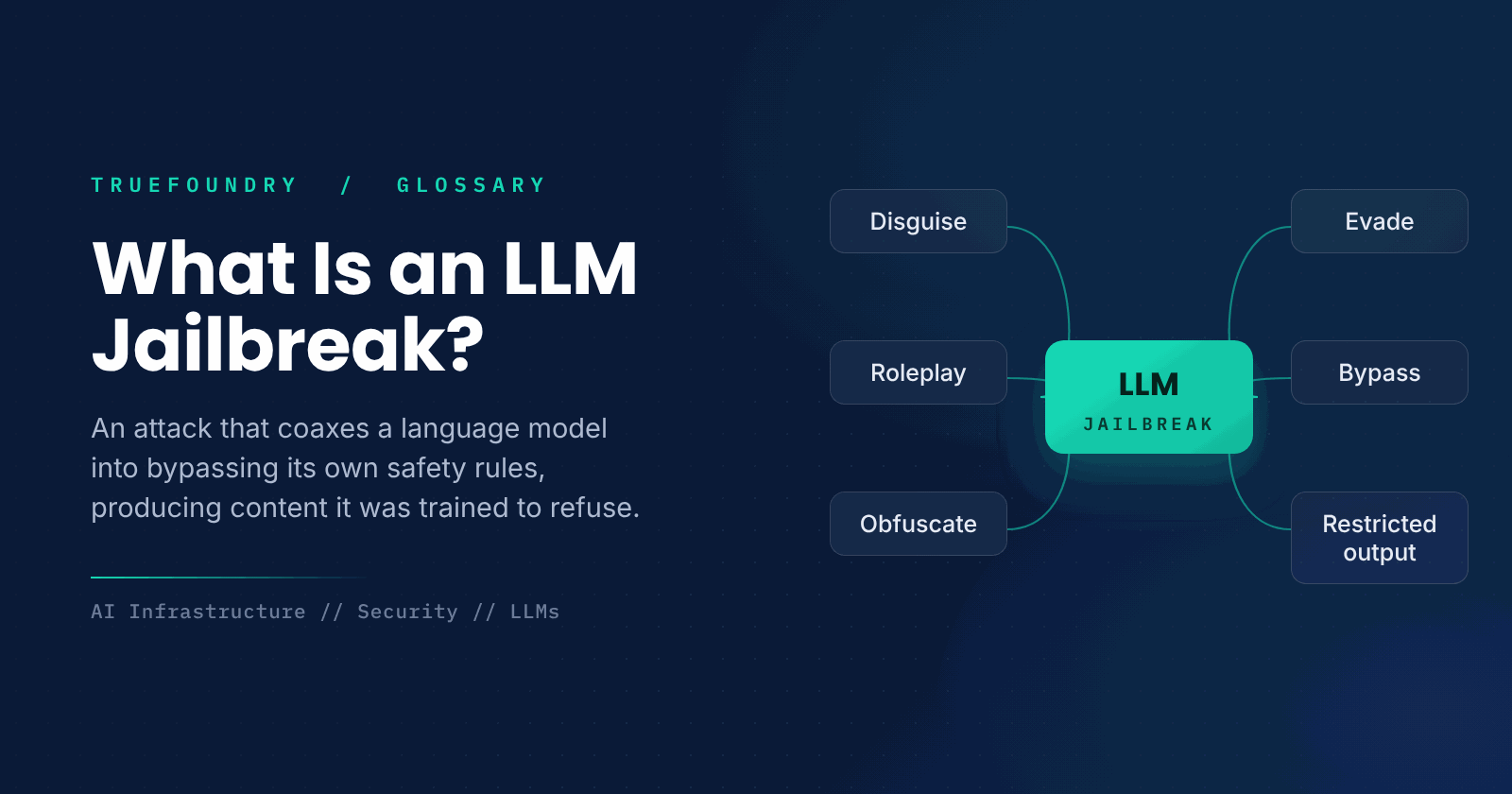
Language models are trained to refuse certain requests, harmful instructions, disallowed content, anything their safety guidelines rule out. A jailbreak is an attempt to get around those guidelines: to phrase a request so cleverly that the model answers something it would normally decline. It is one of the most studied security and safety problems in applied AI.
The reason jailbreaks are possible is that a model's safety behavior is learned, not hard-coded. It is trained to recognize and refuse certain patterns, but a sufficiently novel or disguised prompt can fall outside what it learned to refuse, slipping past the guardrails.
This guide explains what an LLM jailbreak is, how it works, common techniques, how it differs from prompt injection, and how to defend against it.
What is an LLM jailbreak?
An LLM jailbreak is a prompt, or sequence of prompts, crafted to make a language model ignore its safety guidelines and produce output it was designed to refuse. The goal is to bypass the model's trained restrictions, whether to extract harmful instructions, generate disallowed content, or make the model act outside its intended boundaries.
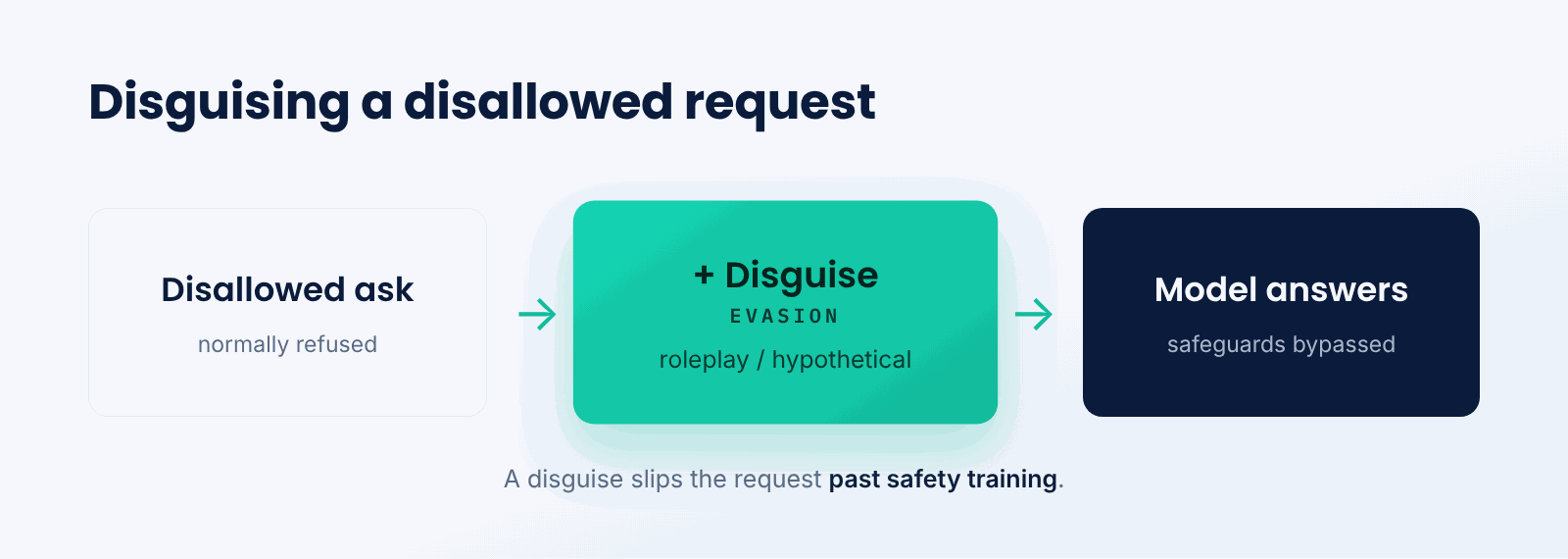
Think of the safety training as a bouncer who turns away certain requests. A jailbreak is a disguise: the same request dressed up as a hypothetical, a story, or a role the model is asked to play, so the bouncer waves it through. The underlying ask is disallowed, but its presentation is not what the model learned to stop.
The core issue is that safety is probabilistic. A model refuses what resembles its training examples of disallowed requests, so inputs that look different enough can evade refusal even when the intent is the same.
How does an LLM jailbreak work?
A jailbreak reframes a disallowed request so the model does not recognize it as one.
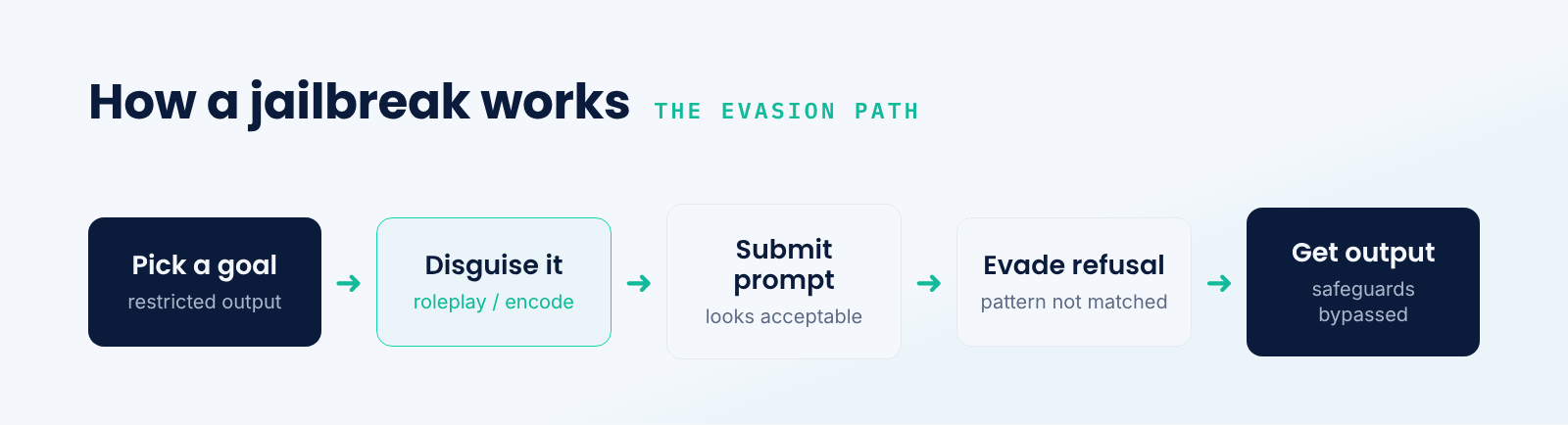
- Identify the goal. The attacker decides what restricted output they want the model to produce.
- Disguise the request. They wrap it in roleplay, a hypothetical, or encoded text to hide its intent.
- Submit the prompt. The crafted input is sent, looking different from a plain disallowed request.
- Evade refusal. The model fails to recognize the pattern it was trained to refuse.
- Obtain the output. The model produces the restricted content the safeguards should have blocked.
Because the techniques keep evolving, defending against jailbreaks is a moving target. A prompt that is patched today can be rephrased tomorrow, which is why defense relies on layered controls rather than a fixed blocklist.
Common jailbreak techniques
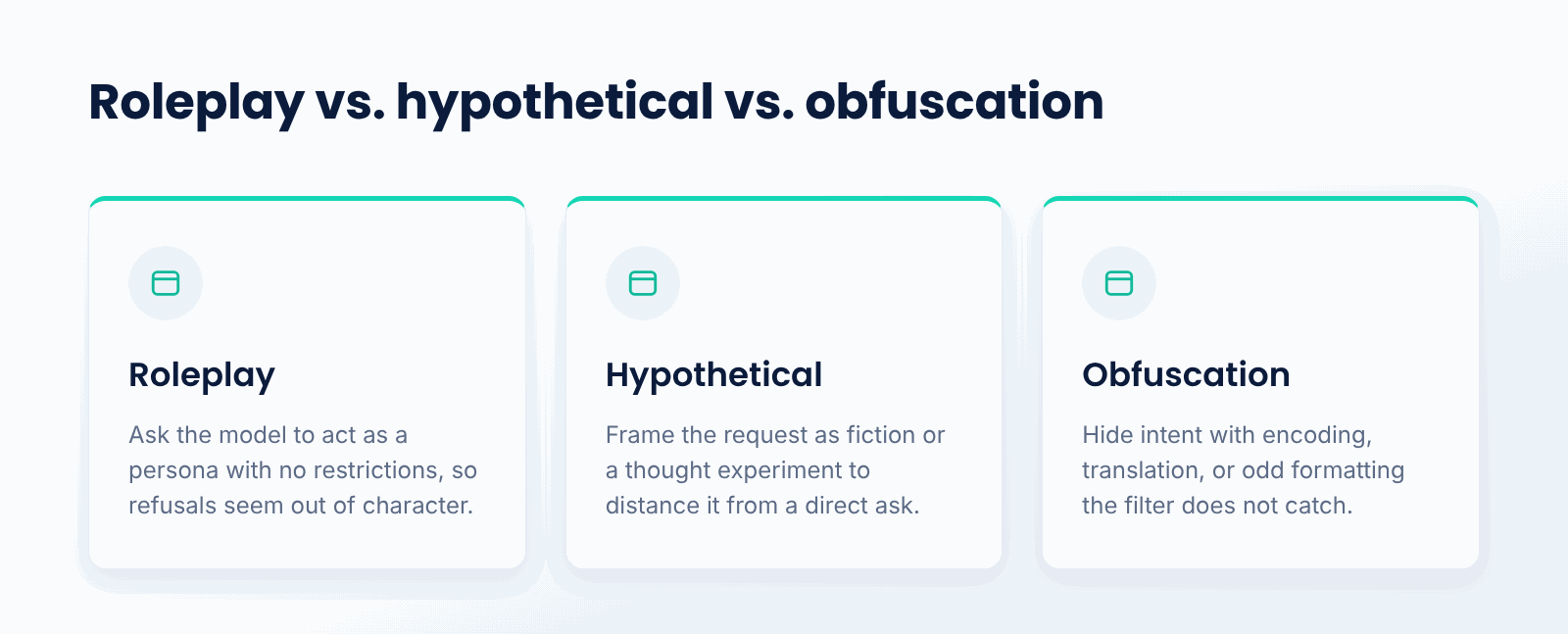
Jailbreaks take a few recognizable forms. Roleplay prompts ask the model to act as a character or persona that has no restrictions, so refusals seem out of character. Hypothetical framing presents the request as fiction, a thought experiment, or an example, distancing it from a direct ask. Obfuscation hides the intent using encoding, translation, or unusual formatting that the safety filter does not catch.
These often combine, a roleplay wrapped in a hypothetical, with key words obfuscated, to stack several evasions at once. What they share is changing the form of the request while keeping its disallowed substance, which is why robust defenses look at intent, not just surface patterns.
Jailbreak vs. prompt injection
Jailbreaks and prompt injection are related but distinct. A jailbreak targets the model's own safety guidelines, trying to make it produce content it was trained to refuse. Prompt injection targets an application's instructions, trying to override the system prompt or hijack behavior through crafted input, often via content the model reads.
They overlap because a jailbreak can be delivered through injection, and an injection can carry a jailbreak. But the distinction matters: one is about defeating safety training, the other about defeating an application's control over the model.
How do you defend against jailbreaks?
- Input guardrails. Screen prompts for known jailbreak patterns before they reach the model.
- Output guardrails. Check responses for disallowed content regardless of how the prompt was phrased.
- Intent classification. Evaluate what a request is really asking, not just its surface wording.
- Monitoring. Log and review interactions to spot new jailbreak attempts as they emerge.
- Defense in depth. Combine safeguards, since no single filter catches every technique.
When should you worry about jailbreaks?
You should consider jailbreaks for any public-facing or high-stakes LLM application, especially one that could produce harmful output if its safeguards were bypassed. The more exposed the application and the higher the stakes of a bad response, the more important jailbreak resistance becomes.
A low-risk internal tool with trusted users faces less exposure, though it is not immune. But any application where safety matters should assume jailbreak attempts will happen and design its guardrails accordingly.
Best practices for jailbreak resistance
- Layer input and output guardrails so a bypassed prompt is still caught on the response.
- Evaluate intent, not just keywords, to catch disguised and obfuscated requests.
- Keep guardrails updated as new jailbreak techniques are discovered.
- Monitor and log interactions to detect emerging attack patterns early.
- Red-team your application against known jailbreaks before and after launch.
- Enforce safeguards centrally at a gateway so every model is protected consistently.
Conclusion
An LLM jailbreak is an attack that gets a model to bypass its safety guidelines and produce content it was trained to refuse, usually by disguising a disallowed request through roleplay, hypotheticals, or obfuscation. Because safety behavior is learned rather than absolute, no single filter stops every jailbreak, and techniques keep evolving. Layered guardrails, intent analysis, and monitoring are what keep the risk in check.
TrueFoundry's AI Gateway lets teams apply input and output guardrails, screen requests for intent, and monitor traffic for abuse across every model in one layer. As LLM applications take on more exposure, defending against jailbreaks through a governed gateway is central to keeping them safe.
Gouvernez, déployez et suivez l'IA dans votre propre infrastructure
Frequently Asked Questions
What is an LLM jailbreak in simple terms?
It is fooling a language model into breaking its own safety rules so it answers something it would normally refuse. The request takes on a hidden form, usually roleplay or a hypothetical, so the model does not recognize it as disallowed.
How is a jailbreak different from prompt injection?
A jailbreak exploits the model's safety training to make it generate restricted content. Prompt injection targets an application's instructions, overriding its system prompt or hijacking its behavior. They overlap but aim at different defenses.
Why can't models just block all jailbreaks?
Because safety behavior is learned from examples, not hard-coded. The model rejects anything that resembles its training, but a sufficiently novel or disguised prompt can slip through. Techniques also keep evolving, so no single filter catches them all.
What are common jailbreak techniques?
Roleplay that asks the model to act as an unrestricted persona, hypothetical or fictional framing that distances the request, and obfuscation that hides intent with encoding or odd formatting. These are often combined to stack several evasions at once.
How do you defend against jailbreaks?
With layered defenses: input guardrails to screen prompts, output guardrails to check responses, intent classification to see past disguises, and monitoring to catch new techniques. No single safeguard is enough on its own.

GenAI infra- simple, plus rapide et moins cher
Les meilleures équipes lui font confiance pour faire évoluer GenAI

- © 2022 ENSEMBLE Technologies



Abonnez-vous à notre newsletter
Les dernières nouvelles, articles et ressources envoyés dans votre boîte de réception


