


Accédez instantanément à un environnement TrueFoundry en direct. Déployez des modèles, acheminez le trafic LLM et explorez la plateforme complète : votre sandbox est prête en quelques secondes, aucune carte de crédit n'est requise.


What Are LLM Evals and How Do They Work?

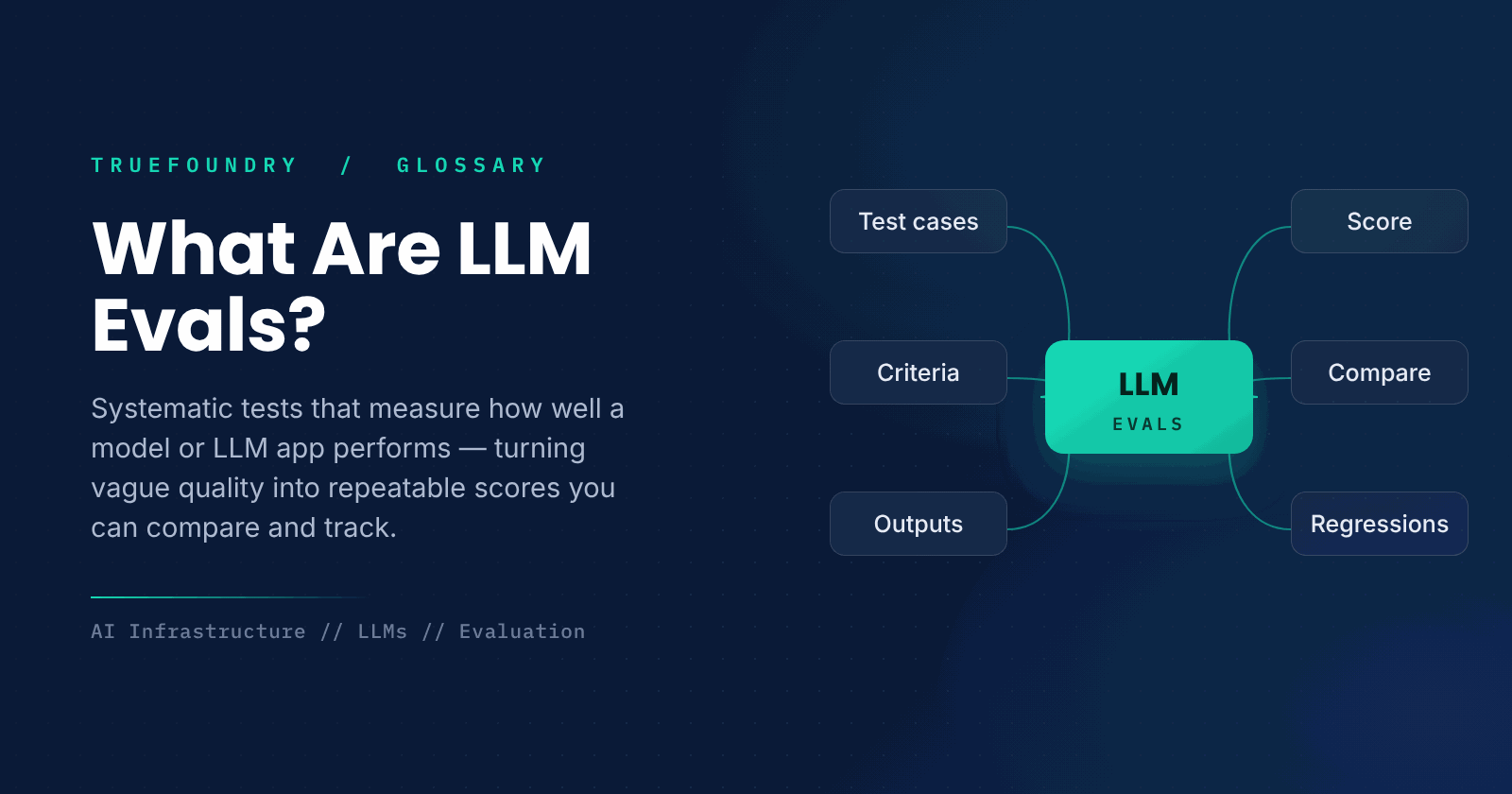
It is easy to tell when a language model gives one obviously good or bad answer. It is much harder to know whether a change to your prompt made the app better or worse across a thousand different inputs. Without a way to measure quality systematically, you are flying blind, shipping on gut feel. LLM evals are how you replace that guesswork with evidence.
Evals turn the fuzzy question is this good into repeatable numbers. You define what good looks like, run the model over a set of test cases, and score the results, so you can compare models, catch regressions before users do, and know whether a change actually helped.
This guide explains what LLM evals are, how they work, the main scoring methods, and why they matter.
What are LLM evals?
LLM evals, short for evaluations, are structured tests that measure the quality of a language model or an LLM-powered application. An eval defines a set of test cases, inputs paired with criteria for a good response, runs the model on them, and scores the outputs, producing metrics you can track and compare.
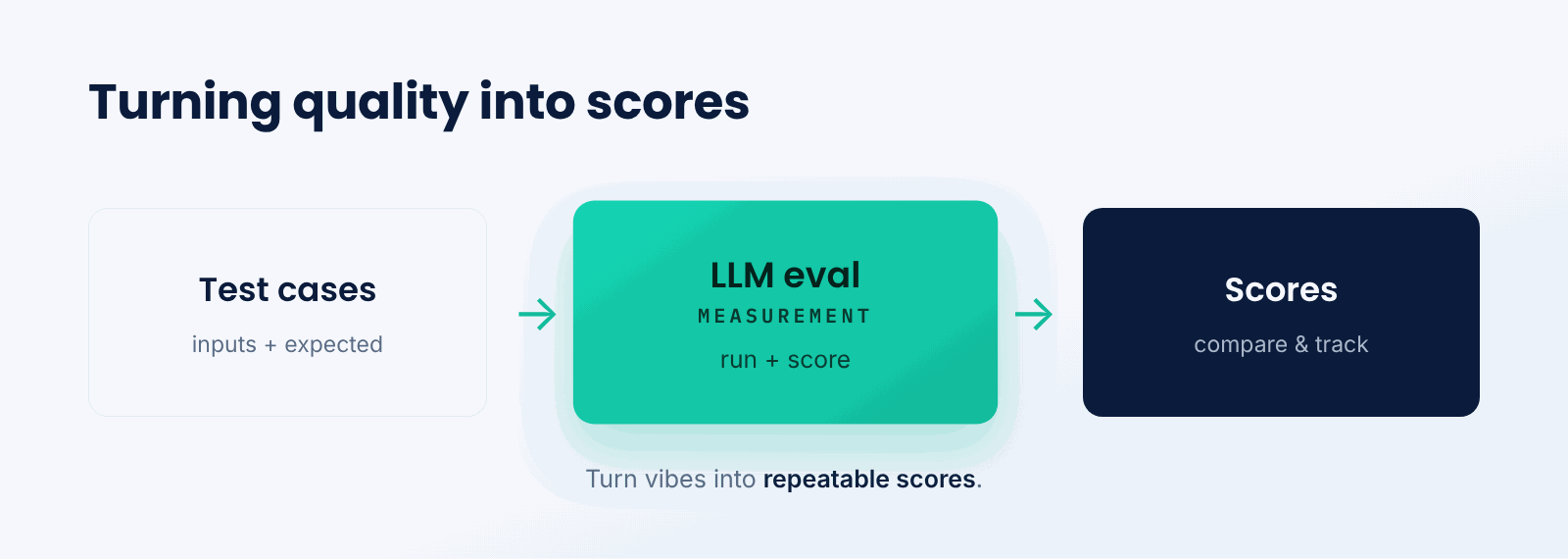
Think of them as unit tests for a model's behavior. Traditional software tests check that code returns the expected output; evals check that a model produces good responses across many cases. The difference is that quality is often a matter of degree, so scoring is richer than a simple pass or fail.
The key idea is measurement. Evals make quality observable and comparable, which is what lets you improve an LLM system deliberately instead of hoping each change helps.
How do LLM evals work?
An eval runs the model over test cases and scores the results against criteria.
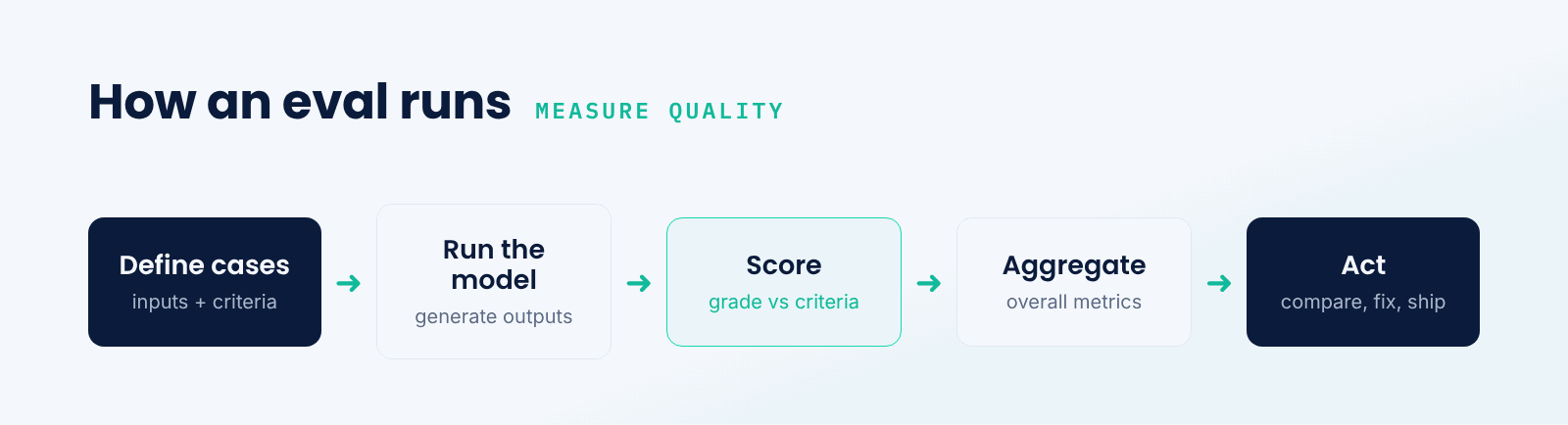
- Define the cases. Assemble a set of inputs and criteria, or expected answers, that represent the task.
- Run the model. Generate the model's output for every test case.
- Score the outputs. Grade each output against the criteria, by rules, another model, or humans.
- Aggregate the results. Combine the scores into overall metrics for the run.
- Act on them. Compare models or versions, catch regressions, and decide what to fix or ship.
The hard part is usually scoring, because many tasks have no single right answer. That is why evals use a mix of methods, from exact checks to model-graded and human scoring, depending on how open-ended the task is.
Exact-match vs. model-graded vs. human evaluation
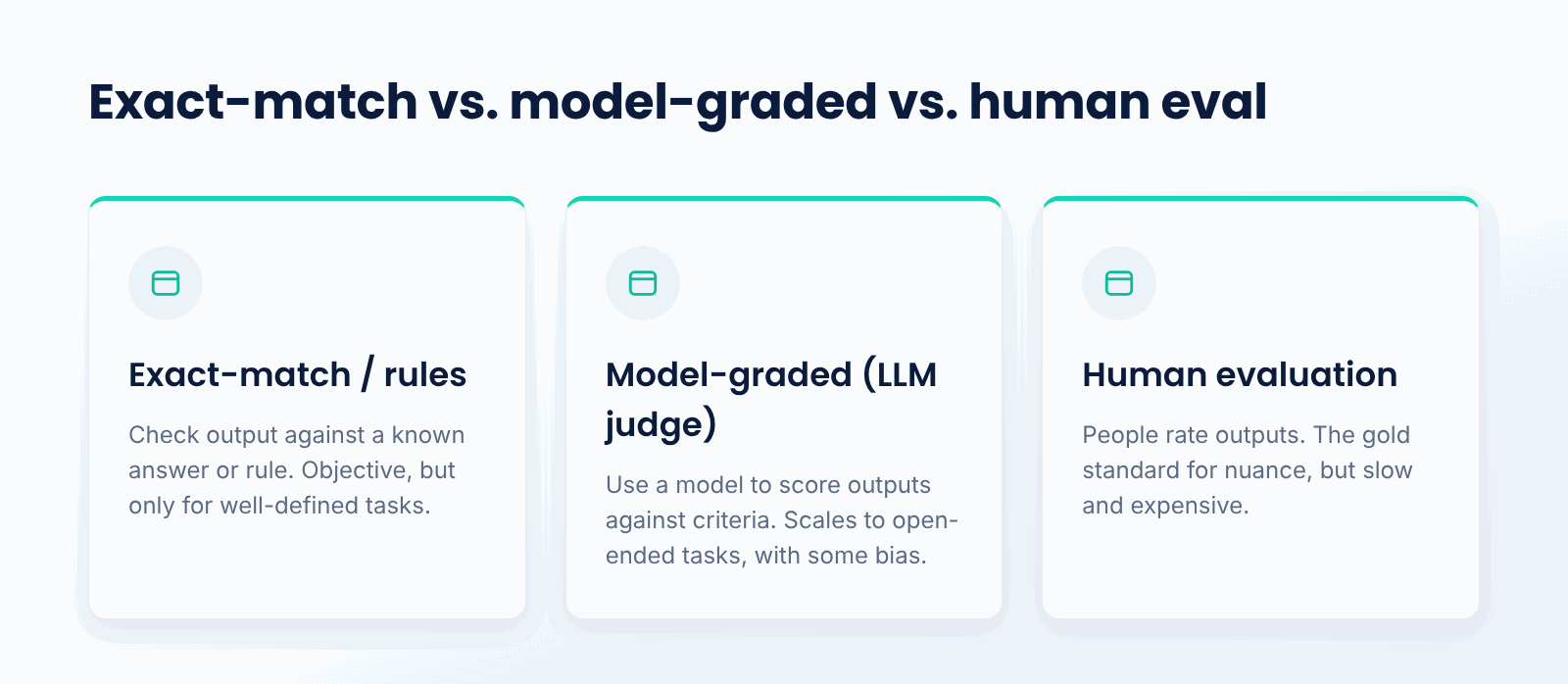
There are three broad ways to score. Exact-match or rule-based scoring checks the output against a known answer or pattern; it is objective and cheap but only works for well-defined tasks. Model-graded scoring, often called LLM-as-a-judge, uses a model to rate outputs against criteria, which scales to open-ended tasks but carries some bias. Human evaluation has people rate outputs, which is the gold standard for nuance but slow and expensive.
In practice teams combine these: rules where answers are exact, a model judge for scale, and human review for the cases that matter most. The mix depends on the task and how much a wrong score would cost.
Why do LLM evals matter?
- Compare models. Evals let you pick the best model or provider for your task on evidence.
- Catch regressions. They surface when a prompt or model change makes things worse before users do.
- Track improvement. Scores over time show whether your system is actually getting better.
- Build confidence. Measured quality is what lets you ship LLM features responsibly.
- Guide iteration. Knowing where the model fails tells you what to fix next.
What are the challenges?
- No single answer. Open-ended tasks are hard to score objectively.
- Representative cases. A test set must reflect real usage, or scores mislead.
- Judge bias. Model-graded evals inherit the judge's quirks and need calibration.
- Cost. Thorough evaluation, especially with humans, takes time and money.
When should you build evals?
You should build evals as soon as you are making changes you need to trust: tuning prompts, switching models, or shipping an LLM feature that matters. Without them, every change is a gamble, and regressions reach users before you notice.
For a quick throwaway experiment, informal checks may be enough. But any production LLM system benefits from a real eval suite, which becomes the safety net that makes iteration safe.
Best practices for LLM evals
- Build a representative test set drawn from real inputs, not just easy cases.
- Match the scoring method to the task: rules for exact answers, a judge for open-ended ones.
- Calibrate model-graded evals against human judgments to check they agree.
- Run evals automatically on every prompt or model change to catch regressions.
- Track scores over time so you can see whether the system is improving.
- Centralize evals and logging behind a gateway so quality is monitored across models.
Conclusion
LLM evals turn the vague question of whether a model is good into repeatable scores you can act on. By defining test cases, running the model, and scoring the results with the right mix of rules, model judges, and humans, evals let you compare models, catch regressions, and improve deliberately. They are the foundation that makes shipping reliable LLM features possible.
TrueFoundry's AI Gateway helps teams capture the data evals need and monitor quality across models in one layer, alongside cost and latency. Whatever you are building on an LLM, evals are how you know it works, and keep it working as you change it.
Gouvernez, déployez et suivez l'IA dans votre propre infrastructure
Frequently Asked Questions
What are LLM evals in simple terms?
These are formalized tests that evaluate how well a model or LLM application does its job. You define test cases and criteria, run the model, and grade the results, translating quality into metrics you can compare and track.
Why are LLM evals important?
Because you will not know whether a change has been positive or negative without them. Evaluations help detect regressions before users see them, allow comparisons between models on evidence, and help track whether the system is improving.
How do you score open-ended outputs?
Frequently with model-based scoring, where an additional model evaluates the output against certain criteria, or with human assessment for the most critical cases. Exact-match scoring applies only when there is one right answer.
What is the difference between evals and monitoring?
Evals test quality by comparing against known cases, normally prior to release or whenever there is an update. Monitoring and observability watch the actions the system performs in production. Together they cover both pre-release testing and live behavior.
How big should an eval set be?
Large enough to represent real usage, including the significant cases and corner cases, not only the easy ones. A few carefully selected cases are more helpful than a large number that do not represent actual system usage.

GenAI infra- simple, plus rapide et moins cher
Les meilleures équipes lui font confiance pour faire évoluer GenAI

- © 2022 ENSEMBLE Technologies



Abonnez-vous à notre newsletter
Les dernières nouvelles, articles et ressources envoyés dans votre boîte de réception


