


Accédez instantanément à un environnement TrueFoundry en direct. Déployez des modèles, acheminez le trafic LLM et explorez la plateforme complète : votre sandbox est prête en quelques secondes, aucune carte de crédit n'est requise.


What Is Data Residency and Why Does It Matter?

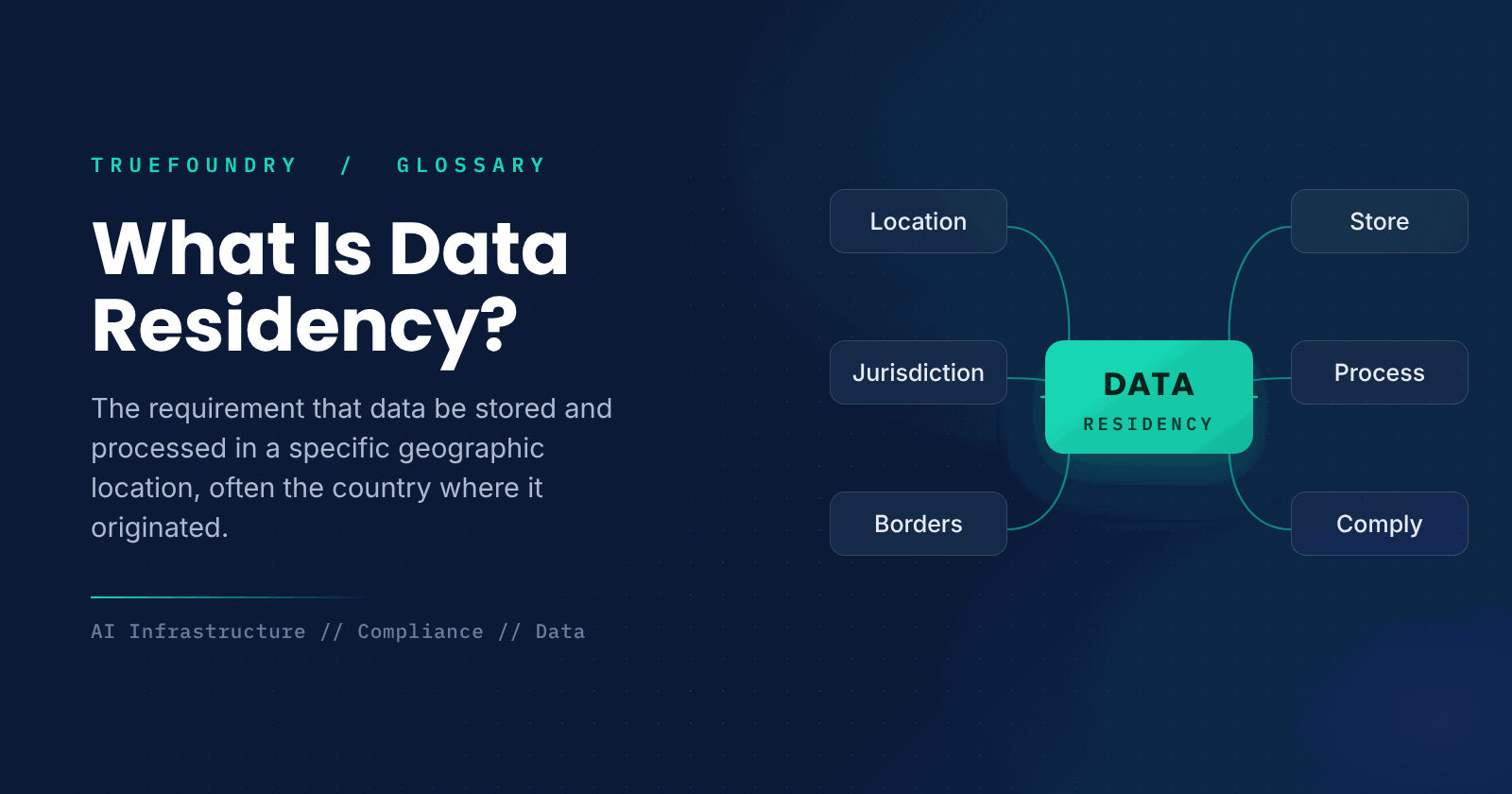
Data does not just exist, it lives somewhere physical: on servers, in data centers, in a particular country. Data residency is about where that is, and increasingly, the law has opinions. Many regulations require that certain data, especially personal data, be kept and processed within specific borders, and organizations must design their systems to comply.
For AI, this adds a dimension that is easy to overlook. When a prompt is sent to a model, the data travels to wherever that model runs, which may be another country entirely. If that data is subject to residency rules, the choice of model and where it is hosted becomes a compliance decision, not just a technical one.
This guide explains what data residency is, how it differs from related terms, why it matters, and how it shapes AI infrastructure.
What is data residency?
Data residency refers to the physical or geographic location where an organization's data is stored and processed. It is often tied to legal and regulatory requirements that mandate data, particularly personal or sensitive data, remain within a specific jurisdiction, such as the country where it was collected.
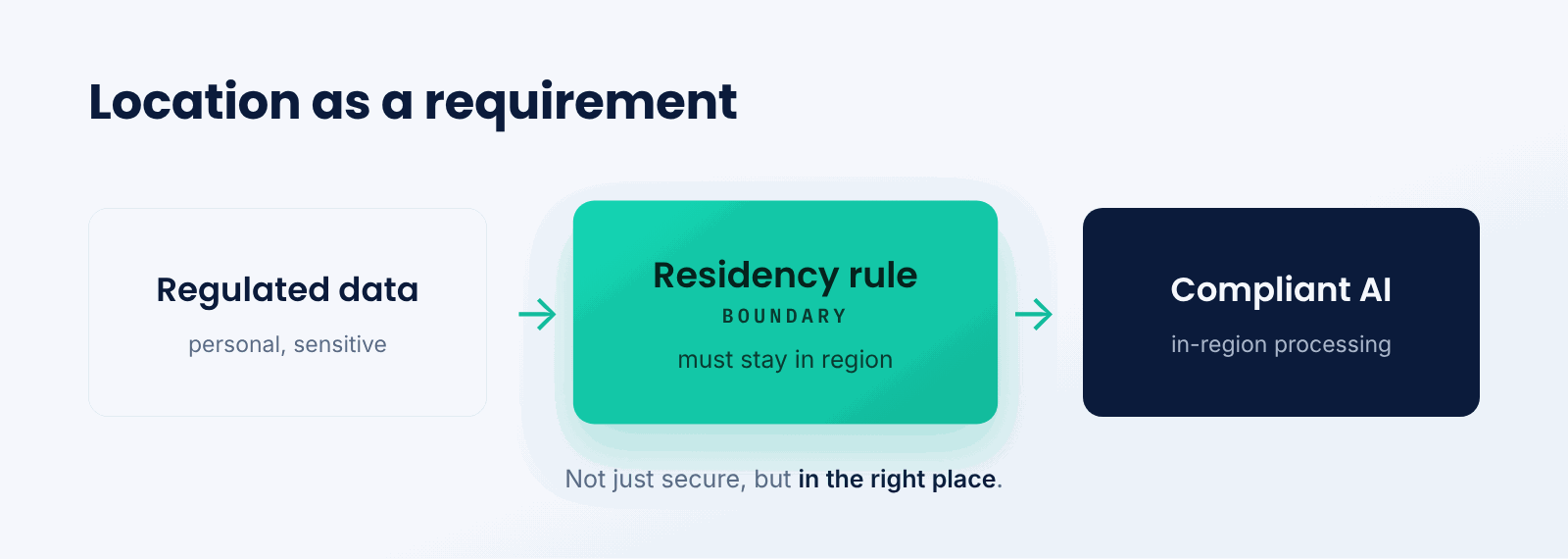
Think of it like rules about where certain records must be physically kept. Just as some documents are required by law to stay in the country, data residency requires that digital data live within defined borders. Where the data sits, not just who can see it, becomes the compliance question.
The key idea is location as a requirement. It is not enough for data to be secure; for many organizations it must also be in the right place, which constrains how and where systems can be built.
How does data residency work in practice?
Meeting residency means controlling where data is stored and where it is processed, including by AI.
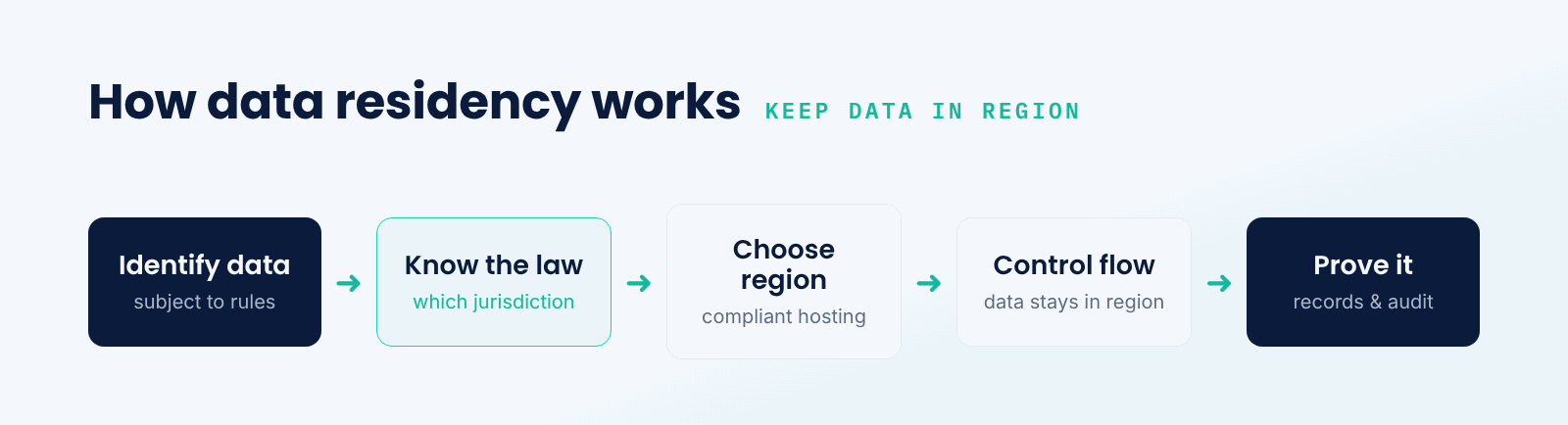
- Identify the data. Determine which data is subject to residency rules and where it originates.
- Know the requirements. Map the laws that dictate where that data must stay.
- Choose locations. Select storage and processing regions that satisfy the rules.
- Control the flow. Ensure data, including AI prompts, does not leave the required region.
- Prove compliance. Keep records showing where data is stored and processed.
For AI specifically, this often means using models hosted in the required region, or running models on your own infrastructure, so that sensitive prompts never cross a border they are not allowed to.
Residency vs. sovereignty vs. localization
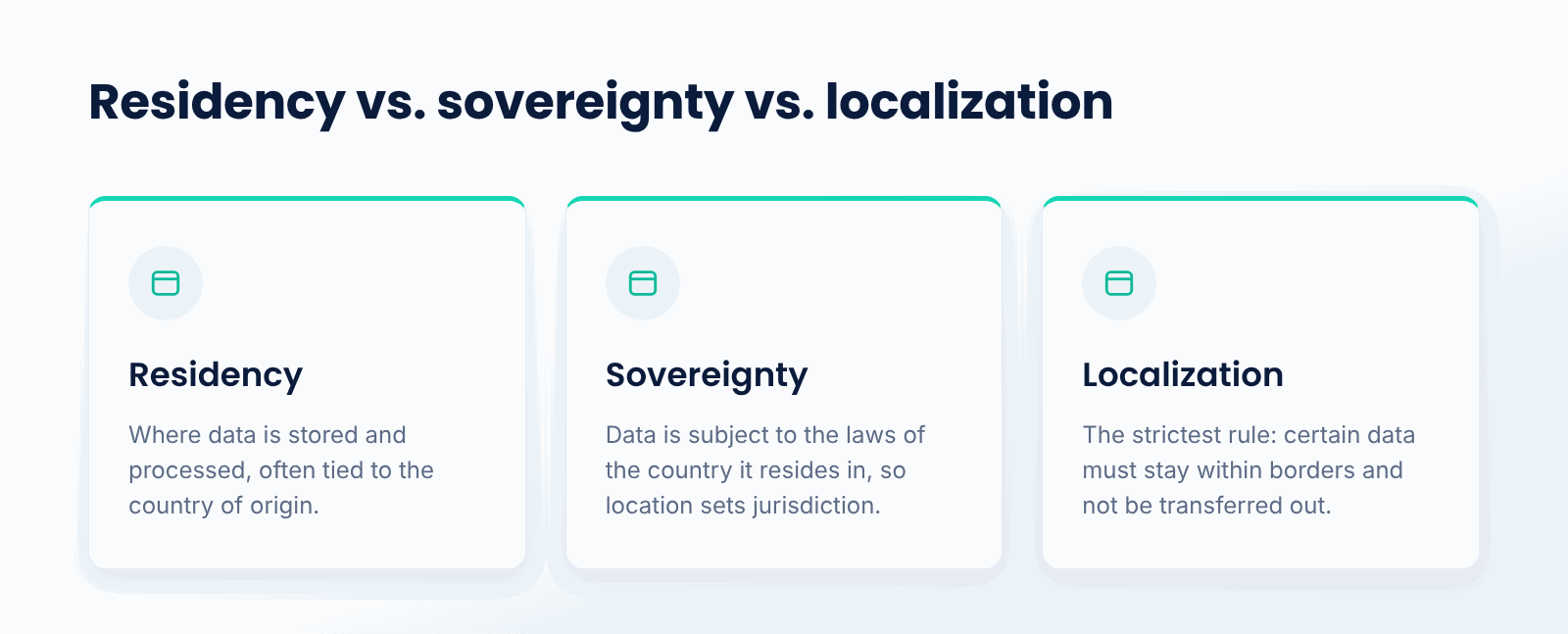
A few related terms are often confused. Data residency is simply where data is stored and processed. Data sovereignty goes further: data is subject to the laws of the country it resides in, so location determines legal jurisdiction. Data localization is the strictest, a legal requirement that certain data be kept within a country's borders and not transferred out at all.
The distinction matters because the obligations differ. Residency is about choosing a location; sovereignty is about whose laws apply; localization is a hard rule against moving data. Many AI compliance questions involve all three at once.
Why does data residency matter?
- Legal compliance. Many laws require data to stay within specific jurisdictions.
- Privacy protection. Residency keeps personal data under the intended legal protections.
- Customer trust. Organizations must assure customers their data stays where promised.
- AI constraints. It dictates which models and hosting options are even permissible.
- Avoiding penalties. Violations can bring significant fines and reputational damage.
What are the challenges?
- Global services. Many AI providers process data across regions by default.
- Complexity. Rules differ by country, data type, and industry, and keep changing.
- Tradeoffs. In-region options may be fewer, costlier, or less capable.
- Visibility. Proving where data actually goes requires control and logging.
When does data residency matter for you?
It matters whenever you handle personal or regulated data subject to location rules, which is common in finance, healthcare, government, and any business operating across borders. The more regulated your data and the more regions you operate in, the more residency shapes your choices.
A project using only non-personal, unregulated data has few residency concerns. But as soon as regulated data and AI processing meet, where that processing happens becomes a decision you must make deliberately.
Best practices for data residency
- Map which data is subject to residency rules and in which jurisdictions.
- Choose model hosting and storage regions that satisfy those rules.
- Keep AI prompts and responses within the required region where mandated.
- Prefer in-region or self-hosted models for sensitive, regulated data.
- Log and document where data is stored and processed for audits.
- Use a gateway to route AI traffic to compliant, region-appropriate models.
Conclusion
Data residency is the requirement that data be stored and processed in a specific geographic location, driven by privacy laws, sovereignty, and industry rules. For AI, it determines where prompts and data may be processed and therefore which models and hosting options are permissible. Meeting it often means keeping data in-region or on your own infrastructure, with clear records to prove compliance.
TrueFoundry lets teams deploy and route AI on their own infrastructure and in chosen regions, so sensitive data stays where regulations require. As data residency rules tighten, controlling where AI processing happens is central to using AI compliantly.
Gouvernez, déployez et suivez l'IA dans votre propre infrastructure
Frequently Asked Questions
What is data residency in simple terms?
It is where your data is physically stored and processed. A lot of legislation mandates that certain data, especially personal data, be housed only within certain regions, so residency becomes a compliance requirement, not just a technical detail.
What is the difference between data residency and data sovereignty?
Residency is basically the physical storage and processing of data. Sovereignty refers to the legal jurisdiction of the particular nation where the data resides, so its location determines which laws govern it. Sovereignty is an extension of residency.
Why does data residency matter for AI?
Because sending a prompt to a model moves the data to wherever that model is located, which could even be across a border. If the data is subject to residency rules, the choice of model and its hosting region becomes a compliance decision.
How do you meet data residency requirements for AI?
By using models hosted in the required region or running models on your own infrastructure, so sensitive prompts never leave the permitted jurisdiction, and by logging where data is stored and processed to prove it.

GenAI infra- simple, plus rapide et moins cher
Les meilleures équipes lui font confiance pour faire évoluer GenAI

- © 2022 ENSEMBLE Technologies



Abonnez-vous à notre newsletter
Les dernières nouvelles, articles et ressources envoyés dans votre boîte de réception


