


Obtenga acceso instantáneo a un entorno TrueFoundry en vivo. Implemente modelos, dirija el tráfico de LLM y explore la plataforma completa: su sandbox estará listo en segundos, sin necesidad de tarjeta de crédito.


What is human-in-the-loop (HITL) in AI and ML?

.webp)
Artificial intelligence has transformed how businesses automate tasks, analyze data, and make decisions. While today's AI systems are faster and more capable than ever, they aren't perfect. They can still misinterpret context, struggle with complex scenarios, or produce inaccurate results when human judgment is needed.
For organizations, these limitations can affect accuracy, compliance, and user trust. That's why many AI systems aren't designed to work entirely on their own. And this is where the HITL approach comes into the picture. They combine the speed of machine learning with human expertise to improve decision-making and continuously refine performance.
Let us understand what human-in-the-loop is, how it works, and more in this article.
H2: What is human-in-the-loop?
Human-in-the-loop (HITL) is an approach in AI and machine learning where humans actively participate in training, evaluating, or improving AI systems.
In simple terms, HITL means that AI doesn't work completely alone. Humans step in at different stages to provide guidance, review outputs, correct mistakes, label data, or make final decisions when necessary.
Think of it like teaching a new employee. The employee may learn quickly, but they still need supervision, feedback, and corrections to perform well. Similarly, AI models become more accurate when humans help them learn and improve over time.
Human involvement can happen before, during, or after the AI makes a decision. Depending on the application, people may provide training data, validate predictions, or oversee critical outcomes.
The main goal of HITL is to create AI systems that are more accurate, trustworthy, and aligned with human expectations.
H2: How does human-in-the-loop work?
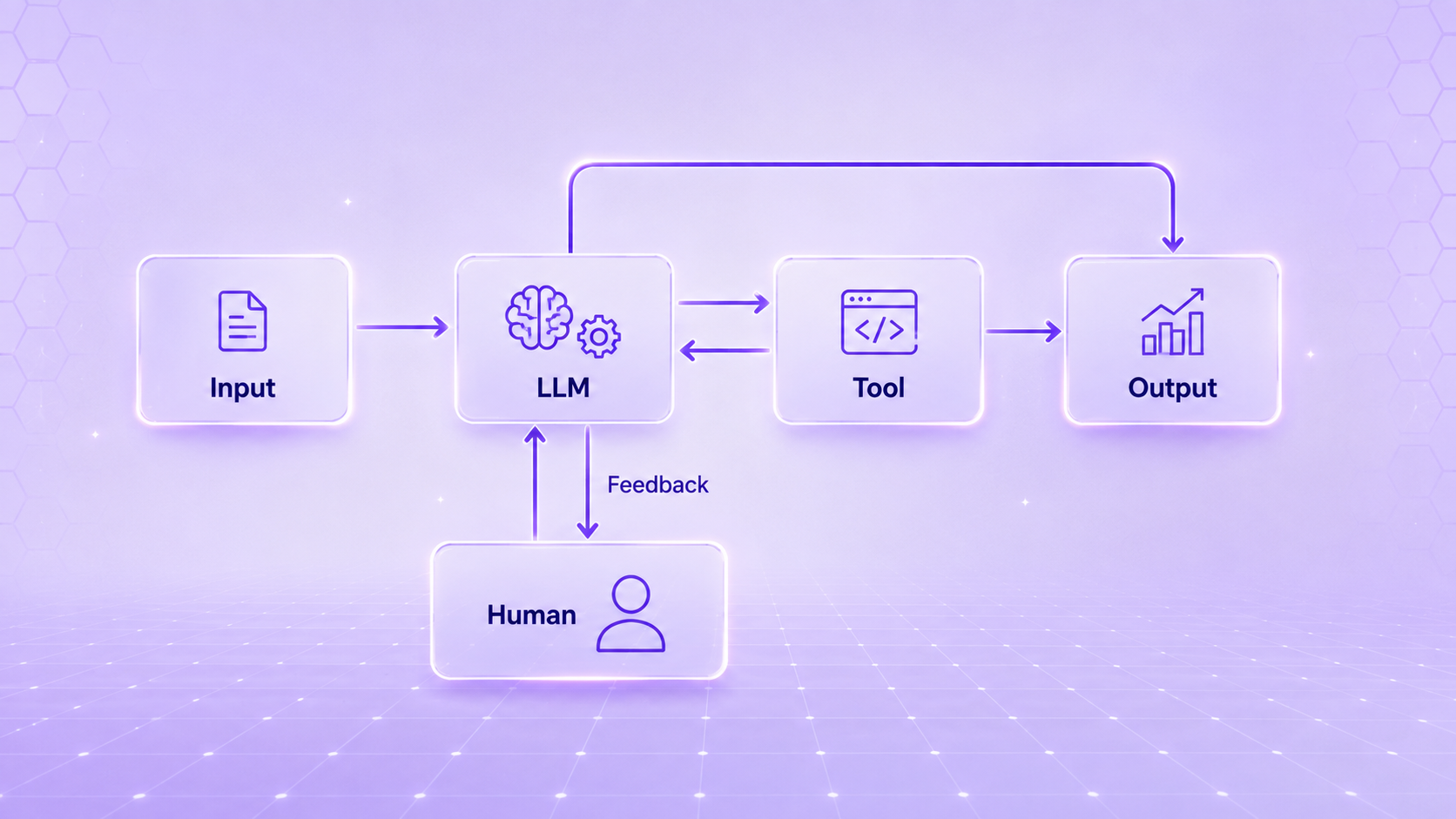
Alt text: Human-in-the-loop working
Human-in-the-loop works by combining machine intelligence with human expertise throughout the AI lifecycle. Instead of relying solely on algorithms, people provide feedback and oversight that help models learn and improve.
Here are some of the most common ways HITL works:
Supervised learning
In supervised learning, humans provide labelled data that teaches the AI how to recognize patterns.
For example, if a company wants to build an image recognition model, people may label thousands of photos as "cat," "dog," "car," or "tree." The model learns from these examples and uses them to make predictions on new images.
Human reviewers may also check the model's predictions and correct errors. These corrections help improve future performance.
Without high-quality human-labelled data, many machine learning models would struggle to learn accurately.
Reinforcement Learning from Human Feedback (RLHF)
Reinforcement Learning from Human Feedback (RLHF) is a training method where humans evaluate AI-generated outputs and provide feedback on which responses are better.
For example, an AI chatbot may generate multiple answers to the same question. Human reviewers rank the responses based on accuracy, usefulness, clarity, and safety. The model then learns from these preferences and adjusts its behavior accordingly.
This approach helps AI systems produce responses that better match human expectations and values.
RLHF has become particularly important in training modern generative AI systems, including conversational AI and large language models.
Active learning
Active learning is a process where the AI identifies data points it finds difficult or uncertain and asks humans for assistance.
Instead of labelling every piece of data manually, humans focus only on the most challenging cases.
For example, a document classification system may confidently categorize most documents but struggle with a few ambiguous ones. Those uncertain cases are sent to human experts for review.
The AI learns from the human input and becomes more capable of handling similar situations in the future.
This approach reduces manual effort while improving model accuracy.
H2: In the Loop vs. On the Loop vs. Over the Loop: What's the difference?
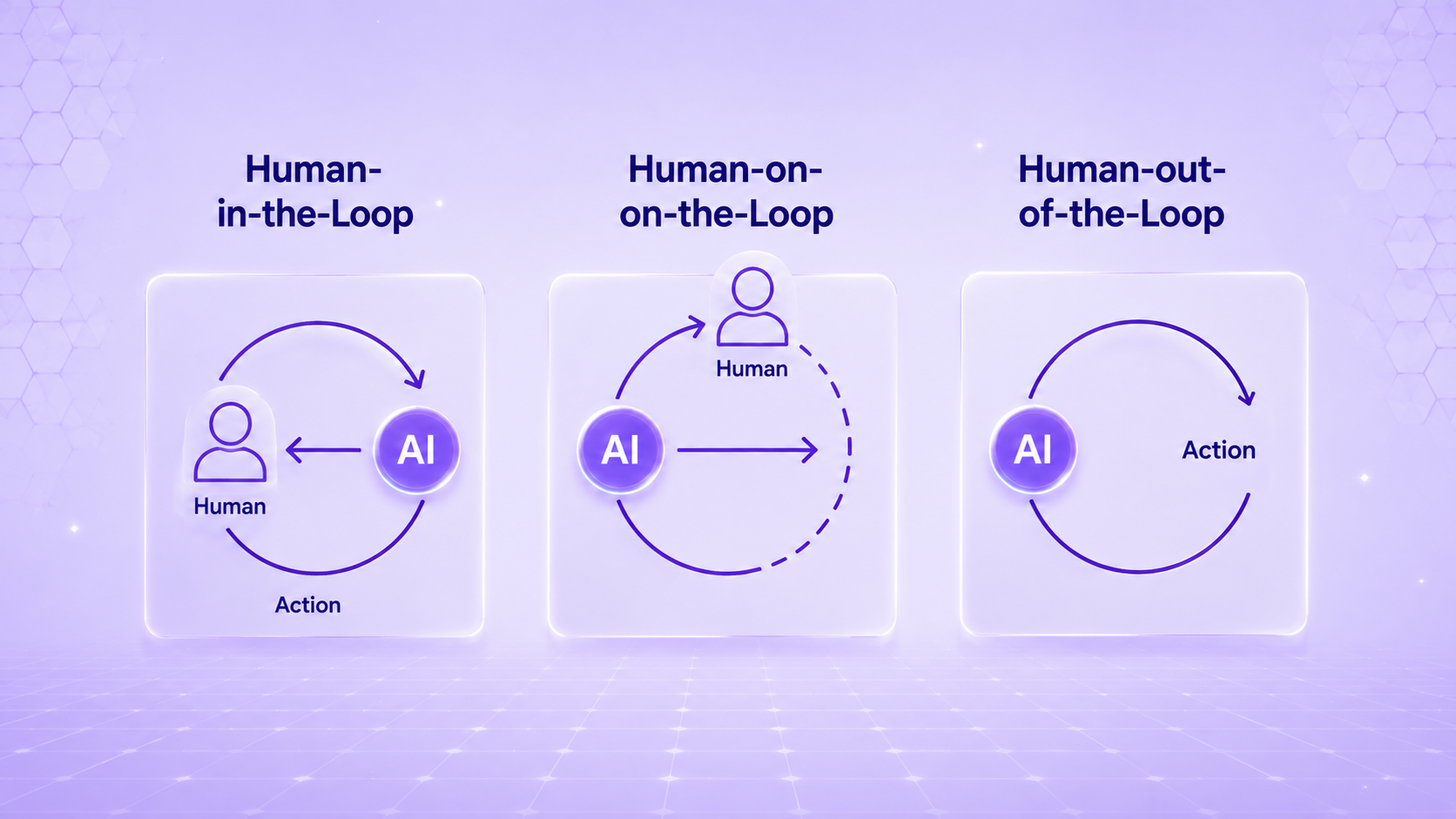
Alt text: Human-in-the-loop vs human-on-the-loop vs human-out-the-loop
Human-in-the-loop means people are directly involved in the decision-making process. The AI may make recommendations, but a human reviews, validates, or approves actions before they are finalized. This approach is common in healthcare, legal services, and financial decision-making, where accuracy and accountability are critical.
Human-on-the-loop means the AI operates independently most of the time, while humans monitor its performance and intervene when necessary. The system makes decisions automatically, but people remain available to supervise operations and handle unusual situations. This model is often used in industrial automation and large-scale monitoring systems.
Human-out-the-loop refers to a higher level of oversight where humans establish rules, policies, and governance frameworks but are not involved in individual decisions. The AI system operates autonomously within predefined boundaries. Human involvement focuses on auditing performance, managing risk, and ensuring compliance rather than reviewing every output.
The choice between these approaches depends on factors such as risk level, regulatory requirements, accuracy expectations, and the potential impact of errors.
H2: What are the examples of human-in-the-Loop (HITL) machine learning
Human-in-the-loop is used across many industries where accuracy, context, and human judgment are important.
- Image classification
Image classification systems often rely heavily on human involvement.
For example, medical imaging AI tools are trained using scans that have been labeled by radiologists. When the model identifies a potential issue, medical professionals may review the prediction before making a diagnosis.
Similarly, content moderation systems use human reviewers to validate images that AI flags as potentially harmful or inappropriate.
Human feedback helps improve classification accuracy and reduces false positives and false negatives.
- Natural Language Processing (NLP)
Natural language processing applications frequently use HITL to improve language understanding and response quality.
Chatbots, virtual assistants, translation systems, and text analysis tools often depend on human reviewers to evaluate outputs and provide corrections.
For example, when an AI translation tool produces awkward or inaccurate translations, language experts can refine the results. These corrections are then used to improve future translations.
Human input helps NLP systems better understand context, tone, cultural nuances, and intent.
- Speech recognition
Speech recognition systems convert spoken language into text, but accents, background noise, and pronunciation differences can create challenges.
Human reviewers often help train and improve these systems by correcting transcription errors.
For instance, customer service call recordings may be reviewed and corrected by human annotators. These corrections help the speech recognition model learn different speaking styles, accents, and vocabulary.
As a result, the system becomes more accurate over time and provides a better user experience.
H2: What are the benefits of human-in-the-loop?
Human-in-the-loop offers several advantages that help organizations build more reliable and responsible AI systems.
Higher quality outputs through human judgment: Human experts review, validate, and refine AI-generated outputs, helping improve accuracy, reduce errors, and ensure results are more reliable and contextually relevant.
Ethical safeguards and responsible AI: Human oversight helps identify bias, prevent harmful outcomes, ensure compliance with regulations, and keep AI decisions aligned with ethical standards.
Better performance in edge cases and ambiguous scenarios: Humans can interpret complex, rare, or uncertain situations that AI may struggle with, enabling more accurate decisions and continuous model improvement.
Stronger alignment between AI decisions and human values: Ongoing human feedback helps AI systems better reflect user expectations, business objectives, and societal values, making their decisions more trustworthy and responsible.
H2: Conclusion
Human-in-the-loop is one of the most important approaches in modern AI and machine learning because it combines the strengths of both humans and machines.
While AI can process vast amounts of data quickly and efficiently, humans provide the judgment, context, ethics, and expertise that machines often lack. By keeping people involved in training, evaluation, and decision-making, organizations can build AI systems that are more accurate, reliable, and aligned with real-world needs.
As AI adoption continues to grow across industries, human-in-the-loop will remain a critical strategy for ensuring technology serves people effectively, responsibly, and safely.
H2: FAQs
What is the primary role of humans in the loop?
The primary role of humans in the loop is to guide, train, evaluate, and improve AI systems. Humans provide labelled data, review outputs, correct mistakes, handle complex cases, and ensure that AI decisions align with ethical standards and business objectives.
How to implement human-in-the-loop?
Implementing human-in-the-loop typically involves identifying stages where human expertise adds value. Organizations can incorporate human reviewers for data labelling, prediction validation, quality assurance, model feedback, and exception handling. A clear workflow should define when humans intervene and how their feedback is used to improve the AI system.
What is the human-in-the-loop used for?
Human-in-the-loop is used to improve AI accuracy, reduce errors, handle ambiguous situations, ensure ethical decision-making, and maintain human oversight. It is commonly applied in healthcare, finance, customer service, content moderation, autonomous systems, natural language processing, image recognition, and speech recognition applications.
Controle, implemente y rastree la IA en su propia infraestructura

GenAI infra: simple, más rápido y más barato
Los mejores equipos confían en nosotros para escalar GenAI

- © 2022 ENSEMBLE Technologies



Suscríbase a nuestro boletín
Las últimas noticias, artículos y recursos enviados a tu bandeja de entrada


