


Obtenga acceso instantáneo a un entorno TrueFoundry en vivo. Implemente modelos, dirija el tráfico de LLM y explore la plataforma completa: su sandbox estará listo en segundos, sin necesidad de tarjeta de crédito.


What Is a Transformer Model and How Does It Work?

.png)
Almost every language model you have heard of, from GPT to Llama to Claude, is built on the same underlying design: the transformer. Introduced in 2017, it replaced the recurrent networks that came before it and unlocked the scale that makes today's models possible. Understanding the transformer is understanding the engine inside modern AI.
What made it such a leap was a single idea, attention, applied at scale. Instead of reading text word by word in sequence, a transformer looks at an entire sequence at once and learns which parts matter to which. That shift is what let models grow larger, train faster, and capture context better.
This guide explains what a transformer is, how it works, how it differs from earlier architectures, and why it became the foundation of modern AI.
What is a transformer model?
A transformer is a neural network architecture built around self-attention, a mechanism that lets each token in a sequence attend to every other token. Rather than processing text in order, it considers the whole sequence together, computing how strongly each token should influence the representation of every other one.
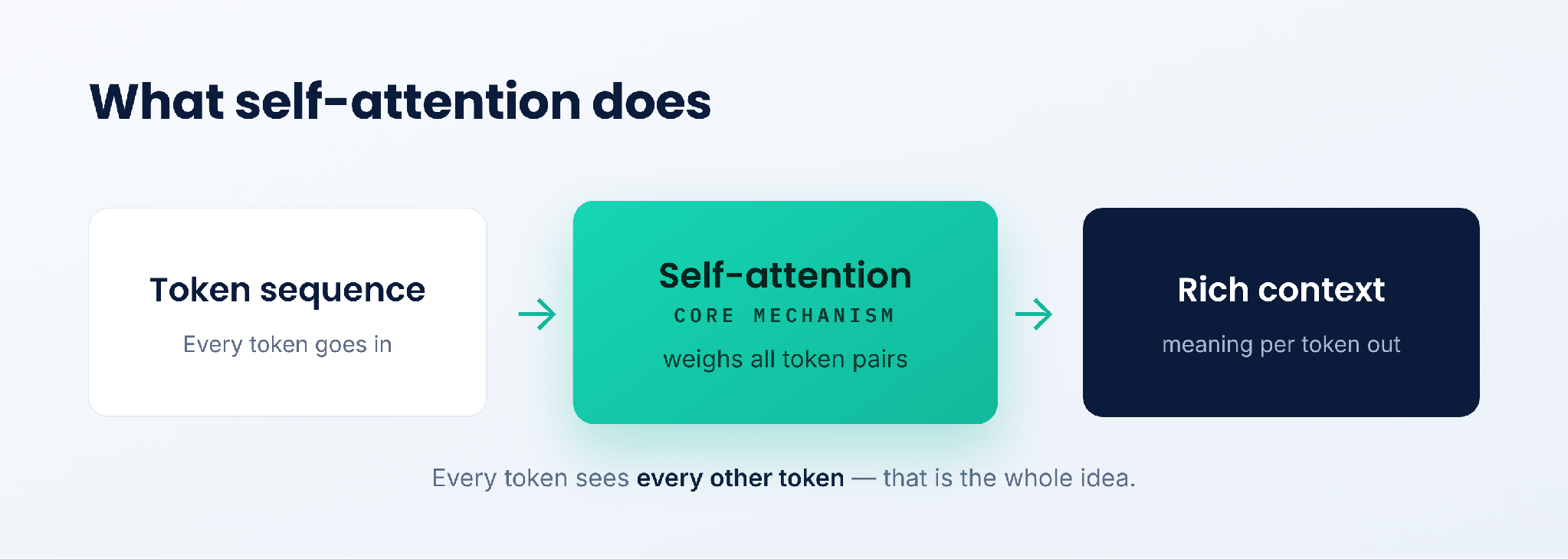
Think of reading a sentence where a pronoun like it could refer to several earlier nouns. You resolve it by glancing back and weighing which noun fits best. Self-attention does the same for every token at once: each one looks across the sequence and decides what to pay attention to. That weighing is the heart of the architecture.
The result is a model that understands context. The meaning of a word is shaped by the words around it, and self-attention is how the transformer captures those relationships, however far apart the words are.
How does a transformer work?
A transformer turns tokens into vectors and refines them through a stack of identical layers.
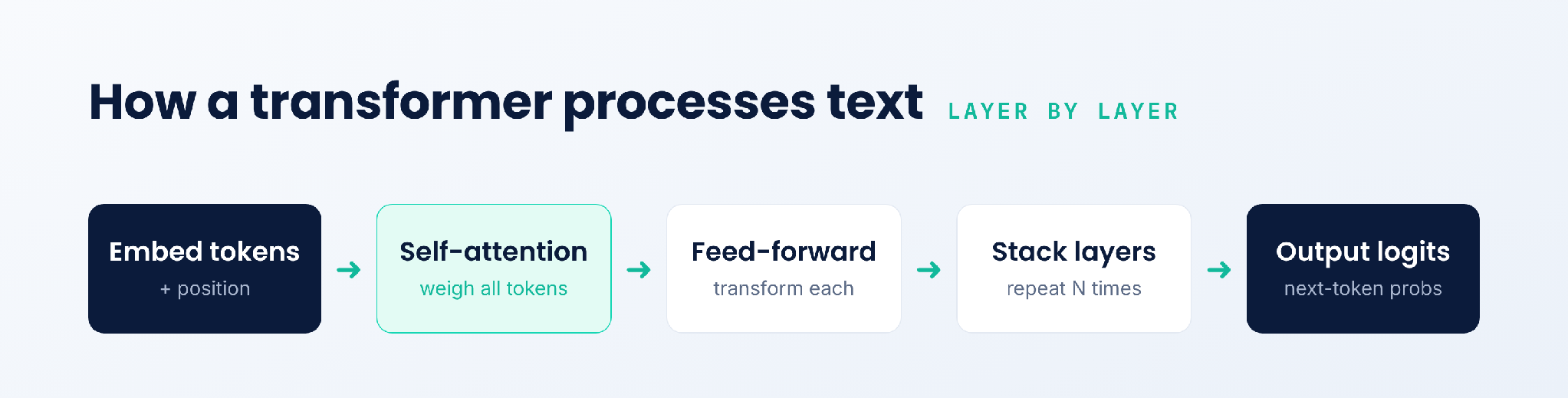
- Embed the tokens. Each token becomes a vector, and a positional signal is added so the model knows the order.
- Apply self-attention. Each token attends to every other token, mixing in information from the parts of the sequence that matter.
- Pass through feed-forward layers. A small network transforms each token's representation independently, adding capacity.
- Stack the layers. Attention and feed-forward blocks repeat many times, building up more abstract representations.
- Produce outputs. A final layer turns the representations into predictions, such as probabilities for the next token.
Because attention looks at the whole sequence at once, every layer can be computed in parallel across tokens. That parallelism is what makes transformers efficient to train on huge datasets and modern hardware.
Transformers vs. recurrent networks
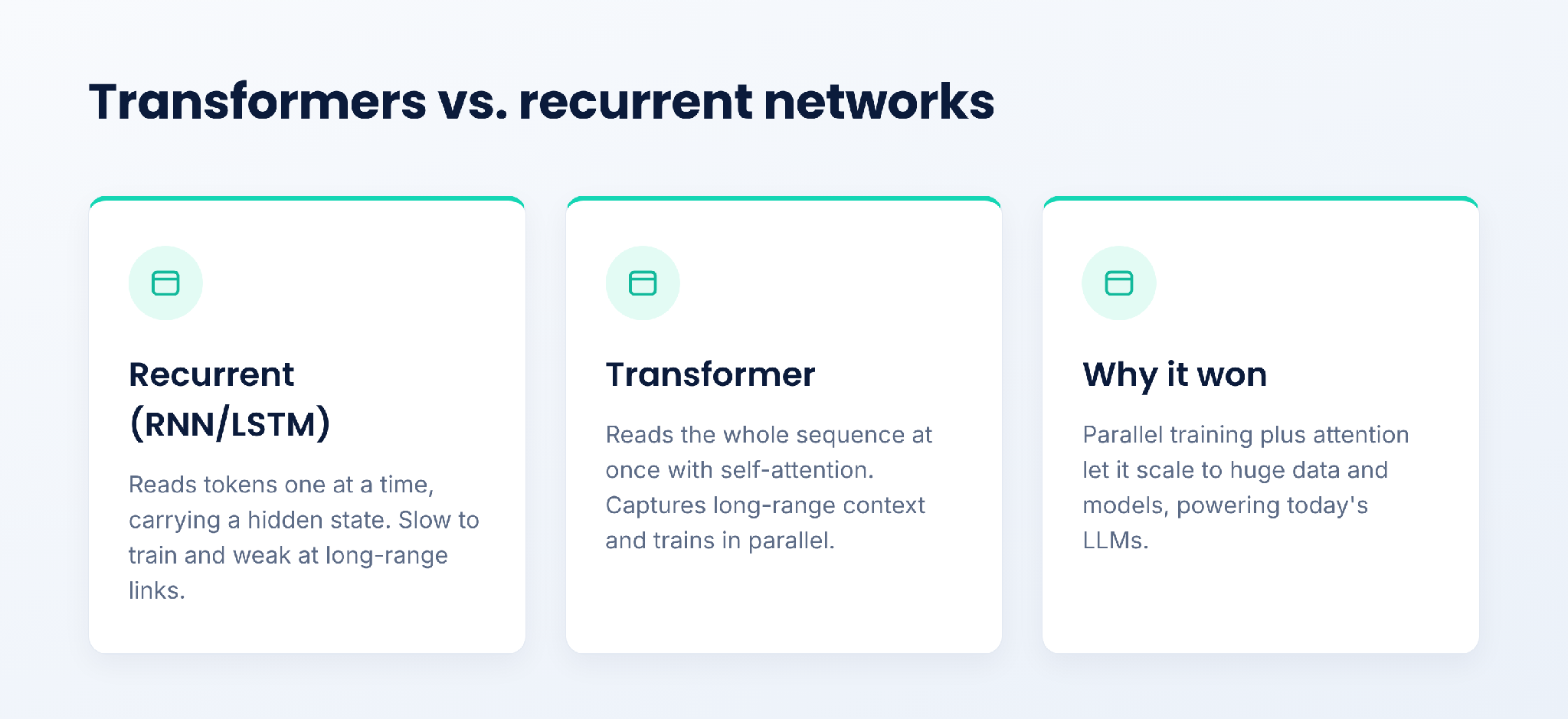
Before transformers, sequence models were mostly recurrent networks like RNNs and LSTMs. These read tokens one at a time, carrying a hidden state forward, which made them slow to train and prone to losing information over long distances. A transformer instead reads the whole sequence together and connects any two tokens directly through attention, no matter how far apart they are.
That difference is why transformers won. Direct connections capture long-range context better, and processing the sequence in parallel rather than step by step makes training far more scalable. Those two advantages together opened the door to the very large models we have today.
What are the types of transformer models?
- Encoder-only. Models like BERT read a whole input to understand it, good for classification and search.
- Decoder-only. Models like GPT generate text one token at a time, the design behind most chat LLMs.
- Encoder-decoder. Models like T5 read an input and generate an output, suited to translation and summarization.
- Multimodal transformers. Variants extend attention to images, audio, or video alongside text.
- Efficient transformers. Many variants reduce attention's cost to handle longer sequences more cheaply.
What are the limits of transformers?
- Quadratic attention. Standard attention cost grows with the square of sequence length, which limits context.
- Data and compute hungry. Transformers need large datasets and significant hardware to train well.
- No built-in memory. They process one window at a time and do not remember across separate calls.
- Opacity. Their internal reasoning is hard to interpret, which complicates debugging and trust.
When do transformers matter?
Transformers matter any time you work with language models, because they are the architecture underneath. Knowing that self-attention relates all tokens, and that its cost grows with sequence length, explains why context windows are limited and why longer inputs cost more.
You rarely build a transformer from scratch; you use pretrained ones. But understanding the architecture helps you reason about cost, context, and why models behave the way they do.
Working with transformer models
- Start from a pretrained model rather than training a transformer from scratch, which is rarely worth it.
- Match the architecture to the task: decoder-only for generation, encoder-only for understanding.
- Watch sequence length, since attention cost and memory grow sharply as inputs get longer.
- Fine-tune or adapt a base model with techniques like LoRA instead of full retraining when you can.
- Serve transformers with an engine like vLLM to get efficient batching and memory use.
- Keep models behind a gateway so routing, cost control, and observability live in one layer.
Conclusion
The transformer is the architecture that powers modern AI. By replacing step-by-step recurrence with self-attention, it lets every token relate directly to every other, captures long-range context, and trains in parallel at massive scale. That combination is why a single design underlies nearly every language model in use today.
TrueFoundry helps teams serve transformer-based models on their own infrastructure through engines like vLLM, with autoscaling, observability, and governance in one gateway. Whatever the model, the transformer is the shape of the thing you are running, and understanding it makes everything else about LLMs easier to reason about.
Controle, implemente y rastree la IA en su propia infraestructura
Frequently Asked Questions
What is a transformer model in simple terms?
It is the architecture that makes modern language models tick. Its main feature is self-attention, where every word within a sentence can see all the other words and determine what is important, so the model understands context.
What is self-attention?
Self-attention is the process that enables each token to consider the importance of every other token in the sequence. This is how a transformer determines which parts of the input are relevant to each position, capturing context.
How are transformers different from RNNs?
RNNs consume tokens individually and carry a hidden state forward, a process that is inefficient and forgets long-range dependencies. Transformers consume the entire sequence all at once using attention, connecting any two tokens directly and training in parallel.
What is the difference between encoder and decoder transformers?
Models such as BERT are encoder-only architectures that read and comprehend the input well, making them ideal for classification. Decoder-only architectures such as GPT generate output one token at a time, while encoder-decoder models do both, which suits translation and summarization.
Why are transformers so important?
The reason for their ability to handle massive amounts of data is their combination of direct, long-distance connections via attention with parallel training. This scalability is what made today's large language models possible.

GenAI infra: simple, más rápido y más barato
Los mejores equipos confían en nosotros para escalar GenAI

- © 2022 ENSEMBLE Technologies



Suscríbase a nuestro boletín
Las últimas noticias, artículos y recursos enviados a tu bandeja de entrada


