


Obtenga acceso instantáneo a un entorno TrueFoundry en vivo. Implemente modelos, dirija el tráfico de LLM y explore la plataforma completa: su sandbox estará listo en segundos, sin necesidad de tarjeta de crédito.


What Is Self-Supervised Learning and Why Does It Matter?

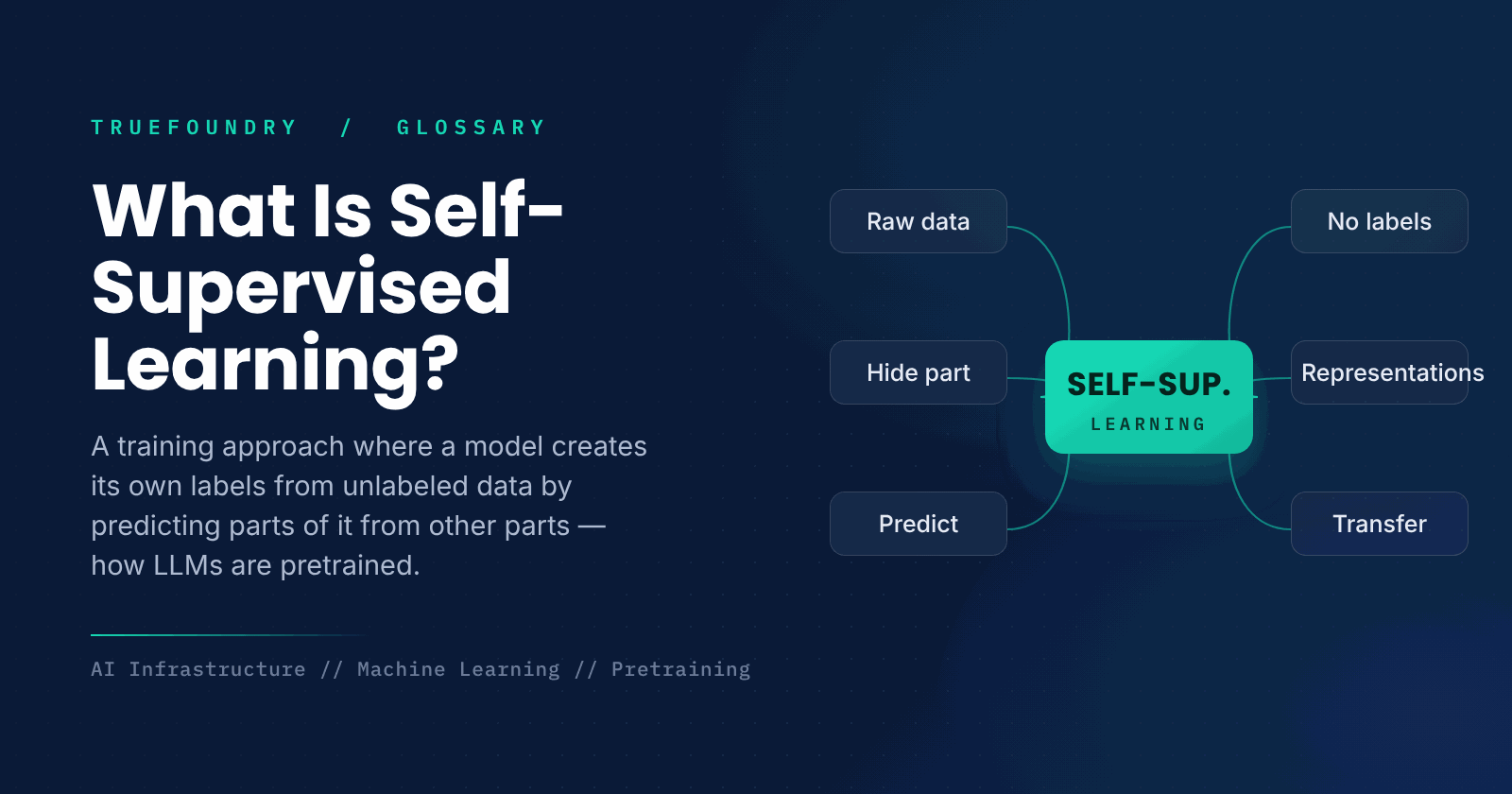
The breakthrough behind modern language models is not just their size but how they are trained. They learn from enormous amounts of raw text that nobody labeled, yet they come away understanding grammar, facts, and reasoning. The trick that makes this possible is self-supervised learning: letting the data supervise itself.
The idea is to turn an unlabeled dataset into a supervised problem automatically. By hiding part of the data and asking the model to predict it from the rest, you create a training signal without any human annotation. Do this at scale, and the model learns rich representations of the underlying structure, whether that is language, images, or audio.
This guide explains what self-supervised learning is, how it works, how it relates to unsupervised and supervised learning, and why it matters so much.
What is self-supervised learning?
Self-supervised learning is a method where a model generates supervisory signals directly from unlabeled data. Part of the input is withheld, and the model is trained to predict it from the remaining part. Because the correct answer is simply the withheld data, labels are created automatically, with no human effort required.
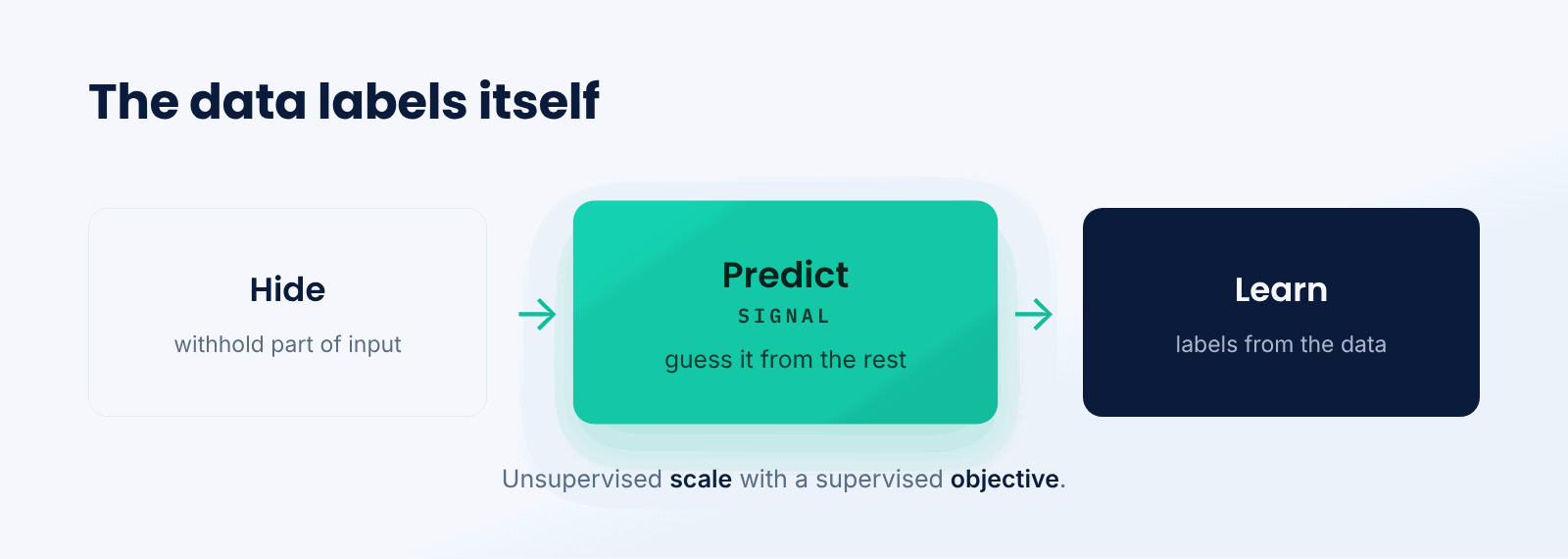
Think of it like filling in the blanks in a text. If you cover a word in a sentence and try to guess it from the surrounding words, you are testing and building your understanding of language. A self-supervised model plays this fill-in-the-blank game billions of times, and in doing so learns deep patterns about how the data is structured.
The key idea is that the data provides its own labels. This combines the best of both worlds: the automatic, label-free nature of unsupervised learning with the clear predictive objective of supervised learning, which is what makes it so effective at scale.
How does self-supervised learning work?
Training sets up a prediction task from the raw data, then learns from the model's attempts to solve it.
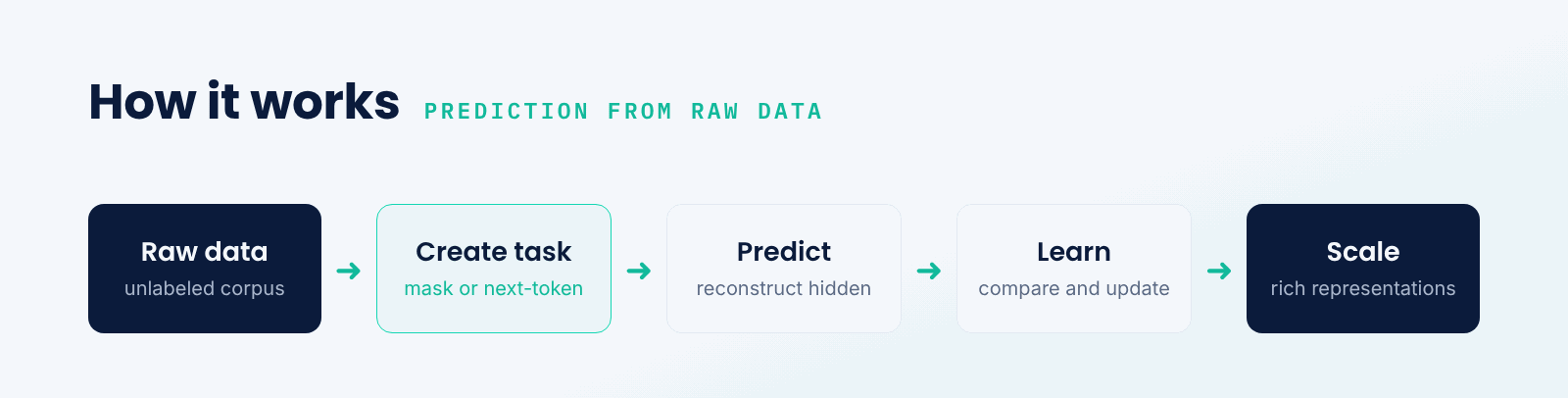
- Take raw data. Start with unlabeled text, images, or other data.
- Create a task. Hide part of the data, such as masking words or the next token.
- Predict. The model tries to reconstruct the hidden part from what remains.
- Learn. Compare the prediction to the true hidden data and update the model.
- Scale up. Repeat across massive datasets to build rich representations.
For language models, the classic task is predicting the next token given the preceding ones. Doing this over a huge corpus forces the model to learn grammar, facts, and reasoning patterns, which is why self-supervised pretraining produces such capable general-purpose models.
Self-supervised vs. unsupervised vs. supervised
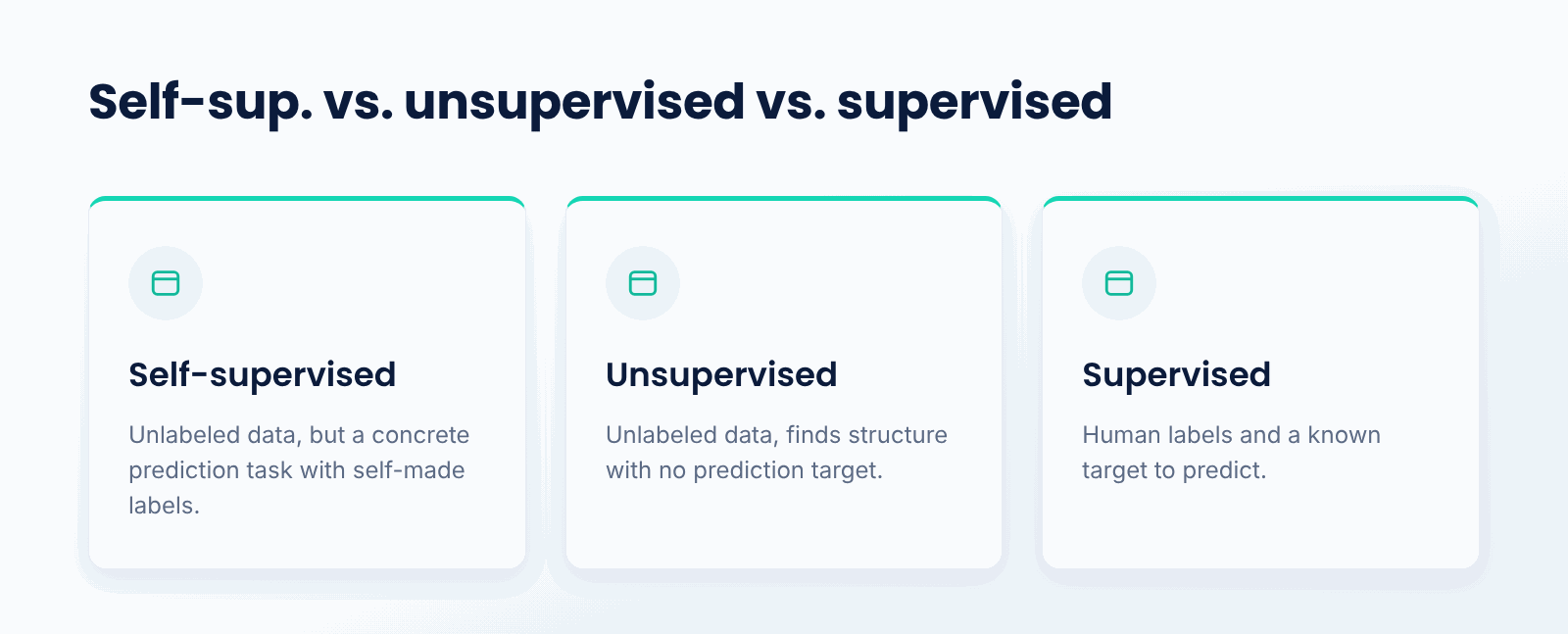
Supervised learning uses human labels to predict known answers. Unsupervised learning finds structure in unlabeled data without a prediction target. Self-supervised learning sits between them: it uses unlabeled data like unsupervised learning, but sets up a concrete prediction task like supervised learning, using labels it generates from the data itself.
That middle position is its strength. It gets the scalability of learning from unlabeled data together with the strong learning signal of a prediction objective. This is why self-supervised pretraining followed by supervised fine-tuning has become the dominant recipe for building powerful models.
Why does self-supervised learning matter?
- No labeling. It learns from raw data without human annotation.
- Scale. It can train on virtually unlimited unlabeled data.
- Foundation models. It is how LLMs and other foundation models are pretrained.
- Transfer. The representations it learns transfer well to many tasks.
- Efficiency. It reduces reliance on scarce, expensive labeled data.
What are the tradeoffs?
- Compute cost. Pretraining at scale demands enormous compute.
- Data quality. The model inherits patterns and biases from its raw data.
- Task design. The pretext prediction task must be chosen well to learn useful features.
- Indirect goal. The pretraining objective is a proxy, not the final task you care about.
When is self-supervised learning used?
It is the standard way to pretrain foundation models, learning general representations from massive unlabeled corpora before adapting them to specific tasks. Any time you have abundant unlabeled data and want a model that understands its structure deeply, self-supervised learning is the approach of choice.
In practice it is almost always paired with a later supervised or preference-based step. The self-supervised phase builds broad capability cheaply from raw data, and the subsequent phase specializes the model, which together is how most state-of-the-art systems are built.
Key points about self-supervised learning
- It creates its own labels from unlabeled data.
- The model predicts hidden parts of the input from the rest.
- It combines unsupervised scale with a supervised-style objective.
- It is how large language models are pretrained.
- Its representations transfer to many downstream tasks.
- It is usually followed by supervised fine-tuning.
Conclusion
Self-supervised learning trains a model by having it predict hidden parts of unlabeled data, creating labels from the data itself. Combining the scale of unlabeled data with the strong signal of a prediction task, it is how large language models and other foundation models are pretrained to learn rich, transferable representations. Its main cost is the compute required to pretrain at scale.
TrueFoundry helps teams fine-tune and serve models built on self-supervised pretraining, bridging from a general pretrained model to a deployed, task-specific one. Understanding self-supervised learning explains how today's most capable models come to be.
Controle, implemente y rastree la IA en su propia infraestructura
Frequently Asked Questions
What is self-supervised learning in simple terms?
It involves training the model by getting it to complete the missing parts of unlabeled data. You cover up some of the data and get the model to guess the covered-up part using the rest, so the data provides its own labels and no human annotation is needed.
How is it different from unsupervised learning?
Unlike unsupervised learning, which detects patterns in the dataset without any targeted outcome, self-supervised learning uses the same type of data but designs a specific prediction task by generating its own labels from the input, giving it a stronger, more directed learning signal.
How are language models trained with it?
The classic task involves predicting the subsequent token based on the previous tokens. Repeated many times over a huge corpus of text, this makes the model understand grammar, facts, and reasoning, which is how large language models become so capable through pretraining.
Does self-supervised learning need any labels?
No labeling by humans involved. The labels are intrinsic to the data because the right answer is simply what is left out. That is why it can learn from nearly unlimited unlabeled data at no extra cost of labeling.
Is self-supervised learning used alone?
Not generally. This approach develops broad capability at a low cost from raw data during the pretraining phase, after which supervised fine-tuning or preference-based training tailors the model to the particular tasks you care about.

GenAI infra: simple, más rápido y más barato
Los mejores equipos confían en nosotros para escalar GenAI

- © 2022 ENSEMBLE Technologies



Suscríbase a nuestro boletín
Las últimas noticias, artículos y recursos enviados a tu bandeja de entrada


