


Obtenga acceso instantáneo a un entorno TrueFoundry en vivo. Implemente modelos, dirija el tráfico de LLM y explore la plataforma completa: su sandbox estará listo en segundos, sin necesidad de tarjeta de crédito.


What Is Bring Your Own Cloud (BYOC) and How Does It Work?

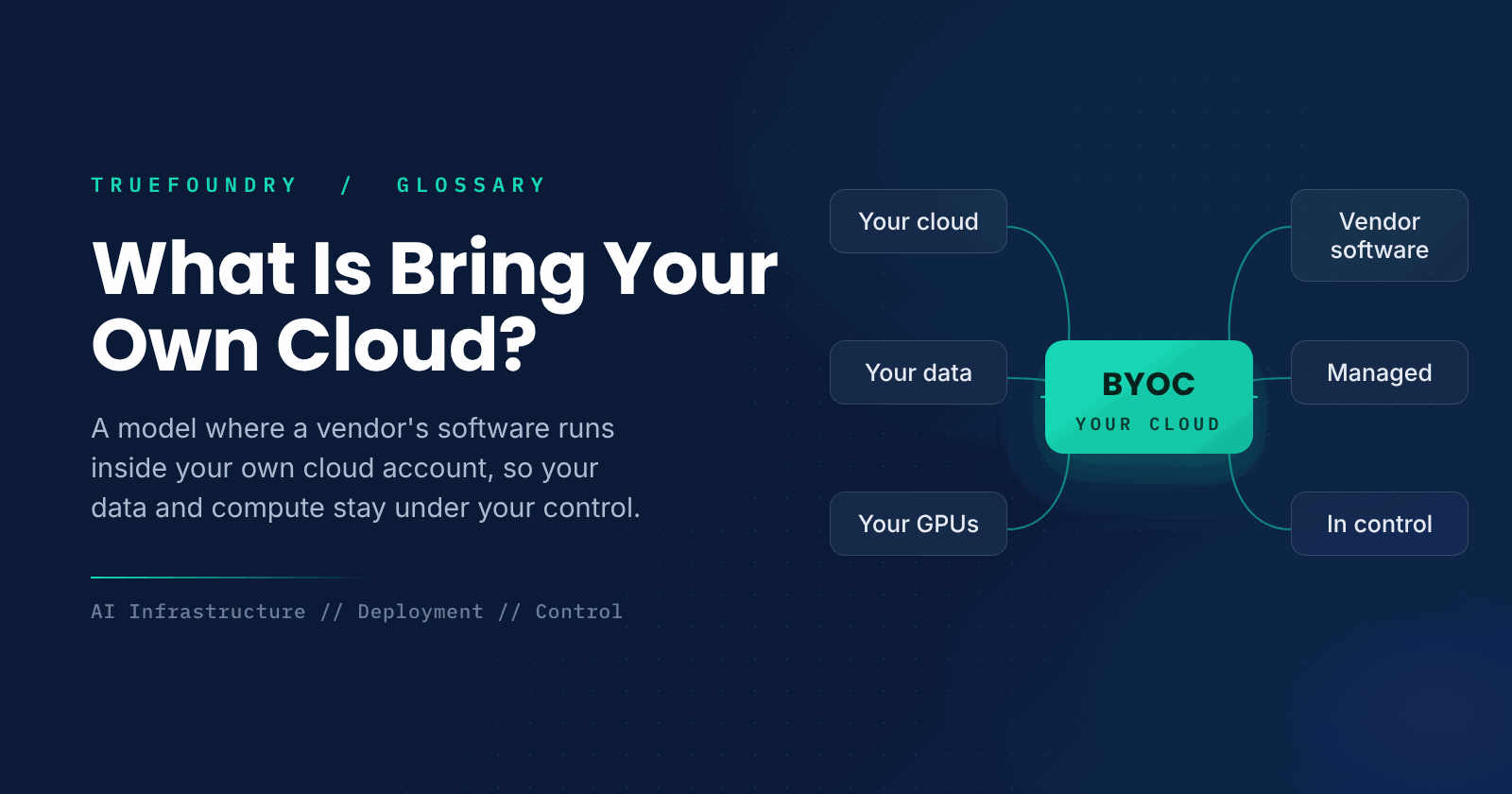
Software is usually delivered one of two ways: as SaaS, where the vendor runs everything in their cloud, or self-hosted, where you run and maintain everything yourself. Each has a cost: SaaS means your data lives in someone else's environment, while self-hosting means carrying the full operational burden. Bring your own cloud is a middle path that aims to keep the best of both.
With BYOC, the vendor's platform is deployed into your cloud account. You get managed software you do not have to build or operate, but your data and compute never leave your environment. For AI, where data is sensitive and GPUs are costly, keeping both in your own cloud is often exactly what teams need.
This guide explains what BYOC is, how it works, how it compares with SaaS and self-hosting, and why it matters.
What is bring your own cloud?
Bring your own cloud, or BYOC, is a deployment model in which a vendor's application runs within the customer's own cloud environment rather than in infrastructure the vendor owns. The vendor provides and manages the software, but it operates inside the customer's account, so the customer's data and compute resources stay under the customer's control.
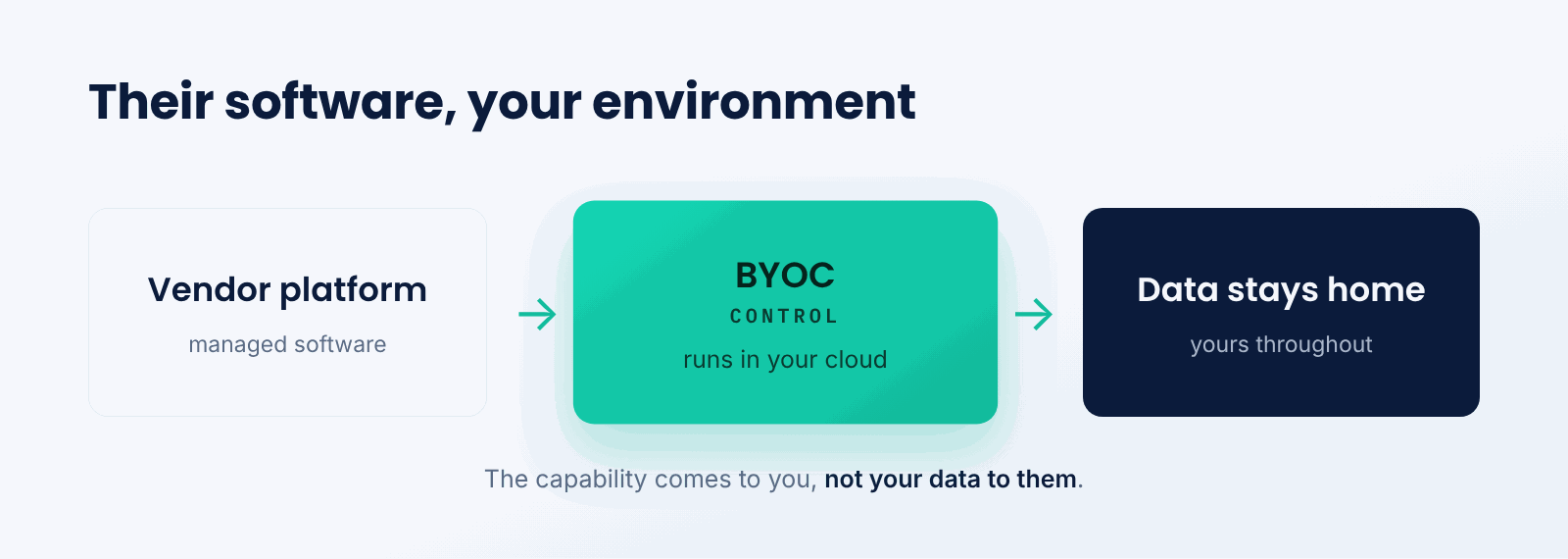
Think of it like hiring a chef to cook in your own kitchen rather than ordering from their restaurant. You get their expertise and the finished meal, but the ingredients, the kitchen, and what happens there stay yours. BYOC brings the vendor's capability to your environment instead of taking your data to theirs.
The key idea is separating the software from where it runs. The vendor supplies and manages the platform; the customer supplies the cloud it runs in, keeping data and compute in-house.
How does BYOC work?
The vendor's platform is deployed into your cloud account and managed there, with data staying put.
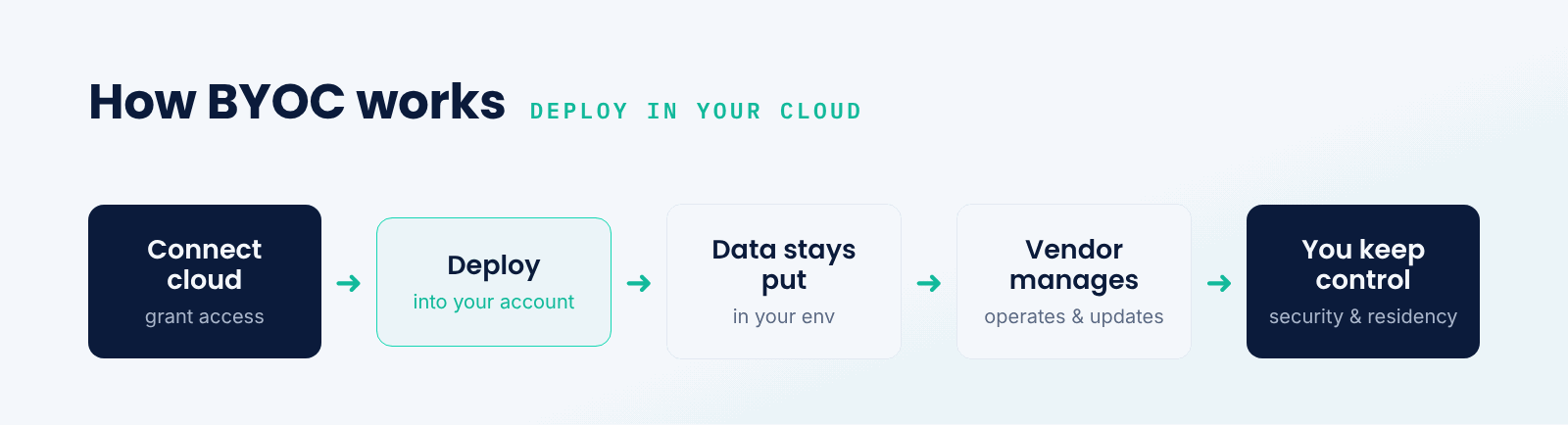
- Connect your cloud. You grant the vendor's platform access to your cloud account.
- Deploy in your environment. The software is installed into your account's infrastructure.
- Data stays put. Your data and compute remain in your environment throughout.
- Vendor manages. The vendor operates and updates the platform where it runs.
- You keep control. Security, access, and residency stay under your policies.
The arrangement splits responsibilities. The vendor handles the software and its operation; you own the environment, the data, and the governance around it. Getting that boundary right is what makes BYOC both convenient and controlled.
BYOC vs. SaaS vs. self-hosted
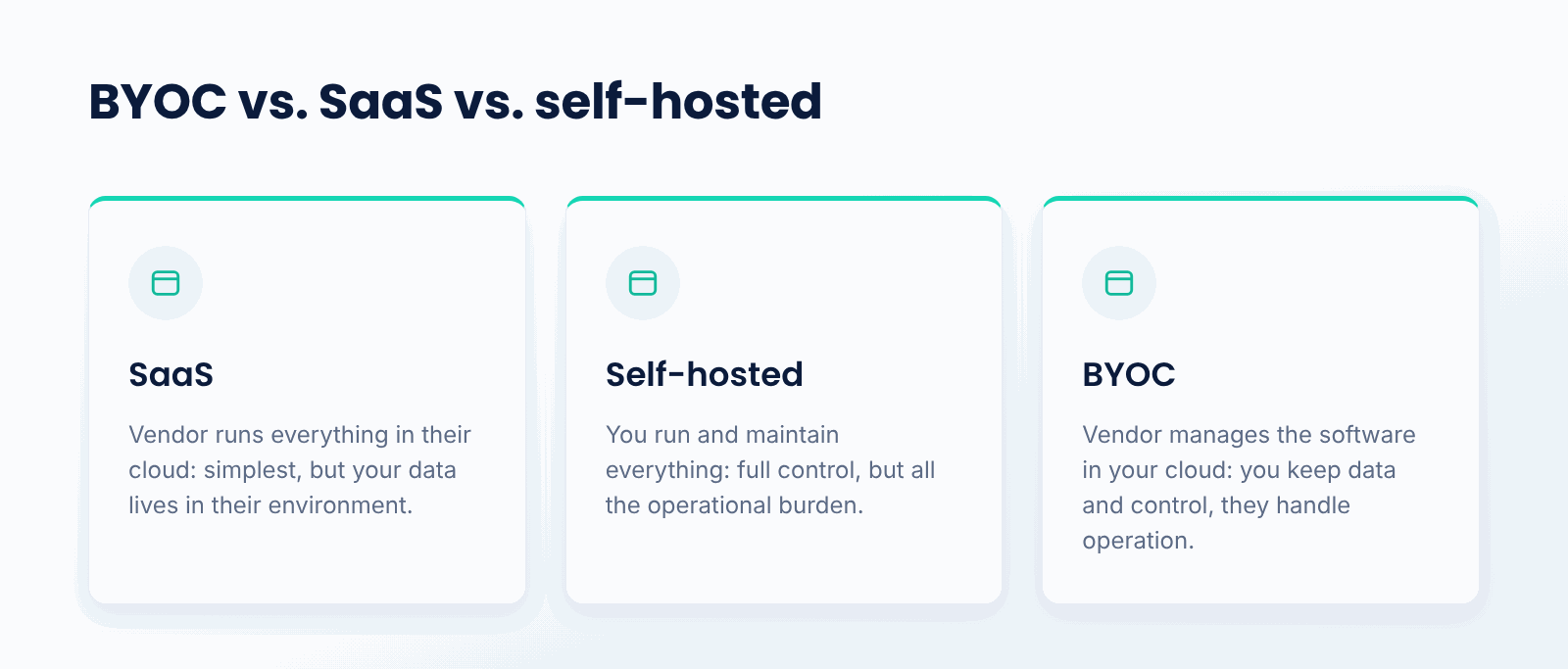
The three models differ in who runs what and where the data lives. SaaS has the vendor run everything in their cloud, which is simplest but puts your data in their environment. Self-hosted has you run and maintain everything in yours, giving full control but all the operational burden. BYOC has the vendor manage the software inside your cloud, so you keep data and control while offloading operation of the platform.
BYOC is the middle ground. It trades a little of SaaS's simplicity for control over data and environment, and a lot of self-hosting's burden for a managed platform. For teams that need control without the full operational load, it is often the right balance.
Why does BYOC matter?
- Data control. Your data stays in your environment, not the vendor's.
- Compliance. It helps meet residency, security, and regulatory requirements.
- Use existing cloud. You leverage your own commitments, credits, and setup.
- Managed software. You still get the vendor's platform without building it.
- Security posture. Your controls and policies govern where the software runs.
What are the challenges?
- Setup. Connecting and deploying into your cloud is more involved than SaaS.
- Shared responsibility. The split between vendor and customer must be clear.
- Cloud requirements. Your environment must meet the platform's needs.
- Access. The vendor needs scoped access to manage the software in your account.
When should you use BYOC?
BYOC fits when you want a managed platform but cannot or do not want to send data to the vendor's cloud, common in regulated industries, security-conscious teams, and AI workloads with sensitive data or existing GPU capacity. The stronger your data-control and compliance needs, the more BYOC makes sense.
If simplicity matters most and your data has no special constraints, plain SaaS may be easier. But when control over data and environment is a requirement, BYOC gives you that without taking on full self-hosting.
Best practices for BYOC
- Grant the vendor the least cloud access needed to run the platform.
- Be clear on the shared-responsibility split for security and operation.
- Use your own cloud commitments and GPU capacity where possible.
- Apply your data residency and governance policies to the deployment.
- Monitor the deployed platform as part of your own environment.
- Choose BYOC for workloads where data must stay in your cloud.
Conclusion
Bring your own cloud runs a vendor's managed software inside your own cloud account, so you get the platform without your data or compute ever leaving your environment. It is the middle ground between SaaS and self-hosting, trading a little simplicity for control over data, compliance, and security. For AI workloads with sensitive data and costly GPUs, BYOC is often the model that fits best.
TrueFoundry can be deployed in your own cloud through BYOC, so models run on your infrastructure and your data and GPUs stay in your environment while TrueFoundry manages the platform. For teams that need control and compliance, BYOC is how they get a managed AI platform on their own terms.
Controle, implemente y rastree la IA en su propia infraestructura
Frequently Asked Questions
What is BYOC in simple terms?
Bring your own cloud means running the vendor's software within your own cloud account rather than theirs. You get the vendor's managed platform, but your data and compute stay in your environment, under your control.
How is BYOC different from SaaS?
With SaaS, the vendor manages everything in their own cloud and your data lives there. With BYOC, the vendor manages the same software but it runs in your cloud account, so your data and compute never leave your environment.
How is BYOC different from self-hosting?
Self-hosting means you run and maintain everything yourself. With BYOC, the software stays in your cloud while the vendor manages and updates it, so you keep control of data and environment without taking on the full operational burden.
Why is BYOC popular for AI platforms?
Because AI usually deals with sensitive data and expensive GPUs. BYOC lets teams use a managed AI platform while keeping that data and those GPUs in their own cloud, which supports compliance, residency, and use of existing capacity.
What access does the vendor need in BYOC?
The vendor needs scoped access to deploy and manage its platform within your cloud account. Following least privilege, that access is limited to just what running the software requires, while you retain control of your data and overall environment.

GenAI infra: simple, más rápido y más barato
Los mejores equipos confían en nosotros para escalar GenAI

- © 2022 ENSEMBLE Technologies



Suscríbase a nuestro boletín
Las últimas noticias, artículos y recursos enviados a tu bandeja de entrada


