


Obtenga acceso instantáneo a un entorno TrueFoundry en vivo. Implemente modelos, dirija el tráfico de LLM y explore la plataforma completa: su sandbox estará listo en segundos, sin necesidad de tarjeta de crédito.


What Is AI Governance and How Does It Work?

As organizations adopt AI across teams, a question quickly follows: who is allowed to use which models, for what, and with what oversight? Without answers, usage sprawls, costs climb, and sensitive data flows to places it should not. AI governance is how an organization brings order to that, with the policies and controls that make AI use safe, compliant, and accountable.
Governance is not about slowing AI down. Done well, it is what lets an organization adopt AI confidently, because the guardrails, approvals, and visibility are in place. It turns ad hoc experimentation into something the business can trust and scale.
This guide explains what AI governance is, how it works, what it covers, and why it matters as AI use grows.
What is AI governance?
AI governance is the framework of policies, processes, roles, and controls that direct how an organization develops, deploys, and uses AI. It sets the rules for which models are approved, who can access them, how they may be used, and how usage is monitored and audited, so AI aligns with legal, ethical, and business requirements.
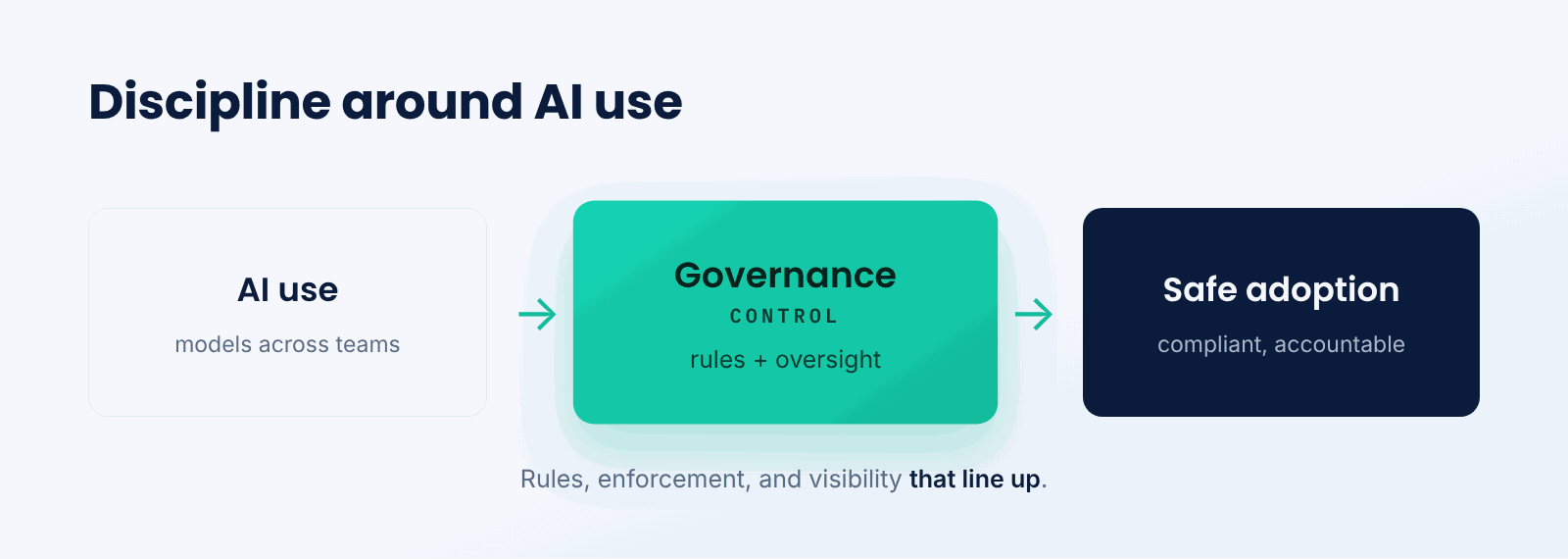
Think of it like the governance a company applies to its finances. Not everyone can spend freely; there are approvals, limits, records, and audits. AI governance brings the same discipline to AI: clear rules about what is allowed, who decides, and how it is tracked, so the organization stays in control.
The key idea is intentional control. Governance replaces assumptions about how AI will be used with explicit policy and oversight, so risk is managed rather than discovered after the fact.
How does AI governance work?
Governance works by defining rules and then enforcing and monitoring them across AI use.
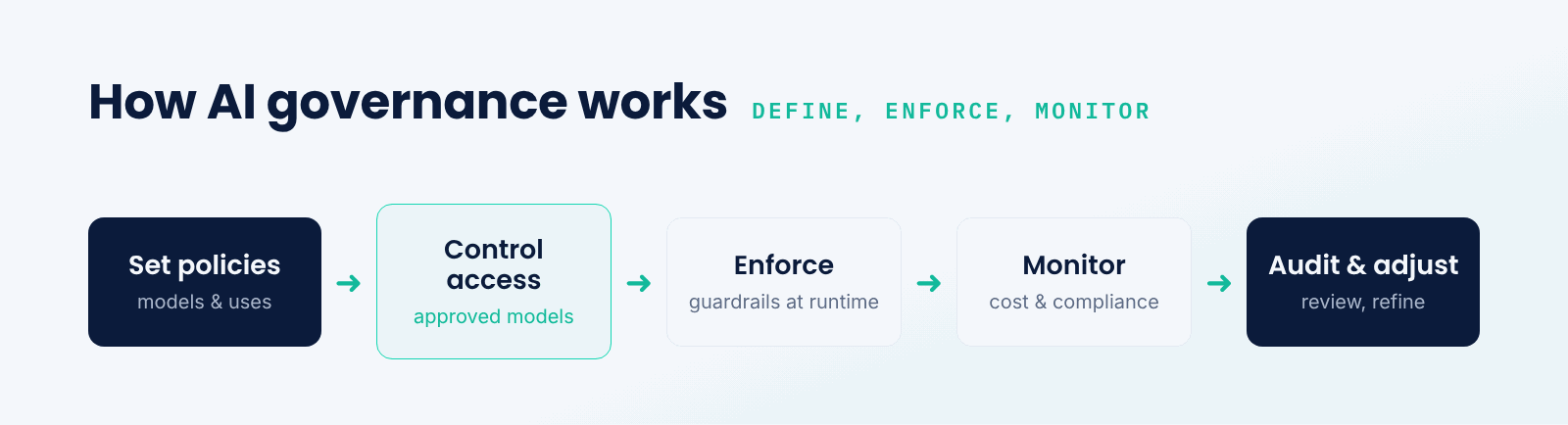
- Set policies. The organization defines which models, uses, and data handling are allowed.
- Control access. Teams and users are granted access to approved models under those policies.
- Enforce at runtime. Guardrails and limits apply the policies on every request.
- Monitor usage. Interactions are logged for cost, compliance, and safety visibility.
- Audit and adjust. Reviews check that use stays within policy and refine the rules over time.
Enforcement is what separates real governance from a document nobody follows. Policies have to be applied automatically, at the point models are used, or they become suggestions rather than controls.
What does AI governance cover?
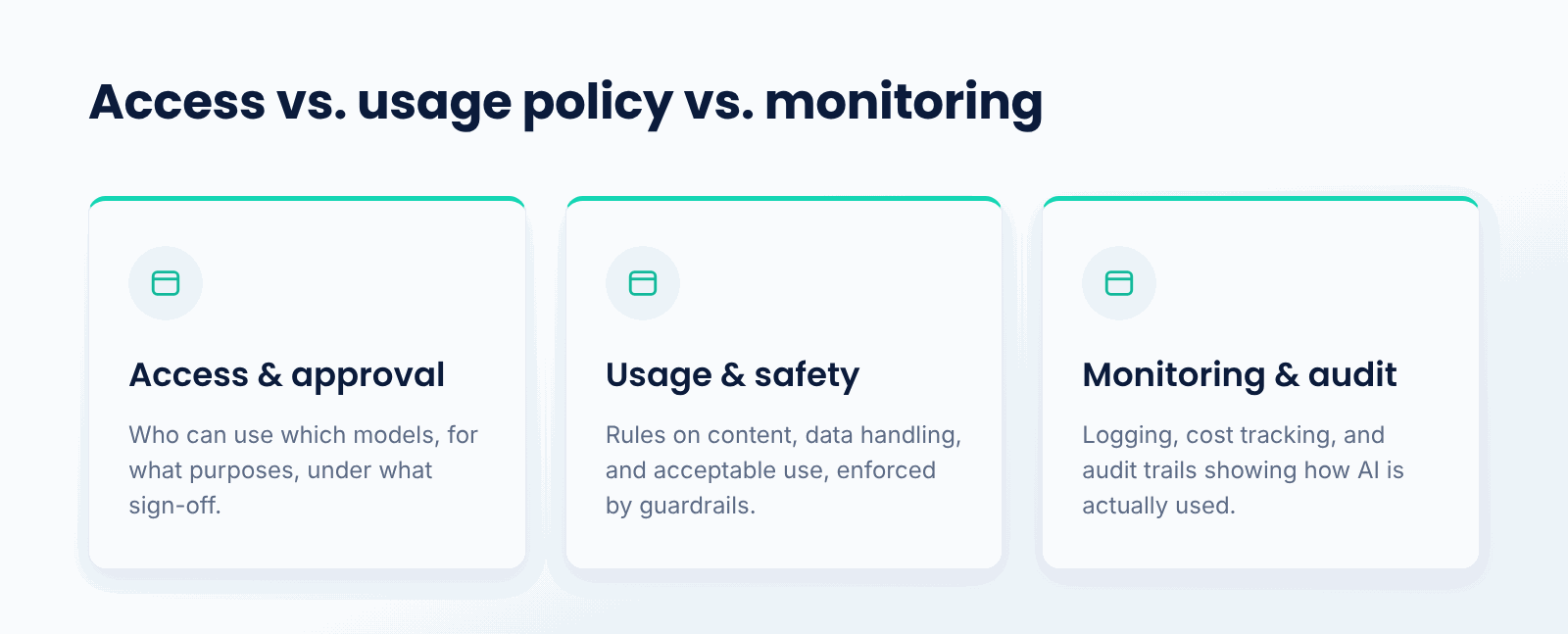
Governance spans a few connected areas. Access and approval decide who can use which models and for what purposes. Usage and safety policies set rules on content, data handling, and acceptable use, enforced by guardrails. Monitoring and accountability provide the logging, cost tracking, and audit trails that show how AI is actually being used.
These work together. Access rules without monitoring leave blind spots, and policies without enforcement leave gaps. Effective governance connects all three so that intent, control, and visibility line up.
Why does AI governance matter?
- Manages risk. It keeps AI use within safe, legal, and ethical bounds.
- Protects data. It controls what data can be sent to which models.
- Controls cost. It gives visibility and limits on AI spending across teams.
- Supports compliance. It provides the policies and audit trails regulators expect.
- Enables adoption. With guardrails in place, teams can use AI confidently at scale.
What are the challenges?
- Balancing control and speed. Too much friction slows teams; too little invites risk.
- Shadow AI. Unsanctioned tools bypass governance if approved options are not easy to use.
- Fast-moving landscape. New models and rules require governance to keep adapting.
- Consistency. Applying the same policies across many teams and tools takes central enforcement.
When do you need AI governance?
You need it as soon as AI use moves beyond a single experiment to multiple teams, real data, or production systems. The more widely AI is used and the more sensitive the data and decisions, the more governance matters.
A solo prototype with no sensitive data needs little formal governance. But any organization adopting AI across its business should put a governance framework in place before usage outgrows its ability to oversee it.
Best practices for AI governance
- Define clear policies on approved models, acceptable use, and data handling.
- Make approved AI easy to access so teams do not route around governance.
- Enforce policies automatically at runtime, not just on paper.
- Monitor usage for cost, safety, and compliance across all teams.
- Keep audit trails so AI use can be reviewed and explained.
- Centralize governance at a gateway so rules apply consistently to every model.
Conclusion
AI governance is the framework of policies, controls, and oversight that keeps an organization's AI use safe, compliant, and accountable. By defining who can use which models under what rules, enforcing those rules at runtime, and monitoring usage, it manages risk while letting teams adopt AI with confidence. Governance is what turns scattered AI experimentation into something a business can trust and scale.
TrueFoundry's AI Gateway gives teams a central place to enforce AI governance, controlling model access, applying guardrails, and tracking usage and cost across the organization. As AI spreads across the business, a governed gateway is how teams keep that growth safe and under control.
Controle, implemente y rastree la IA en su propia infraestructura
Frequently Asked Questions
What is AI governance in simple terms?
It is the set of guidelines and controls over how an organization uses AI. It regulates which models are permitted, who is authorized to use them, how they may be used, and how that use is monitored, keeping AI safe, legal, and accountable.
What does AI governance cover?
Access and approval for models, usage and safety policies enforced by guardrails, and monitoring and accountability through logging, cost tracking, and audit trails. Taken together, they define who uses AI, how, and with what visibility.
Why is AI governance important?
Because unmanaged AI use always carries risk: data leaks, excessive cost, compliance gaps, and unsafe output. Governance keeps use within safe and legal bounds while giving teams the confidence to adopt AI at scale.
What is the difference between AI governance and guardrails?
Guardrails are runtime controls applied to specific prompts and responses. Governance is the wider framework of policies, access, monitoring, and accountability within which guardrails are one enforcement mechanism.
How do you enforce AI governance?
By applying policies automatically where models are used, through access controls, guardrails, and usage limits, and by logging interactions for monitoring and audit. A gateway makes this consistent across all teams and models.

GenAI infra: simple, más rápido y más barato
Los mejores equipos confían en nosotros para escalar GenAI

- © 2022 ENSEMBLE Technologies



Suscríbase a nuestro boletín
Las últimas noticias, artículos y recursos enviados a tu bandeja de entrada


