Blank white background with no objects or features visible.

Te presentamos TrueForge: el entorno de agentes de código abierto y neutral respecto a proveedores. Un 50% menos de coste. Explorar ahora→

Agent Events, Explained: The Runtime Contract Behind Reliable AI Agents

Por Boyu Wang

Published: September 9, 2026

An agent’s final answer tells you what the user saw. Its events tell your application what happened, what is still happening, what needs a human, and how to recover when the connection breaks.

Source Note API Contracts
Source note. This article describes the public TrueForge API and UI event contracts available on September 3, 2026. It separates documented behavior from architectural guidance. Event names and lifecycle semantics are grounded in the linked TrueForge documentation; the production patterns and control boundaries are TrueFoundry editorial analysis.
Key Takeaways

Key takeaways

  • An event is a typed runtime record, not merely a log line or a token fragment.
  • TrueForge exposes lifecycle, model, tool, approval, authentication, sandbox, and subagent events through one stream.
  • Live deltas and persisted events serve different jobs: responsive rendering versus settled recovery and analysis.
  • A completed turn can still contain required actions. Turn completion and workflow completion are different states.
  • Events provide evidence for debugging and evaluation, but do not by themselves guarantee authorization, exactly-once side effects, compliance, or business outcomes.

1. Why a final-answer API is too small for agents

A conventional model call has a reassuring shape: send input, receive output. Even when the response streams, the application is usually reconstructing one answer. Agent execution is different. A run can make several model calls, request tools, wait for approval, authenticate to an MCP server, create a sandbox, delegate to subagents, and resume in a later request.

If the runtime exposes only the last text response, the application loses the structure it needs to operate that workflow. It cannot reliably answer basic questions:

  • Is the agent thinking, invoking a tool, waiting for a human, or finished?
  • Which model message proposed this tool call?
  • Which events belong to a subagent rather than the root agent?
  • Which fragments have already been rendered?
  • After a disconnect, should the client reconnect to the live run or rebuild from persisted state?

This is why events matter. They are the interface between hidden execution and everything that must respond to it: the user interface, approval service, operations console, debugger, and evaluator.

Useful Unit Callout

The useful unit is not “the agent returned a string.” It is “the runtime emitted a typed sequence of state changes that the application can interpret.”

2. What “event” means in TrueForge

TrueForge organizes execution as Agent → Session → Turn → Event → Delta. Each level answers a different question:

Agent Levels Table
Level Question it answers Typical lifetime
Agent Which reusable instructions, tools, model configuration, and runtime behavior define the worker? Many user interactions
Session Which ongoing issue or context does this work belong to? Several turns
Turn What happened in one request/response cycle? One execution cycle
Event What meaningful runtime occurrence happened? One structured record in the stream or history
Delta What incremental content arrived for an event that is still being assembled? Live stream only

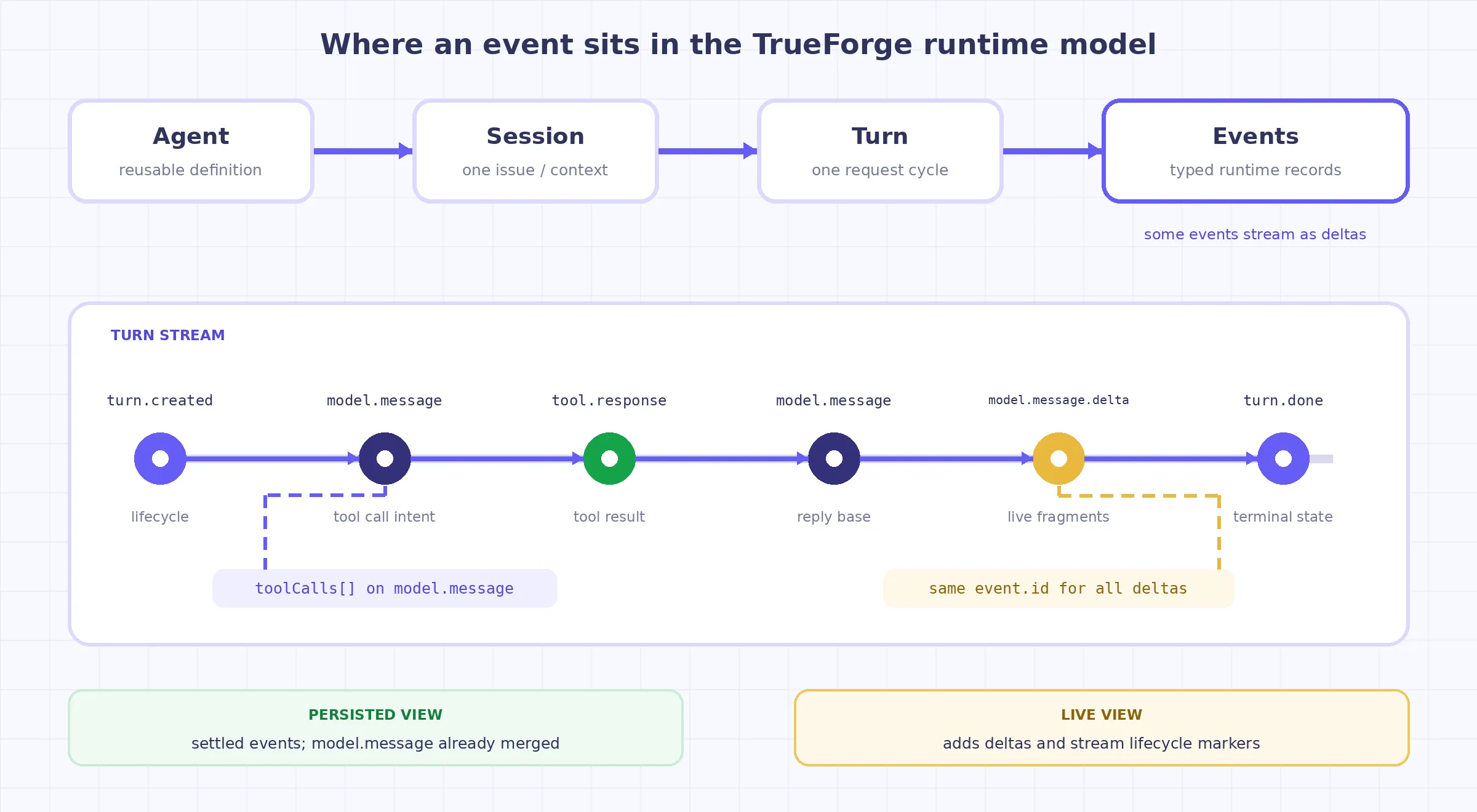
The agent is a definition, not a continuously running process. A session persists context across turns. A turn represents one request cycle, and only one turn runs at a time within a session. Events are the typed records produced inside that turn. Some events—most visibly model messages—can be incrementally assembled through deltas.

TrueForge hierarchy from agent to session to turn to events, with a turn stream and the distinction between live deltas and persisted merged events
Figure 1. An event sits inside a turn, which sits inside a durable session. The live view includes deltas and stream lifecycle markers; the persisted view returns settled events with message deltas already merged.

This hierarchy prevents two common design mistakes. First, session history should not be treated as one unbounded transcript: turns provide natural execution boundaries. Second, a streamed delta should not be stored or evaluated as if it were the final semantic event.

3. The event taxonomy is the runtime state machine

TrueForge’s documented event union covers several categories. The point is not the number of event types; it is that each category implies a different application behavior.

Try now.

One gateway for all your models, MCP servers, and agents.
No credit card needed.

Inscríbase
Tabla de contenido

Controle, implemente y rastree la IA en su propia infraestructura

Reserva 30 minutos con nuestro Experto en IA

Reserve una demostración

La forma más rápida de crear, gobernar y escalar su IA

Demo del libro
Summarize with
ChatGPT logo by OpenAI
Perplexity AI logo
Blurry red snowflake on white background, symmetrical frosty design with soft edges and abstract shape.

Descubra más

No se ha encontrado ningún artículo.
September 9, 2026
|
5 minutos de lectura

Agent Events, Explained: The Runtime Contract Behind Reliable AI Agents

No se ha encontrado ningún artículo.
September 8, 2026
|
5 minutos de lectura

Export TrueFoundry AI Gateway traces to Opik with OpenTelemetry

No se ha encontrado ningún artículo.
September 7, 2026
|
5 minutos de lectura

Claude Agent SDK vs Claude Managed Agents: Which Should You Run in Production?

No se ha encontrado ningún artículo.
September 7, 2026
|
5 minutos de lectura

Claude Managed Agents Alternatives: Top 5 Agent Harnesses to Consider in 2026

No se ha encontrado ningún artículo.

Blogs recientes

Black left pointing arrow symbol on white background, directional indicator.
Realice un recorrido rápido por el producto
Comience el recorrido por el producto
Visita guiada por el producto