


September 24, 2026
|
5 min read


Published: March 27, 2026
.webp)
Blazingly fast way to build, track and deploy your models!
The rapid democratization of generative AI has created an unintended crisis for enterprise IT and security teams. Employees across engineering, marketing, and product teams are increasingly using unapproved AI tools to write code, analyze data, and draft documents.
While this behavior boosts short-term productivity, it introduces serious shadow AI risk, including data leakage, compliance issues, and untracked costs. In many organizations, this problem is driven by the pricing and rigidity of sanctioned enterprise AI platforms. When approved tools are expensive, slow to provision, or limited in scope, teams bypass them.
This guide explains why shadow AI is spreading, how platform economics worsen it, and what leaders must do now to regain control without slowing innovation.
.webp)
"Shadow AI" is defined as "an organization is using an AI tool, model, or API, but they have not approved it by their IT or security teams." An engineer wants to respond to a customer support question by pasting a transcript from customer support into a chatbot such as ChatGPT. A financial analyst wants to use a Large Language Model to auto-summarize a financial report from a spreadsheet. A product development team wants to use a third-party model API to improve their shipping feature by billing it to their personal credit card. All of these are examples of "Shadow AI."
The concept of "Shadow AI" is related to "Shadow IT." "Shadow IT" is a long-standing problem in enterprises. In this problem, users in any organization use software without approval from their IT department. This problem is related to "SaaS applications." However, this problem is different from "Shadow AI." In "Shadow IT," we are using "SaaS applications." We are facing a different problem.
In "Shadow AI," we face a problem in which models are not only storing sensitive data but also processing it. They are generating output based on that data. They are also storing proprietary information. This problem is more severe than "Shadow IT."
The reason for this problem, however, is not negligence; it's because we are moving at a rapid pace. The procurement process for acquiring an AI tool is long; it takes a lot of time to secure one within an organization. However, the models are advancing at a rapid pace and shipping weekly.
The problem, however, lies in the fact that we are under pressure to ship features powered by AI platforms. We are not allowed to wait for one or two months to procure the tool; we are using whatever we can get. We are using whatever is easiest; that's why we are facing the risks of shadow AI.
Shadow IT has been a familiar thorn in the side of corporate IT and security teams for more than a decade. However, treating shadow AI as just another variation on this theme significantly underestimates how much things have changed.
Systems running artificial intelligence live on information and interact with the world in ways that a misbehaving project management tool simply does not.
The table below highlights some of the key differences between these two concepts.
.webp)
The transition from fixed SaaS applications costs to token-based consumption pricing deserves particular attention. A team can accrue tens of thousands of dollars in API costs in a single sprint. Without a gateway or access controls in place, the first time anyone knows about it is when the invoice arrives.
The transition from fixed costs to token-based consumption creates data security risks that are fundamentally difficult to anticipate. A team running high-volume inference queries, such as document processing, summarization, and AI agent workflows, can generate costs many orders of magnitude beyond a normal SaaS subscription, with no visibility until the cloud bill arrives.
.webp)
If an employee sends these prompts to public LLMs without any security controls, they're essentially outsourcing some of the company's most sensitive information. Codebases, financial models, patient information, customer data, proprietary code, etc., are all up for grabs for an honest employee who needs to get this done quickly.
The data security risks of exposure can take two forms, one of which is the more obvious one: what the LLM provider does with the sensitive data they receive. What they're doing with this prompt — whether they are using it for model training, exposing it to other users, or getting breached, etc.
The other one, however, is even more insidious: the one related to data privacy and sovereignty. So healthcare, finance, government, etc., have regulations such as HIPAA, SOC 2, and GDPR. What they're really saying is that the organization should be aware of where personal data is going and who this identifiable information is being exposed to.
So, if a doctor sends patient information to an unauthorized LLM, or if a banker sends financial information to some consumer chatbot, that's essentially a direct regulatory violation and a breach of data protection obligations.
Innovaccer, of course, is an example of the legitimate version of this concern on an enormous scale: they handle around 17 million inference requests per month on their healthcare platform, which means dozens of applications, tens of millions of users, etc. So, without a centralized control plane with PII redaction and data management built in, it would have been untenable from a regulatory point of view. The shadow AI risk in the healthcare space isn't hypothetical; it's just waiting to happen.
The fact that the costs of AI tool services, based on tokens, vary makes them fundamentally unknowable when running AI usage ungoverned. A team running a high volume of inference queries such as document processing, summarization, and AI agent workflows, can have costs many orders of magnitude beyond a normal SaaS cost, and no one is even aware of this until they get their bill from their cloud provider.
This situation quickly gets out of control when many teams are running their own API keys, model subscriptions, and usage patterns in isolation from one another. There is no overall understanding of the cost of use of AI services for the entire organization. There is no ability to understand costs for specific products or business units. There is no ability to limit costs until they get out of control. Instead, the financial team is left to try to perform forensic accounting on the situation.
This is exactly what a central AI Gateway solves for. Both Innovaccer and Aviva solved this problem by directing all LLM traffic through the TrueFoundry AI Gateway to track tokens and costs by team, user, environment, and model. They were able to understand and trace cost increases by service in just minutes. This is something that simply does not exist if each team is running their own fragmented API integration. Without a central plane of control, shadow AI costs are fundamentally invisible until they become a problem.
This means that the compliance systems don't reward participation; they reward results, and with AI usage scattered across unsanctioned systems, results are impossible to produce. There are no centrally collected logs of what models were used, what company data was passed through them, and what was sent as a prompt.
There is no audit trail that the compliance officer can pass along to the regulator. Is this a problem that some organizations might face at some point in the future? Absolutely not. For any organization subject to a SOC 2 audit, a GDPR audit, or a HIPAA audit, this is not a future problem; it is the present problem.
SOC 2 requires evidence of data management and processing controls, GDPR requires evidence of knowledge of where your sensitive data is flowing and the ability to delete it on demand, and HIPAA requires audit trails of all systems that touch patient data.
.webp)
The problem with most enterprise AI strategies is a rather uncomfortable irony: The platforms designed to manage AI usage are so costly, fragmented, and operational in nature that they may inadvertently encourage organizations to turn to the illicit platforms in the first place. Shadow AI is not always the result of irresponsible usage; in fact, it can be a logical response to the challenges posed by the legitimate platforms.
The most important features are single sign-on, role-based access controls, detailed audit trails, and cost allocation by team. These are the features typically reserved for the most expensive pricing tier of any popular AI system. The cost of access to compliant infrastructure for a team trying out a new model or building a simple tool is disproportionate to what they are trying to achieve.
The solution to the organization's problem is obvious. The IT department will simply license the enterprise tier for a handful of users to keep the cost reasonable. The rest of the people will wait in a queue or find another way to get in. The second group of people does not stop what they are doing. They simply stop doing it in a way that the governance boundary cares about.
The cost controls that are put into place to solve the problem are the ones that create the problem.
However, even if they're able to use that sanctioned AI infrastructure, they soon discover that they're not just using one product; they're using one product for the API gateway, another for observability, another for model serving, and another for prompt management. As a result, they have multiple integrations to manage and multiple access flows to manage, and the pain of working with the official stack is just not worth the benefit of calling the API.
The fragmentation of the official stack not only creates a governance problem but also a TCO problem, making it impossible to deploy the technology throughout the entire organization. If, to use the technology, you need multiple vendors and multiple contracts, then the obvious answer is to limit access to it. Of course, that creates another problem of concentration, because now a small percentage of the population can use the technology through the official stack, while the remainder is forced to use unmanaged alternatives.
The need for a platform like TrueFoundry, which provides AI Gateway, observability, model serving, and prompt management in a single control plane, is not only a governance argument; it's a TCO argument. The fact is, sanctioned AI technology won't scale throughout the organization unless it's accessible.
Managed AI services, in turn, have a significant markup over the compute costs. For instance, AWS SageMaker has an effective 25% markup on instance costs. This is a significant difference, especially if the developer is using a high-GPU workload or high-scale inference. For developers who know what these costs ultimately translate to, this is an ongoing source of frustration.
What we're seeing here is a pattern that is very familiar in the world of Shadow IT. What we have is developers effectively self-provisioning their own infrastructure, using their own API keys, or using cheaper, unmanaged services to avoid the cost overhead of using an official platform. Now, they are not trying to get out of some kind of governance model. They are just trying to get something done without expending an arbitrary budget. What we need to do is provide platforms that pass these infrastructure savings back to developers. What TrueFoundry is doing, using Kubernetes and instances instead of a managed service, is specifically designed to eliminate these incentives for developers to get around the official platform.
While it may be reasonable to seek to mitigate shadow AI risk through various security controls, it consistently underperforms in this regard. The tools and techniques used to manage Shadow IT in a rational manner have not been effective in addressing Shadow AI. Controlling Shadow AI is not possible; it just makes it less detectable.
Network-level security controls were designed in a world where Shadow IT was represented by an employee running an unauthorized application or accessing a particular domain. Shadow AI does not work in this fashion. The API call to OpenAI, Anthropic, or Google is just an encrypted HTTPS call over the network, in precisely the same fashion as any call to an external website. The current DLP tools and network monitors cannot distinguish between an employee accessing a production model and an employee using their own API key, as they are identical in nature and appearance. By the time it shows up in network logs as an anomaly, it is already too late.
Having banned AI tools across the enterprise, however, brings up a different problem. The employee can no longer use the AI tools at work, so they take them home and use them on their personal devices with their personal API keys on their home network. The employees have now moved from a problem that can be managed and controlled to one that cannot be managed or controlled.
Studies have shown time and time again that having no options, even with restrictive security policies, leads to non-compliance rather than non-workaround behavior. Employees under competitive pressure to deliver work with artificial intelligence tools are not going to willingly put themselves at a productivity disadvantage. The employees will find a way to get around whatever roadblock the organization puts in their way.
The answer to shadow AI risk isn't more controls; it's to make the controlled path easier than the uncontrolled path. If the controlled path can be quickly entered and used without the penalty of increased experimentation costs, then the need to get around the controls goes away.
Detection has to happen before remediation. Most companies vastly underestimate the extent of unsanctioned AI usage in their networks because it is difficult to detect. The first step is not a policy document; it is to develop visibility.
The first step in developing that visibility is to monitor outgoing traffic to known public endpoints for AI tool services. OpenAI, Anthropic, Google, Mistral, and Cohere are among the companies that use known domains and IP addresses for their API services. For most companies, network and security teams can monitor outgoing traffic to detect traffic to these known endpoints from inside the corporation. Unusual volumes, unusual times, and traffic from unusual sources are all signs. Of course, this is not even close to being exhaustive, because users outside the home network cannot be monitored at this level. But it is a simple way to detect in-network traffic with the greatest exposure risk.
Detection of unsanctioned API keys and subscriptions requires a review of financial and access data. For instance, a review of cloud expenses may indicate AI tool usage that was not formally budgeted. Similarly, a review of source code repositories may indicate hardcoded API keys, a sadly common practice that introduces security vulnerabilities and supply chain risks.
However, the association of AI usage with teams and applications helps close the accountability gap left by merely examining raw traffic flows. It is not very useful to know whether your network is using an endpoint for an LLM; it would be much more useful to know which team or application is using it. This is where tagging, or assigning metadata to API calls, is required to accomplish this. This is precisely what a Centralized AI Gateway can help an organization accomplish. This is precisely what TrueFoundry's Gateway allows an organization to accomplish: tag all of their traffic with user, team, and environment metadata, and then filter their log and metric data by those tags to gain a complete picture of everything in real time.
However, using a Centralized AI Gateway to uncover hidden AI usage is the most scalable detection solution and simultaneously addresses this problem. If all sanctioned AI usage flows through one gateway, then anything not represented in the log data of that gateway itself must necessarily be considered unsanctioned usage. This changes the problem from a reaction-based forensic problem to a definitional problem. The difference between the sanctioned usage reflected in the log data of a Centralized AI Gateway and the total AI usage is a measure of shadow AI risk exposure.
Organizations such as Innovaccer and Aviva have eliminated their shadow AI blind spot completely by using a Centralized AI Gateway, such as TrueFoundry's AI Gateway, to route all of their LLM usage. Not because they have somehow managed to stop everything else, but because they have made their sanctioned usage path so comprehensive that it now includes all of their legitimate usage.
.webp)
The aim is not to make AI tool use more difficult; instead, we want to make "governed" indistinguishable from "easy." Every additional governance step that makes AI usage more difficult legitimately is a force driving us toward Shadow AI. Shadow AI risk reduction is as much a product experience problem as a data security problem.
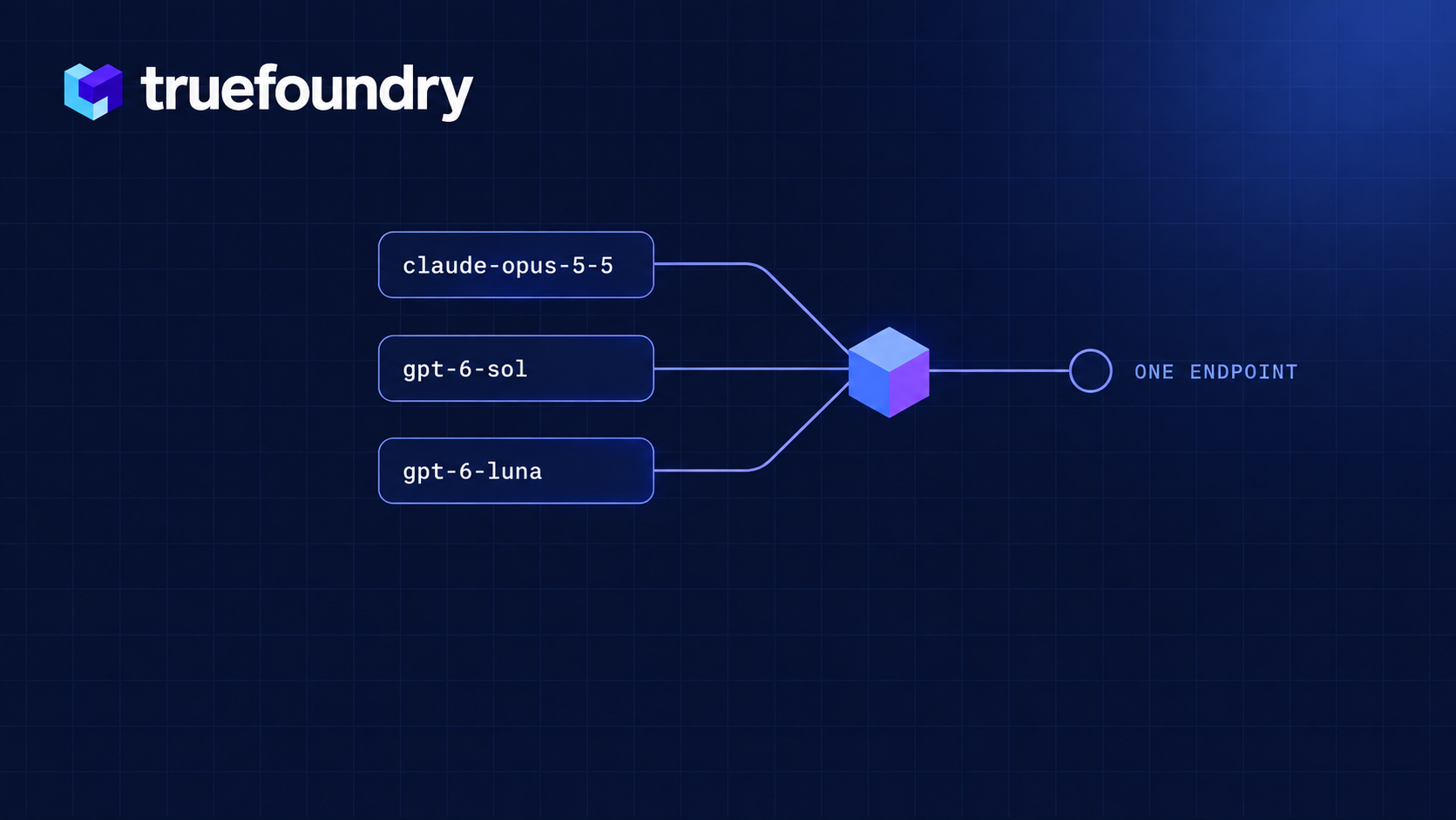
Make AI accessible via a single gateway. The most important thing an organization must do is ensure there is a single "approved" entry point through which all the models it actually wants to use of ai tools are accessible. TrueFoundry's AI Gateway offers a single API via which developers in an organization can access more than 250 LLMs: OpenAI, Claude, Gemini, Groq, Mistral, self-hosted LLaM, etc., all via a single API compatible with OpenAI. It speaks the language that developers already use. Thus, the friction between using an individual API key versus using the official platform is near zero.
Make governance happen automatically at the platform level. Governance controls are most important. PII masking, request logging, access controls, and quota controls must occur transparently in the infrastructure layer, without any developer needing to implement them. TrueFoundry does this automatically at the gateway level. Every request is logged, sensitive data is masked prior to exiting the organization's network, and quota limits or token budgets are enforced based on team or service identity. These clear guidelines are enforced without adding friction to developers.
Make sanctioned AI economically viable at scale. The teams won't use the official platform if it is clear that it is more costly to go through Shadow AI. The fact that TrueFoundry's architecture uses Kubernetes and cloud instances rather than adding a managed service component means it passes those costs through rather than adding a platform cost itself. The fact that it supports fractional GPU usage and spot instances is significant in reducing inference costs. The Aviva team and Innovaccer found this economically viable at scale, which is why it is a sanctioned path and not a mandate in the first place.
Provide self-service options to teams. The single biggest motivator for using Shadow AI is speed, and the only cure for speed is more speed, which TrueFoundry and the sanctioned path provide. The fact that it provides self-service options is important because ML and AI engineers can deploy their models, set up new virtual keys, and implement fallback options and new applications without waiting for their respective infra and IT teams to approve them. The Aviva team expected their new engineers to deploy or update a model within their first week, which is a good measure of what is possible with a platform that is indeed self-service.
Approval and provisioning queues are where sanctioned AI adoption is currently losing to Shadow AI, and those are precisely where it needs to gain ground to make it a viable option again.
.webp)
Most enterprise-class AI platforms require a trade-off. You can have governance or developer velocity, but not both at a scalable cost. TrueFoundry, however, is designed around a different principle. That principle is that this is not a fundamental truth, just a product limitation. Our architecture is designed so that the path of governance is also the path of least cost, maximum velocity, and maximum capability – the only way to eliminate Shadow AI, not just drive it further underground.
TrueFoundry hosts your AI Gateway and model-serving infrastructure directly within your AWS, GCP, or Azure account, not as a SaaS intermediary between your applications and your cloud. That is a fundamental difference in architecture. When we host within your VPC, every inference call, every prompt, every response from your models stays within your environment. That sensitive data never goes through a third-party system, never goes through your shared infrastructure, and never goes outside your governance boundaries.
This is a significant advantage for highly regulated industries. For example, if you're a healthcare organization and you're dealing with PHI data, or if you're a financial services organization and you're dealing with customer data, or if you're a government contractor and you're in GovCloud, you can use TrueFoundry with the same confidence that you're using for any other application in your cloud, because we're in your cloud. That's a fundamental difference in architecture. That's why Innovaccer, for example, is in our AWS GovCloud environment. They use us for their standard workloads and for HIPAA-aligned workloads with a lot of PHI, just because that data never leaves their cloud.
This also solves the major problem of data leakage that is at the core of what Shadow AI attempts to do to begin with. If we are starting with the sanctioned platform, there is no data privacy issue in bypassing it.
TrueFoundry provides RBAC, cost controls, token-based quotas, and observability as standard features of the platform. These are not features that require a professional services engagement to implement. We support rate limits that are configured per user, per service, and per endpoint. We support tokens and cost budgets configured per team with hard limits that prevent overspending altogether, rather than simply detecting it after the fact.
This is important to address with Shadow AI as cost controls are one of the major areas that are commonly sacrificed as a way to control platform access to control costs. The cycle of limiting access to limit costs to limit access to limit costs, and so on, to finally arrive at the solution of Shadow AI as a way to bypass these controls to get actual work done, is broken when we can simply provide a platform that is cost-effective enough to use broadly and fine-grained enough to provide cost controls at the team level. I can provide each engineering team with its own budget, quota, and level of access without creating a cost-control problem.
TrueFoundry’s AI Gateway provides a single pane of glass for all prompts, token counts, model interactions, latency, and error events throughout the organization. Logs are complete and exportable, including user-, team-, environment-, and model-level metadata. Logs can be directly integrated into any observability pipeline. For example, Grafana is used by Innovaccer to view TrueFoundry’s OpenTelemetry metrics in production.
This addresses every blind spot in the organization's data security posture requirements. For example, if the auditor asks to see data access controls for a SOC 2 audit, or if an audit of a HIPAA compliance process requires an audit trail of the systems that have touched PHI, the answer lies in the AI Gateway logs. There is no need to explain or justify anything or to conduct a forensic analysis of why the records don't exist.
TrueFoundry offers a single API, which can be used through OpenAI. This allows it to call any public or private model an organization has set up with over 250 public providers and their own models running on their deployment platform. The experience for a developer using TrueFoundry's API to call GPT-4o is identical to calling it directly. The credential handling, logging, cost handling, and fallbacks are all handled behind the scenes in the infrastructure layer.
The overall effect is that the developer won't have a need or want to bypass the platform. The developer is able to access all models they would want to access, through an interface they are used to using. The deployment platform offered by TrueFoundry also allows for a self-serve model. This allows developers to use their platform to create new services, autoscale, and update models without needing help from a platform team. Because of the self-serve model and the ease of using TrueFoundry's platform, bypassing the platform is always going to be a less-preferred option compared to using the sanctioned platform. This is the only type of Shadow AI governance.
Shadow AI is ultimately a product of a tooling gap. If the sanctioned path for the enterprise AI stack is too slow to access, too costly to scale, or too fractured to use, teams will find a way to use something else outside of it, and we will no longer have visibility into or control over that usage. Buying more restrictive governance tools or procurement practices does not address this issue; they simply make the problem worse by making the sanctioned path even harder to use.
We must make the sanctioned path better than the shadow path. We must make it easier to access, more cost-effective to scale, more usable, and more comprehensive in terms of models and use cases that teams might want to use. If we're in this situation, Shadow AI isn't something we're fighting; it's simply something we don't have to fight because our solution is better than the alternative.
TrueFoundry is built from the ground up to solve this problem. We offer enterprise-grade governance in your own cloud, without per token markup, without features being locked behind expensive editions, and without a user experience that forces teams into a ticketing system.
Schedule a demo to learn how TrueFoundry can help your organization achieve a unified, compliant control plane for all AI usage without slowing your teams down.
The major risks of shadow AI include data leakage of sensitive information, accidental exposure of company data in prompts, compliance issues, lack of visibility into AI usage, unforeseen costs, and fragmented data management processes. TrueFoundry addresses these shadow AI risk factors by providing a safe, controlled means of access to AI tool systems.
Enterprises must provide an authorized enterprise platform that employees prefer to use to mitigate Shadow AI risks. Deploying a central gateway ensures all model interactions remain secure within the private cloud environment. TrueFoundry maintains strict access controls and tracks token consumption without slowing down your overall engineering team productivity.
Detection of Shadow AI risks begins with monitoring outbound network traffic to known public model endpoints. Security teams must audit cloud spend and source code repositories for hardcoded API credentials. Routing all sanctioned traffic through the TrueFoundry gateway exposes any external usage as an unapproved violation of corporate security policies.
Instead of restricting access to AI systems, organizations must ensure safe access. Safe access means providing authorized AI interfaces, providing access controls, and providing data protection mechanisms. By providing organizations with safe access, employees will not use unauthorized AI systems. True Foundry infrastructure can help organizations provide safe access while enabling employees to explore AI systems.
However, in order for organizations to address the risk associated with Shadow AI, they must first have visibility on usage. This is often done by monitoring API usage, analyzing usage patterns, and reviewing outbound data. Having a single point of access for AI use cases makes it easier to track usage. This is exactly what TrueFoundry can provide to an organization.
If certified AI systems for enterprises are difficult to access, costly, or time-consuming to deploy, employees might turn to public AI systems to accelerate task completion. There is a disconnect between what is recommended and what is actually used. Shadow AI occurs when the recommended AI system fails to provide the required speed and flexibility. TrueFoundry fills this gap by offering access to AI systems without introducing additional friction into the process.
The objective of an AI Gateway is to provide a centralized layer that manages all access to AI systems. In other words, it allows an organization to track whether policies are being followed, which AI systems are used, and whether policies are enforced. It helps minimize the use of unsanctioned AI systems by providing a certified path for users to access AI systems. TrueFoundry’s AI Gateway is a centralized layer that enables access to AI systems.
TrueFoundry AI Gateway delivers ~3–4 ms latency, handles 350+ RPS on 1 vCPU, scales horizontally with ease, and is production-ready, while LiteLLM suffers from high latency, struggles beyond moderate RPS, lacks built-in scaling, and is best for light or prototype workloads.






The latest news, articles, and resources sent to your inbox
.webp)
.webp)
.webp)
.webp)
.webp)
.png)
.png)
.png)
.png)
.png)
.png)
.png)


