


October 26, 2026
|
5 min read


Blazingly fast way to build, track and deploy your models!
For AWS-native teams, Amazon Bedrock initially felt like the promised land: a single API for Claude 3.5, Llama 3, and Titan without a single server to manage. It promised to be the "AWS AI Gateway" that would standardize Generative AI across the enterprise stack, just like S3 standardized storage.
But after months of building production systems on Bedrock, the reality is more nuanced. While the models are excellent, the infrastructure around them can feel rigid. Aggressive throttling, opaque latency spikes, and the limitations of managed Knowledge Bases often frustrate teams trying to scale beyond a PoC.
In this honest review AWS Bedrock review, we break down exactly what Bedrock gets right, where it falls short in production, and why many enterprises are layering TrueFoundry on top to solve the "last-mile" problems of AI delivery.
Let’s be precise: Amazon Bedrock is not a model; it is a serverless API layer. It is AWS’s fully managed service that gives you access to foundation models from AI21 Labs, Anthropic, Cohere, Meta, Mistral AI, and Amazon itself.
AWS positions Bedrock as the serverless answer to OpenAI’s API. You don't manage instances (like in SageMaker). You don't worry about GPU availability. You simply hit an endpoint, and AWS handles the inference infrastructure behind the scenes. It is designed to be the utility layer for enterprise AI.
If you live inside the AWS management console, Bedrock gets a lot of things right immediately. The integration with the broader ecosystem removes the friction typical of third-party APIs.
This is the killer feature for DevOps. With Bedrock, you don't have to manage, rotate, or hide API keys. Access is controlled entirely through AWS Identity and Access Management (IAM) roles. You can grant a specific Lambda function permission to invoke only anthropic. claude-3-5-sonnet and nothing else. For security teams, this audit-ready permission structure is the difference between a nightmare and a sign-off.
AWS provides a contractual guarantee that your inputs and outputs are never used to train the underlying foundation models. For banking, healthcare, and government workloads, this is non-negotiable. Unlike some consumer-grade APIs where data usage policies can be murky, Bedrock keeps sensitive data isolated within your AWS trust boundary.
In 2026, reliability is the new benchmark. Bedrock’s "Cross-Region Inference" is a lifesaver. It automatically routes your inference requests to a different AWS region if the primary region experiences an outage or capacity crunch. This abstraction layer means your application doesn't need complex failover logic; Bedrock handles the traffic shaping to ensure consistent uptime.
Despite strong foundations, our AWS Bedrock review found limitations that hit hard once you move from "Hello World" to "Production Traffic." These are the most common complaints found in AWS Bedrock reviews.
The default service quotas are shockingly low. Depending on the region and model, you might be capped at something like 500 tokens per minute (TPM) or 50 requests per minute. For a real-time production app, this is nothing. Increasing these quotas isn't automated; it often requires a manual support ticket and a lengthy back-and-forth with AWS support to prove your use case. We have seen product launches stall simply because the "On-Demand" throughput couldn't scale fast enough.
Bedrock Knowledge Bases promise "RAG in a box," but they are a black box. They simplify the setup, but they lock you into specific chunking strategies and vector stores. If you need advanced retrieval techniques—like hybrid search, custom semantic chunking, or reranking logic—the managed service often falls short. Teams frequently end up tearing out the Knowledge Base and rebuilding their own RAG pipelines on OpenSearch or Pinecone to regain control over retrieval accuracy.
If you try to debug a hallucination using CloudWatch, you are in for a bad time. CloudWatch gives you raw logs and basic metrics like InvocationLatency, but it lacks LLM-specific context. You cannot easily see "Cost per Conversation," visualize token usage by user, or trace a multi-step agent workflow. The native observability is built for infrastructure, not for AI application performance.
Because Bedrock is a multi-tenant service, you are subject to "noisy neighbor" effects. We have observed significant latency variance during peak US business hours. A prompt that takes 2 seconds to generate at 8 AM might take 6 seconds at 2 PM. For agentic workflows that require multi-step reasoning, these spikes compound, leading to timeouts and a degraded user experience that is hard to engineer around without fallback mechanisms.
Many teams assume Bedrock functions as a full AWS AI gateway. It does not. It is a model provider with an API.
A true gateway offers semantic caching, fallback routing, and policy enforcement. Bedrock lacks Semantic Caching, meaning if a user asks the exact same question ten times, you pay AWS to generate the answer ten times. It has no Automatic Model Fallback; if Claude returns a 500 error, your app crashes unless you write custom retry logic code. And while it has IAM, it lacks granular Cost Guardrails to stop a specific team from draining the monthly budget in a day. AWS AI Gateway reviews often highlight these missing AWS AI Gateway features.
TrueFoundry doesn't replace Bedrock; it sits on top of it. It acts as the "Control Plane" that AWS didn't build, solving the reliability and cost issues without sacrificing the security of the AWS ecosystem.
TrueFoundry sits in front of Bedrock to provide the missing gateway features. The most immediate impact is Caching. By caching responses for identical or semantically similar prompts, teams often reduce their Bedrock bill by 15-20% immediately. Furthermore, it handles Fallback Routing. If Bedrock throws a rate limit error in us-east-1, TrueFoundry can transparently route that request to us-west-2 or even to Azure OpenAI, ensuring 99.99% reliability.
Why use Claude 3.5 Sonnet for a simple "Thank you" email? TrueFoundry enables Smart Routing. You can set rules to route complex reasoning tasks to Bedrock's Claude models, while routing simple classification or summarization tasks to cheaper models like Llama 3 (hosted on Bedrock or Spot Instances). This "model arbitrage" drastically reduces the blended cost of inference.
Instead of digging through AWS Cost Explorer tags, TrueFoundry provides real-time dashboards. You can see exactly how much "Team A" spent on "Project X" yesterday. You can set Cost Guardrails that automatically cut off access or send alerts if a deployment exceeds its daily token budget, preventing the dreaded "bill shock."
Bedrock is a powerful tool, but it is not a one-size-fits-all solution.
Amazon Bedrock excels as a model supermarket. It gives you secure, private access to the world's best models via a standard API. However, it lacks the gateway-level features required for robust, cost-effective production systems.
It solves the access problem, but it ignores the operations problem.
TrueFoundry fills these gaps. By adding governance, caching, and multi-provider routing on top of Bedrock, you transform a raw API into a production-ready AI stack.
It can be. While the per-token pricing is competitive, the lack of native caching means you pay for every redundant request. Additionally, high-throughput applications often require "Provisioned Throughput," which involves expensive, long-term commitments compared to the pay-as-you-go model.
The immediate fix is to implement exponential backoff and retry logic in your code. The long-term fix is to request a quota increase via AWS Support (which takes time) or use a gateway like TrueFoundry to automatically failover to a different model or provider when throttling occurs.
No. AWS explicitly states in their service terms that customer data (inputs and outputs) processed through Amazon Bedrock is not used to improve the base models and is not shared with model providers like Anthropic or Cohere.
Not all models support fine-tuning. While you can fine-tune Amazon Titan, Cohere Command, and Meta Llama models, some proprietary models (like earlier versions of Claude) have limited or no fine-tuning support within the Bedrock environment.
If you need more control over your RAG pipeline, the best alternative is to build a custom pipeline using a vector database (like Pinecone, Weaviate, or AWS OpenSearch) and use an orchestration framework (like LangChain or LlamaIndex) managed via a platform like TrueFoundry. This allows you to customize chunking, embedding models, and retrieval logic.
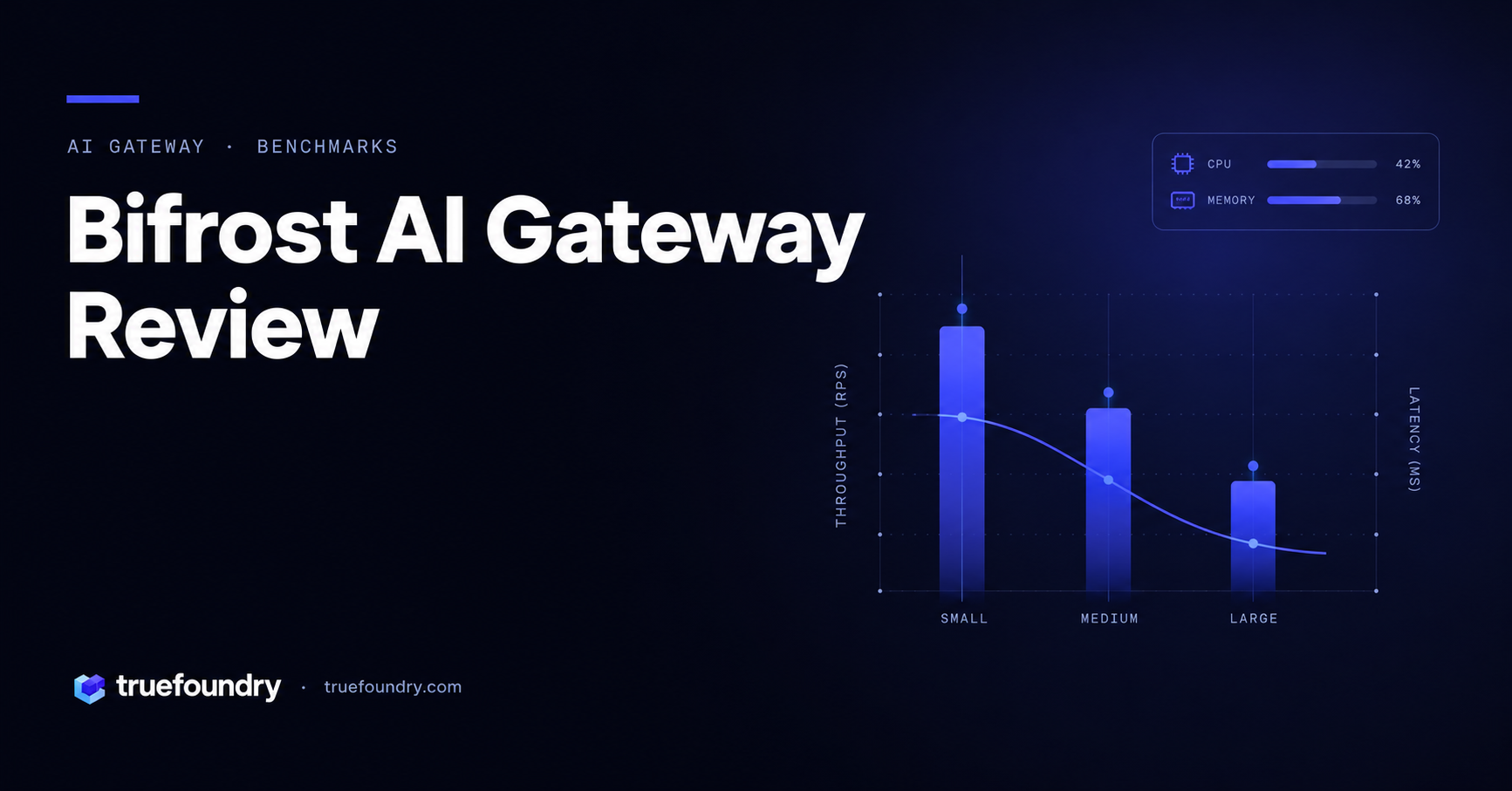
TrueFoundry AI Gateway delivers ~3–4 ms latency, handles 350+ RPS on 1 vCPU, scales horizontally with ease, and is production-ready, while LiteLLM suffers from high latency, struggles beyond moderate RPS, lacks built-in scaling, and is best for light or prototype workloads.






The latest news, articles, and resources sent to your inbox
.webp)
.webp)

.png)
.png)
.png)
.png)
.png)
.png)
.png)
.png)
.png)
.png)
.png)


