


September 24, 2026
|
5 min read


Published: June 23, 2026
Blazingly fast way to build, track and deploy your models!
Shadow AI already accounts for 20% of enterprise breaches, costing organizations an average of $670,000 more than standard incidents. The EU AI Act high-risk enforcement provisions took effect in August 2026, with fines reaching 35 million euros or 7% of global turnover. And Gartner projects that 40% of enterprise applications will embed autonomous AI systems by the end of 2026, up from less than 5% in 2025.
Artificial intelligence governance is no longer a planning conversation. It is an operational requirement, and the gap between what most teams have deployed and what they need is widening fast.
The market for AI governance tools, covering everything from artificial intelligence policy documentation to runtime enforcement gateways, has expanded quickly to meet this demand, but the tools are not all solving the same problem. Some document compliance. Some monitor model performance and drift. Some enforce controls at runtime.
Picking the wrong one means investing in a layer of governance that looks thorough on paper but does nothing to stop a misconfigured agent from accessing sensitive data at 2 AM on a Tuesday.
This article compares the leading AI governance tools in 2026: what each one does, where it falls short, and how to choose based on your team's needs in production. Read on!
Monitoring tools tell you what happened. AI governance tools prevent what should not happen. That distinction matters because by the time you see something in a monitoring dashboard, the data has already moved, the cost has already been spent, or the policy has already been violated.
Compliance workflows and features locked behind enterprise pricing tiers effectively mean governance is unavailable to most teams. If the controls that actually matter, RBAC, audit logs, PII redaction, require a contract upgrade, teams work around them. That is exactly where Shadow AI begins.
The strongest AI governance platforms operate at the infrastructure layer. They apply policy enforcement automatically to every request without requiring developers to write policy logic into application code. If governance depends on developers remembering to implement it, it will not be consistent.
Read our indepth guide on what is an AI governance.

TrueFoundry is recognized as a Representative Vendor in the 2025 Gartner Market Guide for AI Gateways, processing over 10 billion requests per month across Fortune 1000 companies. It deploys as a VPC-native AI gateway platform inside your AWS, GCP, or Azure account, keeping all inference calls, prompts, and model responses within your own network boundary.
TrueFoundry is purpose-built for enterprise teams that need AI governance enforced at the infrastructure layer across models, agents, and tools. It is the right fit for regulated industries, multi-cloud deployments, and organizations requiring full data sovereignty alongside compliance-ready audit trails.
TrueFoundry offers flexible plans, including a Pro tier with VPC deployment and essential governance tools, and an Enterprise tier for organizations running AI at scale with strict compliance, advanced security, and custom deployment requirements. Pro starts at $499/month. Enterprise pricing is available on request.
Ready to govern every model call, agent action, and tool connection from one unified control plane inside your own cloud?
Explore our live demo and see the platform live with and how it works with your own workloads.

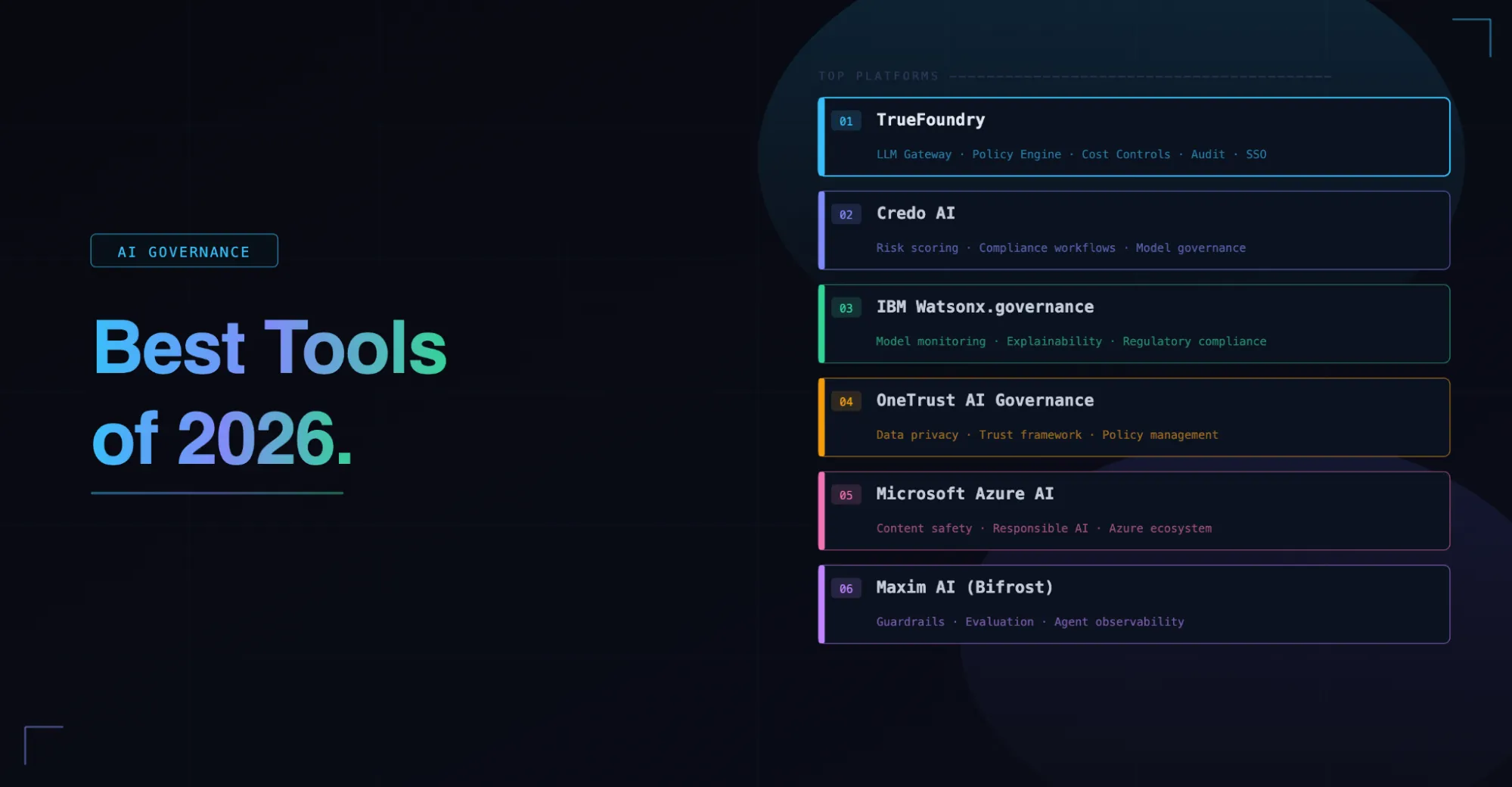
Credo AI is a lifecycle AI governance platform focused on compliance automation and audit-ready documentation. It ships pre-built policy packs aligned to the EU AI Act, NIST AI RMF, ISO 42001, SOC 2, and HITRUST with automated evidence collection workflows.
Credo AI documents governance requirements but does not enforce them at the execution layer. TrueFoundry's AI gateway enforces access controls, cost budgets, and audit logging on every live model request, making governance operational rather than aspirational.

IBM Watsonx.governance provides enterprise-grade AI risk management covering lifecycle monitoring, bias detection, explainability, and model behavior tracking. It received FedRAMP authorization, making it one of the few AI governance platforms cleared for US federal deployments.
IBM Watsonx.governance works best within IBM's own stack and requires significant overhead outside it. TrueFoundry's AI gateway platform is provider-agnostic by design, governing workloads across OpenAI, Anthropic, Azure, AWS Bedrock, and self-hosted models from a single VPC-native control plane.
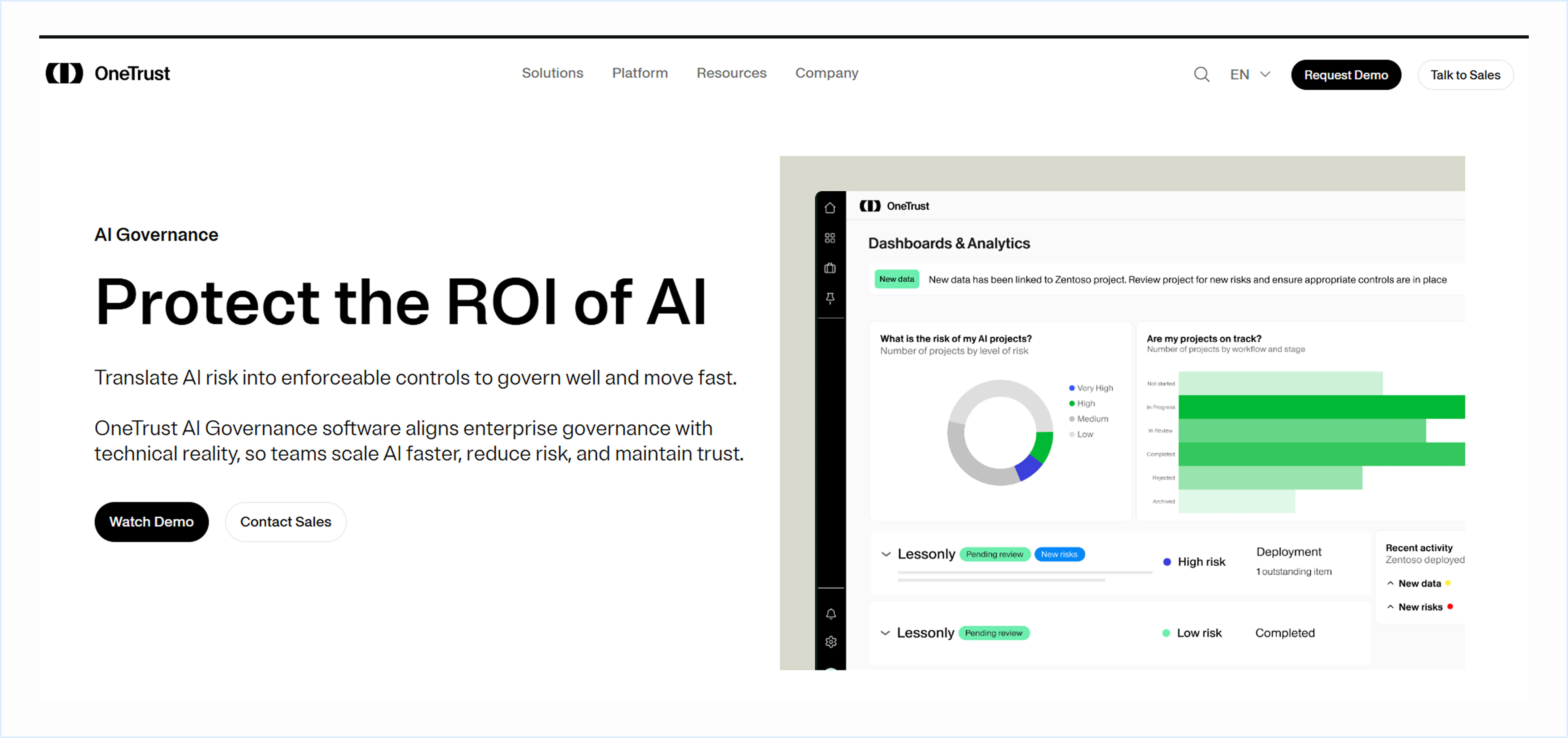
OneTrust AI Governance specializes in GRC workflows for regulated industries, extending OneTrust's established data privacy platform to cover AI system inventories, risk assessments, and vendor management. In March 2026, OneTrust expanded to include continuous monitoring and real-time AI agent detection.
OneTrust governs AI inventory and vendor risk at the policy layer. TrueFoundry's MCP gateway and AI gateway enforce governance at the request layer, applying access controls, content guardrails, and audit logging to every model call and agent tool invocation in real time.

Azure AI Content Safety and Responsible AI provide cloud-native governance for models deployed within Azure, including Prompt Shield for prompt injection defense and responsible AI impact assessments integrated directly into the Azure portal. For organizations already standardized on Azure, these controls require no additional deployment overhead.
Azure AI governance works only within the Azure boundary. TrueFoundry's AI gateway governs workloads across Azure, AWS, GCP, and self-hosted models from a single VPC-native control plane, applying the same access controls and audit logging regardless of where the model runs.

Maxim AI combines infrastructure-level governance through its Bifrost gateway layer, including budget controls, access management, and audit logging, with an integrated LLM evaluation and quality assurance platform for product and engineering teams.
Maxim AI addresses evaluation and basic governance for smaller teams. TrueFoundry's Agent Gateway and AI gateway serve enterprise teams with VPC-native deployment, deep RBAC configuration, agentic workflow governance, and compliance-ready audit trails that purpose-built infrastructure platforms require.
Compliance documentation platforms produce audit artifacts from manual inputs and periodic reviews. They do not intercept a misconfigured agent accessing sensitive data in real time. Documentation and enforcement are two separate layers, and most governance tools address only one. By the time a compliance report surfaces a gap, the access has already happened and the data has already moved.
Cloud-native governance capabilities from Azure, AWS, and Google Vertex lock enforcement to their own model hosting environments. Organizations running workloads across providers, or using self-hosted models, find that those controls simply do not apply outside the vendor's own infrastructure. The result is governed AI on a subset of workloads while the rest operate without oversight. That gap is where shadow AI grows.
Most governance platforms treat governance as a feature within a broader product rather than as foundational infrastructure. Essential capabilities like per-team cost budgets, granular RBAC, and real-time PII redaction end up behind enterprise contracts. Teams unable to access those features work around them, which is precisely how shadow AI spreads inside organizations that believe governance is already in place. The Gartner 2026 Best Practices for Optimizing Agentic AI Costs report reinforces that cost and governance controls must operate at the infrastructure layer to be effective.
None of the compliance-focused platforms address the cost-accountability gap that arises when dozens of teams run inference workloads independently. Finance sees one consolidated bill. Engineering has no mechanism to identify which team, which application, or which model is responsible for cost spikes. TrueFoundry's LLM gateway solves this by tagging every request with user, team, model, and environment metadata at execution time, producing per-request attribution without custom analytics pipelines.

Here is why enterprises need infrastructure-level governance:
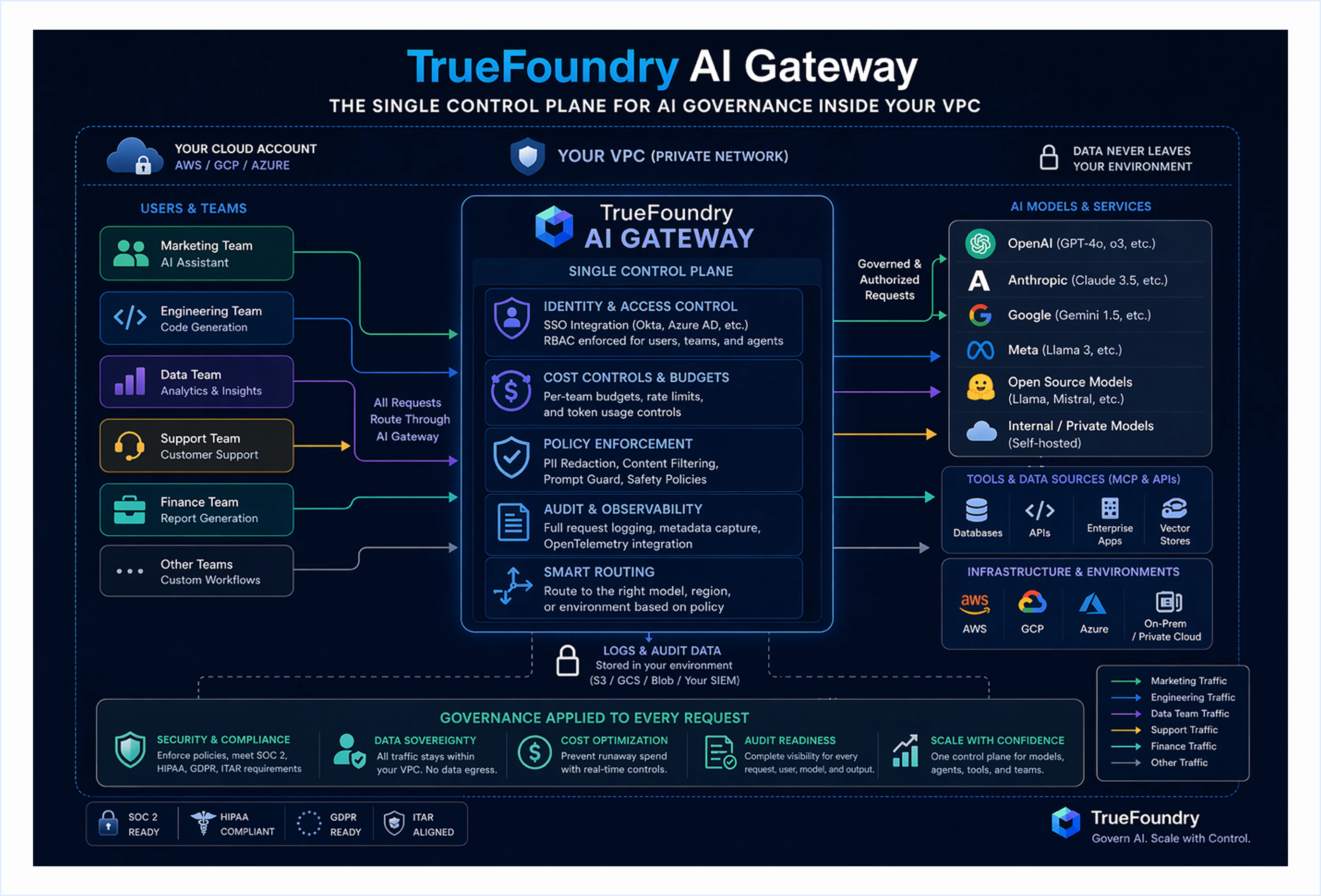
TrueFoundry is built around a straightforward principle: AI governance is an infrastructure problem, not a compliance automation workflow. Every control lives at the gateway layer and applies automatically to every request. No developer has to implement policy automation logic in application code for it to work.
Book a free demo today to get started.
TrueFoundry AI Gateway delivers ~3–4 ms latency, handles 350+ RPS on 1 vCPU, scales horizontally with ease, and is production-ready, while LiteLLM suffers from high latency, struggles beyond moderate RPS, lacks built-in scaling, and is best for light or prototype workloads.




AI governance tools are platforms that help organizations monitor, control, and enforce governance policies across their AI systems. Depending on the tool, this can mean documenting regulatory compliance with the EU AI Act, monitoring model performance and bias drift, enforcing access control on which teams can use which AI models, managing token costs, or logging every inference request as audit trails. The category spans governance frameworks and compliance automation platforms used by compliance teams to infrastructure-level gateways enforcing controls at the request layer.
The right AI governance tools depend on your specific use case and what you need to govern. TrueFoundry is the strongest option for teams needing runtime enforcement, access control, cost budgets, and audit logs inside their own VPC. Credo AI fits compliance teams needing regulatory frameworks documentation. IBM Watsonx works for organizations with existing IBM infrastructure. OneTrust suits data governance teams. Azure AI Content Safety fits Azure-standardized organizations with no multi-cloud requirements.
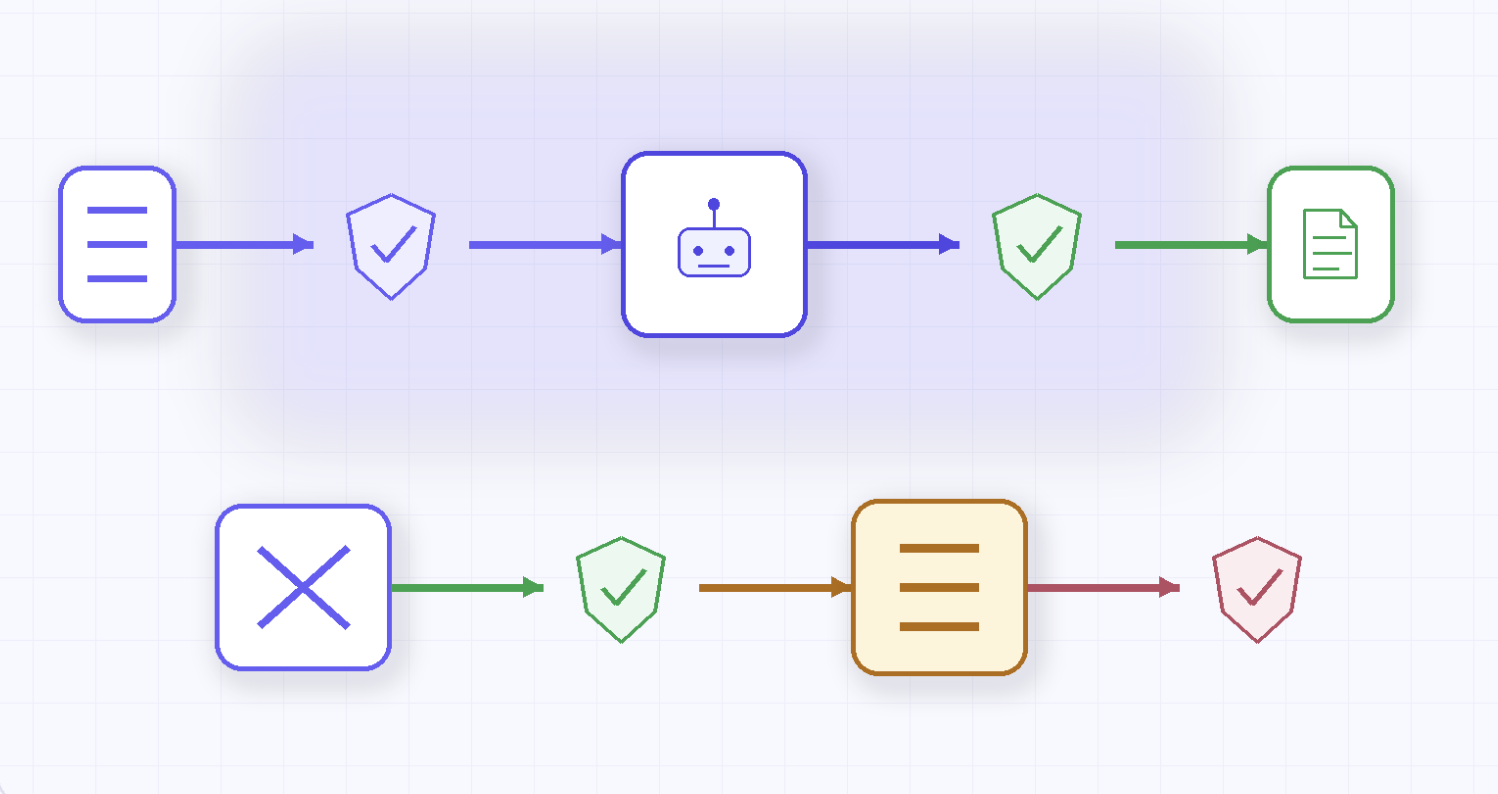
Infrastructure-level AI governance platforms like TrueFoundry sit between your applications and AI models, intercepting every request before it reaches a model. At that layer, they verify identity and permissions, check policy enforcement against cost budgets, scan prompts for sensitive data or violations, and log the full interaction. Compliance automation tools like Credo AI work differently: they collect information about your AI systems through integrations and generate risk assessments, compliance reports, and audit artifacts.
Three reasons that are all operational. First, Shadow AI already accounts for 20% of enterprise breaches. When teams connect to external services for AI use cases without IT visibility, sensitive information leaves through unmonitored channels. Second, the EU AI Act is in enforcement for high-risk systems, with fines up to 35 million euros. Third, token costs across uncontrolled multi-team AI adoption are unpredictable. AI governance platforms address all three through lifecycle management, visibility, and cost controls.
TrueFoundry is one example of a full-stack AI governance platform that deploys inside your own cloud and enforces access control, cost budgets, PII redaction, and audit logs at the gateway layer. Credo AI is another, focused on evidence collection and risk assessments workflows. IBM Watsonx integrates governance into IBM ecosystem AI development for large organizations already working within that stack. Each represents a different approach to AI governance based on whether you need documentation, monitoring, or enforcement.
There is no single answer because the use of AI and the governance requirements it creates vary significantly by industry, deployment type, and regulatory context. For production enforcement, TrueFoundry is the strongest option for enterprises that need governance controls applied inside their own VPC across AI models, agents, and tools.
For compliance automation and regulatory requirements documentation, Holistic AI and Credo AI are purpose-built options. Gartner's 2025 Market Guide for AI Gateways projects that by 2028, 70% of software engineering teams building multimodel applications will use AI governance tools like AI gateways.



The latest news, articles, and resources sent to your inbox
.webp)
.webp)
.webp)
.webp)
.webp)
.png)
.png)
.png)
.png)
.png)
.png)
.png)


