


October 1, 2026
|
5 min read


احصل على وصول فوري إلى بيئة TrueFoundry مباشرة. انشر النماذج، ووجّه حركة مرور LLM، واستكشف المنصة بالكامل — بيئة الاختبار الخاصة بك جاهزة في ثوانٍ، ولا يلزم وجود بطاقة ائتمان.



Published: July 4, 2026

Blazingly fast way to build, track and deploy your models!
Enterprise LLM API spending doubled in six months from $3.5B in late 2024 to $8.4B by mid-2025 with no sign of slowing. Gartner forecasts $2.52 trillion in worldwide AI spending for 2026, a 44% year-over-year increase.
The irony is that token prices have never been lower. GPT-4-class models cost a fraction of what they did eighteen months ago. The bill is exploding because usage volume is exploding faster than prices are falling driven by agentic workflows that consume 10–100x more tokens per session than a chatbot ever did, and by the proliferation of LLM calls across product features that teams built without any cost discipline in place.
Field audits are revealing an uncomfortable truth: 40–60% of token budgets in production LLM applications are pure waste. Redundant calls for identical prompts. Flagship models doing tasks a fraction of their cost could handle identically. No rate limits on developer or CI pipelines. No budget caps that fire before the month-end bill arrives. No visibility into which team, feature, or use case is driving spend.
The optimization techniques exist - semantic caching, intelligent model routing, hierarchical budget limits, on-prem/cloud fallback chains. The problem is that you cannot implement any of them at scale without a centralized control layer. Without something sitting between your applications and your model providers, every optimization lives in application code, duplicated across every team, with no governance and no observability.
An AI Gateway is that control layer. This guide explains why, and shows exactly how TrueFoundry's AI Gateway featured in Gartner's 2026 Best Practices for Optimizing Generative & Agentic AI Costs implements each cost lever at the infrastructure level, independently of what any individual team does in their application.
Most organizations approach LLM cost optimization the same way they approached API cost management five years ago: each team is responsible for its own usage, providers send monthly bills, and someone in engineering periodically looks at the total and winces.
This approach has four structural failure modes for LLM workloads:
1. No attribution. When your OpenAI bill arrives, you see total token usage across your organization. You don't see which application, team, feature, or user drove that usage. You cannot investigate. You cannot allocate costs. You cannot identify which 20% of use cases are driving 80% of spend - even though that 80/20 pattern is almost certainly present in your data.
2. No prevention. Cost anomalies in LLM workloads happen fast. A bug that puts an agent in an infinite loop can consume thousands of dollars in minutes. A developer testing a new feature with a context-heavy prompt can blow through a month's budget in an afternoon. Without rate limits and budget caps at the infrastructure layer, these events are discovered on the monthly bill, not when they happen.
3. No leverage. The most impactful cost optimizations - semantic caching, model routing, on-prem/cloud fallback chains operate best at the infrastructure level where they can be applied across all applications simultaneously. Implementing them in individual applications means every team rebuilds the same infrastructure, with inconsistent coverage and no cross-application cache hit sharing.
4. No model flexibility. When you route directly to providers from application code, switching models requires code changes in every application. This friction prevents teams from adopting cheaper models as they become available, and makes it impossible for a platform team to enforce model tier policies organizationally.
The AI Gateway resolves all four failure modes by making it the single enforcement point for every LLM call in your organization. Route everything through the gateway and you get attribution, prevention, leverage, and flexibility - centrally, without touching application code.
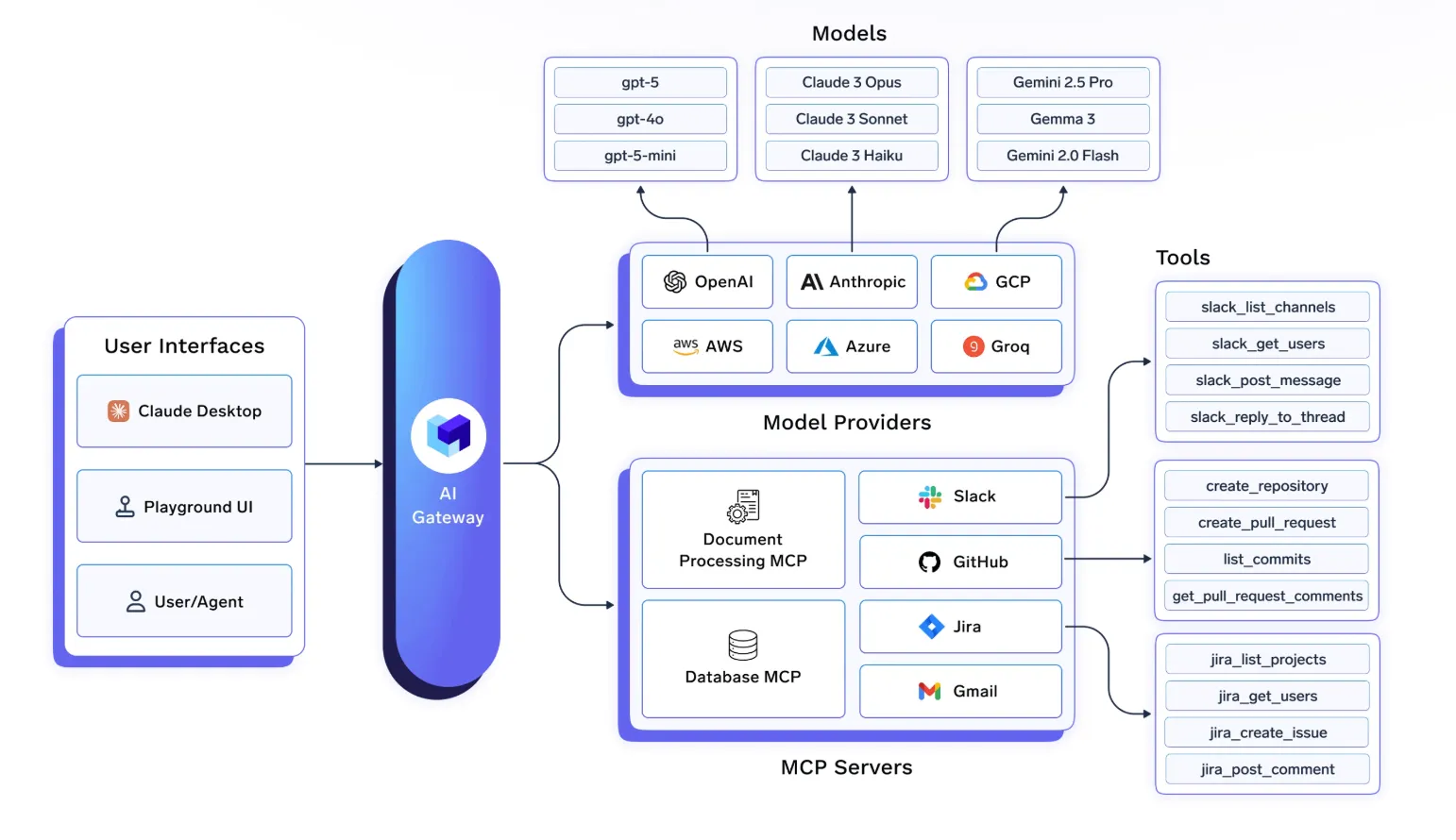
You cannot optimize what you cannot see. The first output of gateway-routing all LLM traffic is a complete, attributable, queryable record of every model call - by user, team, virtual account, application, and model.
TrueFoundry's AI Gateway automatically tracks cost per request using an open-source pricing catalog that stays updated with provider-published rates, including tiered pricing (e.g. Gemini 2.5 Pro's different rates above 200K tokens) and region-specific pricing (e.g. AWS Bedrock Nova Lite's rates per region). For models with custom contracts or fine-tuned pricing, Private Cost configuration lets you set exact per-token rates that flow through to all dashboards.
The result: a live dashboard showing cost broken down by team, user, virtual account, model, and application - filterable by any metadata tag you pass in the X-TFY-METADATA header. Tag every request with project_id, feature, customer_id, or environment and your cost dashboards automatically segment by those dimensions.
See TrueFoundry cost tracking documentation for setup.
This is the highest-priority control to deploy. Before you optimize spend, you need to prevent catastrophic spend. Budget limits and rate limits at the gateway level are the circuit breakers that fire before the bill arrives.
TrueFoundry's budget limiting is hierarchical - rules stack and combine:
Rate limiting at the TrueFoundry gateway addresses three distinct scenarios:
This is where the largest cost savings live. Research consistently shows that 60–80% of enterprise LLM costs come from 20–30% of use cases and that concentration is almost always high-volume, low-complexity tasks where a frontier model is dramatically over-specified.
RouteLLM (published at ICLR 2025) demonstrated that a well-trained complexity router can achieve 95% of GPT-4 performance while routing only 14–26% of requests to the expensive model - a 75–85% cost reduction on routed workloads. The savings are available without sacrificing quality. The prerequisite is a routing layer.
TrueFoundry's Virtual Models implement three routing strategies that map directly to cost optimization scenarios:
The on-prem primary with cloud fallback pattern is the highest-ROI routing configuration for enterprises with GPU infrastructure:
name: loadbalancing-config
type: gateway-load-balancing-config
rules:
  - id: priority-failover
    type: priority-based-routing
    when:
      models:
        - gpt-4
    load_balance_targets:
      - target: onprem/llama
        priority: 0
        fallback_status_codes: ["429", "500", "502", "503"]
      - target: bedrock/llama
        priority: 1
        retry_config:
          attempts: 2
          delay: 100
Traffic stays on your GPUs (zero marginal cost) until capacity is exhausted, then automatically bursts to Bedrock. The cloud API becomes a capacity buffer, not the default. See TrueFoundry load balancing documentation for full configuration options.
Routing can also be scoped by metadata - route development environments to a cheaper model tier, production to the premium model, without any application code change:
- id: dev-environment
  type: weight-based-routing
  when:
    models: [gpt-4]
    metadata:
      environment: development
  load_balance_targets:
    - target: openai-dev/gpt4-mini
weight: 100Caching is the most immediate cost reduction lever for workloads with any query repetition. Repeated or semantically similar prompts return cached responses instantly - zero tokens consumed, zero provider cost, dramatically lower latency.
TrueFoundry AI Gateway supports two caching modes:
Exact Match Caching stores and returns responses for byte-identical prompts. Zero false positives - the same prompt always returns the same cached response. Hit rates depend on workload; best for API-driven, templated prompts where parameters are consistent.
Semantic Caching uses embedding similarity to match prompts that mean the same thing even if worded differently. A question about "how do I reset my password" and "I forgot my password, what do I do?" return the same cached answer. Typical cost reduction: 30–50% for customer support, FAQ, and documentation workloads with repetitive query patterns. See TrueFoundry semantic caching guide for implementation details and similarity threshold tuning.
Both modes support configurable cache expiration policies and manual invalidation - so cached responses stay fresh for time-sensitive data while static content is cached indefinitely.
Provider-native prompt caching sits alongside gateway-level caching as a complementary lever. Anthropic's Claude API prompt caching reduces input token costs by up to 90% on cached prefixes with 13–31% improvement in time-to-first-token. This operates at the provider level - the gateway routes to the right endpoint, and the provider applies prompt caching automatically for supported models.
Every request processed by the gateway is automatically tagged with:
X-TFY-METADATA (project_id, feature, customer_id, environment)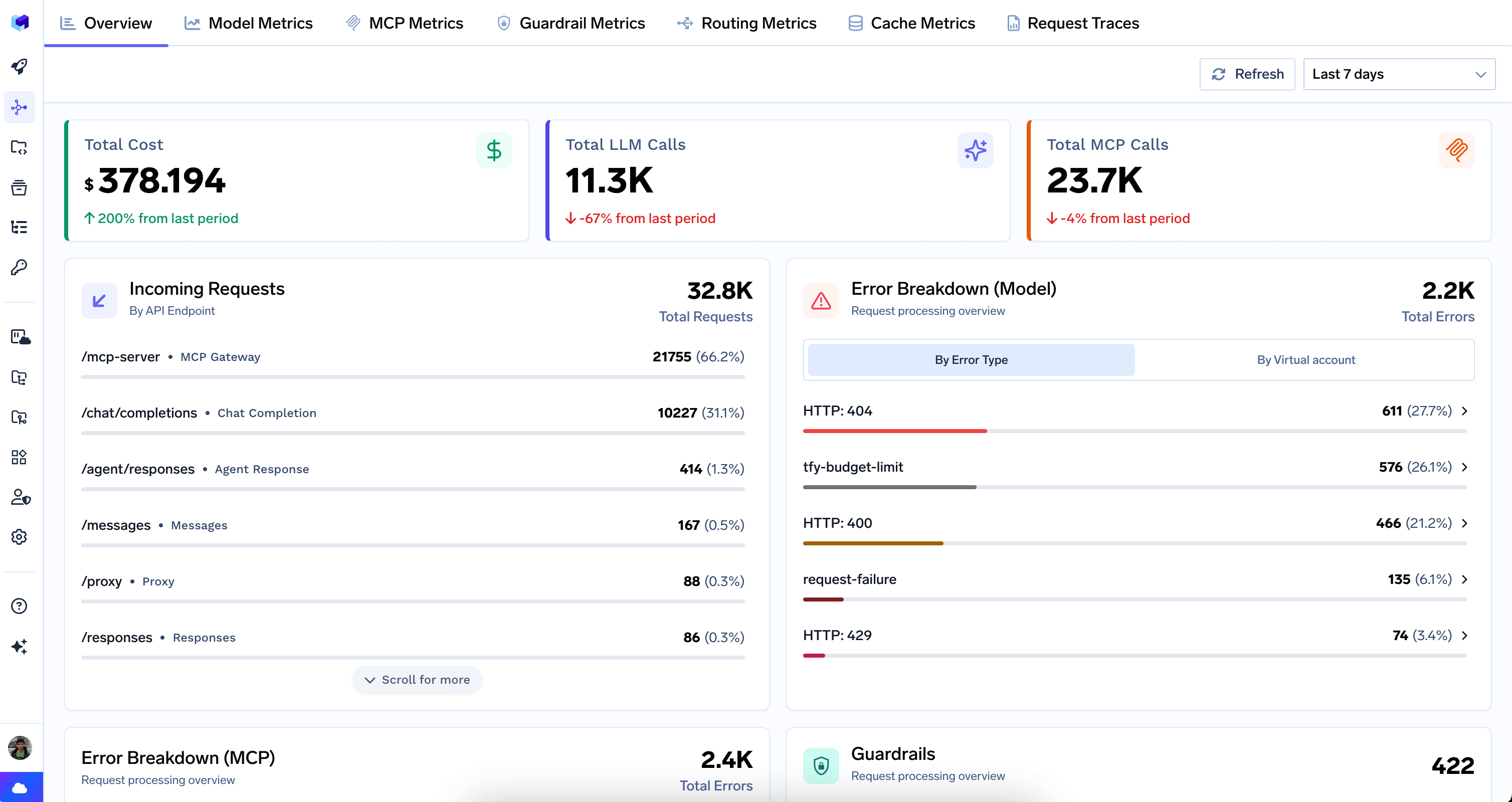
The analytics dashboard surfaces all of this with pre-built views grouped by users, virtual accounts, teams, and configurations. The routing metrics tab shows which budget limits and rate limits are being hit, and by whom, so you know exactly which team is burning budget before the month ends, not after.
All traces export via OpenTelemetry to any SIEM or observability platform - Grafana, Datadog, Splunk, or your existing stack - enabling custom dashboards, automated alerting, and integration with your existing FinOps tooling.
TrueFoundry's budget limiting engine evaluates multiple rules per request, with the most restrictive matching rule taking effect. Rules are ordered and composable:
Practical configuration: Per-developer daily caps with team overrides
ML team members match rule 1 first ($100/day). All other developers hit rule 2 ($10/day). Both rules are evaluated for tracking, but the first match governs the allow/block decision.
Adding a model-level safety net
Individual users stay within $10/day. But even if every user is within their limit, total GPT-4 spending organization-wide is capped at $500/month - preventing a scenario where many users individually within limits collectively exhaust your model budget.
See TrueFoundry budget limiting documentation for the full rule schema.

Rate limits can be scoped beyond just user and team - targeting specific environments, models, or applications:
name: ratelimiting-config
type: gateway-rate-limiting-config
rules:
  - id: openai-gpt4-dev-env
    when:
      models: ['openai-main/gpt4']
      metadata:
        env: dev
    limit_to: 1000
    unit: requests_per_day
This caps GPT-4 usage in the development environment at 1,000 requests/day without affecting production traffic. CI/CD pipelines that hit LLMs during testing — a common source of unexpected cost are gated without touching CI configuration.
See TrueFoundry rate limiting documentation for full configuration options.
Fallbacks aren't just reliability features - they're cost control mechanisms. Automatic failover on 429 (rate limit) responses from a provider means you're not paying for retries or failed requests.
The gateway's fallback chain handles the following scenarios automatically:
TrueFoundry load balancing and fallbacks handles all three routing strategies (priority, weight, latency) with per-target retry configuration — so you don't need to implement retry logic in every application.
Exact savings depend on your workload composition, but this framework gives a directional view of the opportunity:
A realistic combined scenario: A 500-person engineering org with $150K/month in LLM API spend. Semantic caching at 40% hit rate saves 20% overall. Routing dev environments to cheaper models saves 15%. On-prem primary for 60% of traffic saves another 25%. Combined: 60% reduction, or $90K/month saved. At TrueFoundry gateway pricing, the ROI is measured in days, not quarters.
Week 1 - Visibility first. Route all LLM traffic through TrueFoundry AI Gateway. Enable cost tracking with public pricing. Tag every request with your attribution metadata (team, project_id, environment). After one week you'll know exactly where your money is going. This alone changes the conversation from "our AI bill is high" to "the document analysis pipeline in team X is driving 40% of cost."
Week 2 - Prevention. Configure budget limits and rate limits based on what week 1 showed you. Cap per-developer daily spend. Add environment-based rate limits for dev/staging. Set a model-level monthly cap on your most expensive model. These controls prevent the next incident. They don't optimize - they protect.
Week 3 - Routing. Create Virtual Models that implement environment-based routing (dev → cheaper model, prod → premium model) and provider priority chains. If you have on-prem GPU capacity, configure priority-based routing with cloud fallback. This is where the significant savings materialize.
Week 4+ - Caching and refinement. Enable semantic caching for workloads with repetitive patterns. Tune similarity thresholds. Review the routing metrics dashboard to understand which budget and rate limits are being hit most frequently and adjust. The analytics layer shows you where to focus next.
Each team gets its own virtual account with independent budget tracking. The platform team sets org-level model caps and default rate limits. Individual team leads can see their team's cost breakdown without access to other teams' data.
Key configuration: Project-based budgets using metadata + virtual account weekly caps + model-level monthly caps as org-wide safety nets.
See TrueFoundry AI Gateway analytics for team-level dashboard setup.
Customer-facing AI products need per-customer usage tracking to implement chargeback or tiered billing. Tag every request with customer_id in metadata. The gateway tracks cost per customer_id automatically. Set per-customer rate limits that map to plan tiers.
Key configuration: Metadata-based budget rules per customer_id + rate limits scoped by customer tier. This gives you accurate data for your billing pipeline without any custom metering infrastructure.
Agentic workloads are the highest-cost LLM pattern. A single agent task can consume thousands of tokens across dozens of model calls. حدود الميزانية ليست اختيارية لأعباء العمل القائمة على الوكلاء - إنها آلية الأمان الأساسية.
وجه كل حركة المرور القائمة على الوكلاء عبر البوابة من خلال ANTHROPIC_BASE_URL (أو ما يعادله). قم بتعيين مفاتيح افتراضية لكل هوية وكيل بحدود ميزانية يومية. قم بتكوين سلاسل احتياطية محلية/سحابية بحيث تستخدم الوكلاء طويلة الأمد تفضيليًا سعة محلية أرخص للمهام الفرعية الروتينية.
انظر دليل تكامل TrueFoundry Claude Code لتكوين نشر الوكلاء.
غياب البوابة هو بحد ذاته تكلفة. يتجلى ذلك بأربع طرق:
تكلفة الحوادث. حلقة وكيلية بدون حدود للمعدل، مطور يختبر مطالبات غنية بالسياق، خطأ يولد استدعاءات API زائدة — هذه الأحداث تحدث. السؤال هو ما إذا كانت تتوقف عند 50 دولارًا أم يتم اكتشافها عند 5000 دولار في الفاتورة الشهرية.
تأخر التحسين. بدون توجيه مركزي، يقوم كل فريق يرغب في تطبيق بدائل نماذج أرخص أو التخزين المؤقت ببنائها بشكل مستقل. التحسينات على مستوى المنصة التي قد تستغرق مهندسًا واحدًا أسبوعًا واحدًا تستغرق بدلاً من ذلك ستة أشهر من الجهد المجزأ عبر الفرق.
فجوة الإسناد. عندما لا يمكنك إسناد التكلفة إلى الفرق أو التطبيقات أو الميزات، لا يمكنك مساءلة أي شخص عن إنفاق الذكاء الاصطناعي ولا يمكنك تحديد أهداف التحسين الأكثر تأثيرًا.
مخاطر الامتثال. في الصناعات الخاضعة للتنظيم أو المنتجات متعددة المستأجرين، فإن عدم القدرة على إظهار إسناد التكلفة والاستخدام لكل عميل أو لكل فريق ليست مجرد مشكلة مالية - إنها مشكلة حوكمة ودقة فواتير.
تحسين تكلفة نماذج اللغة الكبيرة (LLM) هو مجموعة من الاستراتيجيات والضوابط التي تقلل ما تدفعه المؤسسات مقابل استدعاءات واجهة برمجة تطبيقات نماذج اللغة الكبيرة مع الحفاظ على جودة المخرجات. تكتسب هذه المسألة أهمية الآن لأن إنفاق الشركات على واجهات برمجة تطبيقات نماذج اللغة الكبيرة تضاعف في ستة أشهر ومن المتوقع أن يصل إلى 15 مليار دولار بحلول نهاية عام 2026، مدفوعًا بأعباء العمل القائمة على الوكلاء التي تستهلك عددًا أكبر بكثير من الرموز المميزة مقارنة بنشر روبوتات الدردشة التقليدية. بدون تحسين منهجي للتكلفة، 40-60% من هذا الإنفاق هو هدر محض: استدعاءات متكررة، نماذج مبالغ في تحديد مواصفاتها للمهام البسيطة، عدم وجود تخزين مؤقت، وعدم وجود ضوابط للميزانية.
يمكنك تطبيق تحسينات فردية في كود التطبيق، ولكنك ستواجه ثلاث مشكلات: كل فريق يعيد بناء نفس البنية التحتية بطريقة غير متسقة؛ ليس لديك رؤية مركزية لمعرفة أين تركز؛ والتحسينات لا تكون أفضل من التطبيق الأقل صيانة في مجموعتك التقنية. تطبق بوابة الذكاء الاصطناعي ضوابط التكلفة بشكل شامل ومركزي، وعبر كل تطبيق في وقت واحد دون مطالبة الفرق الفردية بتنفيذ أي شيء. قاعدة توجيه واحدة في البوابة تحل محل مئات التغييرات في الكود عبر عشرات التطبيقات.
يقلل التخزين المؤقت الدلالي التكاليف عادةً بنسبة 30-50% لأعباء العمل ذات التكرار العالي للاستعلامات - مثل دعم العملاء، أنظمة الأسئلة الشائعة، البحث في الوثائق، ومسارات التصنيف. تأتي الوفورات من إرجاع الاستجابات المخزنة مؤقتًا (تكلفة مزود صفرية، زمن انتقال شبه صفري) للاستعلامات المتشابهة دلاليًا مع الأسئلة التي تم الإجابة عليها سابقًا. تعتمد معدلات الإصابة بشكل كبير على أنماط أعباء العمل؛ فأعباء العمل ذات الاستعلامات المتنوعة والفريدة تشهد معدلات إصابة أقل. انظر دليل TrueFoundry للتخزين المؤقت الدلالي لتقييم أعباء العمل وإرشادات ضبط العتبة.
يوجه توجيه النموذج كل طلب LLM إلى النموذج الأكثر ملاءمة من حيث التكلفة بناءً على التعقيد، الفريق، البيئة، أو معايير أخرى. أظهرت الأبحاث (RouteLLM, ICLR 2025) أن توجيه 14-26% فقط من الطلبات إلى نموذج رائد بينما يتم التعامل مع البقية بنموذج أرخص يحقق 95% من أداء النموذج الرائد بتكلفة أقل بنسبة 75-85%. عمليًا، الشكل الأكثر تأثيرًا للمؤسسات التي تمتلك بنية تحتية لوحدات معالجة الرسوميات (GPU) هو التوجيه الأساسي المحلي / الاحتياطي السحابي — حيث يبقى تدفق البيانات على وحدات معالجة الرسوميات الخاصة بك (بتكلفة هامشية تقارب الصفر) وينتقل إلى واجهات برمجة تطبيقات السحابة فقط عند استنفاد السعة. النماذج الافتراضية من TrueFoundry تطبق جميع استراتيجيات التوجيه الثلاث (الأولوية، الوزن، زمن الاستجابة) دون الحاجة إلى تغييرات في كود التطبيق.
تحديد الميزانية من TrueFoundry هرمي ويستند إلى القواعد. يمكنك تحديد قواعد تحدد من تنطبق عليه (مستخدم، فريق، حساب افتراضي، نموذج، أو قيمة بيانات وصفية)، ومبلغ الميزانية والنافذة الزمنية (مثل 10 دولارات في اليوم لكل مستخدم)، وما إذا كان الحد فرديًا أم مشتركًا. تتراكم قواعد متعددة — يمكن للمطور أن يكون لديه حد شخصي قدره 10 دولارات في اليوم ويساهم في سقف على مستوى المؤسسة لـ GPT-4 بقيمة 500 دولار شهريًا. عند تجاوز أي حد مطبق، تحظر البوابة الطلب وتعيد خطأ قبل حدوث إنفاق الرمز المميز. يمكن تكوين التنبيهات لتصدر قبل الوصول إلى الحد.
مشكلة تكلفة نماذج اللغة الكبيرة (LLM) هي مشكلة بنية تحتية، وليست مشكلة تطبيق. لا يمكن حلها بطلب من الفرق الفردية أن تكون أكثر كفاءة في استخدام مطالباتها أو أن تطبق حدود معدلاتها الخاصة. إنها تتطلب طبقة تحكم مركزية تطبق حوكمة التكلفة على كل استدعاء لنموذج اللغة الكبيرة قبل استهلاك الرمز المميز، وليس بعد وصول الفاتورة.
بوابة الذكاء الاصطناعي هي تلك الطبقة. إنها تجعل التكلفة مرئية (الإسناد)، وتجعل الهدر مستحيلاً (حدود الميزانية وضوابط المعدل)، وتجعل النماذج باهظة الثمن استثناءً (التوجيه الذكي)، وتجعل الحسابات المتكررة مجانية (التخزين المؤقت). كل من هذه الفوائد متاح بشكل مستقل؛ وعند دمجها، فإنها تحقق بشكل روتيني تخفيضًا في التكلفة بنسبة 50-80% على أعباء عمل نماذج اللغة الكبيرة في الإنتاج.
تطبق بوابة الذكاء الاصطناعي من TrueFoundry جميع الروافع الأربعة في منصة واحدة، وقد تميزت بها Gartner لتحسين تكلفة الذكاء الاصطناعي الوكيل في عام 2026. مع زمن استجابة إضافي يقل عن 4 مللي ثانية وأكثر من 350 طلبًا في الثانية على وحدة معالجة مركزية افتراضية واحدة، لا تضيف البوابة أي زمن استجابة ذا معنى بينما تضيف كل تحكم ذي معنى في التكلفة.
TrueFoundry AI Gateway delivers ~3–4 ms latency, handles 350+ RPS on 1 vCPU, scales horizontally with ease, and is production-ready, while LiteLLM suffers from high latency, struggles beyond moderate RPS, lacks built-in scaling, and is best for light or prototype workloads.





أحدث الأخبار والمقالات والموارد تصلك مباشرة إلى بريدك الوارد
.png)
.png)
.png)
.png)
.png)
.png)
.png)
.png)
.png)
.png)
.png)


