



October 1, 2026
|
5 min read


احصل على وصول فوري إلى بيئة TrueFoundry مباشرة. انشر النماذج، ووجّه حركة مرور LLM، واستكشف المنصة بالكامل — بيئة الاختبار الخاصة بك جاهزة في ثوانٍ، ولا يلزم وجود بطاقة ائتمان.



Published: July 4, 2026

Blazingly fast way to build, track and deploy your models!
Cloudflare AI Gateway has quickly become a popular choice for teams looking to manage, monitor, and route LLM traffic through a centralized proxy. As LLM adoption accelerates across industries, teams are increasingly introducing AI gateways to add observability, security, and control between their applications and third-party models.
But as AI usage scales, pricing clarity becomes a critical factor. Teams need to understand not just the per-call costs, but the infrastructure and operational patterns that influence long-term spend.
To learn more about how AI Gateways control costs and key considerations to take into account before choosing a vendor, read the full Gartner Market Guide for AI Gateways 2025 here.
At first glance, Cloudflare AI Gateway pricing appears simple, especially with free access to core features. However, real-world usage often reveals hidden costs tied to logging, data retention, and scaling limits.
In this blog, we break down:
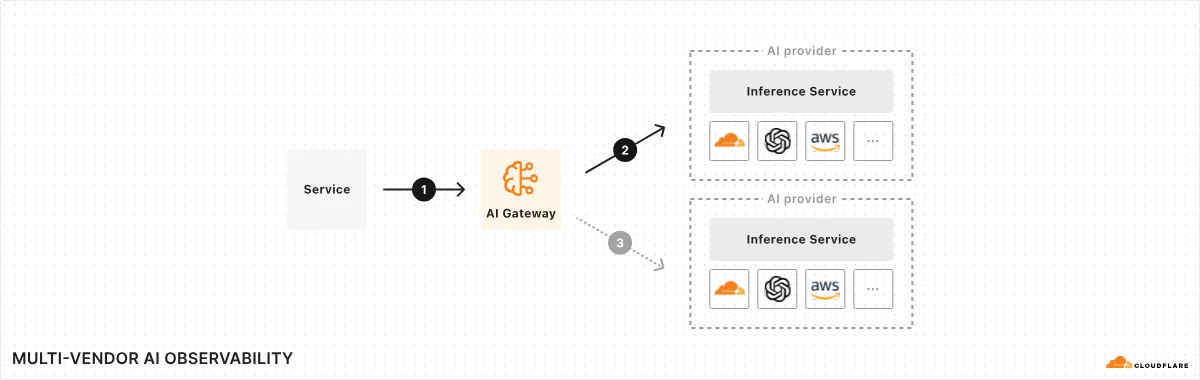
Before covering Cloudflare AI Gateway cost, it’s important to understand what Cloudflare AI Gateway does and where it fits in the AI stack. It acts as a centralized layer for teams deploying AI applications that rely on third-party LLM providers.
Cloudflare AI Gateway enables teams to:
While Cloudflare AI Gateway does not charge per token, several features indirectly affect overall cost as usage scales:
Cloudflare uses a "freemium" model where the gateway itself is available to all users, but scaling your application typically requires a transition from the Free tier to the Workers Paid tier.
Cloudflare’s AI Gateway is available on all Cloudflare pricing plans, and core features are free to use. There is no per-call gateway fee beyond your Cloudflare plan: you simply add the gateway and start sending traffic. By default, Cloudflare includes a free analytics/dashboard, caching, rate limiting, and logging layer, so many teams can spin it up at no extra cost. Under the free plan, however, some limits apply. For example, Cloudflare’s free (Workers Free) tier includes 100,000 total AI Gateway logs per month (across all gateways) and stops logging beyond that. To increase limits, you must upgrade to a Workers Paid plan, which provides 1,000,000 logs total. Notably, Cloudflare does not charge per log on the free or paid tiers – you either stay within the included logs or upgrade.
Because Cloudflare AI Gateway is built on Workers, heavy usage of the gateway may trigger Workers billing.
Cloudflare’s Workers Paid plan starts with a $5 monthly subscription and includes a big usage allowance. For example, Standard (Paid) Workers include 10 million requests and 30 million CPU-ms of execution per month.
Beyond that, Cloudflare charges $0.30 per additional million requests and $0.02 per additional million CPU-milliseconds.
In practice, this means a gateway serving 15 million requests (with average CPU use) costs about $8 total in a month. In contrast, the free plan for Cloudflare AI only includes 100k requests/day and minimal CPU usage – once you exceed those, your Workers will simply stop running (no surprise charges).
💡In summary: light-use AI apps may stay within Cloudflare’s free tier, but production workloads often need Workers Paid ($5+ usage) to scale reliably.
Under the Workers Paid plan, Cloudflare AI Gateway still has usage guidelines. The Workers Paid plan includes up to 1,000,000 AI Gateway logs per month (across all gateways).
If you push logs beyond that, you cannot pay an overage – you must either delete old logs or upgrade your plan to Enterprise. Log storage is capped: by default, each gateway can hold ~10 million logs (you can set your own limit), and once full, no new logs are saved.
Thus, while logging is “included,” there’s an effective limit on how much history you keep.
Cloudflare also offers a Logpush integration (streaming logs to your storage), but only on the paid plan: you get 10 million requests’ worth of logpush per month free, then $0.05 per additional million.
In essence, the Cloudflare AI gateway itself has no per-request fee, but supporting high-volume logging incurs hidden costs.
Keeping more logs (beyond the free allowance) may force storage on external systems or lead to more aggressive log deletion. And if you want automatic log shipping (for SIEM or compliance), that feature is only on paid plans with usage fees.
All of these factors mean Cloudflare’s gateway costs can ramp up indirectly with use – you pay for the Workers plan plus any logging/storage beyond the baseline.
Beyond the AI Gateway service, remember that every request the gateway handles still calls an underlying model provider. Cloudflare does not replace the model: it proxies your calls to OpenAI, etc., so you still pay the model’s token fees separately.
In other words, Cloudflare removes unpredictability from the network layer but does not eliminate per-token charges from OpenAI/Anthropic/etc.
Additionally, heavy use of Workers (e.g. complex request logic or caching) incurs compute charges as noted above. Essentially, using Cloudflare AI Gateway has a base cost of the Workers plan and logging limits, plus whatever you spend calling the actual models.
Beyond the published fees, there are several hidden costs and risks to consider with Cloudflare’s AI Gateway:
In summary, Cloudflare’s AI Gateway can appear “free,” but any non-trivial deployment must account for Workers usage fees, log/storage needs, and data governance issues.
Teams should budget for monitoring Workers usage, possible log shipping or storage, and the potential engineering effort of staying within Cloudflare’s limits.
Cloudflare AI Gateway shines in specific scenarios. For edge-centric or lightweight AI features, it offers a quick on-ramp. If you already use Cloudflare’s CDN/Workers, you can add AI calls with minimal changes (just swap the API endpoint).
This is ideal for small teams or startups that want an instant edge-deployed gateway without DevOps overhead. Early-stage projects can leverage Cloudflare’s free pricing plan to prototype global AI-powered experiences, caching popular responses for speed.
It also fits use-cases where global distribution matters. For example, chatbots or inference running directly on Cloudflare’s network can benefit from Cloudflare’s 250+ PoPs and built-in DDoS protection. Simple rate limiting and retries via Cloudflare are also attractive for apps that need basic resilience. In essence, Cloudflare AI Gateway makes sense when you value speed of integration and breadth of Cloudflare’s network, and when your usage is modest enough to stay within (or only moderately exceed) the free plan.
However, for large organizations with high-volume or highly regulated workloads, these advantages may be outweighed by the hidden costs of Cloudflare AI. The lack of fine-grained control and fixed usage allocations can hinder budgeting and compliance.
As AI systems mature, the priorities shift from fast setup to cost predictability, security, and ownership. Teams begin to outgrow Cloudflare AI Gateway due to:
If you need the benefits of an AI Gateway but cannot compromise on security, observability, or infrastructure control, TrueFoundry offers a fundamentally different approach.
TrueFoundry deploys the AI Gateway directly inside your own cloud account (AWS, GCP, Azure) or server. The control plane (which manages configuration and settings) is operated by TrueFoundry, but the data plane, where actual prompts and responses are processed, stays entirely in your VPC.
Your data never leaves your infrastructure unless you explicitly choose to move it.
In practice, this means:
This eliminates the “black box” compromise seen in SaaS-first platforms like Cloudflare. You get transparent performance, cost visibility, and full ownership with TrueFoundry AI Gateway.
If self-hosted under an Enterprise plan, the only marginal cost is infrastructure (typically ~$600–$1,000/month depending on scale). Even in the SaaS version, TrueFoundry charges no hosting fees beyond your selected storage or cloud usage.
This results in a highly predictable cost structure — teams can forecast growth, upgrade tiers gradually, and retain infrastructure-level control throughout.
With TrueFoundry, you can:
Choosing the right infrastructure is a long-term commitment; to see how our architecture fits into your broader machine learning strategy, read our detailed guide on whether the TrueFoundry ML platform is right for you.
Enterprises evaluating AI gateways often weigh a managed service like Cloudflare against a self-hosted platform such as TrueFoundry. Below is a comparison of key factors:
Selecting an AI gateway is a long-term infrastructure decision not just a question of upfront cost. Cloudflare AI Gateway works well for lightweight, edge-focused AI workloads and early experimentation. But as systems move toward production scale, priorities shift to cost control, observability, compliance, and flexibility.
Platforms like TrueFoundry are built for teams scaling AI in production where infrastructure ownership, data privacy, and usage-based budgeting matter deeply.
One scaling startup migrated from Cloudflare to TrueFoundry after unpredictable logging costs began exceeding compute budgets. By switching to a self-hosted gateway in their AWS VPC, they achieved 35% cost reduction, unified logging to S3, and routed traffic to a mix of OpenAI and private Mistral models - all with clear per-team budget controls.
You can get similar results for your organization as well. Book a demo to see how TrueFoundry can bring AI cost predictability and control to your team.
نعم، توفر Cloudflare وصولاً مجانيًا إلى ميزات AI Gateway ضمن خططها القياسية وخطط Workers المدفوعة. ومع ذلك، قد تفرض حدود الاستخدام وسياسات الاحتفاظ بالسجلات والموارد الحاسوبية الأساسية (مثل وقت وحدة المعالجة المركزية لـ Workers) تكاليف خفية مع زيادة النطاق.
لا تفرض Cloudflare AI Gateway نفسها رسومًا لكل طلب. تنشأ التكاليف بناءً على:
قد تصبح الأسعار غير متوقعة عند الحجم الكبير بدون خطط مخصصة أو إدارة سجلات خارجية. تقدم TrueFoundry بديلاً أفضل؛ يمكنك العثور على الـ تسعير هنا.
تعمل TrueFoundry بالكامل داخل سحابتك الخاصة (AWS، GCP، Azure)، مما يلغي تكاليف نقل البيانات وهوامش ربح SaaS. أنت تدفع فقط مقابل الموارد الحاسوبية والتخزين الذي تخصصه — مع مرونة توجيه كاملة، وسجلات شفافة، وعدم الارتباط بمورد واحد. يمكن للفرق أيضًا التوجيه إلى نماذج خاصة أو استخدام مثيلات فورية لتقليل التكلفة بنسبة 60-70% مقارنة بواجهات برمجة التطبيقات المدارة.
TrueFoundry AI Gateway delivers ~3–4 ms latency, handles 350+ RPS on 1 vCPU, scales horizontally with ease, and is production-ready, while LiteLLM suffers from high latency, struggles beyond moderate RPS, lacks built-in scaling, and is best for light or prototype workloads.





أحدث الأخبار والمقالات والموارد تصلك مباشرة إلى بريدك الوارد
.png)
.png)
.png)
.png)
.png)
.png)
.png)
.png)
.png)
.png)
.png)


