September 13, 2026
|
5 min read


Obtenha acesso instantâneo a um ambiente TrueFoundry ao vivo. Implante modelos, direcione o tráfego de LLM e explore a plataforma completa — seu sandbox estará pronto em segundos, sem necessidade de cartão de crédito.



Published: September 13, 2026
Blazingly fast way to build, track and deploy your models!
Claude Agent SDK vs LangGraph isn't really a product comparison. It's a comparison of two philosophies about who should be responsible for an agent's control flow.
The Claude Agent SDK hands you a loop. It already knows how to plan, call a tool, read the result and decide what's next, because it's the same loop that runs Claude Code. You bring tools and instructions.
LangGraph hands you a box of primitives and expects you to draw the graph yourself. Nodes, edges, a typed state schema. You say what happens and in what order, and the framework runs it until something returns END.
Both approaches are defensible. Which one fits depends on a question most teams answer too late: does your agent actually need a custom topology, or does it just need to work?
The Agent SDK is the Claude Code loop packaged as a Python and TypeScript library you run in your own process. Import it, define your tools, point it at a task. The loop does the rest: plans, calls tools, reads results, keeps going until it's finished or you stop it.
You get code execution, file manipulation, bash, web browsing and MCP tool integrations out of the box. What you don't get is a say in how the loop behaves. The retry semantics, the way it decides what to do next, the order it approaches a problem in, all of that is decided. That's the trade, and for most agents it's a good one, because the loop Anthropic shipped is better than the one most teams would write on a deadline.
The constraint that matters more: it's Claude-only. Every task runs on a Claude model whether or not it needed one. We wrote about what that costs at volume in our comparison of the SDK and Claude Managed Agents.
LangGraph sits a layer lower. You declare nodes, edges and a shared state schema, and the framework executes the graph until a node returns END. Nothing about the flow is assumed. If you want a node that fans out to five parallel branches, joins them, checks a condition and loops back twice, you can write exactly that.
Two features do most of the heavy lifting in production.
Checkpointers give you durable execution. State is saved to persistent storage after every logical step, so a crash or a restart resumes from the last checkpoint instead of starting over. On an agent that runs for an hour, that's the difference between a retry costing seconds and costing the whole run.
Interrupts give you real human-in-the-loop. You can pause the graph at a specific node, wait for a person, and resume with their input folded into state. Not a callback bolted on afterwards, an actual pause in execution.
It's model-agnostic, it's Python and JavaScript, and it plugs into LangSmith for tracing and LangGraph Platform for deployment. It is also the most widely adopted thing in this space by a wide margin, and that maturity is worth something on its own.
Everything above collapses into one question. Do you want to author the flow, or inherit it?
LangGraph's explicitness is a genuine advantage, and it gets dismissed too easily by people selling opinionated loops. If your workflow has a shape you can draw on a whiteboard, and that shape matters to correctness, then encoding it as a graph means the agent does what you designed rather than what the model felt like doing. For compliance-sensitive flows, multi-stage pipelines with validation gates, or anything where "the model decides" is an unacceptable answer, that control is the whole point.
The cost is that you're now maintaining a graph. Every new case is a new node or a new edge. The state schema grows. Six months in, plenty of teams find they've built a small workflow engine and spend more time on the graph than on the agent.
The Agent SDK's bet is the opposite one. The model is good enough now to decide the order of operations, so stop specifying it. That's true more often than graph advocates like to admit, and it's false more often than loop advocates like to admit. It depends entirely on whether your problem has a required shape.
Be honest about which you have. Most agents doing research, summarization, support triage or data lookup don't need an arbitrary topology. Most agents touching money, compliance or irreversible actions do.
Your agent's job is open-ended and the path isn't fixed. Research, triage, investigation, anything where the right next step depends on what the last step found.
You're already committed to Claude for reasons that don't reduce to price.
You want an agent working this week, not a workflow architecture.
You'd rather debug prompts and tools than debug a state machine.
Your workflow has a required shape, and drifting from it is a correctness bug rather than a style preference.
Runs are long enough that resuming from a checkpoint genuinely matters.
You need a human to approve at a specific point in the flow, not just before a specific tool call.
You're already in the LangChain ecosystem and LangSmith is doing real work for you.
There's a gap between these two that neither fills. The Agent SDK's ergonomics are good and its model constraint isn't. LangGraph's model neutrality is good and authoring a graph for a straightforward agent is overkill.
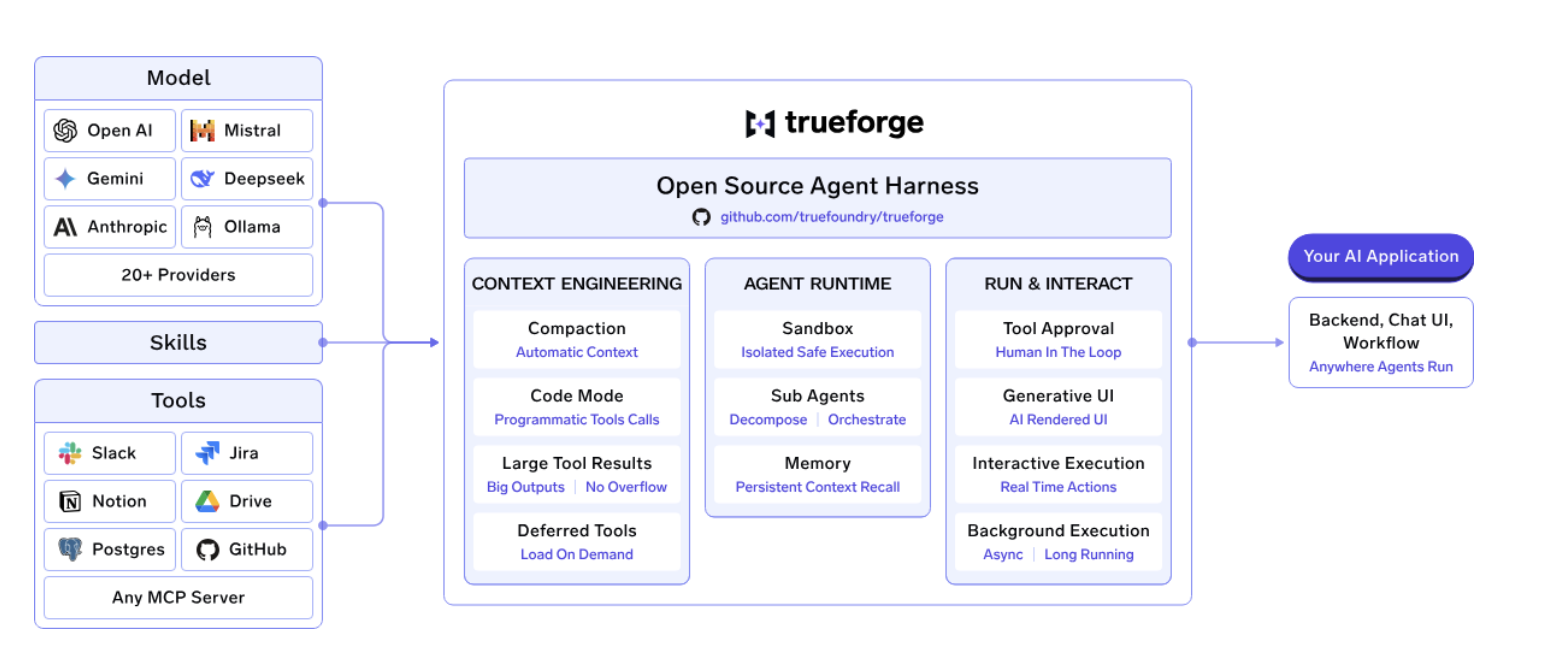
TrueForge is the runtime layer that turns an LLM into a working agent, with MCP tools, skills, sandboxing, approvals, and subagents built in. It is an open-source agent harness with three parts: a core server that runs the agent loop, an HTTP API and TypeScript SDK for driving agents from code, and a chat UI with a React UI SDK for interacting with agents from the browser.
Getting started takes one command: npx @truefoundry/trueforge runs TrueForge locally with no additional infrastructure. The quickstart documentation walks through choosing a model provider and connecting your first MCP server.
Unlike a framework where you assemble the runtime and surrounding infrastructure yourself, TrueForge includes several of the pieces needed to run agents in production:
One architectural detail worth calling out is how TrueForge handles sandboxing. Rather than running the entire agent inside a sandbox, TrueForge treats the sandbox as a tool and provisions one only when the agent actually needs to execute code. This allows a single TrueForge server to run multiple agents concurrently, while avoiding sandbox overhead for turns that don't require code execution.
The architecture also has a direct impact on cost. In TrueFoundry's benchmark of 14 enterprise agent tasks, TrueForge and Claude Managed Agents achieved roughly the same task accuracy when both used Opus 4.8, while TrueForge used about 40% as many tokens and was roughly 30% cheaper per run. When paired with GLM-5.2, TrueForge achieved the same approximate task score for $2.90 per run versus $11.80 for Claude Managed Agents, or roughly 75% lower cost.
The entire runtime is MIT licensed and open source, with the code available in the TrueForge GitHub repository. For teams evaluating LangGraph, the important distinction is that TrueForge provides the runtime layer itself, while keeping model choice, infrastructure, and deployment under your control.
npx @truefoundry/trueforge will have it running in about a minute if you want to compare it against whatever you're using now.
Q: What is the difference between Claude Agent SDK and LangGraph?
A: The Claude Agent SDK gives you a pre-built agent loop that decides its own next step, running Claude models only. LangGraph gives you primitives to author your own control flow as a graph of nodes and edges, with any model. The SDK is faster to a working agent; LangGraph gives you exact control over the sequence.
Q: Is LangGraph overkill for a simple agent?
A: Often, yes. If your agent's path depends on what it discovers rather than following a fixed sequence, authoring a graph adds work without adding correctness. LangGraph earns its complexity when the workflow has a required shape, when runs are long enough that checkpointed resumption matters, or when a human has to approve at a specific stage.
Q: Can LangGraph run Claude models?
A: Yes. LangGraph is model-agnostic and works with Claude, GPT, Gemini, open models, or a mix, which is the main capability the Claude Agent SDK doesn't offer.
Q: Can I run an agent harness in my own VPC or on-prem?
A: Yes, with any self-hosted option here. TrueForge runs from a single npx command locally, or via Docker Compose and Helm for team deployments with Postgres, Redis, replicas and OIDC login. TrueFoundry's managed version also runs self-hosted, on-prem, air-gapped or hybrid, so no data leaves your domain.
Q: Does it support MCP and existing agent frameworks?
A: Yes. All three options speak MCP for tool access. TrueFoundry additionally provides an MCP Gateway, Agent Gateway and registry with tool-level access control, so agents built on LangGraph, CrewAI, AutoGen or a custom framework can be governed centrally.
Q: How do I govern models and MCP servers across many agents?
A: Through a gateway layer. TrueFoundry's AI Gateway puts 1,000+ LLMs behind one OpenAI-compatible API at roughly ~3–4 ms of added latency and 350+ RPS on a single vCPU, with RBAC, budgets, guardrails and credential rotation, plus OpenTelemetry traces into Grafana, Datadog or Prometheus.
Claude Agent SDK vs LangGraph comes down to whether your agent has a shape. If the path is discovered rather than designed, the SDK's fixed loop will get you there faster and you'll spend your time on tools and prompts instead of edges. If the path is designed and deviation is a bug, LangGraph is the right tool and no opinionated loop will substitute for it.
If what stopped you on the SDK was the Claude-only constraint rather than the fixed loop, that's the narrow gap TrueForge fills. It's MIT-licensed and on GitHub, and npx @truefoundry/trueforge takes about a minute.
TrueFoundry AI Gateway delivers ~3–4 ms latency, handles 350+ RPS on 1 vCPU, scales horizontally with ease, and is production-ready, while LiteLLM suffers from high latency, struggles beyond moderate RPS, lacks built-in scaling, and is best for light or prototype workloads.





As últimas notícias, artigos e recursos enviados para sua caixa de entrada
.webp)
.webp)
.webp)
.webp)
.webp)