


Accédez instantanément à un environnement TrueFoundry en direct. Déployez des modèles, acheminez le trafic LLM et explorez la plateforme complète : votre sandbox est prête en quelques secondes, aucune carte de crédit n'est requise.


What Are Open-Weight Models and How Do They Work?

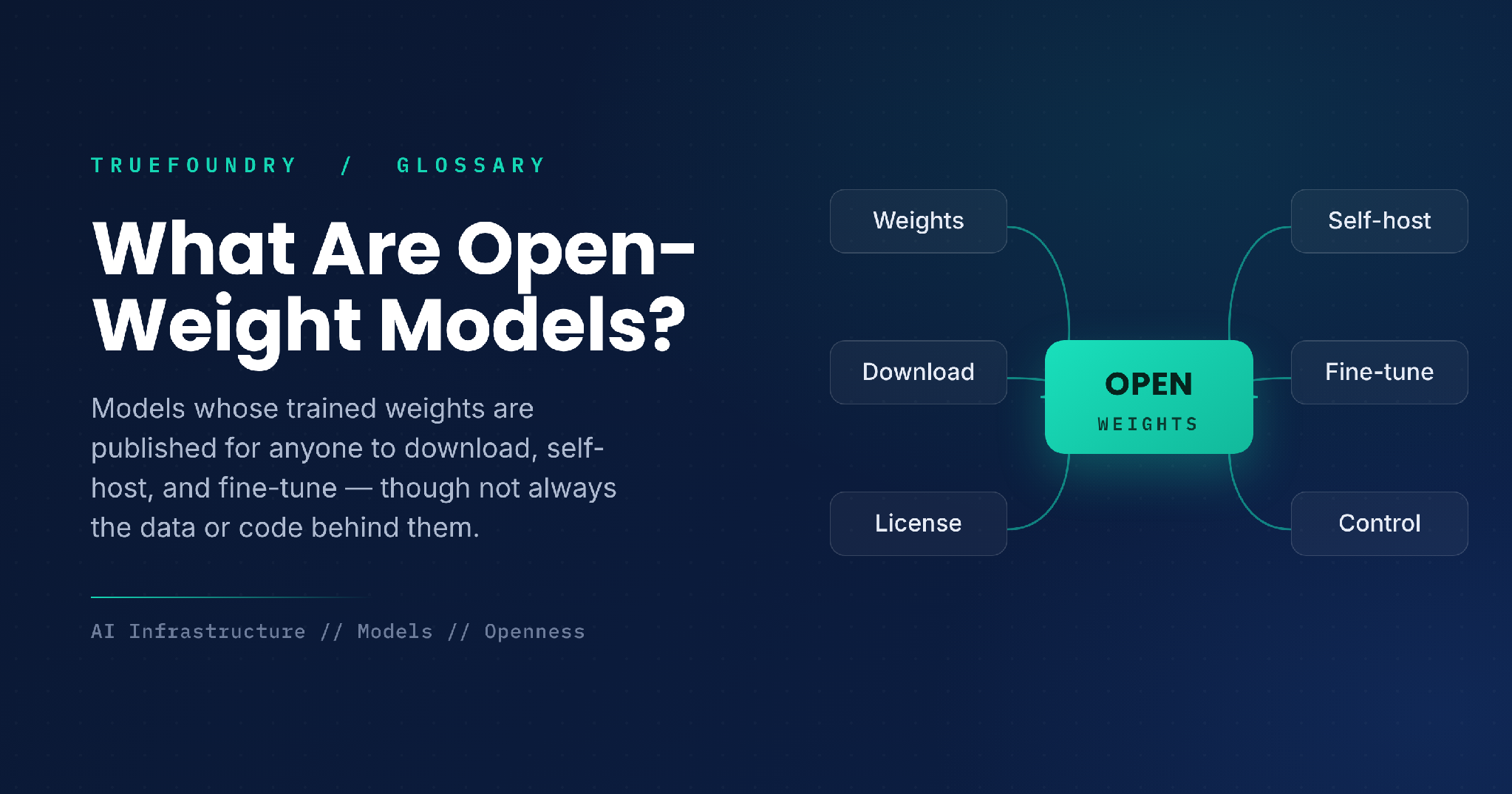
When a lab releases a model, it can share it in very different ways. Some models are available only as an API: you send text, you get text back, and the weights stay locked inside the provider. Others are released as open-weight models, where the trained parameters themselves are published for anyone to download and run. That single difference changes who controls the model, where it runs, and what you can do with it.
Open-weight models like Llama, Mistral, and Qwen have made it possible for teams to self-host capable models, fine-tune them on private data, and avoid sending sensitive prompts to a third party. But open weight is not the same as fully open source, and the details matter.
This guide explains what open-weight models are, how they work, how they differ from closed and fully open-source models, and when they are the right choice.
What are open-weight models?
An open-weight model is one whose trained weights, the numeric parameters learned during training, are made publicly available to download. With the weights in hand, you can run the model on your own hardware, fine-tune it, inspect it, and build on it, without depending on the original provider's API. What is usually not included is the training data and sometimes the exact training code, so you can use the finished model but not necessarily reproduce it.
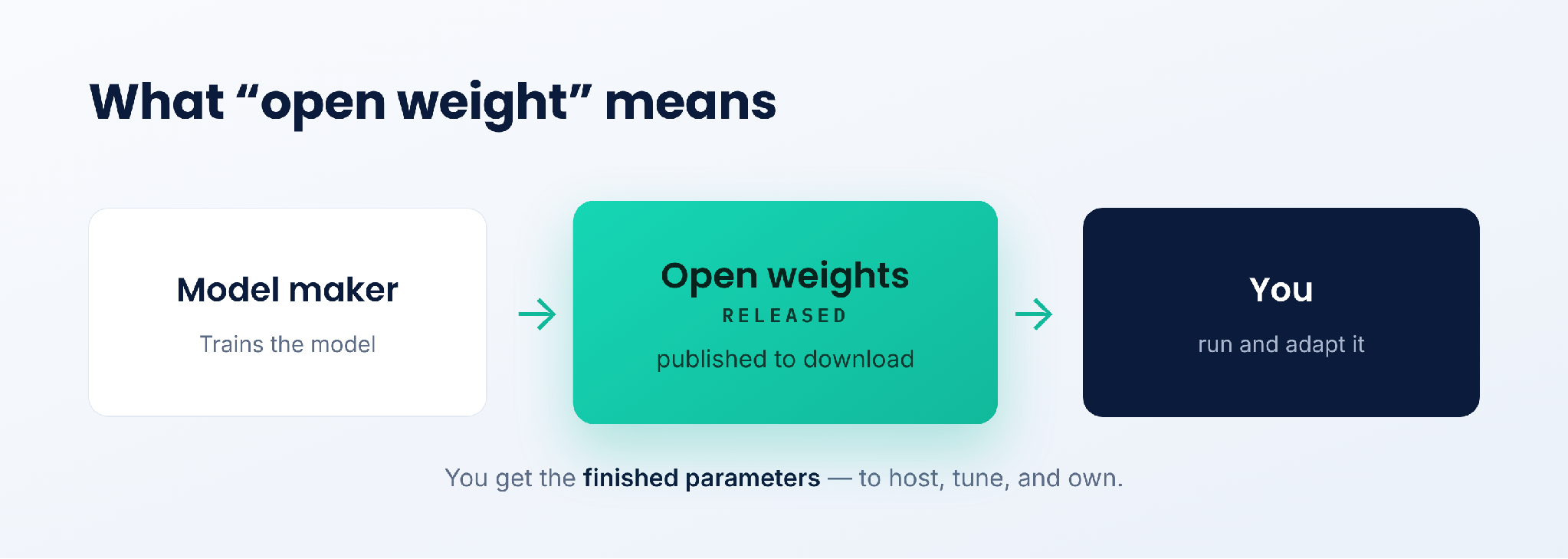
Think of it like getting a finished, fully baked cake rather than a restaurant meal you can only order. With the cake in your kitchen you can serve it, slice it, add your own frosting, and keep it as long as you like. What you do not get is the recipe or the ingredients, so you cannot bake an identical one from scratch. Open weights give you the cake, not the recipe.
The important distinction is between having the model and reproducing the model. Open weights give you the former, which is enough to deploy and adapt it, even if the data and process that created it remain private.
How do open-weight models work?
Using an open-weight model means taking the published weights and running them yourself.
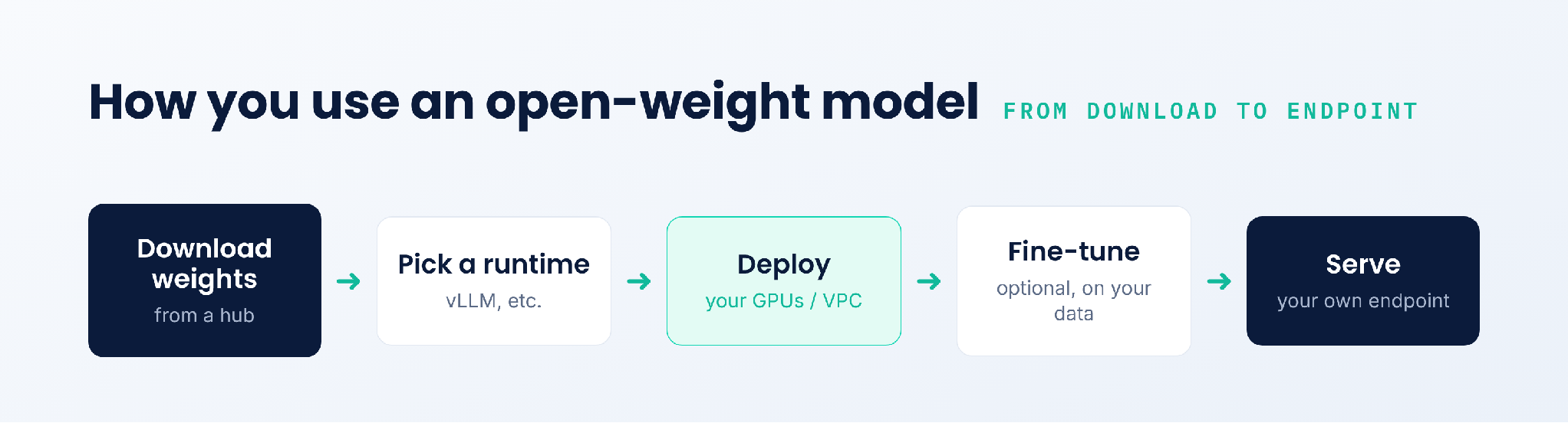
- Download the weights. You pull the model files from a hub such as Hugging Face, subject to its license.
- Pick a runtime. You load the weights into an inference engine like vLLM that can serve the architecture.
- Deploy on your hardware. You run the model on your own GPUs, in your cloud or on-premise environment.
- Fine-tune if needed. You can adapt the model to your data, often with an efficient method like LoRA.
- Serve your own endpoint. The model becomes an API you control, with your data never leaving your environment.
Because you hold the weights, the model is yours to operate. That brings responsibility for the hardware and serving, but it also means full control over privacy, customization, and cost.
Open-weight vs. open-source vs. closed models
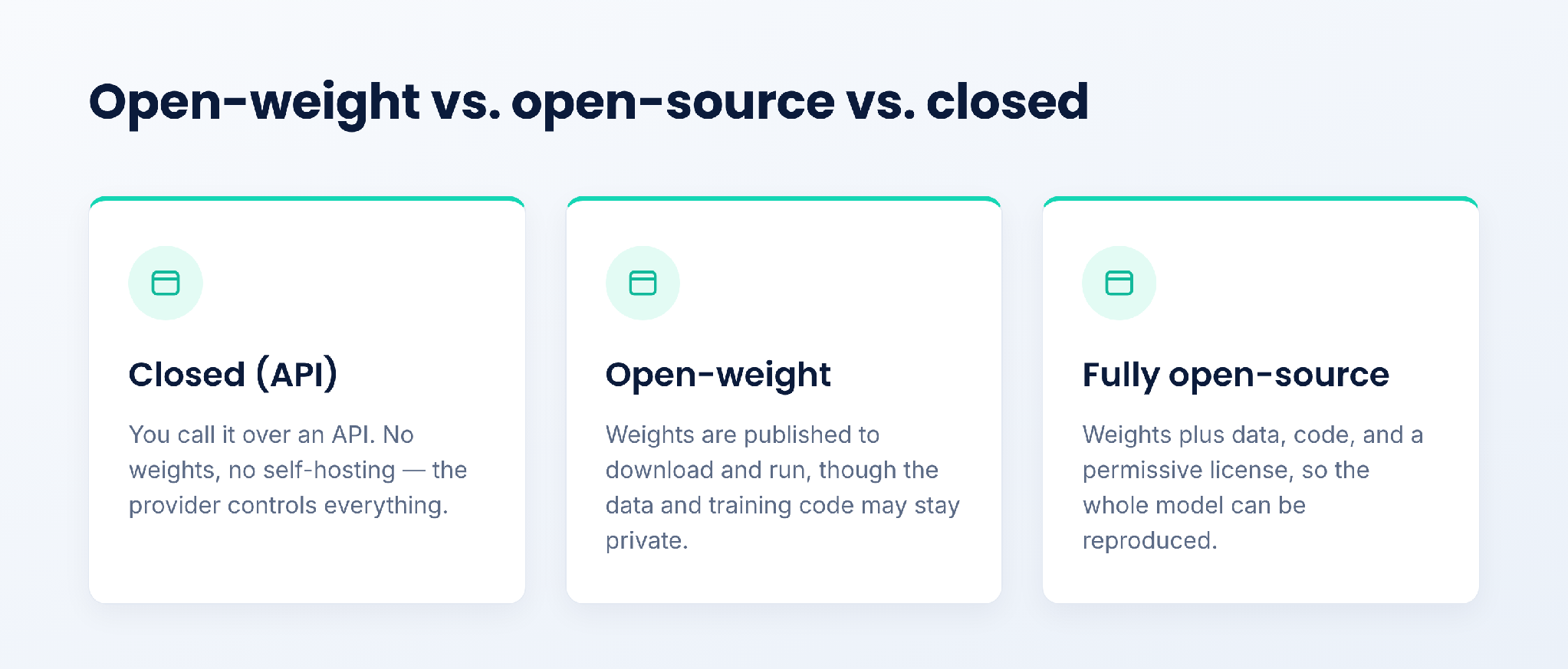
These three sit on a spectrum of openness. A closed model is available only through an API; you never see the weights and the provider controls everything. An open-weight model publishes the weights to download and run, but may withhold the training data, code, or full license freedoms. A fully open-source model goes further, releasing weights along with training data, code, and a permissive license, so the model can be studied and even reproduced.
Most models marketed as open are open-weight rather than fully open-source. That is still a large step: it is the difference between renting access and owning a copy you can run and adapt yourself.
What are the benefits of open-weight models?
- Data privacy. You can run the model in your own environment, so prompts and data never leave it.
- Customization. You can fine-tune the model on your own data to specialize it for your tasks.
- Cost control. Self-hosting can be cheaper at scale and makes spend predictable rather than per-call.
- No vendor lock-in. You hold the weights, so you are not tied to one provider's pricing or availability.
- Transparency. You can inspect and evaluate the model directly rather than treating it as a black box.
What are the considerations and limits?
- You run the infrastructure. Self-hosting means managing GPUs, scaling, and serving yourself.
- License terms vary. Some open-weight licenses restrict commercial use or large-scale deployment, so read them.
- Not reproducible. Without the training data and code, you cannot rebuild or fully audit the model's origins.
- You own safety and updates. Guardrails, monitoring, and keeping up with new versions fall to you.
When should you use an open-weight model?
Open-weight models fit when control matters: when data must stay in your environment, when you want to fine-tune on proprietary data, or when self-hosting at scale is cheaper than per-call API pricing. Regulated industries and privacy-sensitive products are common homes for them.
A closed API model is often simpler when you want the strongest available model with no infrastructure to run, or when volume is low. Many teams use both, self-hosting open-weight models for sensitive or high-volume work and calling APIs for the rest.
Best practices for using open-weight models
- Read the license carefully before building on a model, since terms on commercial and scale use differ.
- Serve with an efficient engine like vLLM to get good throughput and cost on your own hardware.
- Fine-tune with efficient methods like LoRA rather than full retraining where you can.
- Keep data in your environment to capture the privacy benefit that open weights enable.
- Add your own guardrails and monitoring, since safety and observability are now your responsibility.
- Put models behind a gateway so routing, access control, and cost tracking live in one layer.
Conclusion
Open-weight models hand you the trained parameters to download, run, fine-tune, and own, rather than access rented through an API. That unlocks privacy, customization, and cost control, at the price of running the infrastructure yourself and reading the license closely. They are not always fully open source, but having the weights is what makes self-hosting and adaptation possible.
TrueFoundry is built for running open-weight models on your own infrastructure, serving them through engines like vLLM with fine-tuning, autoscaling, guardrails, and observability behind one gateway. For teams that want control over their models and data, open weights are the foundation, and a platform to run them is what makes it practical.
Gouvernez, déployez et suivez l'IA dans votre propre infrastructure
Frequently Asked Questions
What are open-weight models in simple terms?
These models have their parameters trained and published so that anyone can download and use them. This is different from using an API, where you never actually get the model itself.
Is open weight the same as open source?
Not quite. "Open weight" means the weights are published, but the data used to train the model and the code itself can still remain proprietary. "Fully open source" adds the data, the code, and a permissive license, so the model can be reproduced, not just run.
Why would I self-host an open-weight model?
For privacy, personalization, and lower cost. Keeping it local allows data to remain within the organization, allows tuning on proprietary data, and is potentially less expensive than pay-per-API-call rates at scale.
Can I use any open-weight model commercially?
No, they are not all alike. Some licenses do not allow commercial usage or large-scale deployment, so it is necessary to check the license of the particular model before building on it.
What do I need to run an open-weight model?
The weights, appropriate hardware such as GPUs, and an inference engine such as vLLM to serve them. After that, you can deploy the model as your own endpoint and, if needed, fine-tune it on your data.

GenAI infra- simple, plus rapide et moins cher
Les meilleures équipes lui font confiance pour faire évoluer GenAI

- © 2022 ENSEMBLE Technologies



Abonnez-vous à notre newsletter
Les dernières nouvelles, articles et ressources envoyés dans votre boîte de réception


