


September 26, 2026
|
5 min read

Published: April 9, 2026
![8 Vercel AI Alternatives and Competitors for 2026 [Ranked]](https://cdn.prod.website-files.com/6295808d44499cde2ba36c71/69a877c7e93c05705b362d65_ci.webp)
Blazingly fast way to build, track and deploy your models!
Vercel revolutionized the initial setup for AI integration. Their AI SDK reduces the boilerplate required to connect a Next.js frontend to OpenAI’s API, and the Edge Runtime handles streaming infrastructure beautifully. For prototyping, B2C wrappers, or low-traffic internal tools, the Vercel ecosystem remains a top-tier choice.
However, Vercel’s architecture is optimized for frontend delivery, not machine learning operations. As applications graduate from prototype to high-scale production, engineering teams often encounter architectural ceilings: cost scaling driven by function duration, the complexity of deploying custom fine-tuned models (e.g., Llama 3 or Mistral) inside a private VPC, and a need for granular control over the inference stack.
TrueFoundry has emerged as a primary choice for engineering teams requiring Vercel-like developer experience (DX) applied to their own cloud infrastructure. This report evaluates eight alternatives based on infrastructure ownership, model flexibility, and unit economics.
The migration away from Vercel AI usually stems from three specific architectural or operational requirements that emerge at scale.
Vercel’s AI SDK is primarily designed to chain frontend requests to third-party APIs like OpenAI or Anthropic. This architecture works well for generalist models but creates friction when teams need to deploy self-hosted, fine-tuned models. Swapping an external GPT-4 call for a 7B parameter model running on a T4 GPU typically requires re-architecting the backend logic, as it moves beyond simple API wrapping.
Regulated industries (FinTech, Healthcare) often operate under strict mandates regarding data residency. Enterprise security policies frequently require that inference occur within a private VPC (Virtual Private Cloud) where data ingress/egress is strictly controlled by the customer. While Vercel offers strong security measures, it operates as a multi-tenant PaaS. Many enterprises prefer—or are required—to own the entire compute stack inside their own AWS or GCP accounts.
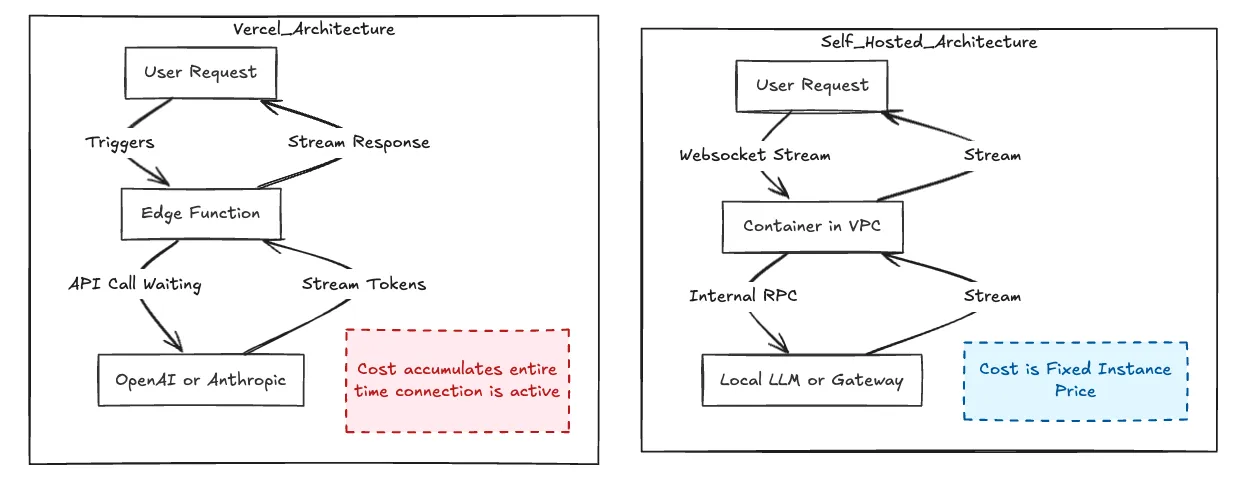
Vercel’s Serverless Function pricing is largely based on GB-seconds (memory allocation × duration).
The Cost Impact:
Running a high-traffic AI app on a serverless model means paying for the compute time while the server simply "waits" for the LLM to generate tokens. At scale, this billing model can result in significantly higher costs compared to a containerized service running on fixed-cost instances.
We prioritized engineering constraints over marketing claims. The alternatives below were scored against four technical criteria:
Key Metrics for Evaluating Gateway
| Criteria | What should you evaluate ? | Priority | TrueFoundry |
|---|---|---|---|
| Latency | Adds <10ms p95 overhead for time-to-first-token? | Must Have | ✅ Supported |
| Data Residency | Keeps logs within your region (EU/US)? | Depends on use case | ✅ Supported |
| Latency-Based Routing | Automatically reroutes based on real-time latency/failures? | Must Have | ✅ Supported |
| Key Rotation & Revocation | Rotate or revoke keys without downtime? | Must Have | ✅ Supported |
| Key Rotation & Revocation | Rotate or revoke keys without downtime? | Must Have | ✅ Supported |
| Key Rotation & Revocation | Rotate or revoke keys without downtime? | Must Have | ✅ Supported |
| Key Rotation & Revocation | Rotate or revoke keys without downtime? | Must Have | ✅ Supported |
| Key Rotation & Revocation | Rotate or revoke keys without downtime? | Must Have | ✅ Supported |
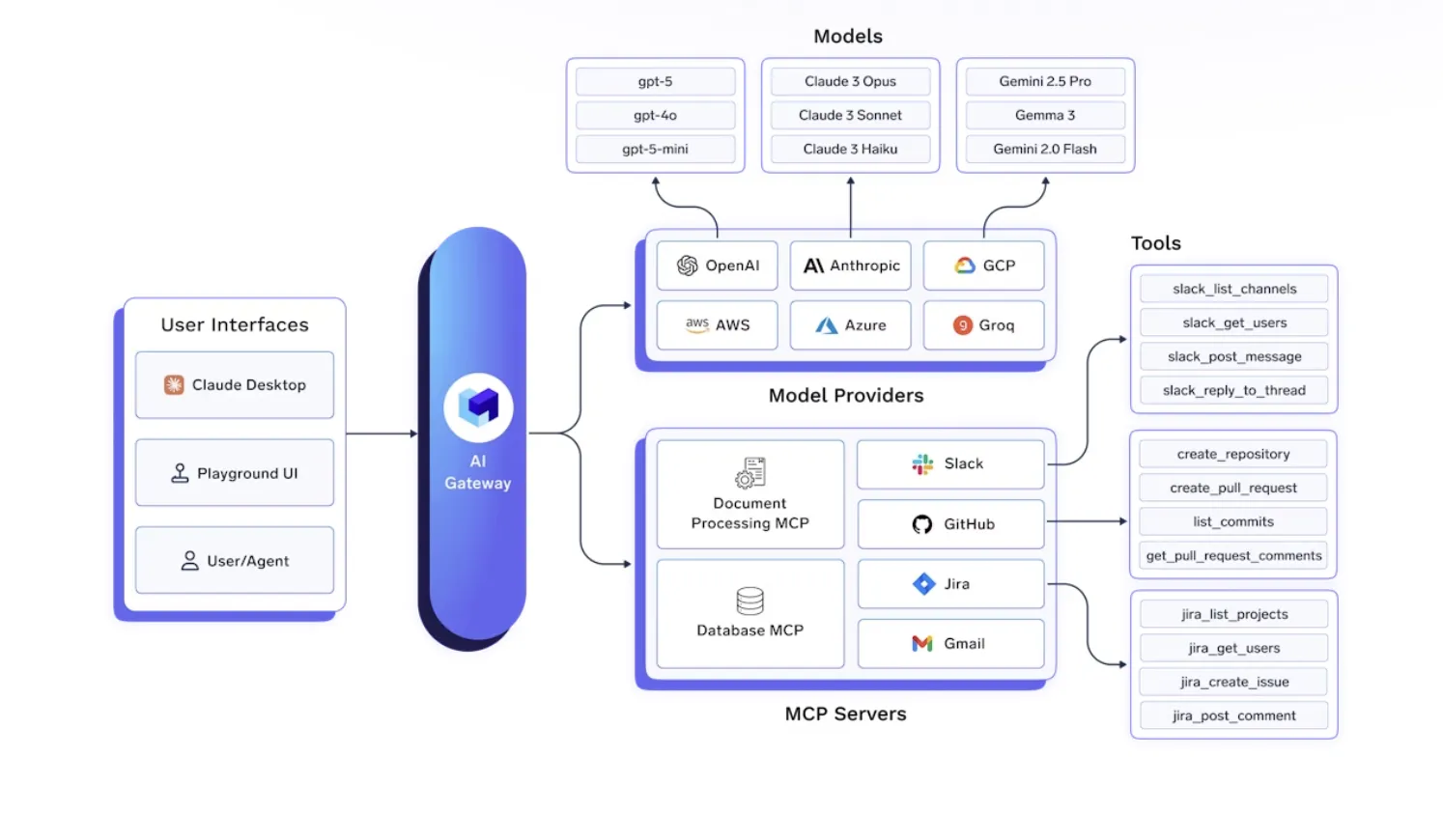
Best for: Teams seeking full infrastructure ownership without Kubernetes complexity.
TrueFoundry functions as a Machine Learning Platform as a Service (MLPaaS) that installs directly onto your existing cloud (AWS, GCP, Azure). Unlike Vercel, which abstracts the infrastructure to prioritize frontend speed, TrueFoundry abstracts the complexity of Kubernetes while retaining full control over the underlying compute. It decouples the "Brain" (Model Inference/Training) from the "UI," allowing teams to deploy fine-tuned open-source models alongside their application logic within their own security perimeter.
Key Features
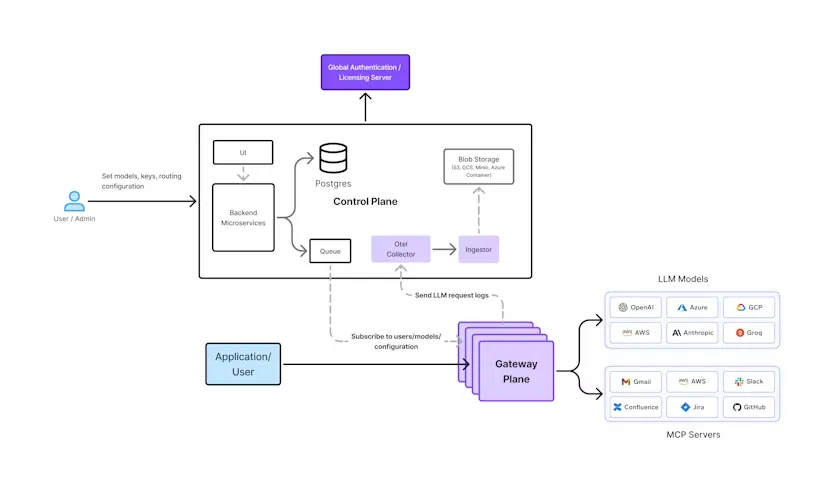
Why TrueFoundry?
TrueFoundry addresses the unit economics of scaling AI. By deploying inference servers on reserved or spot instances within your VPC, teams can eliminate the markup on data transfer and serverless execution time. Because you own the model weights and the data, compliance with data sovereignty requirements (GDPR, HIPAA) is streamlined.
Pricing
Best for: Teams who want a "Serverless" feel with better reliability and observability.
Portkey acts as middleware between the application and model providers. While it does not manage underlying GPU infrastructure like TrueFoundry, it hardens API-based AI apps for production through advanced routing.
Key Features
Pros & Cons
Best for: Complex agentic workflows and application logic.
LangChain is an orchestration framework, and LangSmith is its companion platform for tracing. This is less of a hosting competitor and more of a logic-layer alternative.
Key Features
Pros & Cons
Best for: Advanced RAG (Retrieval-Augmented Generation) pipelines.
LlamaIndex focuses specifically on data ingestion and retrieval. It is the go-to component for the "Context" part of the stack, offering deeper data handling than Vercel’s basic vector integrations.
Key Features
Pros & Cons
Best for: Python-centric Search and QA pipelines.
Unlike Vercel’s JavaScript-centric ecosystem, Haystack is Python-based, making it a standard choice for data science teams building NLP pipelines.
Key Features
Pros & Cons
Best for: DIY Proxy Server management.
LiteLLM is a lightweight, open-source proxy server that standardizes I/O formats to the OpenAI schema. It is a self-hosted alternative to Vercel AI SDK’s routing.
Key Features
Pros & Cons
Best for: Model training metrics and prompt engineering evaluation.
Weights & Biases is used during the development of the model or prompt strategy (LLMOps), rather than the deployment of the final app.
Key Features
Pros & Cons
Best for: Teams with a single-cloud procurement mandate.
The major cloud providers offer managed services to consume models via API without managing servers, keeping data within the cloud contract boundary. AWS Bedrock and Azure OpenAI allow users to consume models via API without managing servers, within the compliance boundary of an existing cloud contract.
Key Features
Pros & Cons
To select the correct architecture for 2026, map your team's primary constraints to the recommended solutions below.
Vercel is an effective launchpad for AI functionality, but its abstraction layer can become a constraint as technical requirements increase. 2026 will be defined by infrastructure ownership. As AI features transition from "nice-to-have" to core product value, the ability to control the inference runtime, manage GPU costs directly, and secure data within a private boundary is essential.
TrueFoundry’s AI Gateway bridges the gap between Vercel's developer experience and the operational rigor required for production AI. It provides platform engineering teams with necessary controls without sacrificing the agility that frontend developers expect.
Ready to move your AI workloads into a secure, high-performance cloud environment? Book a demo today to see how TrueFoundry gives you total control over your production stack.
In general web hosting, Vercel’s competitors include Netlify, AWS Amplify, and Cloudflare Pages. In the AI infrastructure space, the primary competitors are TrueFoundry (for full stack/backend control), AWS Bedrock (for managed models), and Portkey (for API gateway capabilities).
For simple websites and B2C apps, Vercel is a strong choice. However, for teams building AI-first products that require custom model deployment, fine-tuning, or strict VPC compliance, TrueFoundry is often the preferred alternative as it removes the cost overhead of Vercel's serverless model.
Cloudflare (specifically Cloudflare Workers AI) offers lower latency and competitive compute costs for edge inference. However, Cloudflare's developer experience is less integrated with frameworks like Next.js compared to Vercel. For enterprise-grade AI orchestration that spans beyond simple edge functions, TrueFoundry offers a more comprehensive management suite than both.
Moving beyond small projects to enterprise applications involves more than hosting static sites on a free tier. While most Vercel alternatives focus on the frontend, TrueFoundry provides a cloud platform with an enterprise infrastructure management. We deliver high availability and private networking within your AWS ecosystem or Google cloud for scalable infrastructure.
TrueFoundry is the perfect choice for managing complex web services and background workers. Unlike others, our deployment platforms include standout features such as automation and backend support for Virtual Machines. Users can easily link their GitHub repository via Git to trigger CI in secure cloud environments designed for their specific needs.
TrueFoundry AI Gateway delivers ~3–4 ms latency, handles 350+ RPS on 1 vCPU, scales horizontally with ease, and is production-ready, while LiteLLM suffers from high latency, struggles beyond moderate RPS, lacks built-in scaling, and is best for light or prototype workloads.






The latest news, articles, and resources sent to your inbox


.webp)
.webp)
.webp)
.webp)
.webp)
.png)
.png)
.png)
.png)
.png)
.png)


