


September 26, 2026
|
5 min read


Published: September 11, 2026
Blazingly fast way to build, track and deploy your models!

It is a familiar 10AM scenario for operations teams: a critical workflow needs to be automated—verifying supplier inventory, conducting competitive pricing analysis, or securing reservations—but the target platform offers no programmatic access.
While we live in an era of connectivity, many high-value platforms lock their data behind "digital moats." They lack public APIs, forcing developers to rely on the fallback of web scraping. However, traditional scraping is notoriously fragile. It relies on "brittle selectors"—hardcoded CSS paths or XPaths (e.g., div.btn-primary) that break the moment a frontend developer changes a class name to btn-submit.
To address this, we built the Restaurant Booking Automation Accelerator. It is a reference implementation for a new class of automation: resilient agents that do not just "scrape" the web, but operate it.
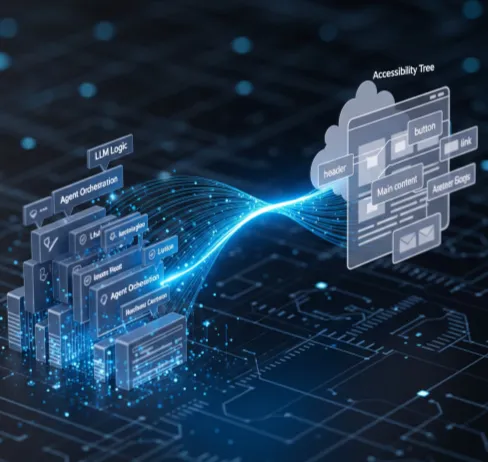
The core innovation in this accelerator is moving away from the Document Object Model (DOM) to the Accessibility Object Model (AOM).
In a traditional script, if a button moves from a sidebar to a header, the automation fails. In this agentic system, we provide the inference engine with a snapshot of the Accessibility Tree. This is a semantic representation of the page designed for screen readers, stripping away styling divs to reveal the core utility of the interface.
This allows the system to reason based on intent rather than coordinates: "I see a calendar widget; I will click the date '15th' because that matches the user's request." If the site undergoes a redesign but the semantic role of the button remains "Confirm Booking," the agent self-heals and the workflow succeeds.
We structured the application using a specialized Controller/Worker pattern. Rather than a monolithic script, we have distinct agents utilizing Playwright for execution and LLMs for decision-making.
Figure 1: High-Level Architecture
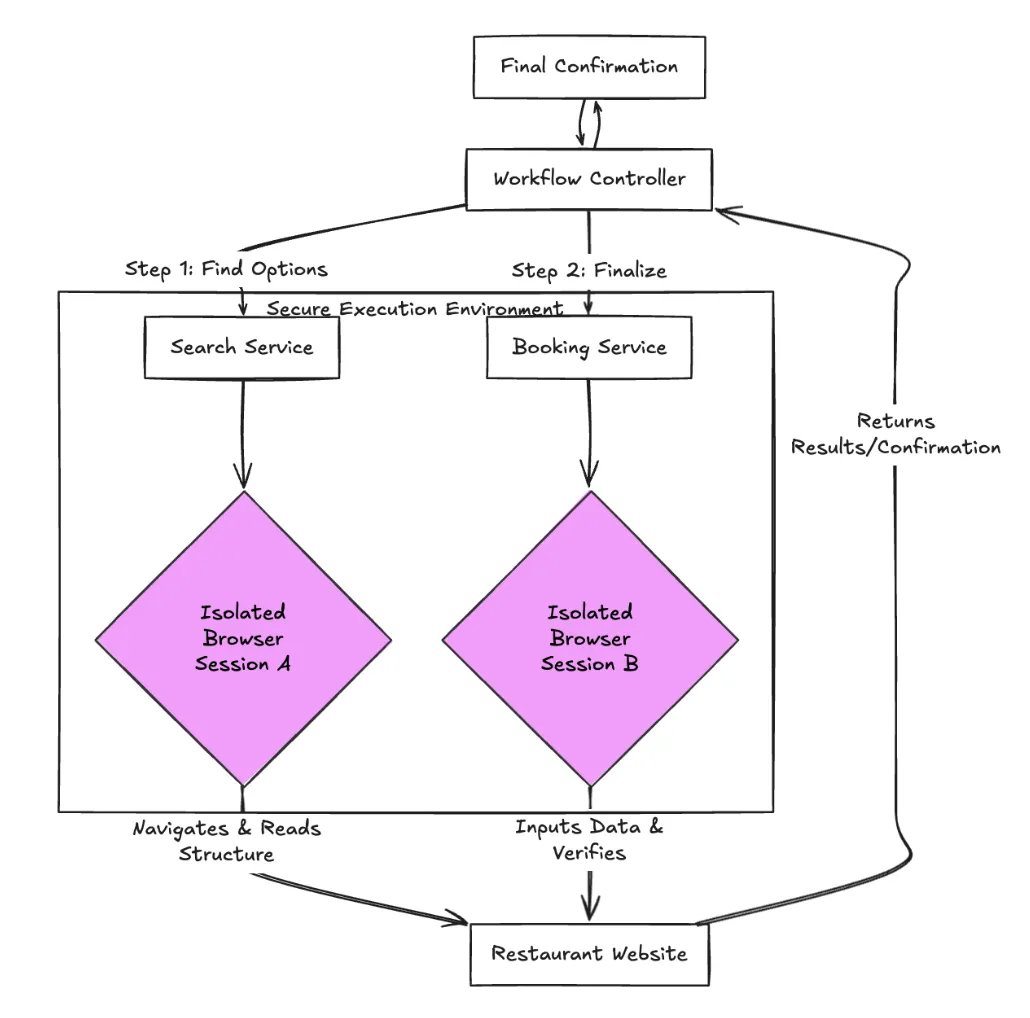
As shown in the architecture diagram, the Workflow Controller manages the state, delegating tasks to two specialized components:
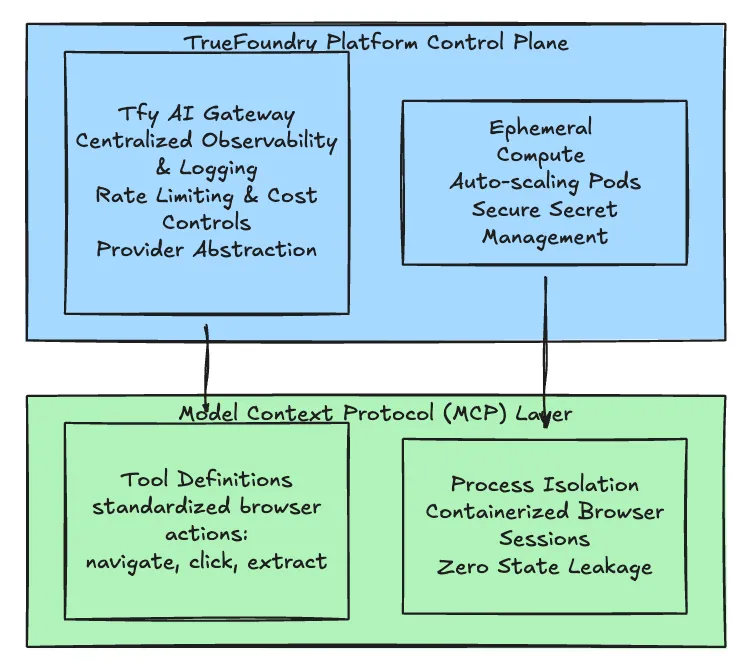
Running these agents in production requires a robust control plane. We utilize the TrueFoundry Platform to manage the infrastructure and the Model Context Protocol (MCP) to standardize the browser integration.
Figure 2: How TrueFoundry supports the application lifecycle
For transactional workflows, we implement a "Verify-then-Execute" pattern. The agent performs the heavy lifting of discovery but requires human confirmation before final execution.
Step 1: Intent & Discovery
The system accepts natural language inputs and normalizes them into structured JSON (Location, Time, Party Size) for the Search Agent.
Step 2: The Confirmation Gate
Upon finding a slot, the Booking Agent pauses. It presents the details to the user and enters a WAIT state, proceeding only after receiving a clear signal.
The most critical test of a web agent is its ability to handle "Human-in-the-Loop" (HITL) scenarios. Modern sites often use Web Application Firewalls (WAFs) that trigger CAPTCHAs or email verification codes when they detect automation.
A standard script fails here. Our system uses a Pause-and-Resume State Machine.
Figure 3: Exception Handling State Logic
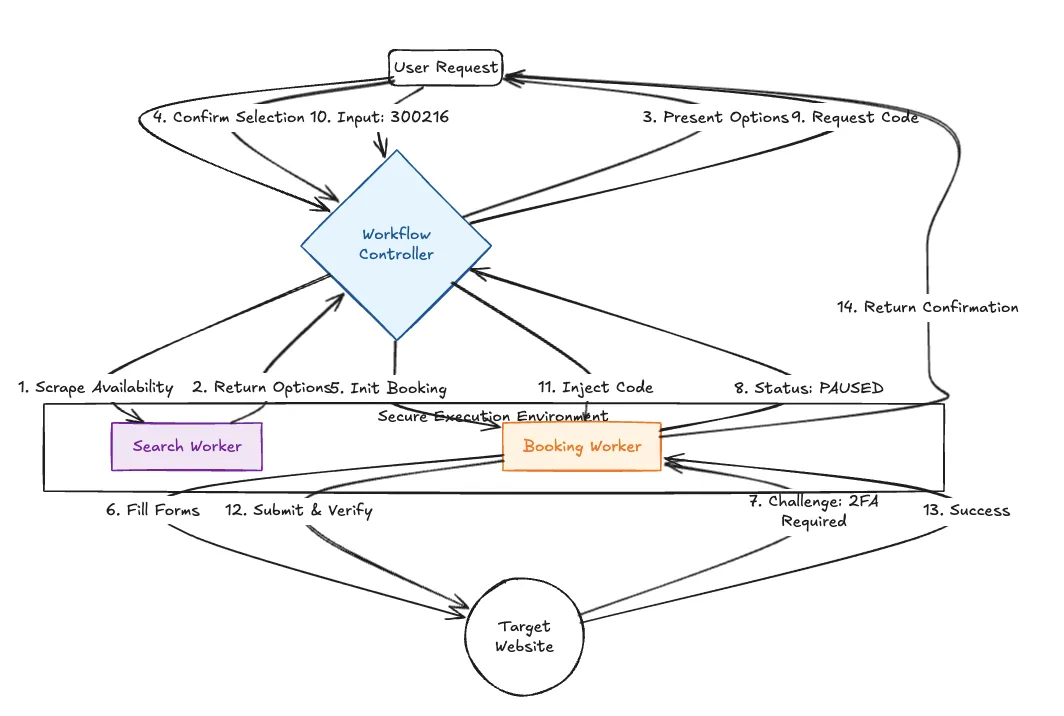
As detailed in the diagram above (Steps 7-11), when the agent detects a challenge prompt:
We are moving from "Web Scraping" to "Web Operating." By leveraging Playwright for the "hands" and semantic inference for the "eyes," we can treat the human-facing web as a programmatic interface.
This accelerator demonstrates that with the right architecture—semantic interpretation, stateful orchestration, and secure infrastructure like TrueFoundry—we can build resilient automations that bridge the API gap.
TrueFoundry AI Gateway delivers ~3–4 ms latency, handles 350+ RPS on 1 vCPU, scales horizontally with ease, and is production-ready, while LiteLLM suffers from high latency, struggles beyond moderate RPS, lacks built-in scaling, and is best for light or prototype workloads.






The latest news, articles, and resources sent to your inbox


.webp)
.webp)
.webp)
.webp)
.webp)
.png)
.png)
.png)
.png)
.png)
.png)


