


.webp)
October 24, 2026
|
5 min read



Blazingly fast way to build, track and deploy your models!
The rapid rise of large language models has pushed the industry into a new era—one where software doesn’t just respond, but acts.
As organizations experiment with AI-driven automation, the focus is shifting from standalone chatbots to autonomous “agents” capable of planning tasks, integrating with business systems, and executing end-to-end workflows.
This shift has created a new need: a structured way to discover, evaluate, govern, and deploy these agents safely at scale.
That’s where AI agent marketplaces come in.
Much like app stores transformed mobile ecosystems, agent marketplaces are emerging as the distribution layer for AI-powered capabilities. They give teams instant access to pre-built agents, reduce development friction, and provide a unified governance framework.
For enterprises, they represent the next major step in bringing AI from experimentation to real, production-grade impact.
An AI agent marketplace is a structured platform where developers and enterprises can discover, publish, deploy, and manage intelligent agents designed to automate specific tasks or workflows. Unlike traditional app stores that distribute static applications, agent marketplaces deliver dynamic, reasoning-driven agents—capable of making decisions, invoking tools, retrieving data, and executing real-world actions autonomously.
At its core, an AI agent marketplace brings three essential functions to the enterprise stack: standardization, distribution, and governance.
In short, an AI agent marketplace is the operational bridge between experimentation and enterprise-scale deployment. Paired with infrastructure like TrueFoundry’s AI Gateway and Agent Registry, it enables organizations to harness autonomous AI agents safely, efficiently, and at scale—while giving developers a clear path to build and share production-ready intelligence.
AI agent marketplaces are gaining rapid traction as organizations seek intelligent automation beyond chat interfaces and prompt wrappers. Today’s agents are capable of executing full workflows across business, technical, and creative functions—integrating with real systems and making autonomous decisions along the way. As a result, several specialized categories of agents have emerged, each tailored to a class of enterprise use cases:
An effective AI agent marketplace is more than a catalog—it’s a full-stack operating layer for intelligent agents. To be enterprise-ready, it must combine discoverability, interoperability, governance, and lifecycle control. These features ensure agents aren’t just usable—they’re trustworthy, secure, and production-hardened.
These core features separate experimental marketplaces from production-ready infrastructure. Platforms like TrueFoundry bring all of this together by combining a fully governed Agent Registry, scalable LLM infrastructure, and a secure AI Gateway that enforces policies at the tool-call level. This makes it possible to deploy, govern, and monitor autonomous agents with the same rigor applied to traditional software systems.
The backbone of any scalable AI agent marketplace is a modular, secure, and extensible architecture—one that balances rapid developer iteration with enterprise-grade control, compliance, and performance.
At the foundation lies the Agent Registry and Metadata Layer. This is the source of truth for all agents—storing structured definitions that include capabilities, supported tools, required permissions, version history, SLAs, and behavioral constraints. Enforcing a strict contract at this layer ensures agents are interoperable and auditable across environments.
Above the registry, the Execution Environment handles the lifecycle of agents in production. Agents are run inside isolated sandboxes or containers, each scoped with identity-bound access controls. This prevents unauthorized tool invocations, enforces permission boundaries, and guarantees that agents operate in secure, predictable contexts. Runtime policies can restrict API call surfaces, enforce timeouts, and redact sensitive payloads.
Sitting atop execution is the Agent Orchestration Layer. This governs multi-step workflows, manages contextual memory, and handles tool routing via protocols like the Model Context Protocol (MCP). Orchestration is especially critical in agent systems where autonomy introduces non-linear reasoning and dynamic tool usage. It ensures the agent’s behavior remains aligned with intent, even across retries or state resumptions.
The Integration Layer acts as the bridge between agents and enterprise systems—CRMs, ticketing tools, SaaS platforms, and private APIs. Marketplace platforms must abstract these connectors securely, exposing them to agents via governed interfaces that enforce data access policies and action-level guardrails.
Finally, the architecture must be wrapped in Observability and Governance infrastructure. This includes request tracing, usage analytics, evaluation pipelines, and fine-grained audit logs. Observability is not optional—it is essential for debugging agent behavior, monitoring drift, and ensuring that decisions made by AI agents can be inspected and verified post hoc.
TrueFoundry’s Architecture in Action
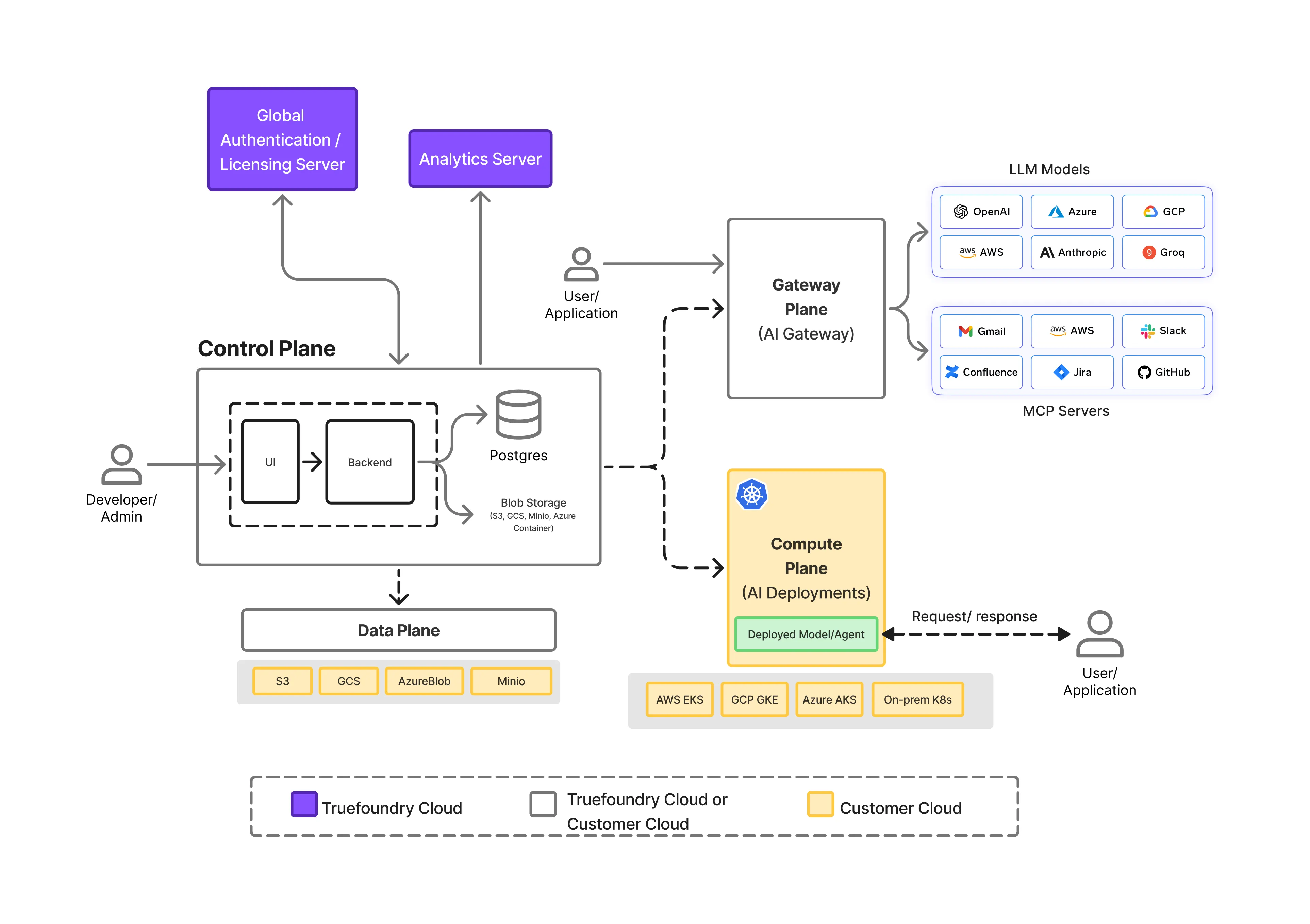
TrueFoundry brings these layers together in a production-grade agent platform. Its AI Gateway provides stateful, token-aware routing and policy enforcement at the tool-call level. The Agent Registry manages standardized agent definitions and deployment metadata. And its LLM orchestration layer handles concurrent agent execution, contextual memory, and safe retries—scalable across internal and public marketplaces. Together, these components create a foundation that makes autonomous agents enterprise-ready by design.
Security, compliance, and governance are non-negotiable pillars in any enterprise-grade AI agent marketplace- especially when agents are empowered to take autonomous actions, interface with sensitive data, or trigger workflows in production systems. Without robust controls, autonomy quickly becomes a liability.
At the core of this layer is fine-grained authorization and identity management. Every agent must operate within clearly defined permission scopes—governing which tools, APIs, datasets, or system endpoints it can access. These scopes are enforced dynamically at runtime, ensuring agents cannot perform actions beyond their intended authority. TrueFoundry’s AI Gateway implements this through action-level guardrails and token-based access control, tightly coupled with user or team identities.
Encryption, access logging, and retention policies are integral to maintaining compliance across verticals like finance, healthcare, and defense. Each agent interaction , whether reading from a database or invoking an external API is logged with contextual metadata, enabling full traceability and post-mortem analysis. TrueFoundry’s observability layer captures these events natively, with support for structured logs and integration into security information and event management (SIEM) tools.
Continuous governance is sustained through real-time monitoring and automated policy enforcement. Evaluation pipelines flag anomalies in agent behavior like unexpected tool usage or drift in output patterns. Enterprises can configure alerts or even halt agent execution on policy violation. For regulated industries, TrueFoundry enables alignment with frameworks like SOC 2, ISO 27001, and ITAR through audit logging, role-based access control (RBAC), and secure data zone separation.
By embedding governance into every layer - from deployment to runtime to monitoring-agent marketplaces built on platforms like TrueFoundry ensure that safety, compliance, and trust are not afterthoughts, but embedded by design.
Key Metrics for Evaluating Gateway
| Criteria | What should you evaluate ? | Priority | TrueFoundry |
|---|---|---|---|
| Latency | Adds <10ms p95 overhead for time-to-first-token? | Must Have | ✅ Supported |
| Data Residency | Keeps logs within your region (EU/US)? | Depends on use case | ✅ Supported |
| Latency-Based Routing | Automatically reroutes based on real-time latency/failures? | Must Have | ✅ Supported |
| Key Rotation & Revocation | Rotate or revoke keys without downtime? | Must Have | ✅ Supported |
| Key Rotation & Revocation | Rotate or revoke keys without downtime? | Must Have | ✅ Supported |
| Key Rotation & Revocation | Rotate or revoke keys without downtime? | Must Have | ✅ Supported |
| Key Rotation & Revocation | Rotate or revoke keys without downtime? | Must Have | ✅ Supported |
| Key Rotation & Revocation | Rotate or revoke keys without downtime? | Must Have | ✅ Supported |
Creating robust, production-grade AI agents demands a streamlined and developer-friendly workflow tailored for LLM-powered systems. Modern agent marketplaces must support this lifecycle—from authoring and validating to deployment and continuous iteration—while maintaining reliability, security, and observability.
Developers begin by defining the agent’s functional role, reasoning flow, toolchain access, memory architecture, and I/O schema. Marketplaces that enforce a structured agent specification ensure portability across environments and reduce misconfiguration risks.
Core steps include:
Platforms like TrueFoundry accelerate this process by offering templated scaffolds, integrated SDKs, and standardized agent metadata schemas.
Pre-deployment testing ensures agents are both predictable and safe. TrueFoundry enables sandboxed execution environments where developers can:
Safety gates can include automated static analysis, scoring heuristics, or human-in-the-loop validation prior to publishing.
Once validated, agents are versioned and deployed to a marketplace (private or public). Semantic versioning helps teams adopt updates without disrupting workflows. TrueFoundry’s Agent Registry supports scoped releases—so teams can tag agents as internal, external, or experimental—and enforce staged rollouts.
Agents published via TrueFoundry’s AI Gateway benefit from default observability, RBAC enforcement, and lifecycle management. This reduces operational overhead and ensures compliance across environments.
AI agent marketplaces must balance ecosystem incentives with enterprise procurement models. As demand grows for specialized and reusable agents, monetization strategies are evolving to support long-term sustainability for developers and scalable cost models for adopters.
Common monetization structures include:
TrueFoundry supports hybrid models by enabling gated agent access, billing analytics, and team-specific usage controls—all with clear auditability.
Despite their potential, agent marketplaces face several obstacles that must be addressed to scale effectively:
1. Interoperability and Standardization
Agents built using different frameworks, prompting styles, or orchestration stacks often exhibit inconsistent behavior. Without a unified specification, integration and reproducibility suffer. TrueFoundry addresses this through a metadata-driven Agent Registry that standardizes how agents declare inputs, tools, permissions, and memory.
2. Governance Complexity
As organizations onboard dozens of agents, managing access scopes, tool connections, and runtime permissions becomes a challenge. Without guardrails, security risks multiply. TrueFoundry’s AI Gateway solves this with action-level authorization, multi-tenant access control, and per-agent observability.
3. Quality Assurance and Evaluation
Ensuring agent reliability requires rigorous and ongoing testing. Many marketplaces still lack benchmarking pipelines, automated QA, or regression tracking. TrueFoundry helps close this gap with test harnesses, sandbox environments, and memory + token inspection tools.
4. Integration Depth
Agents offer real value only when integrated with real systems (e.g., CRMs, databases, cloud functions). Building secure, reusable, and observable connectors across these tools is non-trivial. TrueFoundry provides managed connectors, tool registries, and secure execution wrappers to simplify integration without compromising control.
By addressing these challenges head-on, platforms like TrueFoundry are helping shape agent marketplaces that are not only technically powerful—but safe, governable, and enterprise-ready.
As AI adoption matures, enterprises are transitioning from simple automation to agent-driven ecosystems. The emerging Agentic-AI Economy is built around intelligent agents that function as autonomous digital workers—capable of handling domain-specific tasks with minimal human oversight.
One of the most visible trends is the rise of verticalized enterprise agents. These agents are purpose-built for complex workflows in domains like finance (e.g., reconciliation agents), healthcare (e.g., EHR summarization agents), and legal (e.g., contract analysis agents). What differentiates these agents is their ability to securely access structured internal data, interpret business context, and act with precision—all within a governed runtime.
Another major shift is multi-agent collaboration. Agents are evolving beyond isolated task execution to become orchestrated systems that share context, coordinate responsibilities, and resolve dependencies autonomously. This behavior is already being modeled using frameworks like TrueFoundry’s AI Gateway, which enables controlled agent-to-agent interaction with secure tool routing, memory persistence, and role-based permissions.
We’re also witnessing the rise of tool-choosing agents—those that can dynamically select APIs, compose workflows, and provision services at runtime. These agents go beyond hardcoded logic, leveraging self-reflection, reasoning, and adaptive planning to drive real operational autonomy. This capability will significantly reduce engineering overhead and accelerate deployment cycles.
These trends signal a fundamental change in enterprise architecture: from software-as-a-service to intelligence-as-a-service. In this future, agents are no longer experimental—they are production primitives.
AI agent marketplaces are the next frontier in enterprise automation. By offering discoverability, standardization, and robust governance, they turn agents from isolated experiments into reusable, auditable building blocks for intelligent workflows.
For enterprises, the marketplace is more than a catalog it is the control plane for intelligent execution. It provides a unified environment to evaluate, deploy, and monitor agents, ensuring that AI-driven systems remain transparent, secure, and production-ready.
TrueFoundry’s infrastructure is purpose-built to support this transition. With its AI Gateway, agent registry, and orchestration layer, TrueFoundry abstracts the complexity of deployment while enabling full lifecycle governance—from sandboxed testing to memory-aware execution. Its native support for standards like MCP, along with enterprise-grade observability, makes it a foundational layer for building compliant, multi-agent ecosystems.
As agents evolve into collaborative, autonomous actors, and as organizations seek repeatability over experimentation, the agent marketplace will become the backbone of operational AI. The time to build, govern, and scale agents is now and TrueFoundry is the platform to do it with confidence.
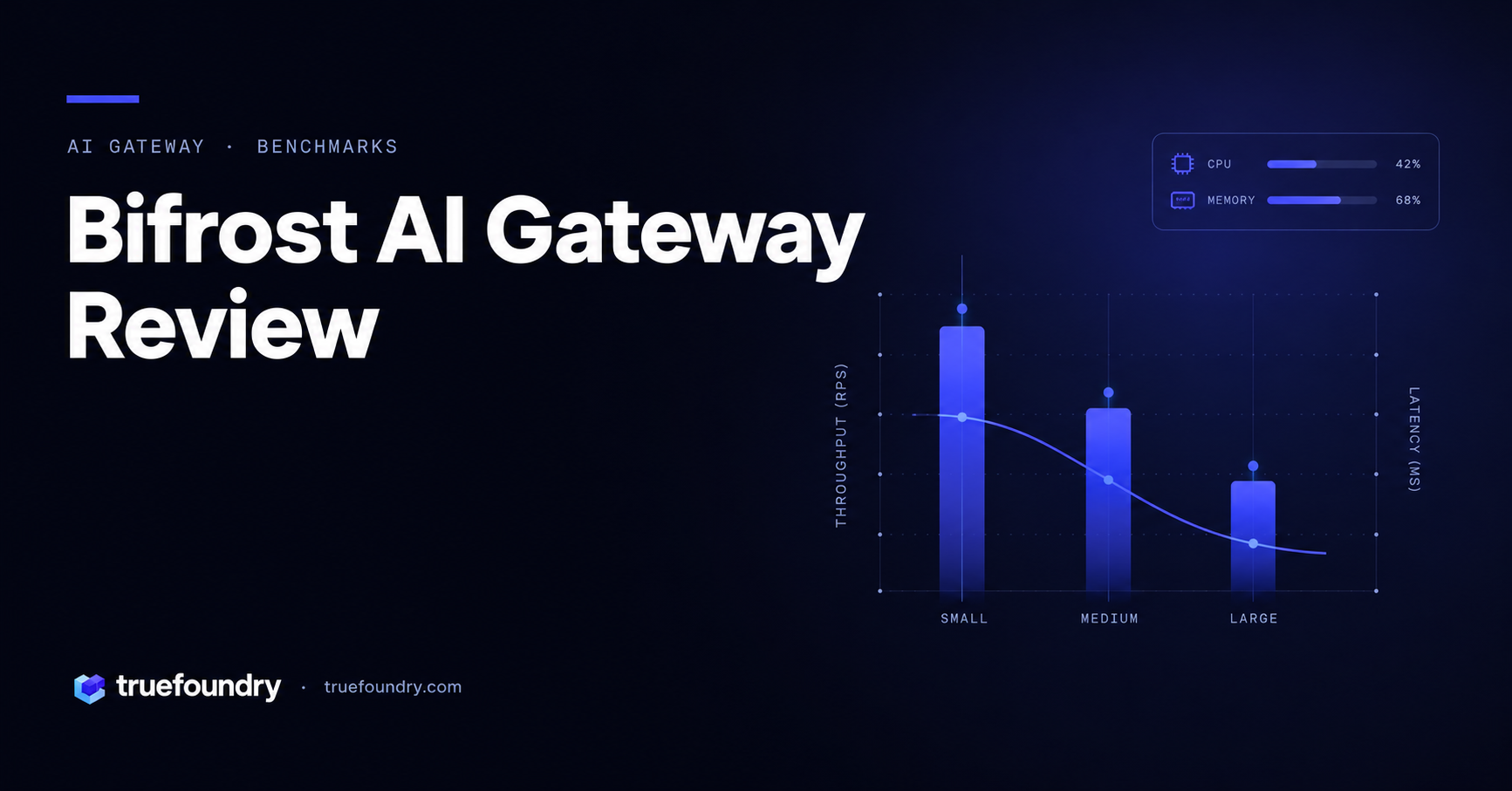
TrueFoundry AI Gateway delivers ~3–4 ms latency, handles 350+ RPS on 1 vCPU, scales horizontally with ease, and is production-ready, while LiteLLM suffers from high latency, struggles beyond moderate RPS, lacks built-in scaling, and is best for light or prototype workloads.




Yes, several AI agent marketplaces have emerged. Platforms like Agentive, Relevance AI, and GPT Store (by OpenAI) allow developers to publish and discover pre-built AI agents. Enterprise-focused options include TrueFoundry and AWS Bedrock Agent Marketplace, which enable teams to deploy and share production-ready agents within organizational boundaries.
The best AI agent depends on the use case. For software development, Claude Code and GitHub Copilot Workspace are leading options. For general business automation, AutoGPT and CrewAI-powered agents are popular. For enterprise workflows, platforms built on LangGraph or TrueFoundry's agent infrastructure tend to deliver the most reliable, governed, and scalable performance.
ChatGPT in its standard form is a conversational AI assistant rather than a true autonomous agent. However, with the addition of tools like web search, code interpreter, and file analysis as well as the newer GPT Actions and Operator features ChatGPT can take on agent-like behaviors that involve planning, tool use, and multi-step task execution.
The seven commonly recognized types of AI agents are: (1) Simple Reflex Agents, which respond to current inputs only; (2) Model-Based Reflex Agents, which maintain an internal world model; (3) Goal-Based Agents, which plan actions toward a defined objective; (4) Utility-Based Agents, which optimize for a satisfaction function; (5) Learning Agents, which improve through experience; (6) Multi-Agent Systems, where multiple agents collaborate; and (7) Hierarchical Agents, which decompose tasks across layers of sub-agents.



The latest news, articles, and resources sent to your inbox

.webp)

.png)
.png)
.png)
.png)
.png)
.png)
.png)
.png)
.png)
.png)
.png)


