


.webp)
October 8, 2026
|
5 min read


Published: September 11, 2026
Blazingly fast way to build, track and deploy your models!
In the world of microservices, we have perfected the art of CI/CD. Unit tests are deterministic: assert(2 + 2 == 4). If the tests pass, the code is safe to deploy.
In the world of Agentic AI, "Unit Tests" don't exist in the same way.
You cannot simply deploy an agent because the code compiles. The prompt is a Hyperparameter of Behavior. A minor tweak to the system prompt ("Be more concise") can cause a massive regression in reasoning capability ("The agent stopped checking for errors because it wanted to be concise").
To solve this, the TrueFoundry Agent Gateway supports Agent DevOps—a specialized lifecycle management layer that brings "Shadow Mode," "Online Evals," and "Canary Rollouts" to the cognitive stack.
Let’s look at a concrete example of why standard CI/CD fails for agents.
The Scenario: You have a Customer Support Agent in production. It’s polite and helpful. The Product Manager wants it to be more efficient. The Change: You update the System Prompt from "You are a helpful assistant" to "You are a concise, direct assistant. Do not waste words."
The Standard Deployment:
The Catastrophe: The agent interprets "direct" as "rude."
The Customer Satisfaction (CSAT) score crashes. You have tainted your brand because you treated a cognitive change like a code change.
The TrueFoundry Gateway supports Traffic Mirroring (Shadow Mode). Instead of replacing v1 with v2, we deploy v2 alongside v1.
The Gateway then compares the outputs asynchronously. You can run an "Auto-Eval" (using a Judge Model) to score the difference.
The dashboard alerts you: "v2 Empathy Regression Detected." You revert the deployment before a single customer sees the rude message.

Before an agent even reaches Shadow Mode, it must pass the Evaluation Pipeline. Just as you run pytest for code, you must run deepeval or ragas for cognition.
The TrueFoundry Registry treats "Evaluation Datasets" as first-class citizens.
When you push a Pull Request, the CI system spins up the agent and runs the 500 queries. Pass Criteria:
If the "Concise Prompt" causes the "Faithfulness" score to drop by 10%, the build fails. "Merge Blocked: Agent creates hallucinations."

Once the agent passes CI and Shadow Mode, you are ready for the real world. But you don't flip the switch to 100%. You use Canary Routing.
The Gateway creates a "Virtual Service" that splits traffic based on weights.
The Gateway automates this. If the "Error Rate" spikes at the 10% stage, the Gateway can help automatically roll back to v1 and pages the on-call engineer.
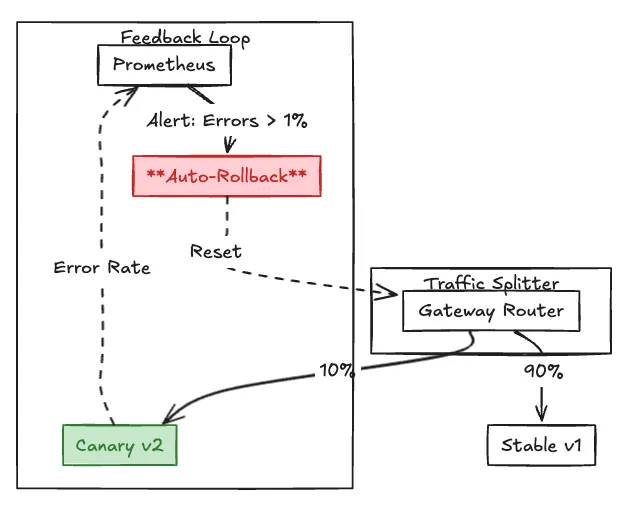
Fig 1: A Canary Rollout Example
One major challenge in Agent DevOps is that the Prompt and the Code often live in different places.
The TrueFoundry Agent Registry enforces Immutable Artifacts. When you deploy, we bundle: Artifact ID = Hash(Code + Prompt + Model Config + Dependencies)
You cannot change the prompt of v1 in production. You must create v1.1. This strict versioning ensures Reproducibility. If an incident happens, you know exactly which combination of Code+Prompt caused it.
Agent DevOps is the discipline of applying engineering rigor to probabilistic software. By moving from "Vibes-based Deployment" (it feels faster) to "Metrics-based Deployment" (Shadow Mode confirmed 5% higher accuracy), TrueFoundry allows enterprises to innovate on their prompts rapidly without breaking the trust of their users.
TrueFoundry AI Gateway delivers ~3–4 ms latency, handles 350+ RPS on 1 vCPU, scales horizontally with ease, and is production-ready, while LiteLLM suffers from high latency, struggles beyond moderate RPS, lacks built-in scaling, and is best for light or prototype workloads.






The latest news, articles, and resources sent to your inbox


.png)
.png)
.png)
.png)
.png)
.png)
.png)


