


October 1, 2026
|
5 min read


احصل على وصول فوري إلى بيئة TrueFoundry مباشرة. انشر النماذج، ووجّه حركة مرور LLM، واستكشف المنصة بالكامل — بيئة الاختبار الخاصة بك جاهزة في ثوانٍ، ولا يلزم وجود بطاقة ائتمان.



Published: August 3, 2026
Blazingly fast way to build, track and deploy your models!
An AI Gateway is an abstraction layer that unifies access to multiple Large Language Models (LLMs) through a single API interface. It provides a consistent, secure, and optimized way to interact with models across providers such as OpenAI, Anthropic, Cohere, Together.ai, or open-source models like Mistral and LLaMA deployed on your own infrastructure.
At its core, an AI Gateway handles the heavy lifting of integrating, routing, authenticating, and monitoring LLM usage across different endpoints. Instead of dealing with multiple SDKs, authentication tokens, rate limits, and pricing models for each provider, teams route all model requests through the Gateway. This streamlines development and enables governance at scale.
TrueFoundry's AI Gateway is built for enterprise-grade performance and observability. It allowsteams to:
In addition, the Gateway supports streaming and non-streaming modes, tool calling (function calling), prompt templating, and tagging for team-level cost breakdowns. With built-in observability, TrueFoundry enables tracking of not just latency and token usage but also user-specific access, traffic trends, and per-endpoint performance.
As LLM usage grows across teams, use cases, and environments, an AI Gateway becomes the foundation for operationalizing generative AI in production. It provides control, visibility, and optimization across the entire lifecycle of LLM interactions.
The increase in AI gateways is mainly in response to growing complexity. Most teams no longer use a single model from one provider. They are testing multiple models, balancing performance with cost, and supporting different use cases across teams. Without an abstraction layer, this situation can quickly become fragile and hard to manage.
Cost pressure has also had a significant impact. As AI usage grows, token consumption and latency shift from being technical issues to business concerns. AI gateways enable teams to route traffic smartly, enforce budgets, and gain insights into actual spending.
Governance is another important factor. As systems handle more sensitive data and regulated workflows, organizations require stronger controls over access, auditing, and compliance. A gateway serves as a natural point for enforcing those policies.
Also Read: OpenRouter vs AI gateway
Key Metrics for Evaluating Gateway
| Criteria | What should you evaluate ? | Priority | TrueFoundry |
|---|---|---|---|
| Latency | Adds <10ms p95 overhead for time-to-first-token? | Must Have | ✅ Supported |
| Data Residency | Keeps logs within your region (EU/US)? | Depends on use case | ✅ Supported |
| Latency-Based Routing | Automatically reroutes based on real-time latency/failures? | Must Have | ✅ Supported |
| Key Rotation & Revocation | Rotate or revoke keys without downtime? | Must Have | ✅ Supported |
| Key Rotation & Revocation | Rotate or revoke keys without downtime? | Must Have | ✅ Supported |
| Key Rotation & Revocation | Rotate or revoke keys without downtime? | Must Have | ✅ Supported |
| Key Rotation & Revocation | Rotate or revoke keys without downtime? | Must Have | ✅ Supported |
| Key Rotation & Revocation | Rotate or revoke keys without downtime? | Must Have | ✅ Supported |
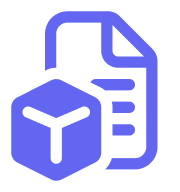
An AI Gateway brings a structured and scalable approach to managing LLM usage across teams and environments. Below are the key features that make it essential for modern GenAI workflows:
Unified Access: AI Gateways offer a single API interface to access multiple LLMs across vendors like OpenAI, Anthropic, or in-house models. This eliminates the need to manage individual APIs, SDKs, or keys for each provider.
Authentication and Authorization: AI Gateways enforce secure access through centralized key management. Developers receive scoped API keys while root keys remain protected, integrated with secret managers like AWS SSM, Google Secret Manager, or Azure Vault.
Role-Based Access Control (RBAC): Ensures that only authorized users can access specific models or actions, aligning with enterprise security standards.
Performance Monitoring: Track latency, error rates, and token throughput for each model endpoint. This helps detect issues early, optimize routing, and maintain SLAs.
Usage Analytics: Detailed logs and dashboards show who used which model, when, and how, offering transparency across projects and enabling cost attribution per user, team, or feature.
Cost Management: Gateways track token-level usage and associate costs with users, teams, or endpoints. This provides clear visibility into spend patterns and helps prevent cost overruns.
API Integrations: Support for external APIs and tools such as evaluation pipelines, prompt guardrails, or vector databases enables seamless integration with broader AI/ML ecosystems.
Custom Model Support: Users can bring their own fine-tuned or proprietary models into the Gateway, routing traffic alongside commercial models.
Caching: Store and reuse identical or similar LLM responses to save tokens and reduce latency.
Routing and Fallbacks: Intelligent request routing based on latency, cost, or reliability. Includes fallback mechanisms and auto-retries to improve resiliency.
Rate Limiting and Load Balancing: Supports user-level quotas, rate limiting, and load balancing across model providers for optimal throughput and stability.
Evaluating the best AI gateway requires a comprehensive assessment of its capabilities across access control, model integration, observability, and cost governance. A robust AI Gateway should simplify model usage while ensuring scalability, performance, and security for production-grade applications.
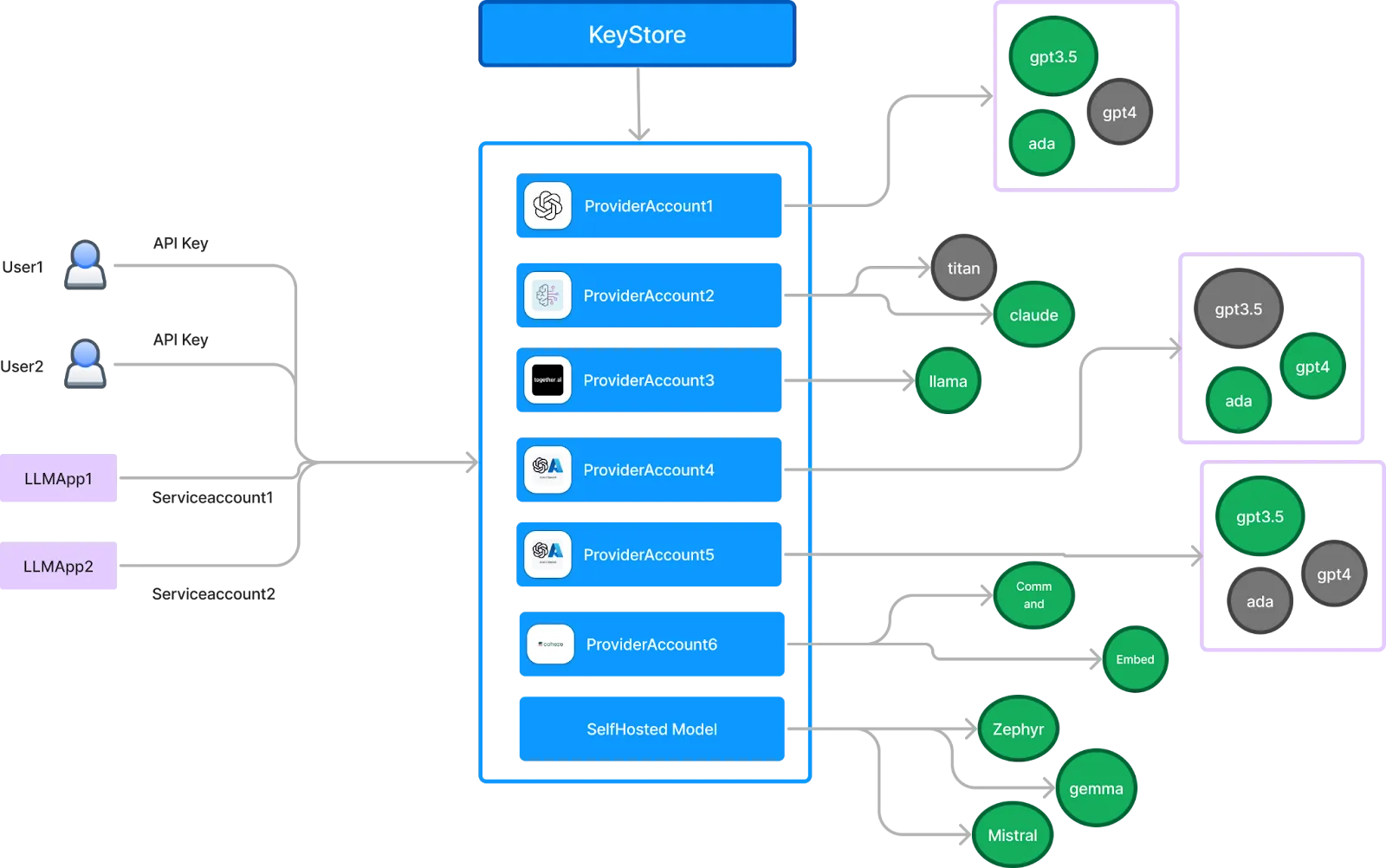
A strong AI Gateway centralizes API key management by issuing individual keys to each user or service while safeguarding root keys using secret managers like AWS SSM, Google Secret Store, or Azure Vault.
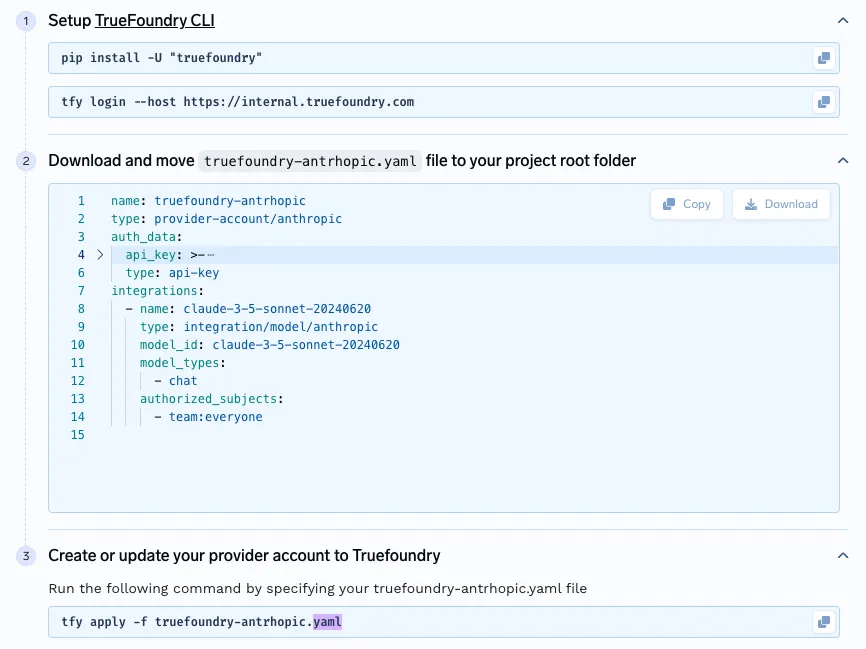
TrueFoundry’s Gateway allows administrators to manage fine-grained access to all integrated models, whether self-hosted or third-party, via a unified admin interface. Access control configurations are tracked in versioned YAML files, ensuring auditability and compliance.
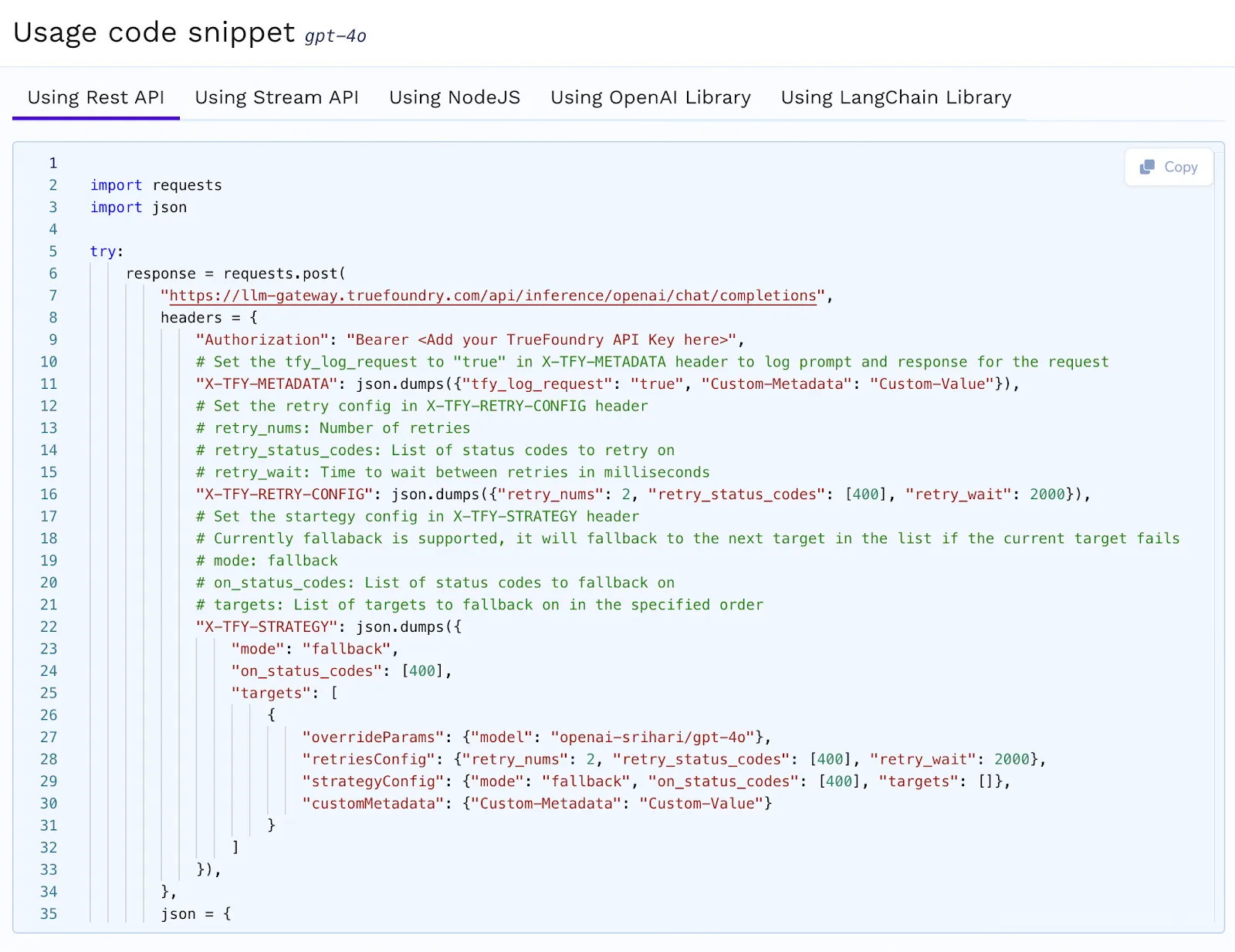
The AI Gateway should offer a standardized interface for interacting with multiple models. TrueFoundry follows the OpenAI request-response format, making it compatible with LangChain and OpenAI SDKs. Developers can switch between models without modifying their code. TrueFoundry also provides auto-generated code snippets for different providers and programming languages, simplifying integration.
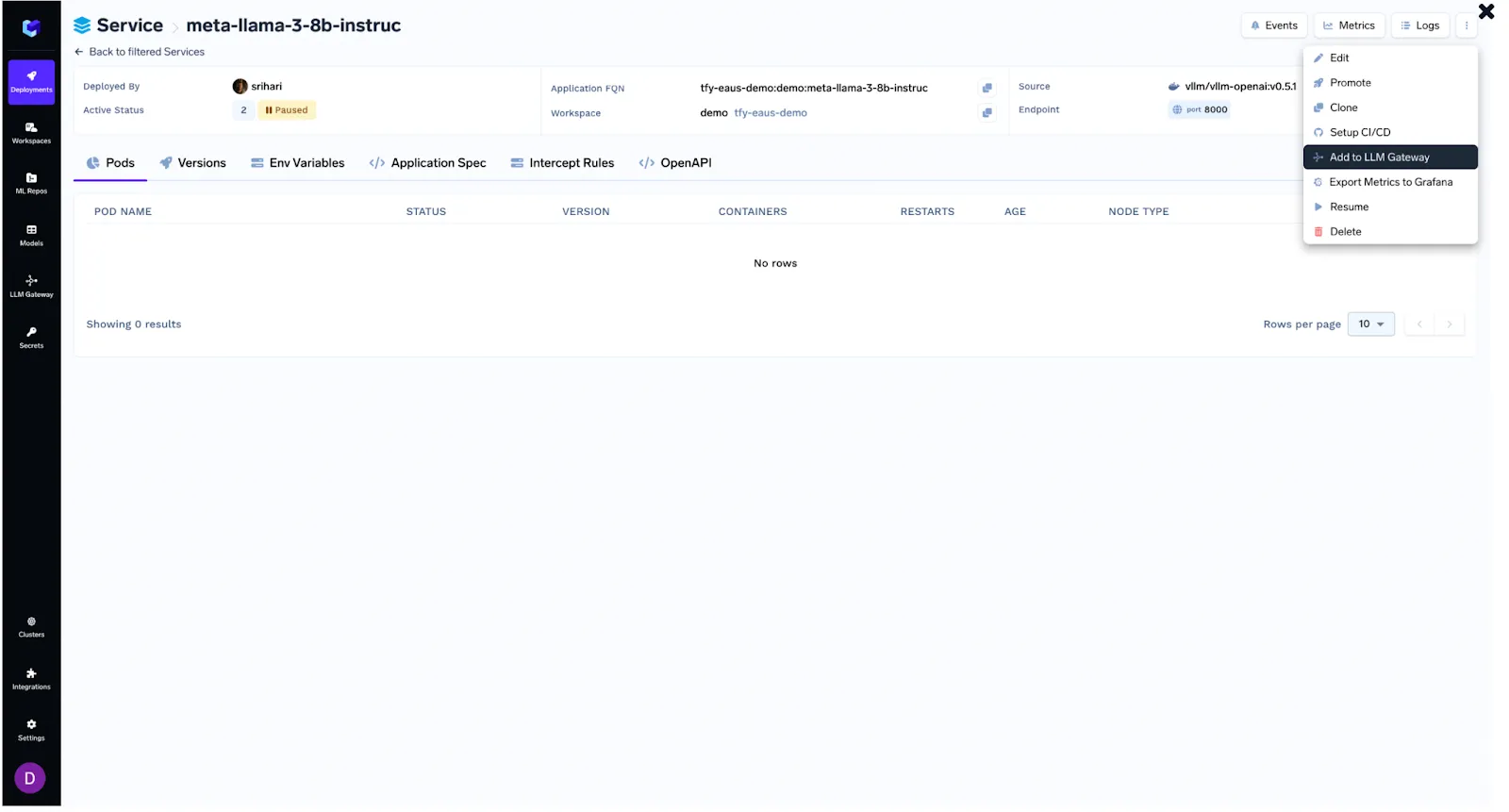
TrueFoundry supports three key routes for model access: third-party providers (like OpenAI, Cohere, AWS Bedrock, and Anthropic), self-hosted open-source models (deployed via HuggingFace or custom infrastructure), and TrueFoundry-hosted models shared across clients. This flexibility enables teams to mix and match models based on use case, budget, or latency requirements.
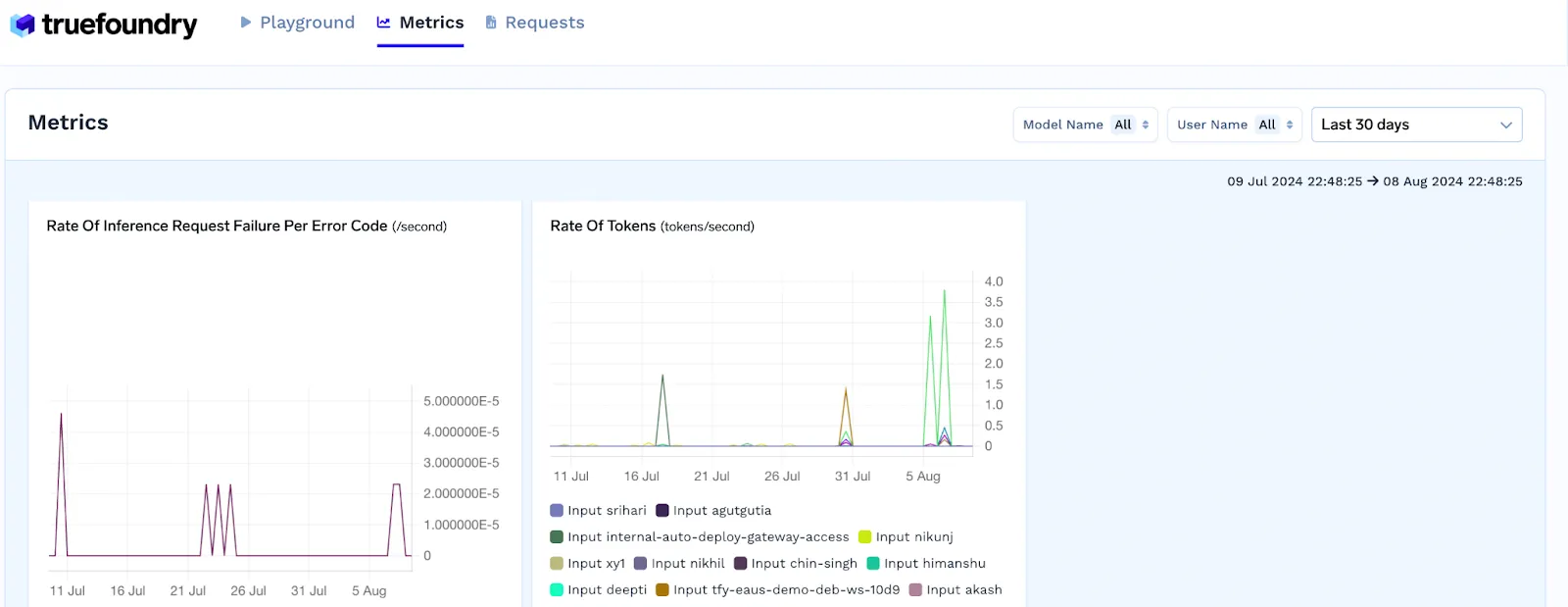
To ensure reliability, the Gateway should monitor latency, error rates, throughput, and inference failures. TrueFoundry captures key metrics like request latency, rate of tokens, and rate of inference failures, making it easy to identify performance bottlenecks through real-time dashboards.
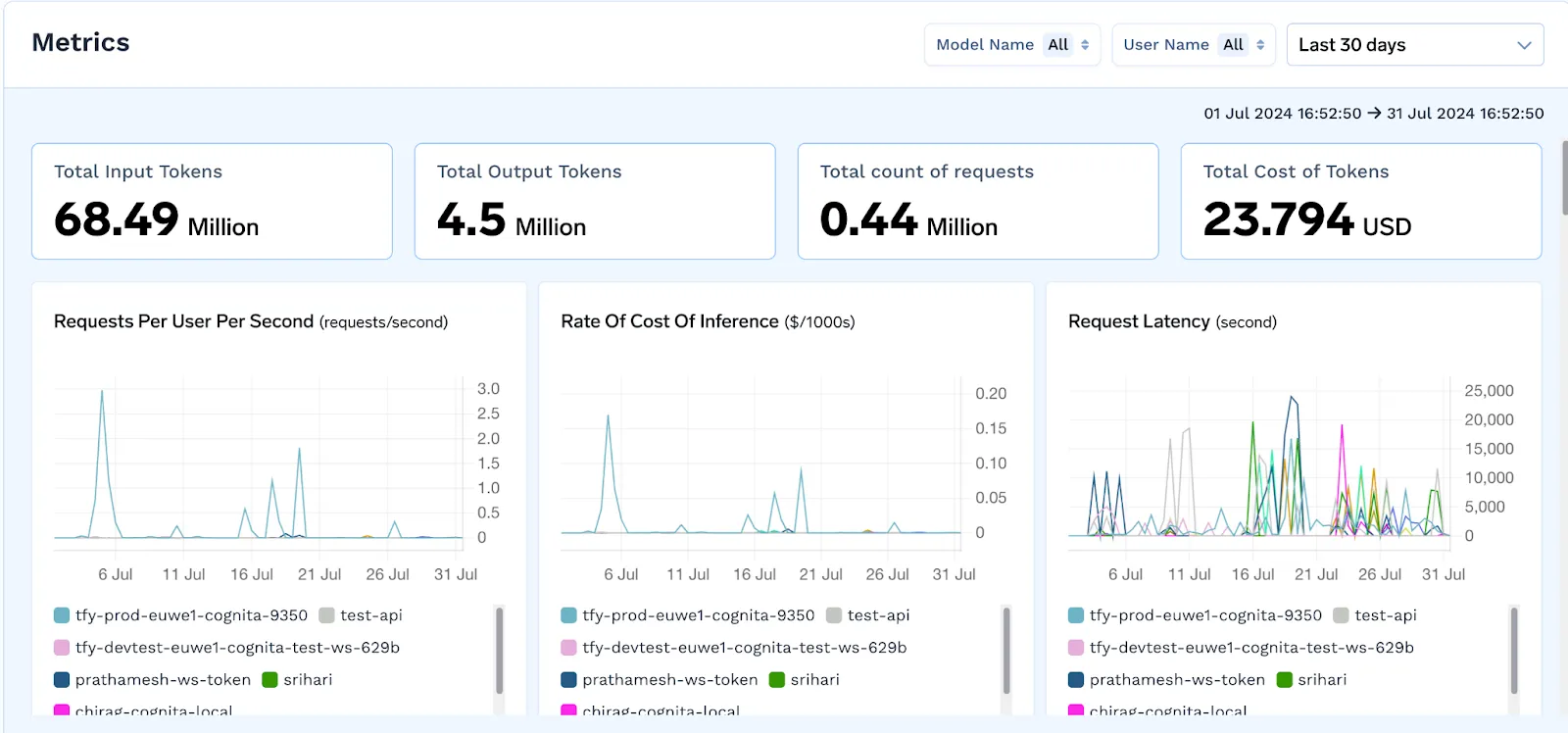
Understanding how, when, and by whom models are used is critical for governance. TrueFoundry logs detailed request and response activity, token consumption, and cost per model. These insights help teams manage workloads and optimize usage patterns.
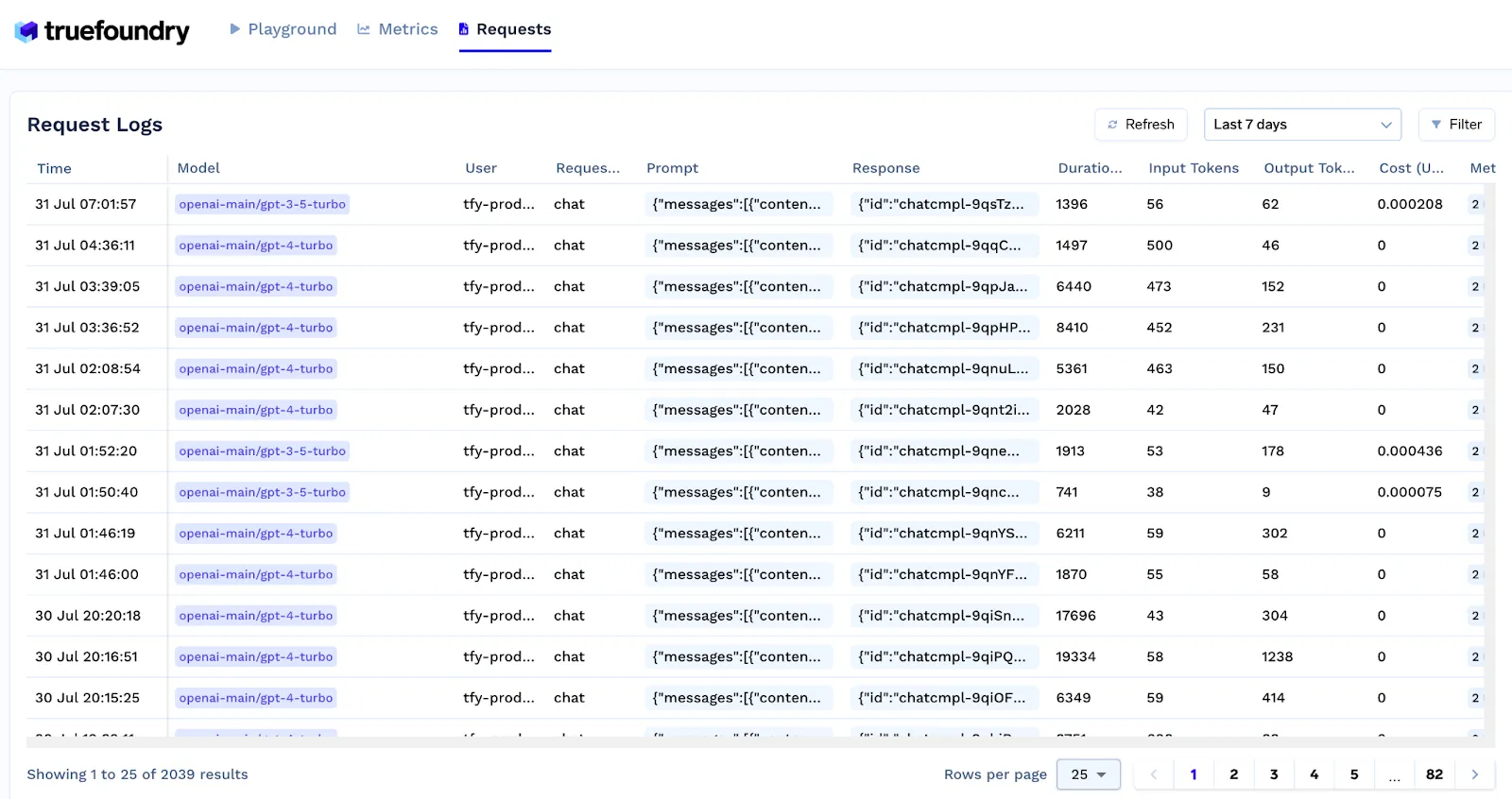
The Gateway should log costs from all model interactions, whether hosted internally or through commercial APIs. TrueFoundry provides full visibility into model usage costs across users, teams, and projects. Integrated dashboards allow organizations to track spend, configure alerts, and apply rate limits or budget caps to control overages.
Advanced features in an AI Gateway determine how effectively it can operate in real-world, production-scale environments. TrueFoundry’s AI Gateway brings a rich set of capabilities that optimize performance, improve reliability, and seamlessly integrate with broader systems, making it enterprise-ready from day one.
Caching helps reduce latency and save costs by avoiding redundant model calls. TrueFoundry supports both exact match caching (for identical prompts) and semantic caching (for similar meaning queries), which enhances speed without compromising on relevance. You can configure cache expiration policies and manually invalidate outdated entries when needed. This ensures that the gateway serves fast, accurate, and up-to-date responses.
For production-critical applications, the gateway automatically routes traffic to alternative models if the primary one fails, ensuring uninterrupted service. Automatic retries help recover from transient errors without user intervention. Built-in rate limiting helps enforce quotas and prevent overuse, while load balancing distributes traffic across multiple models or providers to maintain optimal throughput and minimize latency.
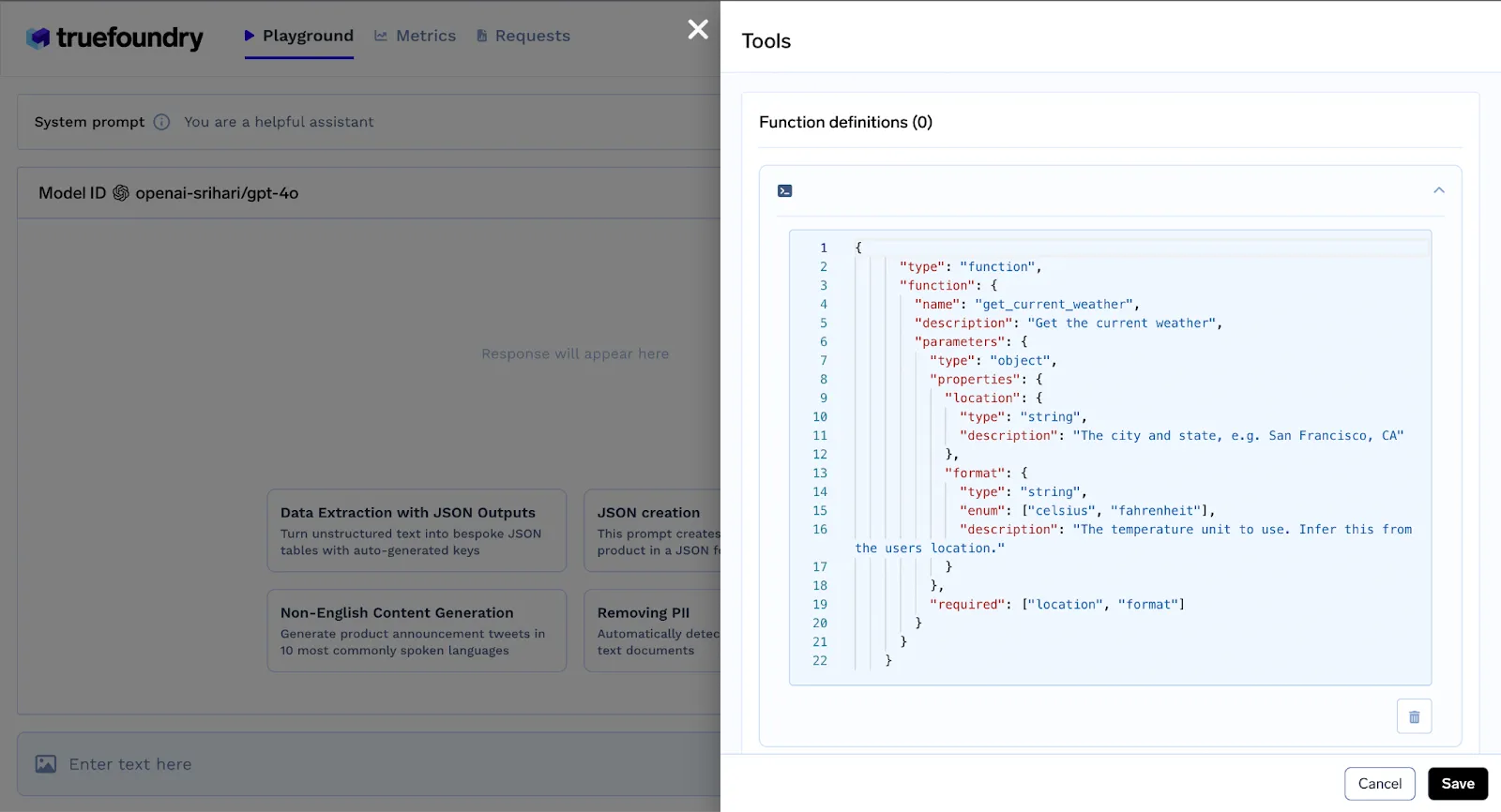
TrueFoundry’s Gateway supports tool calling by simulating interactions with external APIs. While the actual function is not executed by the gateway, the model can return structured outputs representing the intended tool call. This is ideal for building workflows where LLMs need to decide when and how to invoke tools, enabling developers to design and test these behaviors safely.
Modern applications often involve more than just text. The Gateway supports multimodal inputs such as text and images within the same request, which unlocks use cases like document Q&A, visual search, or customer support enriched with screenshots or product photos. This makes the AI Gateway suitable for both traditional NLP and next-gen AI applications that require context from multiple data formats.
TrueFoundry enables deep integration with your existing stack. You can plug in observability tools like Prometheus and Grafana for real-time monitoring, implement safety layers using Guardrails AI or NeMo Guardrails, and evaluate model quality continuously using Arize or MLflow. This connected ecosystem ensures that your AI system is not just performant, but also safe, transparent, and continuously improving.
An AI Gateway delivers significant operational, financial, and engineering advantages for organizations integrating large language models (LLMs) into their products and workflows. It acts as a control plane for AI consumption, providing a consistent interface, enforcing security, and optimizing performance at scale.
الوصول المركزي والحوكمة
عندما تحتاج فرق أو تطبيقات متعددة إلى التفاعل مع مزودي نماذج لغوية كبيرة (LLM) مختلفين، يصبح إدارة المفاتيح والرموز وحقوق الوصول الفردية أمرًا معقدًا. تعمل بوابة الذكاء الاصطناعي على مركزة التحكم في الوصول، مما يتيح الأذونات المستندة إلى الأدوار، وتسجيل التدقيق، وإدارة المفاتيح الآمنة.
مثال: تستخدم مؤسسة عالمية تنشر ميزات الذكاء الاصطناعي عبر فرق التسويق والمنتجات والدعم بوابة ذكاء اصطناعي لتعيين مفاتيح API محددة النطاق وتقييد وصول كل فريق إلى نماذج محددة، مما يقلل من مخاطر سوء الاستخدام العرضي أو تسرب البيانات.
شفافية التكلفة والتحكم في الميزانية
يمكن أن تصبح النماذج اللغوية الكبيرة (LLMs) تكلفة تشغيلية كبيرة، خاصة مع تزايد الاستخدام عبر الفرق. توفر بوابات الذكاء الاصطناعي تتبعًا دقيقًا للتكلفة حسب المستخدم أو الفريق أو المشروع. تساعد هذه الشفافية المؤسسات على إدارة الميزانيات، وتحديد أوجه القصور، وتقديم نماذج استرداد التكاليف عند الاقتضاء.
مثال: تقوم شركة برمجيات كخدمة (SaaS) تقدم ميزات مدعومة بالذكاء الاصطناعي لعملائها بمراقبة الاستخدام عبر البوابة وتستخدم البيانات لتطبيق تسعير متدرج بناءً على الاستهلاك الفعلي للرموز.
التبديل السلس بين النماذج والتجريد
تسمح طبقة واجهة برمجة التطبيقات الموحدة للمؤسسات بتبديل النماذج اللغوية الكبيرة (LLMs) أو المزودين دون تعديل رمز التطبيق. وهذا يسهل اختبار النماذج الجديدة، والتفاوض على أسعار أفضل، أو الانتقال من عمليات النشر التجارية إلى مفتوحة المصدر.
مثال: تنتقل شركة ناشئة كانت تستخدم نموذجًا لغويًا كبيرًا تجاريًا في البداية إلى نموذج مفتوح المصدر مُعدّل بدقة لتحقيق خصوصية البيانات وتوفير التكاليف، دون تغيير قاعدة التعليمات البرمجية الخاصة بها، وذلك بفضل تجريد البوابة.
موثوقية ومرونة محسّنة
توفر البوابات آليات احتياطية مدمجة، وإعادة محاولة تلقائية، وتخزين مؤقت، وموازنة تحميل لضمان خدمة متواصلة وأداء ثابت، حتى تحت الضغط أو أثناء انقطاع خدمة المزودين.
مثال: يتعامل نظام روبوت الدردشة عالي الحركة مع الارتفاعات المفاجئة في حركة المرور عن طريق توجيه الطلبات ديناميكيًا عبر مزودين متعددين مع الرجوع إلى الاستجابات المخزنة مؤقتًا عند الحاجة.
الامتثال وقابلية المراقبة
بالنسبة للصناعات الخاضعة للتنظيم، تعد القدرة على تتبع استخدام النموذج وتدقيقه أمرًا بالغ الأهمية. تتكامل بوابات الذكاء الاصطناعي مع أدوات المراقبة والتسجيل والأمان لتلبية معايير الامتثال وسياسات الحوكمة الداخلية.
مثال: تسجل شركة رعاية صحية كل طلب واستجابة عبر البوابة، مما يتيح إمكانية تتبع كاملة لأغراض التدقيق مع الحفاظ على حدود الوصول إلى البيانات.
إذا كانت مصطلحات مثل بوابة واجهة برمجة التطبيقات (API gateway) وبوابة الذكاء الاصطناعي (AI gateway) تبدو سهلة الخلط، فأنت لست وحدك. تواجه العديد من الفرق البوابات لأول مرة عند توسيع نطاق واجهات برمجة التطبيقات الخاصة بها. مع أخذ هذا السياق في الاعتبار، إليك كيفية اختلاف بوابات الذكاء الاصطناعي وسبب وجودها من الأساس.
صُممت بوابات الذكاء الاصطناعي خصيصًا لتعقيدات نماذج اللغات الكبيرة (LLMs). إنها تتجاوز مجرد إدارة حركة المرور البسيطة لتتعامل مع "ذكاء" البيانات.
إليك مقارنة واضحة بين بوابات واجهة برمجة التطبيقات التقليدية وبوابات الذكاء الاصطناعي المتخصصة.
باختصار، تدير البوابة التقليدية كيفية انتقال البيانات. بينما تدير بوابة الذكاء الاصطناعي تكلفة البيانات وكيفية سلوكها. بالنسبة لمكدس الذكاء الاصطناعي الحديث، تعد البوابة دفاعك الأساسي ضد التكاليف المتصاعدة والمخاطر الأمنية.
مع توسع المؤسسات في استخدامها لنماذج اللغات الكبيرة، تصبح الحاجة إلى واجهة آمنة وموثوقة وفعالة أمرًا بالغ الأهمية. تعمل بوابة الذكاء الاصطناعي كطبقة أساسية، حيث تجرد تعقيد إدارة مزودين متعددين، وتفرض ضوابط الوصول، وتتتبع التكاليف، وتضمن الأداء على نطاق واسع. إنها تمكّن الفرق من تجربة ونشر ومراقبة التطبيقات المدعومة بنماذج اللغات الكبيرة بثقة وتحكم.
سواء كنت تقوم بإنشاء مساعدين داخليين، أو واجهات دردشة موجهة للعملاء، أو سير عمل ذكاء اصطناعي متعدد الوسائط، تساعد بوابة الذكاء الاصطناعي في توحيد البنية التحتية مع الحفاظ على مرونة كافية لدعم أنظمة النماذج المتطورة. كما أن ميزات مثل التخزين المؤقت، والتوجيه، وتحديد التكلفة، واستدعاء الأدوات تزيد من قيمتها لعمليات النشر على مستوى المؤسسات.
في مشهد الذكاء الاصطناعي المتغير بسرعة، لا يعد اعتماد بوابة الذكاء الاصطناعي مجرد رفاهية؛ إنه استثمار استراتيجي في النضج التشغيلي، وقابلية المراقبة، وقابلية التوسع على المدى الطويل.
هل أنت مستعد لرؤية هذه الإمكانيات عمليًا؟ احجز عرضًا توضيحيًا مع TrueFoundry اليوم لتتعرف على كيفية قيامنا بمركزة وتأمين البنية التحتية للذكاء الاصطناعي لمؤسستك.
تعمل بوابة الذكاء الاصطناعي كلوحة تحكم مركزية توحد العديد من مزودي نماذج اللغات الكبيرة تحت واجهة برمجة تطبيقات واحدة. تدير المهام الشاقة لتوجيه الطلبات، والمصادقة، ومراقبة الأداء عبر نقاط نهاية مختلفة. من خلال التعامل مع عمليات إعادة المحاولة التلقائية وتحديد حدود المعدل الخاصة بالفرق، تضمن بقاء البنية التحتية للذكاء الاصطناعي لديك مستقرة وفعالة من حيث التكلفة.
يجب أن توفر أفضل بوابة للذكاء الاصطناعي موثوقية على مستوى الإنتاج ومرونة في اختيار الموردين. تعتبر TrueFoundry منافسًا قويًا لأنها توفر ميزات فريدة للمؤسسات مثل التخزين المؤقت الدلالي لتقليل زمن الاستجابة وآليات التراجع التلقائي للنماذج لمنع الانقطاعات. يتيح ذلك للفرق التبديل بسلاسة بين النماذج التجارية والمستضافة ذاتيًا دون الحاجة إلى إعادة كتابة رمز التطبيق.
بينما يركز جدار حماية الذكاء الاصطناعي تحديدًا على التهديدات الأمنية مثل حقن الأوامر، تدير بوابة الذكاء الاصطناعي "ذكاء" تدفق البيانات الأوسع نطاقًا. تتعامل البوابة مع المهام التشغيلية مثل موازنة التحميل المستندة إلى الرموز المميزة، والتخزين المؤقت الدلالي، وتجاوز فشل النموذج. تخيل البوابة كطبقة الإدارة الكاملة وجدار الحماية كحارس أمن محدد.
تمكّن TrueFoundry المؤسسات من توسيع نطاق الذكاء الاصطناعي من خلال توفير رؤية دقيقة لاستخدام الرموز المميزة والتكاليف عبر الأقسام. كما تبسّط الحوكمة من خلال التحكم في الوصول المستند إلى الأدوار وإدارة الأوامر ذات الإصدارات، مما يضمن الامتثال وقابلية الاستنساخ. يتيح هذا النهج المركزي للمؤسسات الانتقال من النماذج الأولية التجريبية إلى بيئات إنتاج آمنة وعالية الأداء بكفاءة.
TrueFoundry AI Gateway delivers ~3–4 ms latency, handles 350+ RPS on 1 vCPU, scales horizontally with ease, and is production-ready, while LiteLLM suffers from high latency, struggles beyond moderate RPS, lacks built-in scaling, and is best for light or prototype workloads.





أحدث الأخبار والمقالات والموارد تصلك مباشرة إلى بريدك الوارد
.png)
.png)
.png)
.png)
.png)
.png)
.png)
.png)
.png)
.png)
.png)


