September 15, 2026
|
5 min read


Published: August 27, 2026
Blazingly fast way to build, track and deploy your models!
Agno earned its following for good reason. Agents instantiate in around 2 microseconds and run on roughly 3.75 KiB of memory, the framework is model-agnostic across 20-plus providers, and its AgentOS control plane gives teams a working chat UI and monitoring surface without stitching one together themselves. With over 40,000 GitHub stars, it's become one of the more visible names in the Python agent framework space.
Teams start looking at Agno alternatives once they hit a different set of requirements: centralized credential management across many agents instead of per-project secrets, production-grade observability owrite nce agents multiply beyond a handful, or deployment inside a VPC or on-prem environment rather than a hosted control plane. None of these are gaps unique to Agno, they show up once any single-framework tool has to support a platform team running agents at scale.
While Agno is an excellent framework for building AI agents, it doesn't solve the operational challenges of running those agents in production. Teams still need to deploy agents, manage infrastructure, monitor performance, secure model access, and scale workloads reliably. Here are the key factors to look for when comparing alternatives:
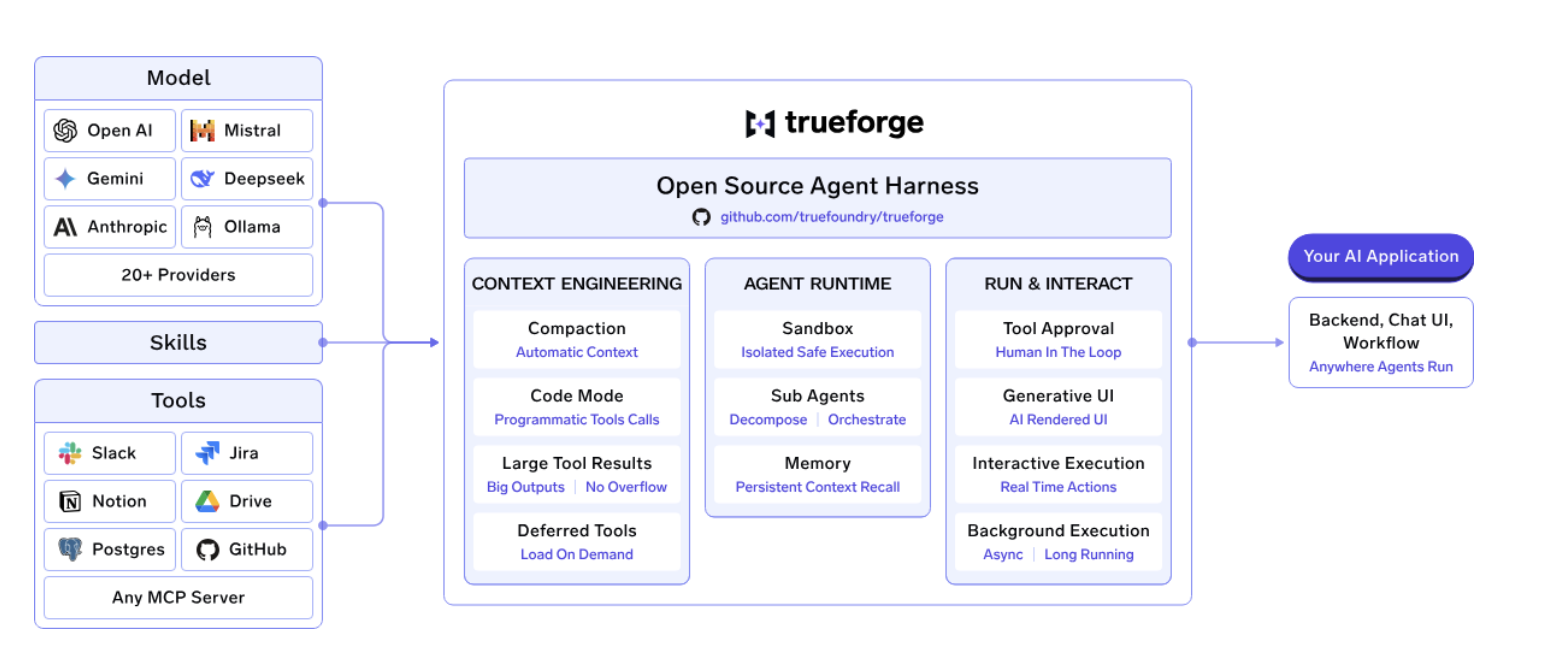
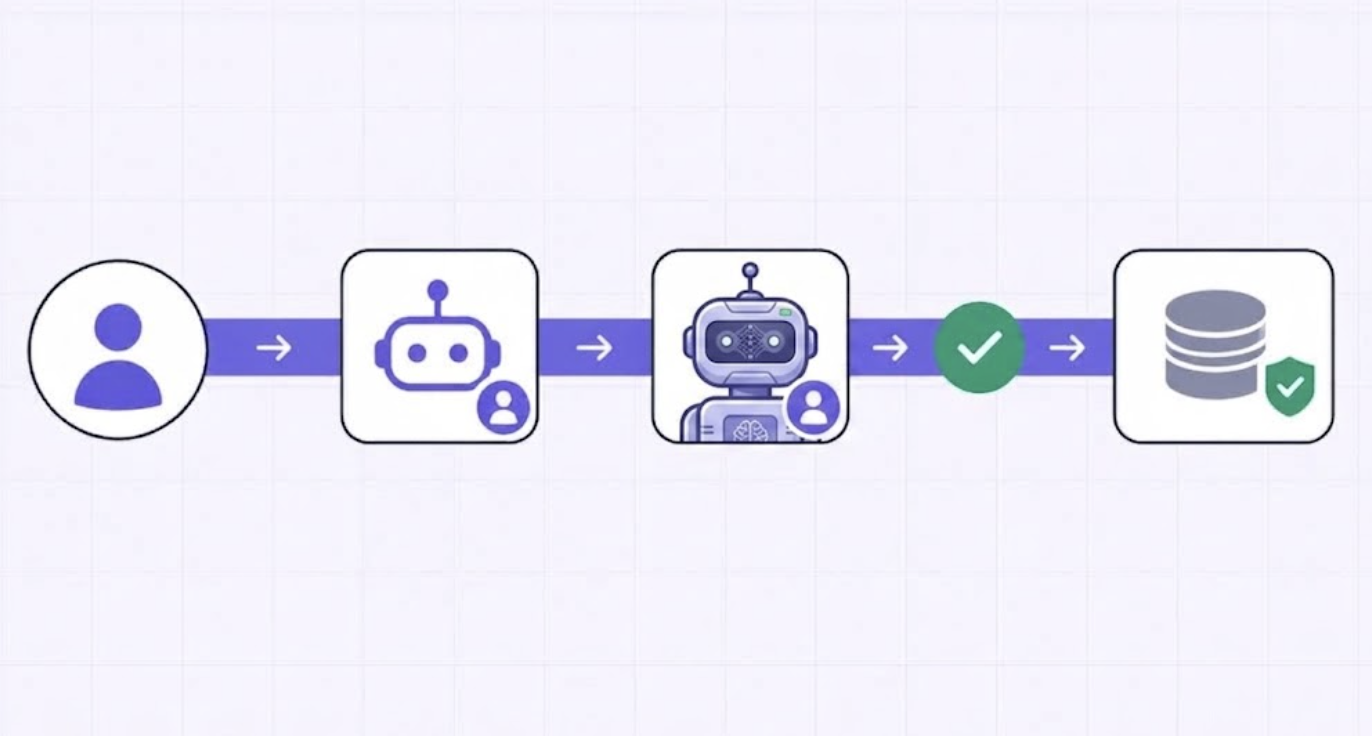
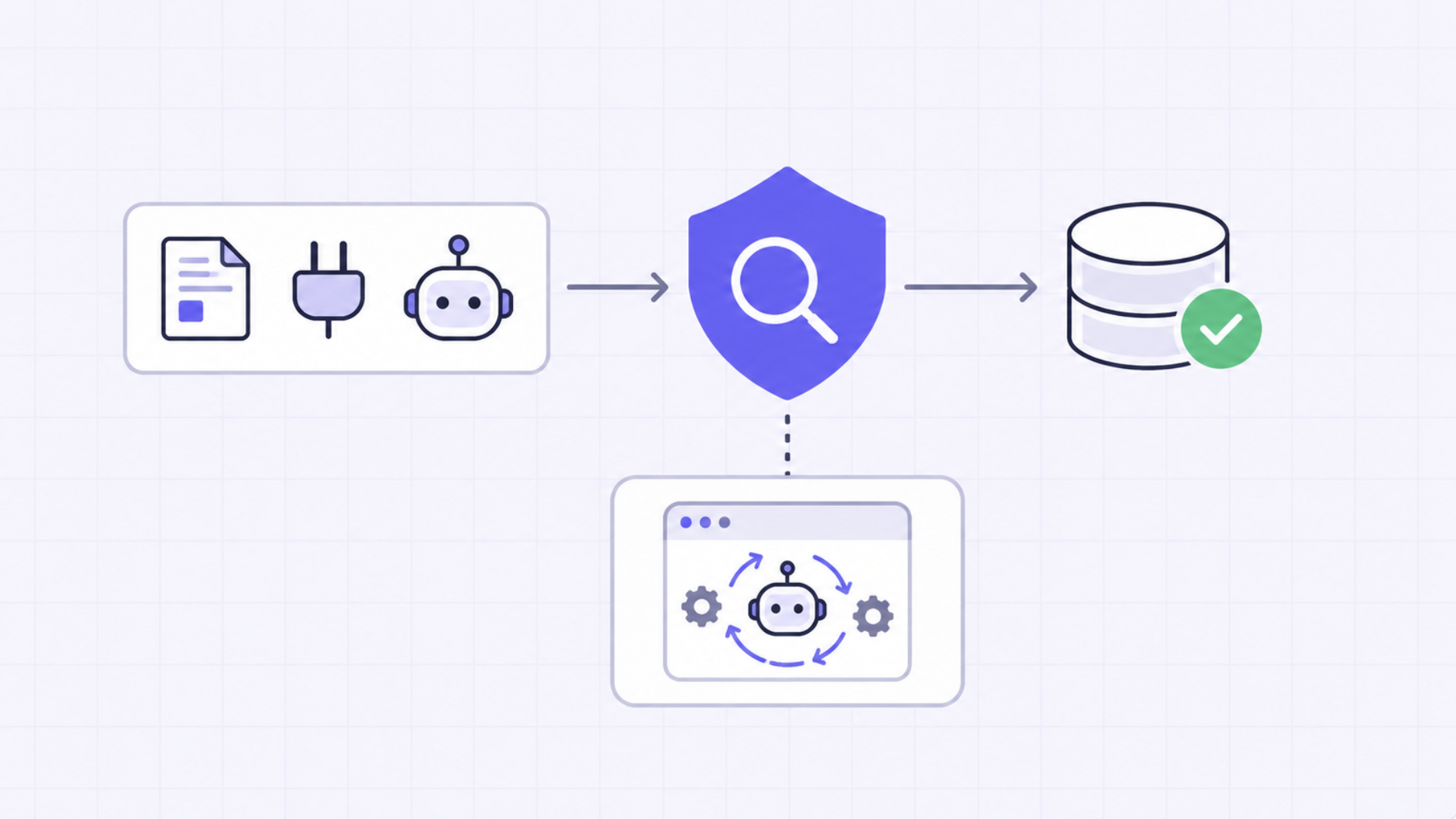
TrueForge is TrueFoundry's open-source, vendor-neutral agent harness. It sits at the runtime layer around an LLM, handling the agent loop, tool execution, context management, sandboxing, human approvals, session state, and subagents. Unlike a framework tied to how agents are built, TrueForge is designed to provide the infrastructure needed to run and operate agents in production.
TrueForge is built around three components: a core server that runs the agent loop, an HTTP API and TypeScript SDK for driving agents from code, and a chat UI with a React UI SDK for interacting with agents from the browser. Models, MCP servers, and sandbox providers are bring-your-own, so teams can choose the infrastructure and model providers that fit their workloads.
The biggest difference for teams evaluating Agno alternatives is the control plane around the agent. TrueForge can be used alongside TrueFoundry's AI Gateway and MCP Gateway to centralize model access, MCP credentials, access control, budgets, routing, and observability. This means teams can govern agents across different frameworks rather than creating a separate credential and monitoring setup for every project.
TrueForge is also designed to be flexible about deployment. You can run it locally with npx @truefoundry/trueforge, or deploy it for shared use with Docker Compose or Helm. Its sandbox is treated as a tool rather than the environment where the entire agent runs, so a sandbox is provisioned only when the agent actually needs to execute code.
TrueFoundry also benchmarked TrueForge, Claude Managed Agents, and Deep Agents (LangGraph) on DevRev's Enterprise-Bench, using the same 14 enterprise tasks, MCP servers, and Opus 4.8 model. Results were evaluated by a blind LLM judge.
The three harnesses achieved broadly similar accuracy, but the execution economics were significantly different. TrueForge used about 40% as many tokens as Claude Managed Agents and less than a quarter as many as Deep Agents, making it roughly 30% cheaper per run than Claude Managed Agents and 2.5x cheaper than Deep Agents on the same model.
For teams that have started with Agno because it is lightweight and easy to use, the distinction is therefore less about replacing the framework and more about what happens when the agents need to be governed and operated at scale. TrueForge can sit underneath agents built with different frameworks, giving platform teams a common layer for deployment, credentials, models, security, and observability.
LangGraph models an agent as a StateGraph: nodes are functions, conditional edges decide what runs next, and a checkpointer persists state after every transition, which is what makes interrupt_before and time-travel debugging possible. It's the natural next step for teams already using LangChain's Runnable protocol for individual chains and want an orchestration layer that can loop and branch on top of it.
Pros:
Cons:
Best for: teams already invested in LangChain who need explicit, checkpointed control flow for multi-step agents.
Pricing: framework is free and open source; LangGraph Platform hosting starts from $35/month.
CrewAI structures agents around roles and tasks rather than a state graph: a "crew" is a set of agents with defined roles collaborating on a shared goal, with both hierarchical and sequential process modes, plus "flows" for event-driven, more precisely controlled workflows. By CrewAI's own account it processed around 2 billion agentic executions in the twelve months to January 2026, and counts close to half of the Fortune 500 among its users.
Pros:
Cons:
Best for: teams whose agent workflows map naturally onto defined roles and hierarchical task delegation.
Pricing: free tier (50 executions/month, 1 seat); Professional at $25/month; Enterprise custom, with published Ultra-tier pricing around $120,000/year.
Microsoft moved AutoGen into maintenance mode in early 2026 and now points new projects to the Microsoft Agent Framework, which reached general availability on April 2, 2026. It converges AutoGen's multi-agent conversation patterns with Semantic Kernel into one supported platform, built by the same teams behind both predecessor projects, with interoperability across Python and .NET and tight integration into Azure AI Foundry.
Pros:
Cons:
Best for: teams already on Azure or migrating off AutoGen who want Microsoft's long-term supported agent platform.
Pricing: framework is free and open source; costs are the underlying Azure OpenAI or model usage.
OpenAI's Agents SDK is a lightweight, open-source set of primitives: agents, handoffs between agents, and guardrails, plus built-in tools for web search, file search, and computer use, along with native sandboxed execution for tasks that touch files or run code. It's a thinner layer than Agno's full framework plus control plane, designed for teams who want minimal abstraction over the underlying model calls.
Pros:
Cons:
Best for: teams standardized on OpenAI models who want a minimal SDK rather than a full framework.
Pricing: SDK is free; costs are the underlying model API usage (current flagship GPT-5.5 at $5.00 input / $30.00 output per million tokens).
What are the best Agno alternatives?
TrueForge, LangGraph, CrewAI, Microsoft Agent Framework, and the OpenAI Agents SDK are the most commonly evaluated alternatives, each trading off differently on governance, deployment flexibility, and framework structure.
Is there a free Agno alternative?
Yes. LangGraph, CrewAI, Microsoft Agent Framework, and the OpenAI Agents SDK are all free and open source at the framework level, and TrueFoundry is open-sourcing Agent Harness as well. Paid tiers on any of these typically cover hosting, execution volume, or enterprise support rather than the core framework.
What is the best Agno alternative for enterprise?
TrueFoundry Agent Harness is built specifically for that scale, centralized model and MCP credential governance, built-in observability, and deployment in your own VPC or on-prem, so a platform team can support many agents across many people without per-agent credential sprawl.
Does TrueFoundry support MCP and AI agents?
Yes. TrueFoundry includes an MCP Gateway, an Agent Gateway, and an MCP and Agents Registry with tool-level access control, so agents built on Agno, LangGraph, CrewAI, or any other framework can be deployed and governed through one control plane.
Agno is a strong option if your priority is building lightweight, fast, Python-based agents. LangGraph is a better fit when you need explicit state management and more control over complex agent workflows. CrewAI, Microsoft Agent Framework, and the OpenAI Agents SDK each make different trade-offs depending on your framework and infrastructure preferences.
But once agents move from individual projects into production, the framework is only one part of the problem. Teams also need to think about credential management, model access, observability, sandboxing, approvals, governance, deployment, and cost.
That's where TrueForge takes a different approach. Instead of replacing the framework you're already using, it provides an open-source runtime and control layer around agents. It can work with agents built using Agno, LangGraph, CrewAI, or other frameworks, while centralizing the operational concerns that become harder to manage as the number of agents grows.
If you're choosing an Agno alternative for a single project, the simplest framework may be the right choice. If you're choosing one for a platform team that expects to run many agents across multiple models, teams, and environments, the production infrastructure around the agent becomes just as important as the framework itself.
TrueFoundry AI Gateway delivers ~3–4 ms latency, handles 350+ RPS on 1 vCPU, scales horizontally with ease, and is production-ready, while LiteLLM suffers from high latency, struggles beyond moderate RPS, lacks built-in scaling, and is best for light or prototype workloads.






The latest news, articles, and resources sent to your inbox
.webp)
.webp)
.webp)
.webp)