September 14, 2026
|
5 min read


Published: September 14, 2026
Blazingly fast way to build, track and deploy your models!
Most people searching for LangGraph alternatives aren't unhappy with LangGraph. They're unhappy with how much of it they're using.
LangGraph is the most capable agent framework in open source, and it's earned that position. Nodes, edges, a typed state schema, checkpointers that let a crashed run resume from the last step instead of the beginning, interrupts that pause execution at an exact point for a human. If your workflow has a shape and that shape matters, nothing else gives you this much control.
The trouble starts when the workflow doesn't have much of a shape. Then you've built a graph to express "call some tools until you're done," and you're maintaining a state machine to do a job that didn't need one. Six months in, the graph is the project.
Below are five frameworks worth considering instead, what each is actually good at, and a question worth asking before you pick any of them.
Your language, properly supported. Python and TypeScript are not equally served across this field. A Python-first framework with a TypeScript port you'll be the fourth team to use is not the same as one built for your stack.
How much orchestration you genuinely need. Be honest here, because it's the criterion that decides everything else. Arbitrary topology with conditional loops is a real requirement for some workflows and pure overhead for most. Count the branches you actually have.
Durability, and whether you need it. LangGraph's checkpointers are a genuine differentiator. If your runs are short, you'll never notice them missing. If your runs are long, their absence will hurt on the first crash.
Cost behavior under the hood. Frameworks make LLM calls you didn't write. A workflow that looks fine in development can cost several times more in production because of calls the abstraction generates on your behalf. Instrument before you commit.
How much you're locked in. Every framework in this space asks you to adopt its abstractions. The question isn't whether there's lock-in, it's how much code you'd throw away if you left in a year.
Agno is a Python-first, agent-centric framework designed to make it easy to build and compose AI agents. Instead of starting with a graph, developers work with higher-level primitives such as Agents, Teams, and Workflows.
Agno is a good LangGraph alternative if you want to build agentic applications without modeling every part of the execution as a graph. It also emphasizes performance and provides built-in capabilities for memory, knowledge, tools, and multimodal agents.
Best for: Developers who want a lightweight, high-level agent framework with built-in multi-agent and workflow primitives.
CrewAI is an agent framework built around the idea of role-based collaboration. You define agents with specific roles, goals, and tools, then organize them into crews and tasks.
Its opinionated approach makes it straightforward to model workflows where multiple specialized agents collaborate - for example, a researcher gathering information and a writer turning it into a report.
Compared with LangGraph, CrewAI abstracts away much of the underlying execution graph in favor of a simpler agent-and-task model.
Best for: Teams building role-based multi-agent workflows with a straightforward, opinionated programming model.
PydanticAI is a Python agent framework from the team behind Pydantic. Its main focus is bringing type safety and structured outputs to agent development.
It uses Python's type system and Pydantic models to validate agent inputs and outputs, making it particularly useful when agents need to interact reliably with existing application code.
Unlike LangGraph, PydanticAI isn't primarily focused on graph-based orchestration. It instead provides a lightweight foundation for building typed, production-oriented agents.
Best for: Python developers who prioritize type safety, structured data, and integration with existing Python applications.
The OpenAI Agents SDK is a lightweight framework for building agents with models, tools, handoffs, guardrails, and sessions.
Its design keeps the core agent abstraction relatively small. Developers can start with a single agent and introduce handoffs when specialized agents need to take over different parts of a task.
Compared with LangGraph, it provides fewer low-level orchestration primitives, making it a better fit when you want a simpler agent runtime rather than an explicit execution graph.
Best for: Developers looking for a lightweight agent SDK with tools, handoffs, guardrails, and minimal orchestration overhead.
AutoGen is a framework for building conversational and multi-agent applications where agents can interact with each other, use tools, and collaborate on tasks.
Its approach is centered around agent-to-agent communication, making it well suited for systems where different agents have distinct roles and need to coordinate to solve a problem.
Compared with LangGraph's explicit graph-based orchestration, AutoGen provides higher-level abstractions for defining agents and their interactions. This can make multi-agent applications easier to prototype, while offering less direct control over the underlying execution flow.
Best for: Teams building conversational multi-agent systems where agent collaboration is the primary requirement.
Here's the thing that doesn't come up often enough in these comparisons: some teams looking for LangGraph alternatives don't need a framework at all.
A framework gives you primitives to build an agent and expects you to author the control flow. That's the right approach when your workflow has a defined shape. But when the agent's path is discovered dynamically - where the next step depends on what the last step found—you're effectively hand-building a loop that could already be provided by a runtime.
That's where an agent harness comes in. The loop is already written, along with context management, sandboxing, approvals, and session state. You provide the tools and instructions rather than defining every edge and condition.
TrueForge is our MIT-licensed, open-source agent harness, released in August 2026. It runs the agent loop with streaming, approval gates, subagent delegation, and compaction. It also handles context efficiency through deferred tool loading, Code Mode, and offloading oversized tool responses to the sandbox.
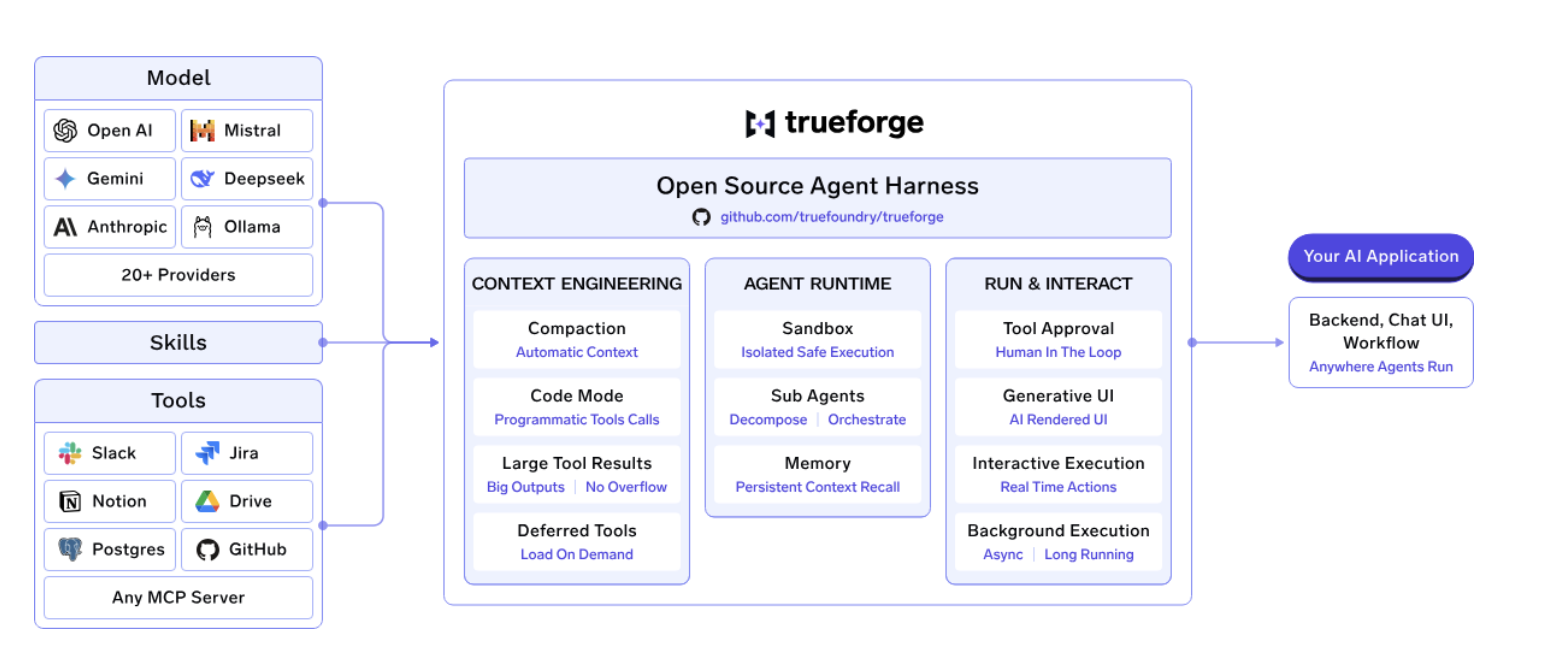
It ships as three pieces rather than one. A core server runs the loop: streaming, approval gates on sensitive actions, subagent delegation, compaction, and sessions that survive reconnects. An HTTP API with a TypeScript SDK (@truefoundry/trueforge-sdk) gives your code everything the UI can do. And a chat UI with its own SDK (@truefoundry/trueforge-ui) is there to use as-is, theme, or embed. That third piece is what separates it from most of this list, which stops at the terminal.
The design choice that moves your bill most: TrueForge treats the sandbox as a tool. It spins one up only when the agent actually needs to run code, instead of wrapping the whole session in a container. One server handles many agents at once, and turns that never touch code stay cheap.
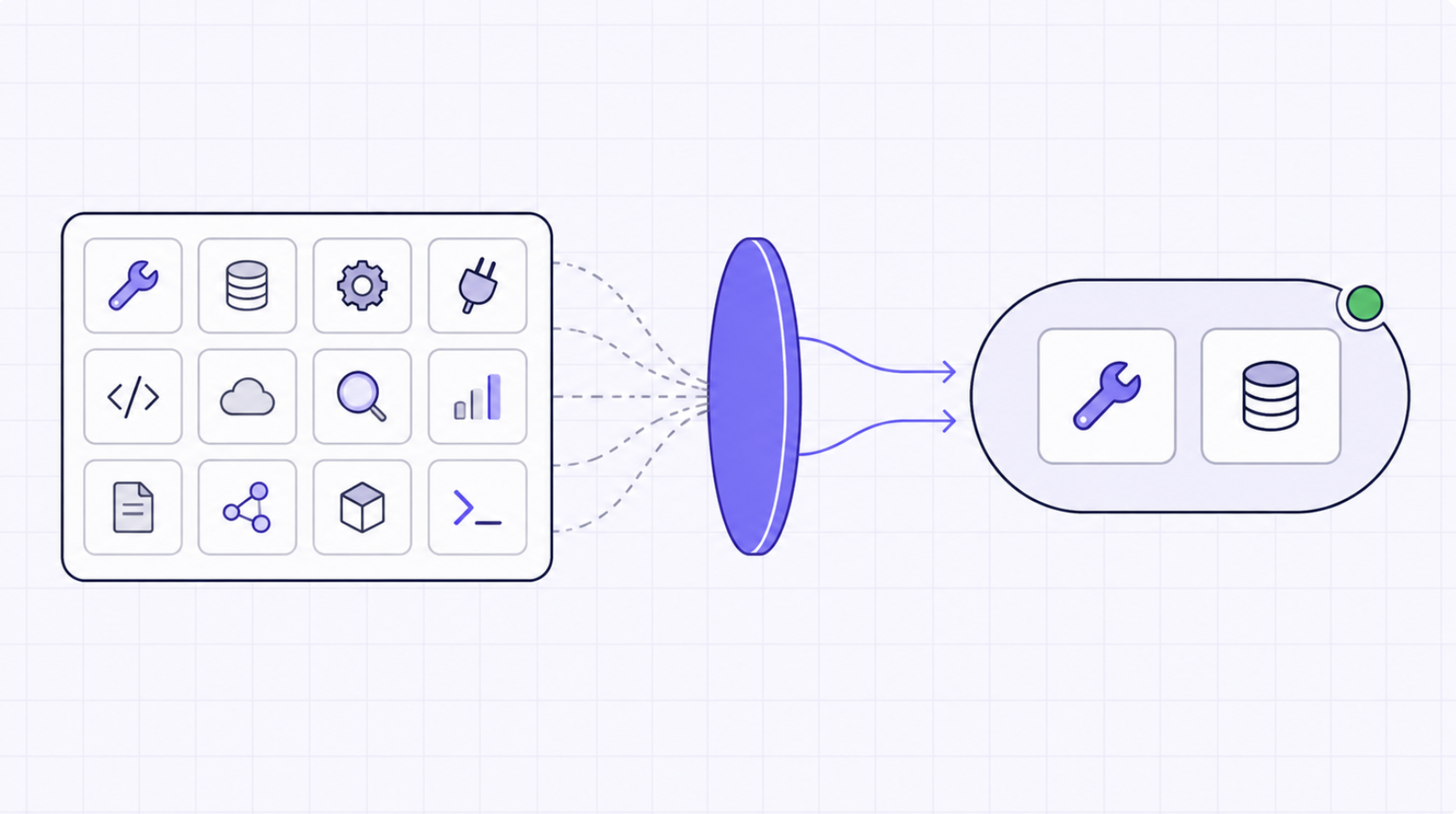
What it adds on top of the loop is the context work, because that's what decides whether long runs stay affordable. Deferred tool loading means MCP tool schemas load on demand rather than filling the window upfront. Code Mode lets the agent chain several tool calls inside one sandbox script so only the printed summary enters context. Oversized tool responses get written to a sandbox file and replaced with a path and a preview. Compaction triggers at 80% of the model's context length and replaces old history with a structured summary. Subagents run with their own clean context and return only the result.
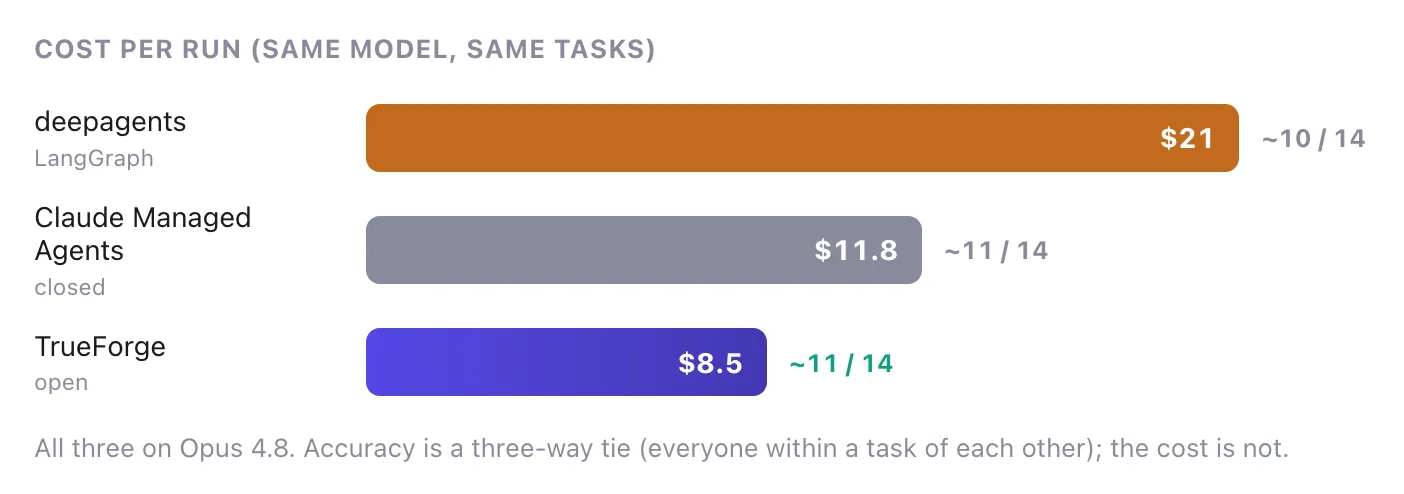
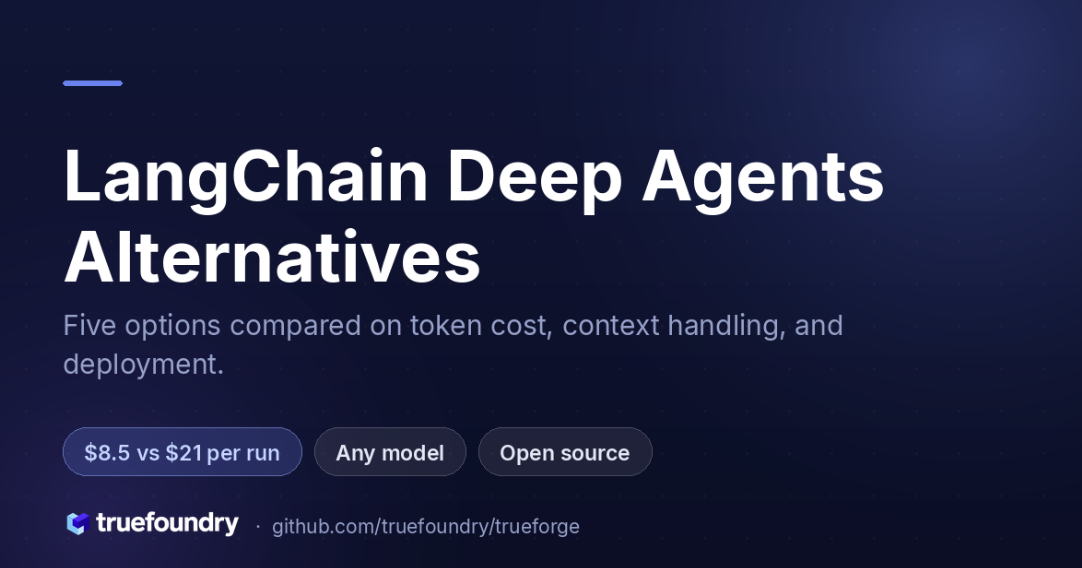
On DevRev's Enterprise-Bench, TrueForge on Opus 4.8 solved the same 14 cross-system tasks as Claude Managed Agents at $8.5 per run and 3.8M tokens, compared with $11.8 and 10M tokens. Against deepagents, LangChain's harness built on LangGraph, it used under a quarter of the tokens for the same work. The full methodology is published.
But there's an important limit: a harness isn't a framework substitute. If you need an arbitrary graph with validation gates at specific nodes or conditional loops back to earlier stages, LangGraph is the better fit. In many cases, the right architecture is actually both: a framework for orchestration between agents, and a harness for running the agents themselves.
Try it in 60 seconds: npx @truefoundry/trueforge or star it on GitHub.
LangGraph isn't necessarily the framework you need just because you're building an AI agent.
If your application requires complex, stateful orchestration, LangGraph's explicit graph model can give you the control you need. If you want a simpler or more opinionated development experience, alternatives like Agno, CrewAI, PydanticAI, OpenAI Agents SDK, and AutoGen offer different trade-offs.
And when the workflow itself doesn't need to be manually defined, an agent harness can be a better fit than another orchestration framework.
Ultimately, the right question isn't “What's the best LangGraph alternative?” It's “Do I need to design the agent's workflow or do I need a runtime that can run the agent for me?”
Q: What are the best LangGraph alternatives?
A: CrewAI is the most popular, and the fastest route to a multi-agent system when the work maps to defined roles. Pydantic AI suits Python teams who want type safety without orchestration, Mastra is the strongest TypeScript option, Microsoft Agent Framework fits .NET and Azure shops, and LlamaIndex Workflows is best for retrieval-heavy agents. If your agent's path isn't fixed, a harness such as TrueForge may be a better fit than any framework.
Q: Is CrewAI easier than LangGraph?
A: Yes for role-based workflows, and no for conditional logic. Declaring agents with roles and tasks takes far less code than building a graph, but once you need branching or loops you'll be working against the abstraction. It can also generate LLM calls you didn't write, so measure production cost before committing.
Q: What's the difference between an agent framework and an agent harness?
A: A framework gives you primitives and expects you to write the control flow. A harness ships the loop already written, along with context management, sandboxing and approvals. Frameworks are for building agents; harnesses are for running them. Many production systems use both at different layers.
Q: Can I run an agent framework or harness in my own VPC or on-prem?
A: Yes, with any self-hosted option here. TrueForge runs from a single npx command locally, or via Docker Compose and Helm for team deployments with Postgres, Redis, replicas and OIDC login. TrueFoundry's managed version also runs self-hosted, on-prem, air-gapped or hybrid, so no data leaves your domain.
Q: Do these support MCP?
A: Most now do, and MCP support is the thing that makes switching cheap. If your tools are MCP servers, they connect to a new framework or harness without modification, which is usually the bulk of the integration work.
Q: How do I govern models and MCP servers across many agents?
A: Through a gateway layer. TrueFoundry's AI Gateway puts 1,000+ LLMs behind one OpenAI-compatible API at roughly ~3–4 ms of added latency and 350+ RPS on a single vCPU, with RBAC, budgets, guardrails and credential rotation, plus OpenTelemetry traces into Grafana, Datadog or Prometheus. Agents built on LangGraph, CrewAI or anything else can be governed centrally.
TrueFoundry AI Gateway delivers ~3–4 ms latency, handles 350+ RPS on 1 vCPU, scales horizontally with ease, and is production-ready, while LiteLLM suffers from high latency, struggles beyond moderate RPS, lacks built-in scaling, and is best for light or prototype workloads.






The latest news, articles, and resources sent to your inbox
.webp)
.webp)
.webp)
.webp)
.webp)