


September 18, 2026
|
5 min read


Blazingly fast way to build, track and deploy your models!
Claude Managed Agents is a good product. The developer experience is clean, the sandbox lifecycle is fully managed, and for teams already standardized on Claude, it removes much of the operational work involved in running agents in production.
So why are teams looking for Claude Managed Agents alternatives?
Usually, it comes down to four structural constraints. First, Claude Managed Agents is Anthropic-only, meaning every task runs on Claude models even when a smaller or less expensive model might be sufficient. Second, pricing combines standard token costs with a per-session runtime charge, which can add up quickly for agents running thousands of times a day. Third, the hosted architecture means agent loops, tool calls, and reasoning traces run on Anthropic's infrastructure - a limitation for organizations with strict data residency or regulatory requirements. And fourth, teams don't have the option to route individual tasks to cheaper models when frontier-level reasoning isn't necessary.
None of these are necessarily flaws. They're trade-offs that make sense for a managed, Claude-centric platform.
This guide covers five alternatives to Claude Managed Agents, what each is genuinely good at, what migration involves, and how their costs compare. Where we cite performance or pricing numbers, they come from published head-to-head benchmarks or vendor documentation.
Before comparing products, it is worth being precise about what you are replacing. Claude Managed Agents is an agent harness - the runtime layer that turns a model into a long-running agent by managing the execution loop, tool calls, context, sandboxing, approvals, and session state. Any replacement has to cover that whole surface, not just the model call.
Five criteria separate real replacements from partial ones:
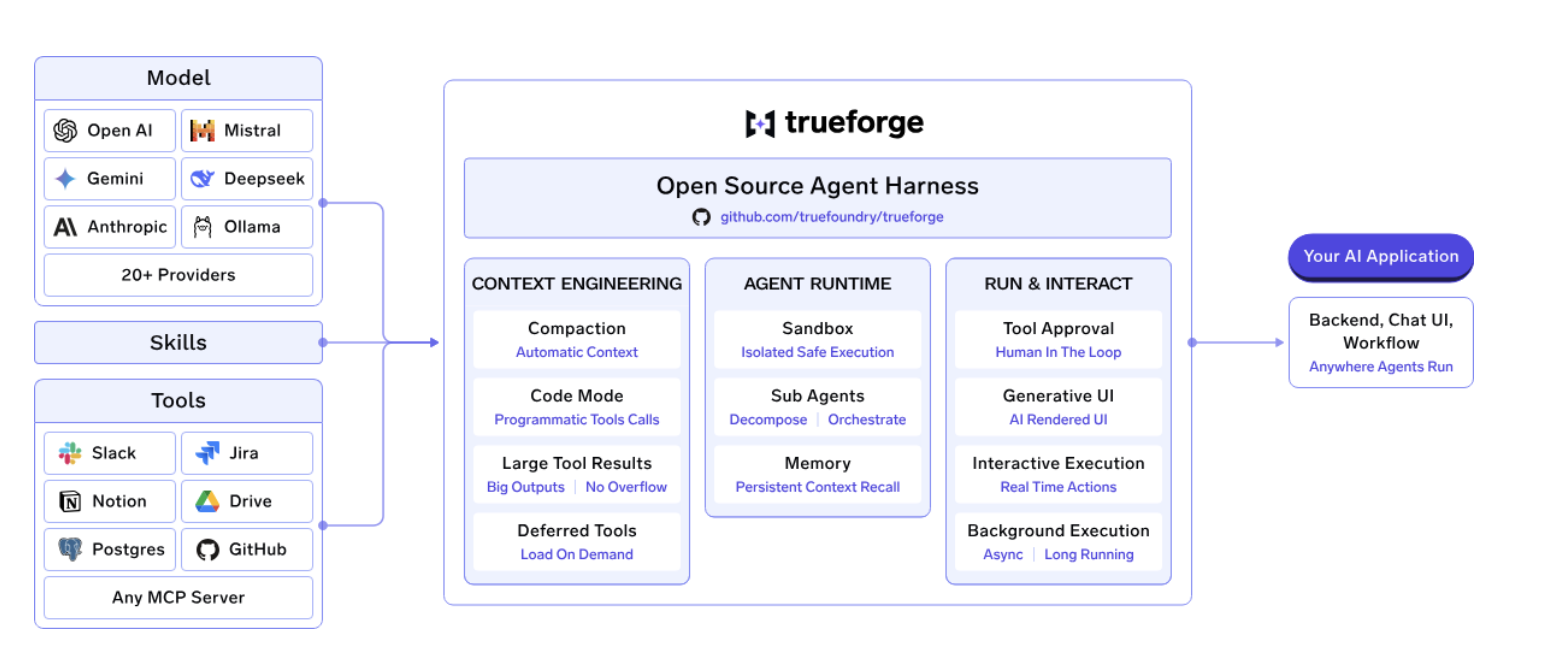
TrueForge is the MIT-licensed agent harness we open-sourced in August 2026 - the same runtime we run in production behind our own AskTFY agent. It was built specifically to give teams managed-agent ergonomics without the model lock-in: models, MCP servers, and sandbox are all bring-your-own, connected through open OpenAI-compatible interfaces.
It is the most direct functional replacement for Claude Managed Agents because it covers the same surface. A core server runs the agent loop, streaming every step, pausing for approval on sensitive actions, keeping context lean with subagents and compaction, and persisting sessions across reconnects. An HTTP API with a TypeScript SDK (@truefoundry/trueforge-sdk) gives your code everything the UI can do. A chat UI with a UI SDK (@truefoundry/trueforge-ui) ships a complete interface you can use as-is, theme, or embed in your own product.
The architectural difference that most affects your bill: TrueForge treats the sandbox as a tool, provisioning one only when the agent actually needs to run code, rather than wrapping the entire session in a container. One server runs many agents concurrently and non-code turns stay cheap. On top of that sit deferred tool loading, Code Mode for chaining multiple MCP calls in a single sandbox script, large tool response offloading, automatic context compaction, subagent delegation, human checkpoints, and generative UI.
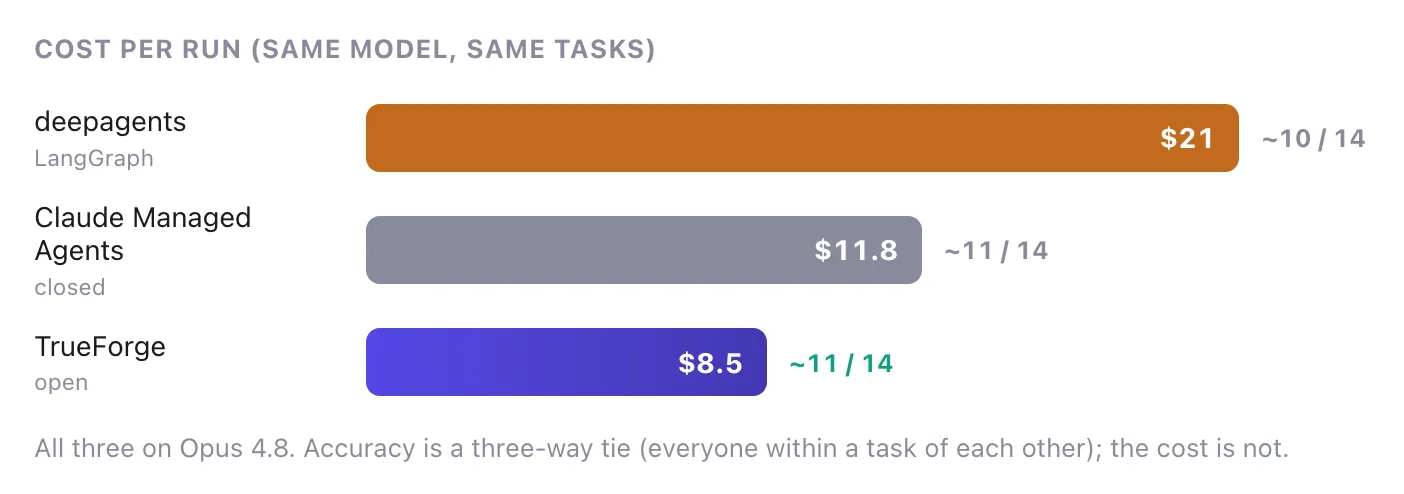
We benchmarked it directly against Claude Managed Agents on DevRev's Enterprise-Bench - 14 cross-system tasks, three MCP servers, a fresh session per task, blind LLM judging. On the same model (Opus 4.8), TrueForge solved the same number of tasks at $8.5 per run against $11.8, using 3.8M tokens against 10M, in 40 minutes against 63. Swap in an open model and the gap widens: GLM-5.2 on TrueForge solved the same tasks Opus solved on Claude Managed Agents, for $2.9 per run - about 75% cheaper.
Pros:
npx on a laptop to Docker Compose or Helm with Postgres, Redis, replicas, and OIDC loginCons:
Best for: Teams leaving Claude Managed Agents over cost or data residency who want the same managed-agent experience without handing the model decision to a vendor.
Pricing: Free and open source (MIT). Managed TrueFoundry Agent Harness is enterprise-priced.
Try it in 60 seconds: npx @truefoundry/trueforge or star it on GitHub.
If what you want is another managed platform rather than something you run yourself, Microsoft Agent Framework is the closest direct substitute. MAF reached 1.0 GA on April 2, 2026, converging AutoGen and Semantic Kernel into one supported platform with the same concepts and APIs across .NET and Python.
Its Agent Harness layer covers the expected surface: automatic context compaction that monitors token usage mid-loop, a TodoProvider for multi-step task tracking, AgentModeProvider for separating plan from execute, AgentSkillsProvider for filesystem-based skill discovery, BackgroundAgentsProvider for parallel subtask delegation, hosted web search, sandboxed shell execution (.NET), and a ToolApprovalAgent with "don't ask again" rules for sensitive calls. OpenTelemetry tracing is built in.
Foundry Hosted Agents is the managed runtime: your agent packaged as a container on Foundry-managed infrastructure with built-in identity, automatic scaling, managed session state, and versioning. It scales to zero when idle and resumes with the filesystem intact, and every session gets a VM-isolated sandbox. Microsoft also ships CodeAct (alpha), which collapses multi-step tool chains into a single sandboxed Python program — on their published multi-step benchmark that cut time 52.4% and tokens 63.9%.
The tradeoff is that you are trading one platform's gravity for another's. Foundry Hosted Agents is deeply Azure-integrated, so this is the right move if you are already an Azure shop and the wrong one if you were leaving Claude Managed Agents to reduce platform dependency.
Best for: Enterprise .NET and Azure organizations that want a managed agent runtime with first-party support and are comfortable standardizing on Foundry.
deepagents is LangChain's opinionated harness built on LangGraph. It bundles planning tools, a virtual filesystem, subagent delegation, context engineering, persistent memory, skills, sandboxed code execution, and human-in-the-loop support, and it is model-agnostic and production-ready with streaming, persistence, and checkpointing.
For teams already invested in LangChain, the ecosystem integration is worth real money - observability, evaluation, and deployment tooling all connect without glue code.
The cost is weight. That bundled machinery rides along in every turn, and deepagents re-reads its accumulated context step after step rather than compacting it. In the same Enterprise-Bench run on Opus 4.8, it used 16.5M tokens at $21 per run for roughly 10 of 14 tasks- the most expensive option we measured, at around $2.10 per correct answer, or nearly 2x Claude Managed Agents. If you are leaving Claude Managed Agents to cut costs, this is the one alternative that may raise them.
Best for: Teams already running LangGraph in production who value ecosystem continuity over token efficiency.
OpenHands (formerly OpenDevin) is the most mature autonomous software-engineering agent in open source, with 72,000+ GitHub stars and an $18.8M Series A behind it. Its event-stream architecture cycles through four states per loop - the agent reasons, emits an action, the environment executes it, the environment returns an observation with each session running in an isolated Docker sandbox.
Always-on Docker isolation is the right call for its use case, since OpenHands is built to work a codebase autonomously. But it is specialized: if you were using Claude Managed Agents for cross-system business tasks spanning a CRM, a tracker, and a document store, OpenHands is not tuned for that shape of work.
Best for: Teams whose Claude Managed Agents workload was primarily autonomous coding against a repository.
Pi, from Earendil Works, took the opposite approach and won a large following for it, growing from 54k to 98k GitHub stars in three months. Its @earendil-works/pi-coding-agent CLI ships a deliberately minimal four-tool core - Read, Write, Edit, Bash and pushes everything else into TypeScript extensions, custom tools and providers, prompt templates, skills, and packages. A lazy-loading skill system injects instructions only when a task needs them, keeping context lean without aggressive compaction. It is BYOK and provider-agnostic.
Pi is terminal-first, so it is a downgrade in surface area from Claude Managed Agents: no embeddable chat UI, no generative UI, no HTTP API to build a product on. It is the right answer for individual developers, not for replacing a platform serving a team.
Best for: Developers who want a provider-agnostic terminal agent they can reshape in TypeScript.
Claude Managed Agents pricing has two components: standard Claude token rates plus a per-session-hour charge for the sandboxed container your agent runs in. At Opus 4.8 list rates of $5 per 1M input and $25 per 1M output tokens, the token side dominates on any agent doing real multi-step work.
That is where the harness matters more than most teams expect. Accuracy across the three benchmarked harnesses was effectively a three-way tie - everyone landed within a task of each other, because the model sets the ceiling on what is possible. What the harness sets is the price of getting there, through four mechanisms:
A leaner starting payload. Every turn re-processes the system prompt and tool definitions. Heavier harnesses carry planning scaffolding, virtual filesystems, and subagent machinery in every single turn, and across hundreds of turns that fixed overhead compounds.
Fewer, more targeted tool calls. Most of the cost is the loop, not the answer, and every tool round-trip ships the growing context back to the model.
Compaction instead of replay. Trimming history and large tool responses rather than re-sending them verbatim is the difference between 3.8M and 16.5M tokens on identical work.
Per-task model choice. Work that does not need a frontier model is not billed like it does. This is the 75% lever, and it is the one Claude Managed Agents structurally cannot offer.
Full methodology is in our TrueForge vs Claude Managed Agents benchmark.
Switching harnesses is less work than most teams assume, because the pieces that took effort to build are the ones that carry over.
Q: What are the best Claude Managed Agents alternatives?
A: TrueForge is the strongest overall alternative - MIT-licensed, runs any model on your own infrastructure, and matched Claude Managed Agents on benchmark accuracy at $8.5 per run versus $11.8, or $2.9 using an open model. Microsoft Agent Framework with Foundry Hosted Agents is the best option if you want another managed platform, deepagents suits teams already on LangGraph, and OpenHands is stronger for autonomous coding specifically.
Q: What are Claude Managed Agents?
A: Claude Managed Agents is Anthropic's hosted agent harness - the runtime that manages the agent execution loop, tool calls, sandboxing, approvals, and session state so you do not have to. It runs on Anthropic's infrastructure and uses Claude models exclusively.
Q: Do Claude Managed Agents work with other LLMs like Llama?
A: No. Claude Managed Agents is Anthropic-only, so every task runs on a Claude model regardless of whether it needed frontier-level capability. If you want to route tasks across open models like Llama, GLM, or Qwen, you need a model-neutral harness such as TrueForge, deepagents, or Microsoft Agent Framework.
Q: Is there an open source alternative to Claude Managed Agents?
A: Yes. TrueForge is MIT-licensed and vendor-neutral, running on your own infrastructure with any model. Benchmarked head-to-head on the same 14 enterprise tasks with blind grading, it matched Claude Managed Agents on accuracy at roughly 30% lower cost with the same model, and about 75% lower running an open model instead.
Q: Can I deploy an agent harness in my own VPC or on-prem?
A: With an open-source harness, yes - TrueForge runs from a single npx command locally, or via Docker Compose and Helm for team deployments with Postgres, Redis, replicas, and OIDC login. TrueFoundry's managed version also runs self-hosted, on-prem, air-gapped, or hybrid, so no data leaves your domain. Claude Managed Agents does not offer this.
Q: How do I govern models and MCP servers across many agents?
A: Through a gateway layer. TrueFoundry's AI Gateway provides 1,000+ LLMs behind one OpenAI-compatible API with roughly ~3–4 ms of added latency and 350+ RPS on a single vCPU, plus RBAC, budgets, guardrails, and credential rotation, with an MCP Gateway for tool-level access control and OpenTelemetry traces into Grafana, Datadog, or Prometheus.
Most teams looking for Claude Managed Agents alternatives aren't looking for a better agent experience - they want the same experience without the constraints. The biggest is model lock-in. In our benchmark, switching to a cheaper model reduced the cost per run by roughly 75%, while a leaner execution loop reduced costs further.
If that difference matters at your scale, start with TrueForge: npx @truefoundry/trueforge gets you running in about a minute, and the repo is available on GitHub. If you need enterprise governance - budgets, RBAC, credential rotation, and unified traces across agents- book a demo to see the same harness managed on TrueFoundry.
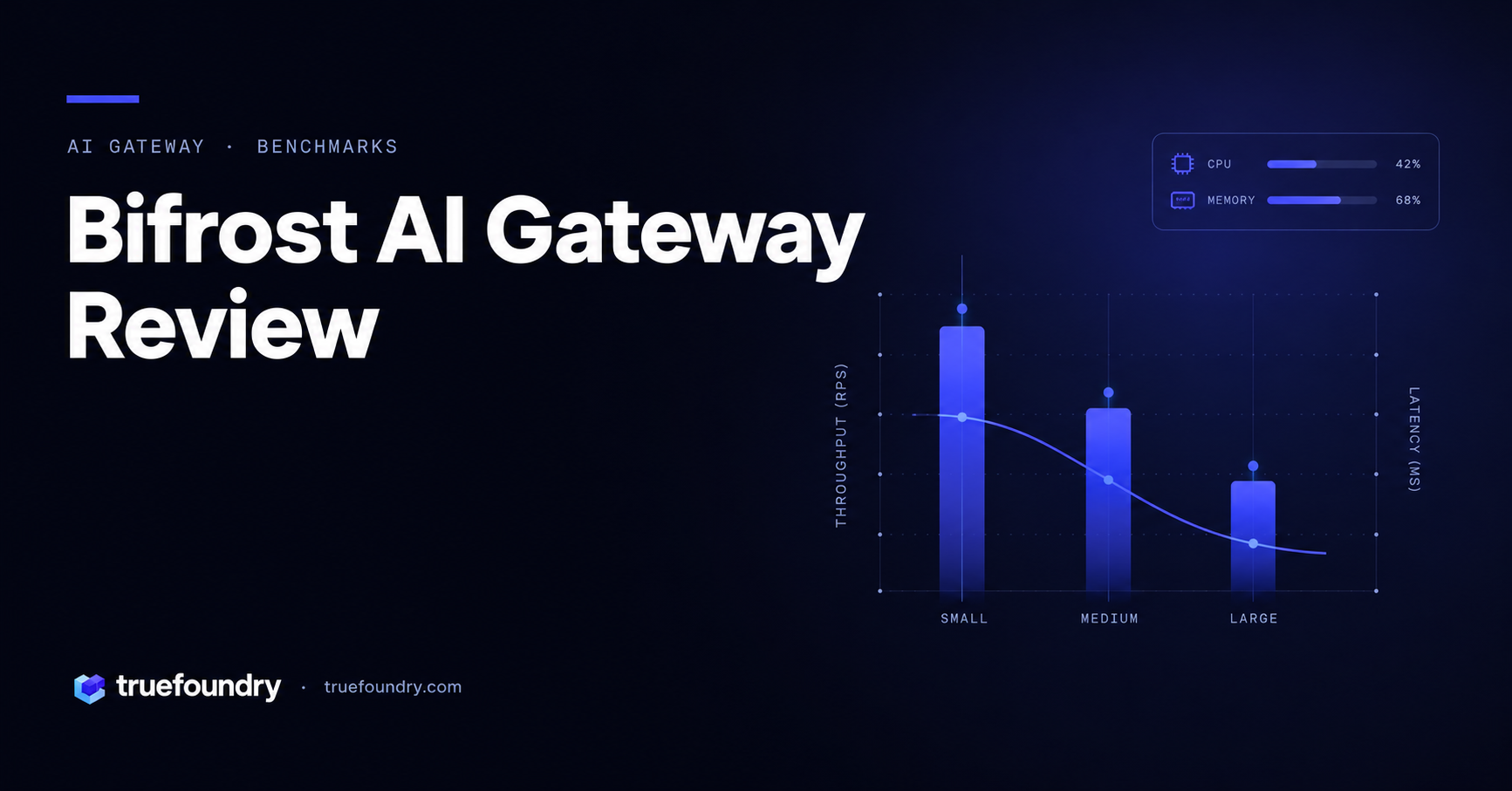
TrueFoundry AI Gateway delivers ~3–4 ms latency, handles 350+ RPS on 1 vCPU, scales horizontally with ease, and is production-ready, while LiteLLM suffers from high latency, struggles beyond moderate RPS, lacks built-in scaling, and is best for light or prototype workloads.






The latest news, articles, and resources sent to your inbox
.webp)


.png)
.png)
.png)
.png)
.png)
.png)
.png)
.png)
.png)
.png)
.png)


