


October 1, 2026
|
5 min read


احصل على وصول فوري إلى بيئة TrueFoundry مباشرة. انشر النماذج، ووجّه حركة مرور LLM، واستكشف المنصة بالكامل — بيئة الاختبار الخاصة بك جاهزة في ثوانٍ، ولا يلزم وجود بطاقة ائتمان.



Published: July 28, 2026
.webp)
Blazingly fast way to build, track and deploy your models!
Most evaluations of AI security tools combine two categories that solve different problems. One category uses machine learning and artificial intelligence to strengthen existing cybersecurity workflows across endpoints, networks, identities, and cloud workloads. The other category governs AI systems themselves, including models, prompts, agents, data flows, and tool execution.
This distinction matters for security leaders making buying decisions. A SOC platform with an AI assistant cannot stop an agent from calling a tool it should never touch. A model scanning service cannot cap inference spend, enforce tool-level permissions, or govern model access across production AI applications.
The threat model, deployment pattern, and working definition of secure differ across both categories. Traditional cybersecurity tools improve detection, investigation, and response across IT environments. AI security platforms control the new AI attack surface created by LLMs, agents, MCP servers, prompts, and enterprise data.
This guide separates the market clearly. It compares leading AI security tools, explains where AI security software helps, and shows what both categories miss once autonomous AI agents reach production. You should finish with a buying framework, not a simple vendor ranking.
Getting the category distinction right matters because both tool types protect different risk surfaces. AI-powered security tools strengthen the cybersecurity stack that enterprises already use. They apply machine learning to endpoint detection, network detection, identity monitoring, threat detection, and SOC triage automation.
These tools are usually owned by security operations, security operations centers, and incident response teams. Their threat model covers malware, phishing, identity compromise, network intrusion, suspicious user behavior, and cloud misconfiguration. They help reduce alert fatigue and allow SOC teams to manage repetitive tasks with stronger context.
AI security platforms solve a different problem. They govern AI workloads themselves, including models, prompts, agents, data flows, and tool execution. They control which users, teams, and agents can call specific models, access sensitive data, or execute MCP tool calls inside production workflows.
Buying one category when the other is required creates serious gaps. A traditional SOC tool cannot fully govern LLM inference, prompt injection, or MCP tool calls. An AI gateway does not replace endpoint protection. Large enterprises running production AI usually need both categories working together.
The common mistake appears in quarterly security reviews. A SOC team chooses a familiar endpoint or XDR platform to “cover AI.” Platform engineering then ships agents into production without runtime governance. Six months later, an incident exposes the gap, and both teams retrofit controls under audit pressure.
.webp)
These AI security tools strengthen traditional security operations with machine learning, behavioral analytics, and automated response. They protect endpoints, networks, cloud workloads, and identities, not LLM prompts or agent tool calls.
.webp)
CrowdStrike Falcon is a cloud-native endpoint and threat intelligence platform for enterprise security teams. It protects endpoints, cloud workloads, identities, and data from one platform. Charlotte AI helps analysts query threats, investigate incidents, and accelerate security operations workflows.
CrowdStrike Falcon is best for security operations teams that need AI-assisted endpoint, identity, and cloud threat response across large enterprise environments.
.webp)
Darktrace uses Self-Learning AI to understand normal enterprise activity and identify high-risk anomalous behavior. It supports threat detection across networks, cloud, email, and critical environments. Its strength is real time behavioral analysis across traditional security surfaces.
Darktrace is best for organizations that need AI-driven anomaly detection and real-time visibility across networks, email, cloud, and operational environments.
SentinelOne Singularity unifies endpoint security, identity protection, cloud security, and AI-assisted security workflows. Purple AI helps teams investigate threats, translate data across the security stack, and support analyst decision-making. It is built for autonomous incident response and modern SOC operations.
SentinelOne Singularity is best for SOC teams that need endpoint-to-cloud coverage, AI-assisted investigation, and automated incident response across enterprise environments.
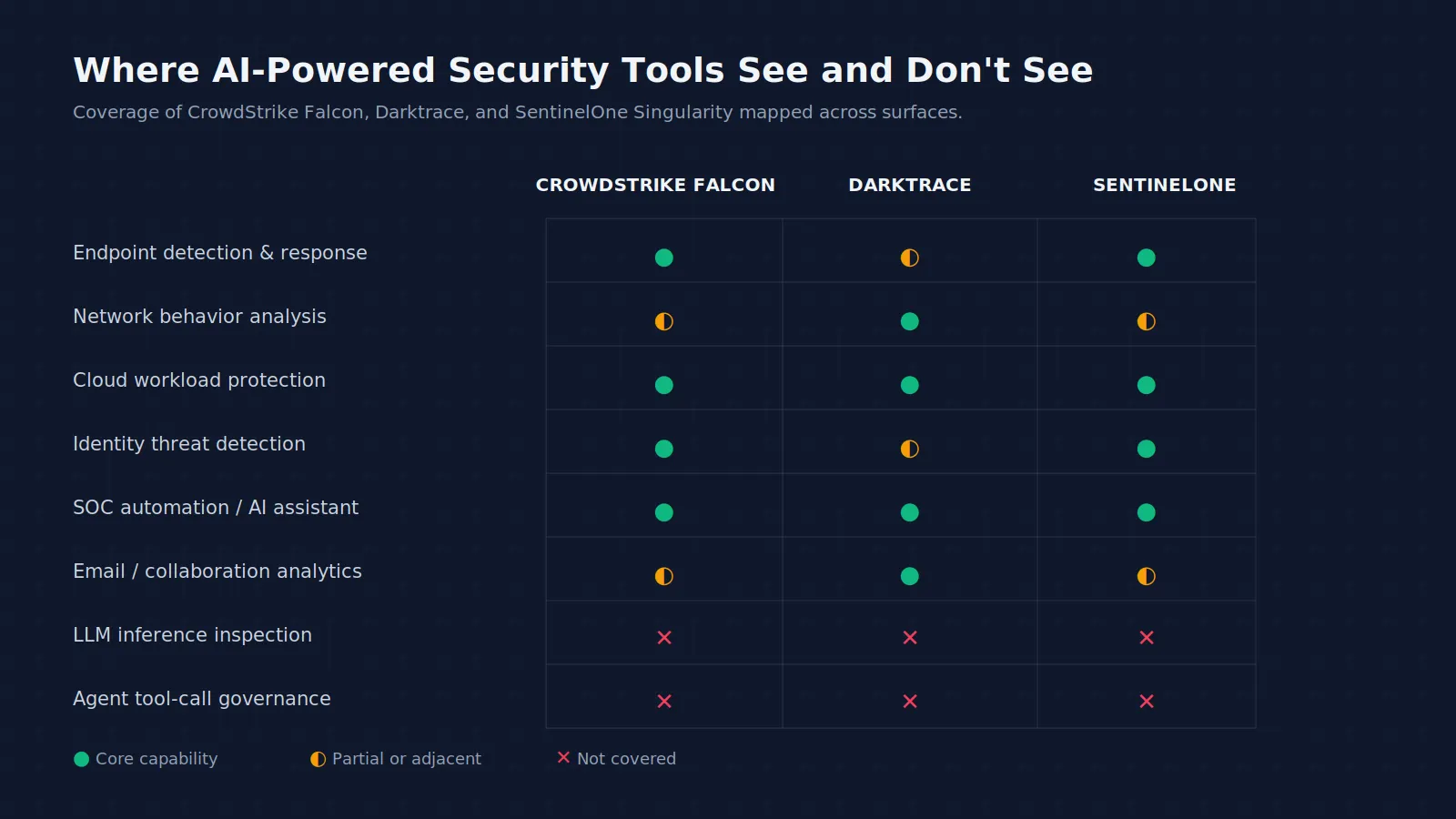
These platforms protect AI systems themselves. The category is younger than traditional cybersecurity, and vendors differ sharply by deployment model, runtime depth, and governance scope. The right choice depends on whether teams are securing models, governing agents, or controlling full inference traffic.
.webp)
TrueFoundry is an infrastructure-first AI security platform for enterprise AI systems. Its AI gateway centralizes model access, observability, governance, guardrails, and cost controls across enterprise AI workloads. The platform also includes MCP Gateway and Agent Gateway for governing tool-connected and agentic workflows.
VPC-native deployment and audit control: AWS, GCP, Azure, on-premise, and air-gapped deployments are supported for enterprise environments. Prompts, responses, logs, and governance data stay inside the customer’s environment. This supports security and compliance needs.
TrueFoundry offers four pricing tiers. Developer is free for early experimentation, while Pro starts at $499 per month for small teams shipping AI features. Pro Plus starts at $2,999 per month for stricter data controls and priority SLAs. Enterprise pricing is custom for organizations needing advanced governance, security, custom deployment, and mission-critical reliability.
TrueFoundry is best for enterprise security, platform engineering, AI infrastructure, and compliance teams that need governance across models, agents, MCP tools, and sensitive data workflows. It is especially relevant for organizations running production AI agents, regulated workloads, multi-provider model access, and private-cloud or air-gapped deployments.
HiddenLayer focuses on securing AI models across the AI lifecycle. Its platform supports model scanning, red teaming, AI detection and response, and security posture management. It is strongest when teams need model-layer protection and adversarial AI testing.
HiddenLayer is best for organizations with mature ML development teams that need model-layer protection, scanning, and adversarial robustness testing.
.webp)
Lasso Security focuses on LLM security, agentic cybersecurity, and MCP protection. Its open-source MCP Gateway acts as a proxy and orchestrator for MCP interactions, adding governance, monitoring, and security controls. It is useful for teams already focused on LLM runtime protection.
Lasso Security is best for organizations prioritizing LLM interaction monitoring, prompt security, and MCP visibility across agentic workloads.
.webp)
Palo Alto Networks Prisma AIRS is designed to secure enterprise AI applications across the lifecycle. Its capabilities cover AI agents, runtime governance, AI app development, and security assurance. It is most relevant for teams already invested in Palo Alto Networks security architecture.
Prisma AIRS هو الأفضل للشركات الكبيرة التي تستخدم بالفعل Palo Alto Networks وتسعى لتأمين دورة حياة الذكاء الاصطناعي ضمن هذا النظام البيئي.
.webp)
لا توفر أي من الفئتين، بمفردها، الضمانات التي يحتاجها الذكاء الاصطناعي الوكيل في بيئة الإنتاج. تكتشف أدوات الأمان المدعومة بالذكاء الاصطناعي أنماط الهجوم المعروفة عبر الأسطح التقليدية. لا يمكنها تحليل نية المطالبة، أو فحص تدفقات البيانات داخل سير عمل الذكاء الاصطناعي، أو تحديد ما إذا كانت استدعاء أداة الوكيل ينتهك منطق العمل.
أمان نماذج الذكاء الاصطناعي تحمي المنصات النماذج أثناء التطوير والتشغيل. تساعد في فحص النماذج، واختبار الاختراق (red teaming)، واكتشاف التهديدات. ومع ذلك، فإن التحكم في الوصول لكل فريق، وميزانيات الاستدلال، والتحكم في مستوى الأدوات، وأذونات وقت التشغيل غالبًا ما تتطلب مستوى تحكم أوسع.
تخلق إقامة البيانات فجوة أخرى. إذا تم توجيه حركة مرور الاستدلال عبر منصة SaaS للتحليل أو الحوكمة، فقد تغادر المطالبات والمخرجات الخاصة حدود المؤسسة. وهذا مهم للفرق الخاضعة للتنظيم التي تتعامل مع البيانات الحساسة، وسجلات العملاء، وبيانات الرعاية الصحية، أو سير عمل المؤسسات السرية.
الذكاء الاصطناعي الوكيل يحتاج إلى نقطة إنفاذ واحدة للنماذج والأدوات وبيانات الاعتماد والإجراءات. يجب أن يربط مستوى التحكم هذا التنفيذ بهوية المستخدم، ويحتفظ بالسجلات داخل بيئة المؤسسة، ويفرض السياسة قبل التنفيذ. تصبح الوساطة في وقت التشغيل أكثر أهمية مع حصول الوكلاء على إمكانية الوصول إلى الأدوات.
يوضح وكيل RAG للرعاية الصحية هذه الفجوة. قد لا ترى أداة أمان نقطة النهاية استرجاع بيانات المرضى عبر أداة MCP. قد لا يعرف الماسح الضوئي لطبقة النموذج ما إذا كان المستخدم الطالب لديه حقوق الوصول. تُغلق الفجوة عندما تتحقق البوابة من الهوية، وتسترجع النطاقات، وتسجل الإجراء داخل شبكة VPC الخاصة بالعميل.
.webp)
تم بناء TrueFoundry كمنصة أمان للذكاء الاصطناعي تعتمد على البنية التحتية أولاً لأعباء عمل الذكاء الاصطناعي في بيئة الإنتاج. يتم نشر بوابة الذكاء الاصطناعي داخل بيئة العميل على AWS أو GCP أو Azure أو في الموقع أو في بيئة معزولة (air-gapped). وهي تحكم أنظمة الذكاء الاصطناعي في الطبقة التي يتم فيها تنفيذ استدعاءات النماذج وإجراءات الوكلاء وطلبات الأدوات.
بموجب هذا النموذج، تتوافق متطلبات الامتثال مع ضوابط قابلة للتنفيذ. يدعم التنفيذ المدرك للهوية مبدأ أقل الامتيازات. تدعم تصفية المطالبات معالجة البيانات. يدعم تسجيل التدقيق على مستوى VPC أدلة الحوكمة. تحول الضوابط على مستوى البوابة حوكمة الذكاء الاصطناعي من مجرد توثيق إلى تطبيق فعلي أثناء التشغيل.
.webp)
غالبًا ما تختبر الفرق التي تقيّم أدوات أمان الذكاء الاصطناعي فئتين أو ثلاث فئات قبل أن تدرك المتطلب الأساسي. يحتاج الذكاء الاصطناعي الوكيل في بيئة الإنتاج إلى لوحة تحكم واحدة للنماذج، والوكلاء، وخوادم MCP، والحواجز الوقائية، ومسارات التدقيق.
إذا كانت أعباء عملك تتضمن بالفعل وكلاء مستقلين يتصلون بأنظمة حية، فاستعرض معنا البنية قبل توسيع الإنتاج. احجز عرضًا توضيحيًا مع TrueFoundry لتحديد متطلبات أمان الذكاء الاصطناعي الخاصة بك مقابل تصميم مرجعي قائم على البوابة.
TrueFoundry AI Gateway delivers ~3–4 ms latency, handles 350+ RPS on 1 vCPU, scales horizontally with ease, and is production-ready, while LiteLLM suffers from high latency, struggles beyond moderate RPS, lacks built-in scaling, and is best for light or prototype workloads.





أحدث الأخبار والمقالات والموارد تصلك مباشرة إلى بريدك الوارد
.png)
.png)
.png)
.png)
.png)
.png)
.png)
.png)
.png)
.png)
.png)


