


Obtenha acesso instantâneo a um ambiente TrueFoundry ao vivo. Implante modelos, direcione o tráfego de LLM e explore a plataforma completa — seu sandbox estará pronto em segundos, sem necessidade de cartão de crédito.


What is a Risk Management Framework (RMF) and Why Does It Matter?

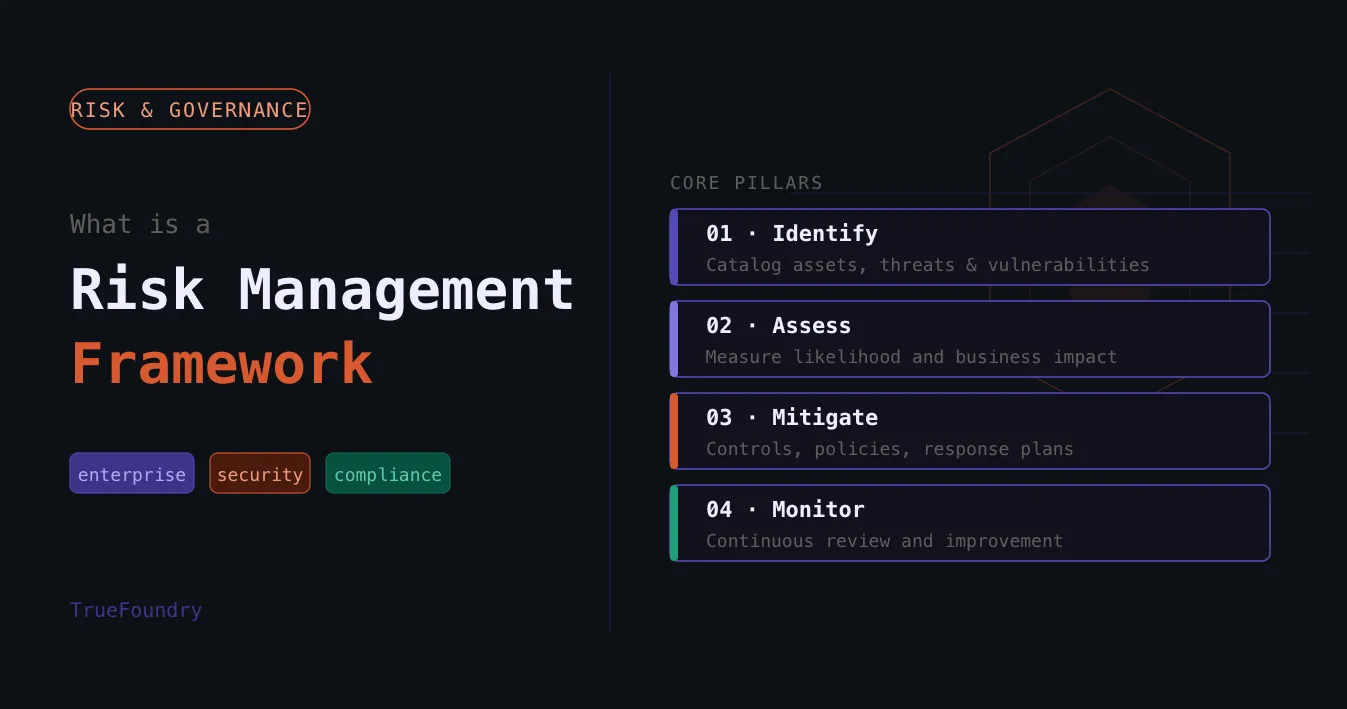
A risk management framework (RMF) is a methodology for the identification, evaluation, treatment, and monitoring of risks. It defines who is responsible for each risk, the acceptable level of risk, and what happens once a risk has occurred.
Without such a framework, whoever spots a risk deals with it in their own way. With an RMF in place, the same problem is treated the same way every time, and you can show an auditor or a customer how you reached that conclusion.
What does a risk management framework include?
- Policies and procedures: the written rules for how risk is handled.
- Processes: how risks are identified, analyzed, treated and tracked.
- Roles and responsibilities: who owns each risk, from team leads to the board.
- Controls: the safeguards that actually reduce risk.
- Reporting: how risk information reaches the people who decide.
Why organizations use one
- Better decisions: leaders see risk and reward side by side instead of guessing.
- Audit and compliance readiness: standards such as ISO 31000, NIST and SOC 2 expect documented risk practice.
- Fewer surprises: known risks get owners and controls before they turn into incidents.
- Trust: customers and regulators trust a company that can explain how it manages risk.
Types of risk an RMF covers
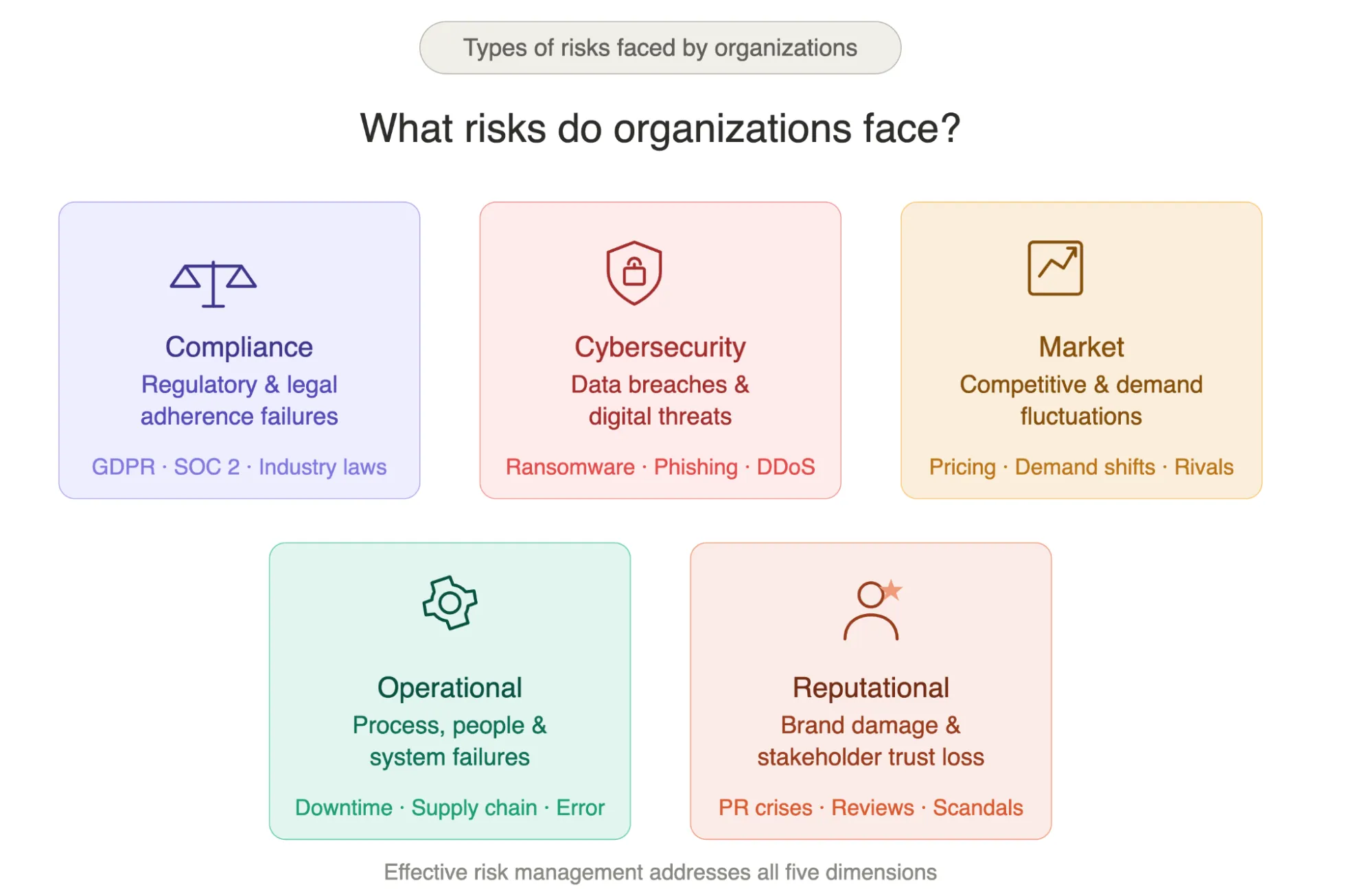
- Compliance risk: breaking laws, regulations or contracts, which brings fines and legal action.
- Cybersecurity risk: breaches, ransomware and data loss.
- Operational risk: failures in processes, systems or people.
- Market and financial risk: shifts in rates, demand or prices.
- Reputational risk: loss of trust after an incident or public mistake.
AI adds a layer on top of these: data leakage through prompts, unreviewed model outputs, and teams using models nobody approved. See our guides to AI security risks and AI compliance.
The steps of a risk management process
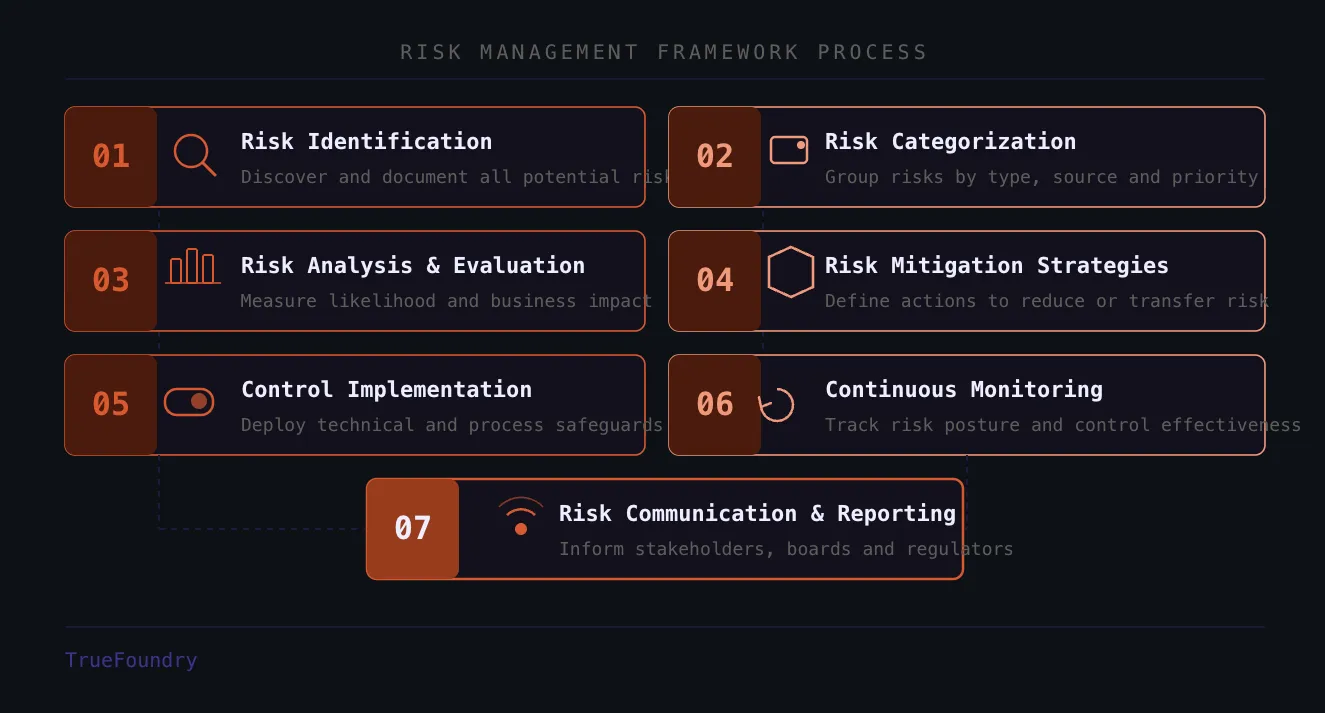
Frameworks differ on names, but the cycle looks like this:
- Identify what could go wrong, using internal processes and outside threats.
- Categorize each risk so similar ones are handled together.
- Assess likelihood and impact to rank them.
- Plan a response: avoid, reduce, transfer or accept.
- Implement controls through policy, process and technology.
- Monitor and review as threats and systems change.
- Report to the people who own the decision.
The NIST Risk Management Framework (SP 800-37) uses its own seven steps: Prepare, Categorize, Select, Implement, Assess, Authorize and Monitor. It is the version US federal agencies and their contractors follow.
Risk response strategies

Popular risk management frameworks
NIST updated its Cybersecurity Framework in 2024. Version 2.0 added a sixth function, Govern, ahead of the original five. For AI systems, the NIST AI RMF and its Generative AI Profile are now the usual starting points, alongside ISO/IEC 42001 for an AI management system.
Risk management vs risk mitigation
Risk management covers the whole process: identifying risks, ranking them, treating them, and monitoring the results. Risk mitigation is the step in that process where we treat a risk identified earlier. You can mitigate without a framework. You cannot manage risk well without one.
Best practices
- Set your risk appetite first, so everyone knows what acceptable means.
- Give every risk a named owner, not a team.
- Rank by impact and likelihood, and spend effort on the top of the list.
- Automate evidence collection so audits do not become fire drills.
- Review the register on a schedule and after every major incident.
- Cover AI explicitly: approved models, data rules, logging and human review.
Related: risk mitigation and the AI Gateway.
Govern, Deploy and Trace AI in Your Own Infrastructure


- © 2022 ENSEMBLE Tecnologias



Assine nossa newsletter
As últimas notícias, artigos e recursos enviados para sua caixa de entrada


